
Vegas Layover? The Secret 5-Minute Ride to the World’s Most Famous Blvd
Beneath the most famous fountain on earth sits a windowless room its own engineers call “the Batcave” — and the lake it sits in was built specifically to bury a golf course where one of the Strip’s most notorious old casinos used to stand.
The Fountains of Bellagio shoot water up to 460 feet into the air, choreographed to music ranging from Sinatra to Lady Gaga, watched by an estimated 20,000 people a day from the sidewalk along Las Vegas Boulevard. None of it runs on autopilot. Beneath the 8.5-acre artificial lake sits a underground control room, nicknamed the Batcave by the roughly 30-person team of engineers, mechanics, and pool specialists who run it — all of them dive-certified, because someone occasionally has to get into the water to fix a jet. The lake itself sits on the exact footprint of what used to be the golf course at the Dunes, a 1955-era casino that fell into decline and was demolished in 1993 in a televised, deliberately spectacular implosion, specifically to clear the site for what Steve Wynn was about to build in its place.
The name “Bellagio” isn’t a marketing invention — it’s an actual town on Lake Como in northern Italy, and Wynn modeled the resort and its fountains directly on that town’s setting, importing the aesthetic of an entire European lakeside village onto the exact spot where a different, older Vegas had just been blown up on live television. Most people watching the fountain show have no idea they’re standing above a literal Batcave, on top of a buried golf course, looking at water choreographed to outdo a town in Italy that most of them have also never been to. This guide treats Las Vegas as more than a stopover for slot machines — it’s a genuinely strange, layered, extremely well-engineered place, and a 6-hour layover is enough time to see exactly how strange if you know where to look.
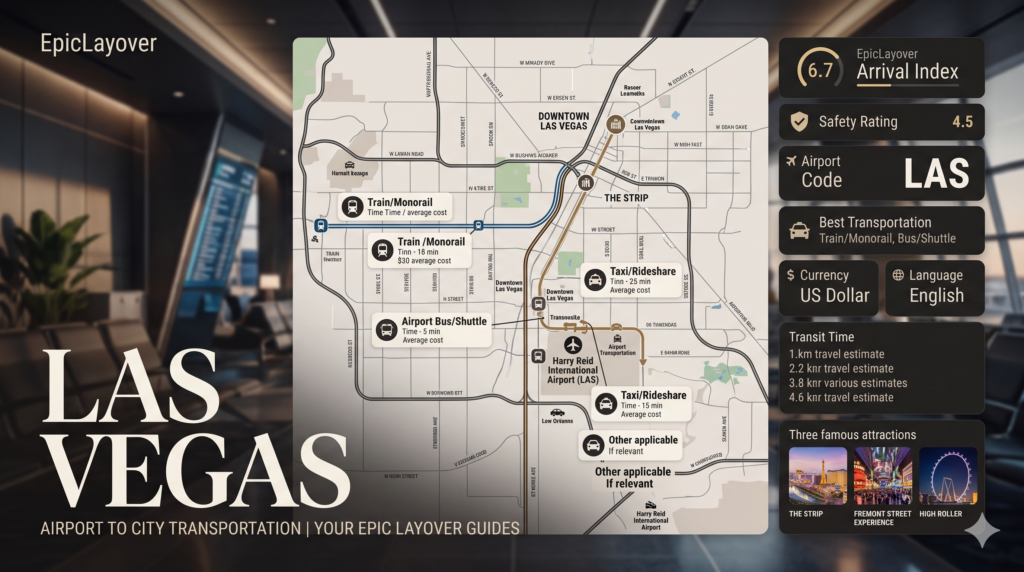
Harry Reid International Airport (LAS), formerly McCarran, is one of the busiest airports in the US, handling nearly 55 million passengers in 2025, and sits only 3-5 miles from the Strip — one of the closest major US airports to its city’s actual tourist core. The airport operates across two separate terminal buildings, five concourses, and more than 110 gates, with Terminal 1 serving primarily domestic carriers and Terminal 3 (opened 2012) serving full-service domestic carriers, all international airlines, and hosting every airline lounge at the airport.
This is the single most important structural fact for anyone connecting through LAS. If your inbound flight lands at one terminal and your outbound departs from the other, you cannot simply walk between them inside security — you must exit, use ground transportation or the airport tram (accessible only after re-clearing security on the other side), and allow real transfer time. A 45-minute connection that requires a terminal change is genuinely risky. Always check your specific terminal assignment for both legs before assuming a quick gate change is all that’s required.
Despite some older guides claiming otherwise, Harry Reid does not offer traditional self-service lockers inside the terminals. Your actual options are third-party storage services (Bounce, Qeepl, and similar, from roughly $7-10 per item per day) at locations near the airport and along the Strip, or a hotel bell desk if you’re buying a day-use pass or spa visit. Book ahead online rather than assuming you’ll find a counter on arrival.
5-6 hours comfortably covers a Strip walk and the Bellagio fountains; under that, the Strip is genuinely just 10-15 minutes away, but you’re cutting your margin tight. Budget the taxi/rideshare each way, a 2.5-3 hour airport return buffer, and you’re realistically looking at 2-3 hours of actual Vegas time on a 5-6 hour layover.
Underestimating Strip traffic and security/TSA wait times on return, particularly around major events (CES in January, the Las Vegas Grand Prix, March Madness, big fight weekends, New Year’s Eve) when rideshare pickup and road traffic both slow significantly. Check the Harry Reid website’s TSA wait-time tool before you commit to a city plan.
Yes, but it requires you to be actively gambling and to tip the cocktail server (roughly $2+ per drink is standard etiquette) — it isn’t simply free for anyone standing near a slot machine. On a tight layover, it’s rarely worth the wait time involved; treat it as a bonus if it happens, not something to plan around.
Cards work almost everywhere, but casino ATMs are notorious for high withdrawal fees ($6-8 is common) — if you need cash, a bank ATM inside a Walgreens or CVS off-Strip gets you a materially better rate.
Should You Leave? The Las Vegas Layover Gauge
Under 4 hours, or if your connection requires switching between Terminal 1 and Terminal 3, don’t attempt a Strip trip. LAS itself has more than 1,000 slot machines spread across both terminals if you want a taste of Vegas without leaving, plus several lounges (The Centurion by Amex, The Club LAS) and Minute Suites nap pods in Terminal 1.
Taxi or rideshare directly to the Bellagio, see the fountains and the Conservatory, walk a short stretch of the Strip, and head straight back. This window doesn’t fit a casino crawl or a second resort on top — pick one anchor point, not a multi-stop circuit.
With 6+ hours, the Bellagio, a proper meal, and a second resort (Caesars Palace, The Venetian) are all comfortably achievable. With 8+ hours and a genuine desire to leave the neon behind entirely, Red Rock Canyon — 25 minutes west — delivers a complete change of register: desert views, a 13-mile scenic drive, and short hikes, all while technically still on the same layover.
Work out your Las Vegas window precisely
Enter your LAS landing time and departure gate-close. If your connection involves a Terminal 1 to Terminal 3 change, the calculator accounts for the full re-clearance most travellers don’t expect at this airport.
Getting from LAS to the Strip
| Option | Time | Cost | Notes |
|---|---|---|---|
| Taxi Recommended | 10-20 min | $21.25-29.25 flat-rate zones | Curbside at Terminal 1 (Doors 1-4) and Terminal 3 (Level 1). Flat-rate zones by Strip section: South Strip $21.25, Mid Strip $25.25, North Strip $29.25 — no meter surprises. Watch for “long-hauling” (the I-215 tunnel detour to inflate fares); politely request “no tunnel” if you suspect this. |
| Uber / Lyft | 10-20 min | $14-25 | Pickup from Terminal 1’s parking garage Level 2, or Terminal 3’s valet level. Often cheaper than taxi, but expect a short walk to the pickup zone and surge pricing during major events. |
| Private Sedan/Transfer | 10-20 min | $60-100 | A driver meets you at baggage claim with a name sign and handles your luggage. Worth the premium specifically when your return timing is tight and you can’t risk surge pricing or a rideshare delay. |
| RTC Bus (Route 109/WAX) | 30-45 min | $2-6 | Connects to the South Strip Transit Terminal. Cheap but slow and not luggage-friendly — skip this on a tight layover. |
Harry Reid’s official website now publishes approximate real-time TSA wait times — check this before you leave the Strip to head back, particularly around major events when security lines can run longer than usual. This single habit protects your return flight more than almost anything else in this guide.
What to Do in Las Vegas on a Layover
Fountains of Bellagio
An 8.5-acre artificial lake built directly on the site of the old Dunes golf course, holding 22 million gallons of water pushed through 1,214 nozzles and 4,792 lights, choreographed to music ranging from Sinatra to Céline Dion. The show runs every 30 minutes from afternoon until 8pm, then every 15 minutes until midnight, and is cancelled only if winds exceed 25mph — a rare occurrence given how few cancellations (five, as of 2005) have happened in the show’s history. Free, and visible from the sidewalk along Las Vegas Boulevard without entering the resort. The Conservatory and Botanical Gardens just inside the lobby — 14,000 square feet, changing seasonal displays four times a year, tended by a 125-person staff working six days a week — is a genuinely worthwhile five-minute detour once you’re there.
Caesars Palace and the Forum Shops
Directly across from the Bellagio, Caesars Palace’s Roman-themed grounds and the attached Forum Shops (with a genuinely impressive aquarium, free to view) make a natural second stop on the same general stretch of the Strip, without needing a separate transfer.
The Sphere
The newest icon on the Strip’s skyline — a fully spherical venue wrapped in the largest LED display on earth, visible (and genuinely striking) from a significant distance. A quick photo stop just off the Strip takes minutes and delivers one of the most distinctive images available on a short Vegas visit.
Red Rock Canyon National Conservation Area
For travellers with 8+ hours who want a complete change of register from the Strip’s density, Red Rock Canyon — roughly 25 minutes west — offers a 13-mile scenic drive (about an hour) and short, accessible hikes including the moderate 2.2-mile Calico Tanks Trail. $15 per vehicle entry, or roughly $5 per person if arriving by rideshare. A genuinely different Las Vegas experience from anything on the Strip, and a strong choice for travellers who’ve done Vegas before and want something new.
Fremont Street Experience (Downtown)
The original Las Vegas, predating the modern Strip by decades — a four-block pedestrian zone under an LED canopy that runs synchronised light shows hourly, lined with vintage casinos (El Cortez, Golden Nugget) rather than mega-resorts. A genuinely different, grittier register from the polished Strip experience, and a strong choice if you’ve done the Bellagio/Caesars circuit on a previous trip.
Fountains of Bellagio with Paris Las Vegas in Frame
From the sidewalk in front of the Bellagio, turn left after exiting and walk to the backside of the fountains for a composition that includes the Paris Las Vegas Eiffel Tower replica in the background alongside the water show — a genuinely stronger frame than the straight-on view most visitors default to.
During any scheduled show time. From the sidewalk, backside angle including Paris Las Vegas in frame.
The Sphere at Night
The Sphere’s full LED wrap is most striking after dark, when its current visual program is displayed across the entire exterior. Shoot from a distance along Strip-adjacent streets to capture the full sphere shape without the perspective distortion of being too close.
After dark. From a moderate distance to capture the full sphere shape undistorted.
The Las Vegas Layover Itinerary
10-20 minutes, flat-rate Mid Strip zone fare.
60-75 minutes including waiting for a scheduled show.
A short walk across the Strip. 45-60 minutes including the aquarium.
A proper sit-down meal rather than a rushed snack. 75-90 minutes.
10-20 minutes. Check TSA wait times before you leave the Strip. Build in a 2.5-3 hour airport buffer.
10-20 minutes.
90 minutes total.
10-20 minutes back. Build in the full departure buffer.
Las Vegas Layover Scenarios — Real Situations, Specific Solutions
LAS’s two terminals are not connected airside — you cannot walk between them inside security, even though they’re part of the same airport.
Treating this like a simple gate change at a single-terminal airport risks missing the connection entirely, since you must exit, transfer via ground transport or the post-security tram, and re-clear security.
Verify both legs’ terminal assignments before you fly. If a terminal change is required and your connection is under 90 minutes, treat this as genuinely tight — don’t add a Strip detour on top.
“Long-hauling” — taking an unnecessarily long route, often via the I-215 tunnel, to inflate the fare — has been a documented issue with some LAS taxi drivers.
Paying more than the posted flat-rate zone fare for a longer, slower route.
Politely request “no tunnel, please” before the ride starts, and track your route on Google Maps. The flat-rate zone system means you shouldn’t be paying more than the posted Mid/South/North Strip fare regardless of route.
Major events (CES in early January, the Las Vegas Grand Prix, March Madness, big fight weekends) bring surge pricing on rideshare, packed restaurants, and significantly slower traffic across the Strip.
A normally 15-minute Strip trip can take considerably longer during peak convention traffic, threatening your return buffer.
Check the Las Vegas events calendar before committing to a city plan. During major conventions, consider staying airside or sticking to the airport’s own amenities rather than risking the Strip’s traffic and crowds.
Summer temperatures in Las Vegas regularly hit 110-115°F, and walking even short outdoor stretches can be genuinely draining and risky without preparation.
Underestimating desert heat can lead to real heat exhaustion, not just discomfort.
Plan an air-conditioned route — rideshare directly to your destination rather than walking long Strip stretches, stay hydrated, and consider an indoor-only itinerary (casino floors, the Forum Shops, the Conservatory) during peak summer heat.
Casino-floor ATMs are widely known for steep withdrawal fees, commonly $6-8 per transaction.
Repeated withdrawals at casino ATM rates add up quickly.
Use a bank ATM inside a Walgreens or CVS off the casino floor for a materially better rate, or use a Wise card where accepted.
LAS doesn’t have real in-terminal lockers, and dragging luggage through casino floors and Strip heat is genuinely impractical.
Minor, but it meaningfully reduces comfort and mobility on the visit.
Pre-book Bounce or a similar third-party storage location near the airport or along the Strip before you fly.
Food in Las Vegas
Buffets, Still a Vegas Institution
Bacchanal Buffet at Caesars Palace remains one of the most genuinely impressive buffet experiences in the US — pricey (roughly $80) but a real culinary event rather than a generic spread, if your layover budget and time both allow it.
In-N-Out Burger
A short drive off the Strip, and a genuine Vegas institution for visitors wanting an authentic, cheap local favourite rather than another Strip-priced meal.
Secret Pizza (The Cosmopolitan)
A deliberately unmarked pizza spot inside The Cosmopolitan, genuinely favoured by locals — a good contrast to the polished, expensive Strip dining scene if you want something more low-key.
Chinatown Las Vegas
Five minutes west of the Strip, Las Vegas’s Chinatown is a genuinely strong, diverse food destination — ramen, hotpot, and Vietnamese comfort food at a different price point and register entirely from the Strip resorts.
Thirty people, all certified divers, work in shifts inside a windowless control room beneath an artificial lake, keeping more than a thousand water jets and nearly five thousand lights synchronised to music for an audience that mostly has no idea the room exists. The water they’re managing sits exactly where a golf course used to be, attached to a casino that was, by the late 1980s, tired enough that its owner decided the most dramatic possible ending was to blow it up on television rather than simply tear it down. What replaced it took the name of an actual town six thousand miles away, on a lake most of the people watching the fountains will never see in person, recreated here with engineering precision rather than authenticity as the goal. None of this is secret, exactly. It’s just buried under enough spectacle that almost nobody standing on the sidewalk, waiting for the next show to start, ever thinks to ask what’s underneath the water, or what used to be there before.
Gear, eSIM, and Connectivity
Harry Reid offers free terminal Wi-Fi, though speeds can fluctuate during major events. A US-compatible eSIM is still worth having once you leave the airport.
Get an eSIM →LAS terminal Wi-Fi and Strip café networks are both open. Banking access on a public network — covered in under a minute.
Get NordVPN →A Wise or Revolut card, used at a non-casino ATM, avoids the $6-8 per-transaction fees common at casino-floor machines.
Get Wise →LAS has no real in-terminal lockers — book third-party storage near the airport or Strip before you fly.
Find Storage →Tours and Experiences
A guided pickup-and-return circuit covering the Bellagio, Caesars, and The Sphere, with a hard turnaround time built in specifically to protect your return flight.
Book via GetYourGuide →Guided transport and a scenic drive through Red Rock Canyon, removing the need to rent a car or navigate independently for a complete change of pace from the Strip.
Book via Klook →Insurance and Hotels
Standard travel cover including missed-connection protection — relevant given LAS’s two-terminal structure and event-driven traffic spikes.
Get a Quote →Same-day activation medical cover. Worth arranging for any visit beyond a same-day layover, particularly if heading out to Red Rock Canyon.
Get a Quote →Close to the airport with a free shuttle — the right choice for an overnight layover without the full Strip commute.
Check availability →The closest major Strip resorts to the airport, ideal for a quick day-use pass or overnight stay without venturing far up the Strip.
Check availability →What’s your real Las Vegas window?
If you’re changing terminals at LAS, the real connection time is longer than a simple gate change — enter your specifics for the real number.
Calculate My Time →Check the Vegas Events Calendar
Major conventions (CES, the Grand Prix, March Madness) significantly affect traffic and pricing — check before you commit to a city plan.
Vegas Events Calendar →Continuing elsewhere in the US?
If your routing also touches Los Angeles or Dallas, our other US layover guides cover those hubs’ logistics.
Los Angeles Layover Guide →Frequently Asked Questions
It’s the nickname the Bellagio’s own engineering team uses for the underground control room beneath the 8.5-acre fountain lake. A roughly 30-person team of engineers, mechanics, and pool specialists — all dive-certified, since maintenance sometimes requires entering the water — manages the 1,214 nozzles and 4,792 lights that produce the choreographed show. The lake itself was built on the exact site of the former Dunes hotel’s golf course, after the Dunes was demolished in a televised implosion in 1993.
Correct — Terminal 1 and Terminal 3 at Harry Reid International are not connected airside. If your connection requires a terminal change, you must exit one terminal, transfer via ground transportation or the post-security automated tram, and re-clear security at the other terminal. Always verify your terminal assignment for both legs of your journey before assuming a quick gate-to-gate change is sufficient.
Not in the traditional self-service locker sense — Harry Reid does not offer in-terminal lockers. Your actual options are third-party storage services (Bounce, Qeepl, and similar) located near the airport and along the Strip, typically $7-10 per item per day, or a hotel bell desk if you’re purchasing a day-use pass. Book ahead online rather than expecting to find a counter on arrival.
Major conventions and events — CES in early January, the Las Vegas Grand Prix, March Madness, big fight weekends, and New Year’s Eve — bring surge pricing, packed venues, and significantly slower Strip traffic. Summer weekends (June-August) bring genuinely dangerous heat (110-115°F) that makes extended outdoor walking risky without careful planning. Check the local events calendar and weather before committing to a city plan on any of these dates.
Harry Reid International Airport (LAS) — Official Resources
Flight information, terminal guidance, and TSA wait times for one of the closest major US airports to its city’s tourist core.
Official real-time TSA security wait time estimates — check before heading back from the Strip.
harryreidairport.com →Official bus route information and fares for travellers on a tighter budget.
rtcsnv.com →Current entry fees, trail conditions, and scenic drive information.
redrockcanyonlv.org →Official LVCVA event calendar — check before planning a Strip trip during major conventions.
lvcva.com →Standard US emergency number for police, fire, and ambulance throughout Nevada.
A major Las Vegas trauma centre, commonly used by visitors and locals alike.
Harry Reid International Airport passenger services — terminal information and connection assistance.
Several countries maintain honorary consulates in Las Vegas. Find your embassy →
- UpgradedPoints / PSS West Coast Las Vegas Airport Terminal Guides. LAS handled ~55M passengers in 2025; Terminal 1 and Terminal 3 NOT connected airside; flat-rate taxi zones South Strip $21.25, Mid Strip $25.25, North Strip $29.25; Terminal 3 hosts all international carriers and airline lounges. May 2026.
- Qeepl / Bounce / Airwise Las Vegas Luggage Storage Guides. No traditional in-terminal lockers at LAS; third-party storage (Bounce, Qeepl) from $7.39-10/item/day; hotel bell desks as alternative for day-use pass holders. 2025-2026.
- Wikipedia / OnTheStrip / Hartley Botanic Bellagio history. Built on former Dunes golf course site, Dunes demolished 1993; Fountains opened 1998, $40M cost, 1,214 nozzles, 4,792 lights, 8.5-acre lake, water shoots up to 460ft; underground engineering team nicknamed “the Batcave,” ~30 dive-certified staff; Conservatory 13,500-14,000 sq ft, 125-person maintenance staff, four seasonal displays yearly. 2026.
- Airport.online / Review-Journal LAS Layover Guides. TSA wait times now published on official airport website; CES, Grand Prix, March Madness flagged as high-traffic/high-price periods; summer temperatures 110-115°F common June-August. 2026.
Disclaimer: Fares, terminal assignments, and event schedules verified June 2026 and subject to change. Affiliate links may earn EpicLayover a commission at no additional cost to you.
