
New York City Layover 2026: From Airport Time to Iconic Moments
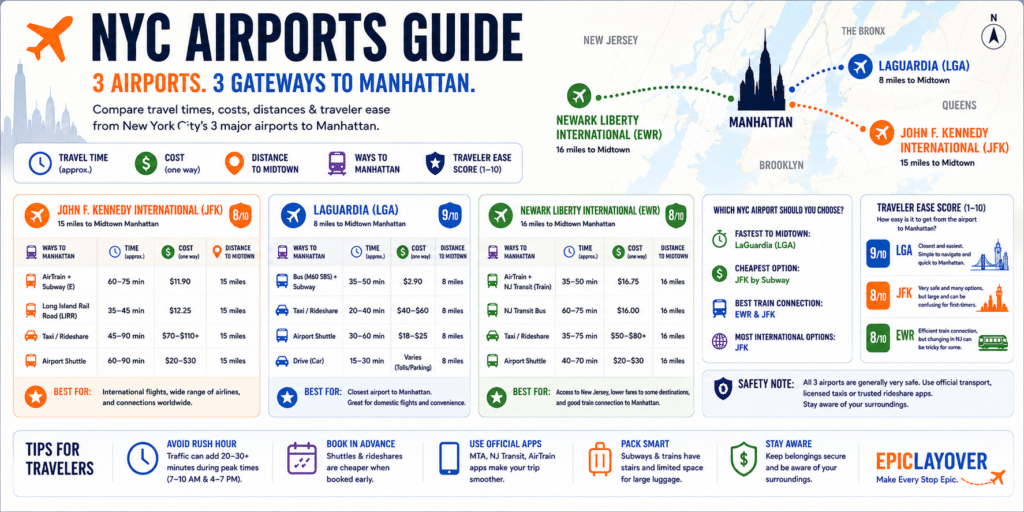
New York is the only city in this guide series served by three separate international airports, none of which are connected to each other, and only two of which have a direct rail link to Manhattan at all. That sounds like a disadvantage. It isn’t. It means whichever one you land at, there is almost always a specific, well-documented way to reach the Brooklyn Bridge, Central Park or a proper New York slice and back, in the time a single layover actually gives you. This guide treats each airport as its own decision, because they are not interchangeable, and the internet’s advice for “getting into NYC from the airport” usually assumes you know which one it means.
New York is the answer sentence first: a layover here is genuinely workable from JFK or Newark with 5 hours or more, and from LaGuardia with 6 or more, because two of the three airports connect to Manhattan by fixed-schedule rail that ignores road traffic entirely. The subway itself runs 24 hours, covers virtually every neighbourhood worth seeing, and costs a flat $3.00 regardless of distance, a rate that rose from $2.90 in the January 2026 fare adjustment, so any guide still quoting the old number is already out of date.
The real pain point in New York isn’t distance, it’s the gap between what road transport promises and what it delivers. A taxi to Midtown from any of the three airports can take 25 minutes on a good day or 90 on a bad one, and there is no way to know which you’ll get until you’re in it. The fix, at every single airport in this guide, is the same: prefer rail and fixed-schedule transit over anything that depends on the road, and you convert an unpredictable city into a genuinely reliable one.
Below: an honest, airport-by-airport transit breakdown with current 2026 fares, a genuinely important Newark AirTrain construction disruption most guides haven’t caught yet, how the subway actually works, time-based itineraries built around real transit numbers, and the current 2026 ESTA cost, which has nearly doubled since this guide was last written anywhere else.
The United States offers no airside transit: every international passenger, even one only connecting to another flight, clears Customs and Border Protection on arrival at JFK, LaGuardia or Newark. Citizens of the 42 Visa Waiver Program countries need an approved ESTA before boarding, now $40.27 per applicant following the September 2025 fee increase from $21, plus a small annual inflation adjustment from 1 January 2026. Everyone else needs a valid US visa, which can take weeks to months depending on nationality. Not sure what applies to you? Our layover visa guide covers ESTA and entry rules by nationality, or use iVisa for a guided ESTA application with human review before your travel date.
Your Airport: JFK, LaGuardia or Newark?
The right transit plan depends entirely on which of the three you land at, since they share no rail connection to each other and two very different profiles for reaching Manhattan.
John F. Kennedy International (JFK), Queens — the best of the three for a layover
The AirTrain connects every terminal to Jamaica Station and Howard Beach, giving direct subway access with no taxi or bus required, running 24/7. As of the current 2026 fare schedule, AirTrain access costs $8.75 to enter or exit the system at Jamaica or Howard Beach (up from $5.50 before a recent increase), separate from the $3.00 subway fare. AirTrain plus the E, J or Z subway reaches Midtown in 55 to 65 minutes, roughly $11.75 total. AirTrain plus the LIRR to Penn Station is faster, 35 to 45 minutes, for $15 to $20. A taxi runs a flat $70 plus tolls and tip, 45 to 75 minutes depending on traffic; rideshare runs $45 to $90 with surge pricing common.
LaGuardia Airport (LGA), Queens — the most central, the hardest to escape
LaGuardia has no rail link whatsoever, a genuine structural gap compared to the other two. Your only options are bus, taxi or rideshare, all fully exposed to traffic on the Grand Central Parkway and Triborough Bridge approaches. The Q70 Select Bus Service to Jackson Heights connects to the E, F, M, R and 7 trains, 45 to 65 minutes total for $3.00 (bus and subway both included under the transfer window). The M60 SBS reaches Harlem and Upper Manhattan in 60 to 80 minutes for $3.00. Taxi runs $30 to $55 plus tolls and tip, 25 to 60 minutes; rideshare $25 to $60, both highly traffic-dependent. Given the unpredictability, treat any LaGuardia layover under 7 hours as a stay-in-the-terminal decision, not a city trip.
Newark Liberty International (EWR), New Jersey — well connected, currently mid-construction
Technically New Jersey, not New York, but genuinely well linked to Manhattan via NJ Transit, and increasingly the sleeper-favourite option for exactly that reason: at 16 miles from Midtown, Newark’s rail-based transit time (30 to 40 minutes) beats JFK’s for many travellers. AirTrain Newark connects all three terminals to Newark Liberty Airport Station, where NJ Transit trains reach New York Penn Station in 20 to 30 minutes, current combined fare (AirTrain access plus rail) around $17.25. Taxi runs $55 to $80 plus tolls, 35 to 65 minutes; rideshare $40 to $80.
AirTrain Newark is mid-replacement, a multi-year project to swap the current monorail for a new cable-driven system. As of 15 January 2026, AirTrain service is suspended on weekdays from 5:00am to 3:00pm, replaced by free shuttle buses covering the same route at a slower pace. Further planned suspensions run 30 September to 30 October 2026, and again from 30 October 2026 through 15 January 2027. If your Newark layover falls on a weekday morning or early afternoon, or in either autumn/winter closure window, budget meaningfully more time for the airport-to-rail-station leg and check the Port Authority’s current AirTrain Newark status before you fly, not after you land.
Should You Leave the Airport? The Decision Gauge
New York’s biggest layover risk isn’t distance, it’s traffic exposure. Rail-based transit (JFK’s AirTrain-to-subway, Newark’s AirTrain-to-NJ Transit) is consistent and largely immune to it; road transport at any of the three airports is not.
How much time do you actually have?
Enter your arrival and departure and we calculate the real usable window after customs, transit and buffer time. Most people have less than they think.
Navigating the NYC Subway on a Layover
The subway is the most powerful tool a layover traveller has here: 24/7 service, virtually every neighbourhood covered, and a flat $3.00 fare (raised from $2.90 in the January 2026 adjustment) regardless of distance. Tap any contactless card or phone directly at the turnstile via OMNY: no MetroCard needed, and as of late 2025 general MetroCard sales have effectively ended in favour of OMNY.
| What you need to know | Detail |
|---|---|
| Lines | Lettered (A, C, E, N, Q, R…) or numbered (1–6), each a different route; colour groups related services on the map. |
| Express vs local | Bold circles on the map are express stops (skip stations, faster for distance); open circles are local-only. |
| Direction | In Manhattan, trains run uptown (north) or downtown (south). Confirm your direction before tapping in. |
| Payment | Contactless card or phone (OMNY) at any turnstile, $3.00 per tap, weekly cap of $35 after 12 rides in 7 days. |
| From JFK | AirTrain to Jamaica Station, then E, J or Z subway. The E train is most useful for Midtown (Fifth Ave, World Trade Center). |
Pay for the subway and everything else the smart way. New York is close to fully card-based, and OMNY accepts any contactless card directly, but a home bank card can still add foreign transaction fees on every tap. A Wise or Revolut card avoids that markup entirely, useful across a full day of small transit and food purchases.
Your phone needs to work from the moment you land, since Google Maps’ real-time transit directions are the actual reason the subway’s reputation for complexity is overstated. International visitors arriving without US coverage should install an Airalo US eSIM before boarding so it’s live on arrival. For a short layover, Roamless pay-as-you-go data covers a few hours for a couple of dollars.
What to Do in New York on a Layover
Manhattan rewards a layover better than almost any city in this series precisely because the subway removes the distance problem: once you’re on a train, the whole island (and Brooklyn) opens up on a fixed, traffic-proof schedule.
Fifth Avenue and Midtown
Straight out of the AirTrain-and-subway combination from JFK, Fifth Avenue’s walk south past Bryant Park, the New York Public Library and Grand Central Terminal costs nothing and covers the classic Midtown postcard in about 45 minutes on foot.
The High Line
An elevated former freight rail line converted into a 1.5-mile linear park, running roughly 14th to 34th Street. Free entry, genuinely striking city views, and quietest before 10am. The southern end near Hudson Yards gives the best long perspective shot of the Vessel and the surrounding glass towers.
9/11 Memorial and Lower Manhattan
The twin reflecting pools are free to visit with no ticket required (the adjacent museum does require one and takes considerably longer than a layover allows). Lower Manhattan’s dense financial-district streets are walkable in under an hour end to end.
Brooklyn Bridge
A 25-minute walk from the Manhattan side, with views in every direction and, at the midpoint, the single best skyline photograph a layover traveller can get without a boat. Genuinely reachable and back within a 7-to-10-hour window via subway.
Central Park
Enter at 59th Street for the closest approach to Midtown. Bethesda Fountain is a 15-minute walk in; bike rental stands operate near most entrances if you want to cover more ground in less time. Best suited to a 10-plus-hour window alongside other sights rather than a standalone stop.
DUMBO, Brooklyn
Washington Street’s view of the Manhattan Bridge framing the Empire State Building is one of the most photographed spots in New York. Reachable via the A or C subway to High Street–Brooklyn Bridge, then a 5-minute walk. Best attempted only on a 10-plus-hour window given the extra transit distance.
Walk from the Manhattan side, entrance near City Hall Park. At the midpoint, turn back toward Manhattan for the classic shot: bridge cables framing the Lower Manhattan skyline. Best in early morning before tour groups arrive, or at blue hour just after sunset. Use the pedestrian walkway’s centre lane and step aside for photos; cyclists use the outer lane and move fast.
Stand on Washington Street looking toward the Manhattan Bridge; the bridge frames the Empire State Building perfectly in the gap between buildings. Arrive early morning for empty streets and golden light. A or C subway to High Street–Brooklyn Bridge, then five minutes on foot.
Itineraries by Time Window
Crossing into Brooklyn (DUMBO’s skyline view, a proper afternoon in the borough) only makes sense with 9-plus hours from JFK or 10-plus from Newark: the extra transit distance and return-leg buffer eat into a shorter window fast. Under that, Manhattan alone is the honest answer, and the Brooklyn Bridge walk from the Manhattan side gets you most of the same visual payoff without the added distance.
Travel Scenarios: Real Situations Across NYC’s Airports
You land at JFK with a 6-hour layover and, wanting to move fast, jump straight into a taxi queue instead of the AirTrain.
A JFK-to-Midtown taxi runs anywhere from 45 to 75 minutes depending on traffic, with zero way to know which end of that range you’ll get until you’re already committed. The AirTrain-to-subway combination is 55 to 65 minutes every single time.
Default to rail on the way in, every time, at any of the three airports. It’s rarely much slower than road transport and never subject to the same variance.
Your Newark layover falls on a weekday between 5am and 3pm in 2026, and you plan your itinerary around the AirTrain’s normal schedule without checking current status.
AirTrain Newark is suspended during exactly this window as part of an active replacement construction project, with free shuttle buses covering the route more slowly. A plan built on the AirTrain’s normal timing runs late before you’ve even left the airport.
Check the Port Authority’s current AirTrain Newark status before you fly, and if your layover falls in a suspension window, add 20 to 30 minutes to your transit estimate for the shuttle-bus substitute.
You land at LaGuardia with 6 hours and assume, since it’s the most central of the three airports geographically, that it’s also the easiest to leave.
LaGuardia has no rail link at all. Every option (bus, taxi, rideshare) is fully exposed to traffic on the Grand Central Parkway and Triborough Bridge approaches, the least predictable transit profile of the three airports despite the shortest geographic distance.
Treat any LaGuardia layover under 7 hours as a stay-in-the-terminal decision. The renovated Terminal B is genuinely one of the better US airport terminals to be stuck in.
You’re a Visa Waiver Program traveller who applied for an ESTA years ago and assumes the cost is still the roughly $21 figure widely quoted online.
The fee jumped to $40 in September 2025 and now sits at $40.27 following a routine inflation adjustment. Applying at the gate with the wrong amount budgeted, or discovering a renewal is needed, is a bad surprise on a tight connection.
Apply for or check your ESTA status well before travel at the official esta.cbp.dhs.gov portal, budgeting the current $40.27, and use iVisa if you’d rather have a guided application with human review.
You land with a 7-hour layover and a carry-on your airline wouldn’t check through, and plan to bring it with you into Midtown.
Subway turnstiles are tight, sidewalks are packed, and a full-size bag on a crowded Manhattan platform at any time of day is genuinely miserable, for you and everyone around you.
Store it at the airport or a Bounce partner location near Penn Station or Grand Central the moment you arrive in the city, and walk the rest of the day hands-free.
Winter weather delays your inbound into JFK or Newark, both genuinely disruption-prone in poor weather, and your onward international leg is on a separate ticket.
On a same-ticket itinerary the airline must rebook you; on a separately booked one, you bear the full replacement cost, and a short-notice transatlantic or transpacific fare out of New York is one of the most expensive rebooking scenarios anywhere.
Carry cover that pays out on separate-ticket misconnects before you fly: World Nomads or InsureMyTrip to compare the right level of delay and missed-connection coverage for your specific route.
What to Eat: New York in Four Bites
A proper New York slice
Thin, foldable, eaten standing up: Joe’s Pizza on Carmine Street is the enduring benchmark, but any busy corner counter serves a genuine version. $3 to $5 a slice, the fastest bite on this list.
Hell’s Kitchen cheap eats
Ninth Avenue between 44th and 57th Streets is the densest, most reliable stretch of affordable, quick, genuinely good food within easy reach of Midtown, from halal carts to small sit-down spots.
Bagels
New York’s other signature carb: dense, chewy, boiled before baking. A classic everything bagel with cream cheese from any established Manhattan bagel counter is $4 to $7 and travels well if you need to eat on the move.
A hot dog from a street cart
The cheapest, most iconic quick bite in the city, $3 to $5, available on nearly every Midtown corner. Not fine dining, but genuinely part of the experience.
Staying Inside the Airport: The Under-5-Hours Plan
If the gauge says stay, JFK Terminal 4 (the Delta hub) has the strongest dining and lounge options of any NYC-area terminal, Terminal 5 (JetBlue) is well designed with solid food, and Terminal 1 carries a Priority Pass lounge. At Newark, Terminal C (United’s hub) has a United Club plus Priority Pass access. LaGuardia’s renovated Terminal B is genuinely one of the better US terminals to be stuck in, a real upgrade from its old reputation.
Working on shared airport Wi-Fi for several hours means your banking and saved passwords are travelling over a network shared with thousands of strangers, at three of the busiest airports in the country. A VPN closes that exposure in one tap: NordVPN covers the laptop-and-phone combination most travellers carry.
Layover Gear: Connectivity and Power
Domestic US travellers already have coverage, but if you’re connecting internationally through any of the three airports, your phone needs to work from the moment you clear customs.
Hotels for Overnight Layovers
The overnight decision depends on which airport and which direction you’re headed next: a hotel near the airport for an early departure, or a Midtown property for a genuine evening in the city.
Tours Worth Booking in Advance
Luggage Storage, Transfers and Insurance
Luggage storage
New York is not a city to explore with a rolling bag: tight turnstiles, packed sidewalks, and staircases everywhere. Store it before you leave the airport area.
Airport transfers
Rail beats road at every airport in this guide, but a pre-booked transfer earns its price for pre-dawn departures, heavy luggage, or groups where the per-person maths flips.
Insurance
New York’s three airports are among the most disruption-prone in the country during winter weather, and a delayed connection here can cascade into an expensive short-notice rebooking on an international leg.
If something goes seriously wrong, lost passport, medical emergency, legal situation, international visitors need their country’s consular representation. Our embassy and consulate guide lists every consular office in every city we cover, with direct phone numbers. New York hosts the largest concentration of foreign consulates of any US city.
More Layover Guides
New York City Layover FAQ
Official NYC Airport and Transit Resources
Primary sources for live flight, transport and entry information. Bookmark these before you fly.
Safety and Help in New York City
Sources and Citations
- MTA official 2026 fare change materials and Wikipedia, “New York City transit fares” — $3.00 base fare effective January 2026 (up from $2.90), $35 weekly cap, MetroCard sunset in favour of OMNY
- Wikipedia, “AirTrain JFK” — current $8.75 AirTrain access fee, 2025-2026 passenger figures, Terminal 1 closure/reopening history
- OMNY official FAQ (omny.info) — AirTrain JFK contactless fare confirmation
- Wikipedia, “AirTrain Newark” — active replacement project, weekday 5am–3pm suspension effective 15 January 2026, planned autumn/winter 2026 suspension windows, free shuttle bus substitute
- NJ Transit official site (njtransit.com/airport) — current EWR-to-Penn Station combined fare (~$17.25), AirTrain-inclusive ticketing
- VisasNews / VisaHQ / USAGov, ESTA fee reporting — fee increase from $21 to $40 effective September 2025, further inflation adjustment to $40.27 effective 1 January 2026, fee breakdown
- Fragomen LLP, “DHS Announces Implementation of New Fees for ESTA, EVUS, and Land Border I-94 Forms” — official confirmation of the fee restructuring under HR-1
- Port Authority of NY & NJ official airport information — terminal amenities, lounge access by terminal
- Google Maps Transit and MTA official subway map — routing and navigation reference
- Original EpicLayover NYC layover research (March–May 2026 build cycle) — itinerary structure, neighbourhood detail, carried forward and fact-checked against current 2026 sources
Fares, schedules, entry requirements and construction status were verified in July 2026 and change without notice, particularly the Newark AirTrain replacement project’s suspension windows and any future ESTA fee adjustments. Always confirm critical details against the official sources above before travelling. Some links on this page are affiliate links: they cost you nothing and help keep EpicLayover’s guides free and current.