
9 Amazing Osaka Layover Experiences Beyond the Airport
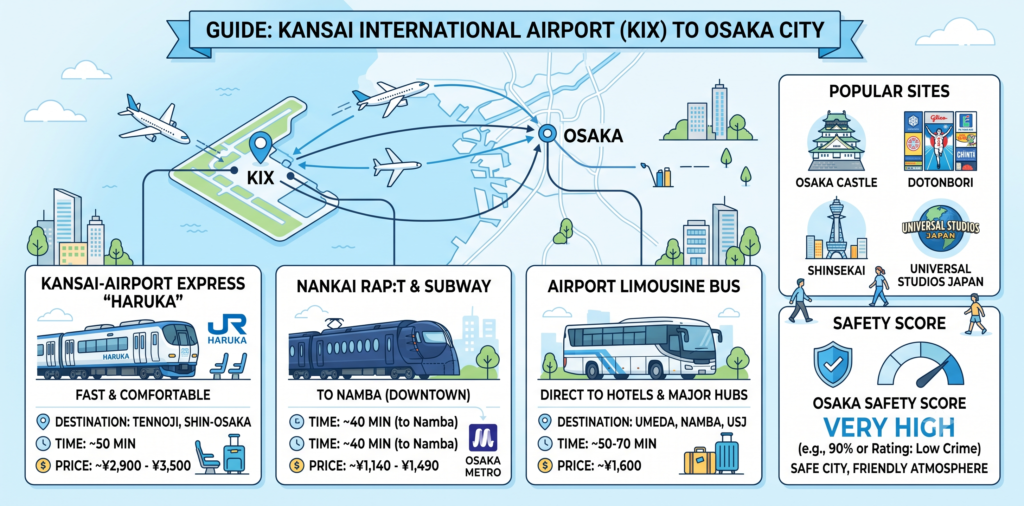
Kansai International was the world’s first airport built entirely on an artificial island, opened in 1994 on reclaimed land sitting in water 18 metres deep. The soft clay seabed means the island has been sinking ever since, more than 13 metres so far, held operational by hydraulic jacks under the terminal columns. And yet this structurally imperfect airport runs the most operationally perfect baggage system on earth: not one checked bag lost in over 30 years of handling roughly 10 million bags a year. In May 2026 it passed 600 million total passengers. A sinking island that never drops a suitcase is a very Japanese contradiction, and it is your gateway to Osaka, Kyoto, Nara and Kobe.
Here is the part most layover guides get wrong about KIX: the airport is not in Osaka. It sits in Osaka Bay, 38 kilometres southwest of the city centre, connected to the mainland by a single 3km road and rail bridge. Every plan you make for a KIX layover starts with that bridge. The good news is that the trains crossing it are fast, frequent and cheap, and they deliver you into Namba, the neon heart of the city, in as little as 34 minutes.
The pain point at KIX in 2026 is not the airport itself, which finished its largest renovation since opening in March 2025 and now clears arrivals through single-machine Joint Kiosks that combine immigration and customs in one scan. The pain point is arithmetic. Travellers see “8-hour layover” and mentally spend all 8 hours in Dotonbori. In reality you lose 45 to 60 minutes to arrival formalities, 38 minutes each way on the train, and a 90-minute pre-departure buffer. That 8-hour layover contains about 4 hours of actual Osaka. This guide does that maths for you before you commit.
Below: how the two terminals actually work (they are not connected, and that catches people), which train to take and when, what to do with 4, 6 or 9 hours, where to eat, what the 2026 rule changes mean for your wallet, and how to protect the return leg so a street-food detour never becomes a missed flight.
Japan admits passport holders from 74 countries and regions visa-free for short stays, typically 90 days for US, UK, Canadian, Australian and most EU passports. There is no electronic authorisation to buy in 2026: JESTA becomes law in 2029, not now, and paid “JESTA application” sites are fraudulent. Register free on Visit Japan Web at least 6 hours before landing to get a QR code for the Joint Kiosks. Not sure what applies to your passport or your onward destination? Our layover visa guide covers transit and entry rules by nationality, or use iVisa if your nationality does need a visa and you want a guided application with human review before your travel date.
Airlines at KIX: Who Flies Here and From Which Terminal
KIX handled more than 34 million passengers in 2025 across roughly 570 weekly flights on 97 routes, served by 67 airlines connecting about 90 cities in more than 24 countries. Terminal 1, the 1.7km Renzo Piano building that remains the longest airport terminal in the world, handles almost everything. Terminal 2 exists for one reason: Peach.
Peach Aviation: Japan’s low-cost carrier, born at KIX
Peach is headquartered at Kansai and runs its main base from Terminal 2, a deliberately bare single-storey building with no jet bridges: you walk to the aircraft, and staff hand out umbrellas when it rains. Peach connects KIX across Japan (Tokyo, Sapporo, Okinawa, Fukuoka) and to Seoul, Taipei, Shanghai and Hong Kong. KIX won Skytrax’s World’s Best Low-Cost Terminal award in 2026 largely on the back of this operation. The catch for layover travellers: Peach fares exclude checked bags by default, and nothing transfers automatically between Peach and another airline. If your itinerary mixes carriers, you are collecting your bag, riding the shuttle between terminals, and checking in again from scratch.
Should You Leave the Airport? The Decision Guide
The honest maths: arrival formalities at the renovated Terminal 1 run 20 to 45 minutes with a Visit Japan Web QR code (longer without one), the train to Namba is 38 minutes each way, and you want to be back at KIX 90 minutes before an international departure, 2 hours to be comfortable. That is roughly 3 hours of fixed overhead before you have seen a single takoyaki stand.
How much time do you actually have?
Enter your arrival and departure and we calculate the real usable window after immigration, transit and buffer time. Most people have less than they think.
Getting Into Osaka: Every Option, Priced
Two railway companies run competing lines across the airport bridge from the shared Kansai-Airport Station, a 5-minute indoor walk from Terminal 1 arrivals. Nankai goes to Namba (the southern, street-food side of the city). JR goes to Tennoji, Osaka Station and onward to Kyoto. Pick your train by picking your destination, not the other way round.
| Option | To | Time | Cost | Notes |
|---|---|---|---|---|
| Nankai Rapi:t | Namba | 34–39 min | ¥1,520 e-ticket / ¥1,670 paper | All seats reserved, every 30 min. The retro-futurist blue train. Best choice for Dotonbori. |
| Nankai Airport Express | Namba | 45–50 min | ¥970 | Commuter train, no reservations, 12 stops. The budget play if the timing works. |
| JR Haruka | Tennoji / Osaka Stn / Kyoto | 30 / 45 / ~80 min | ¥1,820 / ¥2,380 unreserved | Discounted one-way tickets for foreign passports available. The only sane Kyoto option. |
| JR Kansai Airport Rapid | Tennoji / Osaka Stn | 50 / 70 min | ¥1,060 / ¥1,180 | Half the Haruka price, 15–25 min slower, crowded at rush hour. |
| Airport Limousine Bus | Namba / Osaka Stn | 45 / 60 min | ¥1,300 / ¥1,800 | Useful with heavy bags or when carrying a pram. Traffic risk on the return leg. |
| Taxi | Central Osaka | 50–70 min | ¥18,000+ | Almost never the right answer. The train crosses the same single bridge for a tenth of the price. |
Pay for local transport and street food the smart way. Japan remains far more cash-driven than visitors expect: market stalls, small ramen counters and some temple entries take yen notes only, and airport ATM withdrawals on a home bank card stack foreign transaction fees on a poor exchange rate. A Wise or Revolut card converts at the mid-market rate, works in Japanese ATMs for the cash you will genuinely need, and taps directly onto the transit IC readers where accepted. Load a tap-to-pay Suica or ICOCA into your phone wallet before you land and the ticket machines stop being your problem entirely.
Planning an onward leg overland rather than flying? Shinkansen and highway bus tickets between Osaka, Kyoto, Tokyo and the rest of Honshu can be compared and booked in one place on Omio, which is the least painful way to price a train-versus-bus decision in English before committing.
KIX connects to the mainland by exactly one structure, the 3km Sky Gate Bridge carrying both road and rail. When Typhoon Jebi hit in September 2018, a drifting tanker struck the bridge and thousands of travellers were stranded on the island. Full disruption is rare, but the lesson stands: in typhoon season (roughly August to October), check conditions before you leave the terminal, keep your return buffer generous, and treat any weather warning as a reason to stay airside. There is no alternative route back.
Your phone needs to work from the moment you land, and not just for maps. The Visit Japan Web QR code lives in your browser, train e-tickets live in your email, and translation apps carry you through every menu in Shinsekai. Install an Airalo Japan eSIM before boarding and it activates the moment you switch off airplane mode. For a short layover where a fixed plan wastes money, Roamless pay-as-you-go data covers a 6-hour visit for the price of an airport coffee.
What to Do in Osaka on a Layover
Osaka rewards the layover traveller better than almost any city in Asia, because its signature experience is not a museum or a monument. It is a walk through Namba with food in your hand. The Rapi:t drops you 10 minutes from the middle of it.
Dotonbori and the Glico Running Man
Dotonbori is a canal-side strip of restaurants, giant mechanical crab signage and full-sensory advertising that has been Osaka’s entertainment district since the 17th century. The Glico Running Man sign above Ebisubashi Bridge has been sprinting since 1935 through six versions; the current LED edition is the single most photographed spot in the city. Walk the canal, cross the bridge, and let the side streets pull you in. It costs nothing and it is the concentrated essence of Osaka.
One block south, duck into Hozenji Yokocho, a stone-paved alley of tiny bars and restaurants around Hozenji Temple. The moss-covered Fudo Myoo statue there is kept green by visitors ladling water over it, a practice locals have followed for decades. The contrast with the neon 40 metres away is the whole city in one frame.
Kuromon Ichiba Market
Five minutes from Namba Station, Kuromon Ichiba is a 580-metre covered market where Osaka’s chefs have bought seafood since the Edo period, and where stall after stall now grills scallops, tuna and wagyu skewers for walk-up customers. Eat as you go, carry cash, and treat it as lunch. Most stalls open by 09:00 and wind down late afternoon, which suits a daytime layover perfectly.
Osaka Castle
The 1931 reconstruction of Hideyoshi’s 16th-century fortress sits in a large public park about 20 minutes from Namba by Metro. The main tower’s museum and observation deck cost ¥1,200 (raised from ¥600 in April 2025), and the ticket queue in peak season can run 30 to 45 minutes, a serious bite from a layover window. Book a timed skip-the-line entry via GetYourGuide and walk straight in, or settle for the park and moat views, which are free and arguably the better photograph anyway.
Shinsekai and Tsutenkaku
Shinsekai (“New World”) was built in 1912, modelled partly on Paris and Coney Island, and then left to develop its own retro-neon character for a century. The Tsutenkaku tower anchors the district, and the streets below it are the home of kushikatsu, Osaka’s deep-fried skewers. It is 10 minutes from Namba on the Midosuji Line and pairs naturally with a 6-to-8-hour window.
Umeda Sky Building
Two 40-storey towers joined at the top by a ring-shaped rooftop deck, the Kuchu Teien Observatory, 173 metres up with 360-degree views across the city to Osaka Bay. Admission is ¥2,000 and the glass escalator crossing the void between the towers is worth the ticket by itself. Only attempt this with 8-plus hours: Umeda is at the opposite end of the city from Namba, and sunset slots sell out, so book ahead through Klook if the timing matters to you.
Shoot from the bridge’s southwest corner after dark, when the canal reflects the full LED wall. Wide angle, crowd included: the people are part of the picture. The sign has marked this spot since 1935, so you are photographing a 90-year lineage, not just an advert. Expect to wait a minute for bridge space on weekends.
Stand on Janjan Yokocho or the main approach street and frame the tower between the oversized pufferfish lanterns and kushikatsu signage. Late afternoon gives you lit signs against a still-blue sky, the best 20 minutes of the day here. Portrait orientation, tower centred, signs bleeding in from both edges.
Itineraries by Time Window
With 10-plus hours, Kyoto is technically reachable: the JR Haruka runs direct from the airport in roughly 80 minutes, and discounted one-way Haruka tickets exist specifically for foreign passport holders. But be honest about what you get: nearly 3 hours of round-trip train for 3 to 4 hours in one Kyoto district. Fushimi Inari’s gates sit close to a Haruka-line transfer and are open 24 hours, which makes them the only Kyoto target we recommend on a layover. Anything less than 10 hours, stay in Osaka and enjoy it properly.
Travel Scenarios: Real Situations at KIX
You land at KIX with a 7-hour window and a rolling carry-on your airline would not check through. Kuromon Ichiba’s aisles are shoulder-width at lunchtime and Dotonbori on a Saturday is a slow-moving river of people.
Dragging a bag through a covered market where every second person is holding a skewer of grilled scallop is miserable for you and everyone around you, and the terminal lockers at T1 fill up by mid-morning in peak season.
Drop the bag at a Bounce partner shop near Namba Station the moment you step off the Rapi:t, a few hundred yen for the day, and walk the market with both hands free for food.
You booked a cheap Peach flight into KIX Terminal 2 with an onward international leg on a full-service carrier out of Terminal 1, on separate tickets, 2 hours apart.
T2 has no rail station and no airside link to T1. You must collect your bag (Peach checks nothing through to another airline), ride the free shuttle 7 to 10 minutes, and check in again from zero. Two hours evaporates fast, and a separate-ticket misconnect is your cost, not the airlines’.
Treat any T2-to-T1 self-connect under 3 hours as high-risk, and carry cover that pays out when a separate-ticket connection collapses: World Nomads covers missed connections on separately booked itineraries.
Your inbound is delayed and you clear arrivals close to midnight. KIX runs 24 hours, but the last Rapi:t and Haruka departures leave mid-evening to around 23:00, and after that the city might as well be another country.
A taxi across the bridge into Osaka and back costs more than most hotel rooms, and dozing upright in the terminal before a long-haul leg is a bad start to it.
Stay on the island. Hotel Nikko Kansai Airport is connected to Terminal 1 by a covered walkway, and cheaper capsule-style rooms sit in the same Aeroplaza complex. Book tonight’s room on Agoda, which consistently prices Japanese airport properties below the walk-up rate.
Your Visit Japan Web QR, your Rapi:t e-ticket and your maps all need a connection, and your home carrier wants a small fortune per day for roaming in Japan.
Airport Wi-Fi gets you out of the terminal, then drops you in Namba with no navigation, no translation and a paper-ticket queue at the machines while your window shrinks.
Install an Airalo Japan eSIM before you board. It activates on landing, your QR codes load at the kiosk, and the whole layover runs off your phone the way it is designed to.
Kuromon stalls, the kushikatsu counter in Shinsekai and the temple donation box all want yen notes, and your home debit card adds a foreign transaction fee to a marked-up rate on every withdrawal.
Three or four per cent skimmed off everything you spend, on a layover where every purchase is small and frequent. It adds up to a Rapi:t ticket’s worth of pure fees.
Withdraw once from a convenience-store ATM using a Wise card at the mid-market rate, and tap the card for everything that takes plastic.
You stayed overnight in the city and your departure is at 07:00, which means being at KIX by 05:00-05:30, before the first comfortable train connections from Namba have you there.
Miscount the first-train timetable by one departure and you are standing on a dark platform doing panic maths about a 38km taxi across a bridge, at whatever price the meter decides.
Fix the price the night before: a Welcome Pickups transfer confirmed in advance, driver waiting at your hotel at 04:30, cost known before you sleep. The peace of mind is the product.
What to Eat: Osaka in Four Dishes
Osaka’s nickname is kuidaore, “eat yourself into ruin,” and the city treats that as a civic duty rather than a warning. Everything below is walkable from Namba Station.
Takoyaki
Octopus dumplings, invented in Osaka in the 1930s: batter poured into half-sphere iron moulds, a piece of boiled octopus dropped into each, then turned with picks until golden outside and molten inside, finished with sauce, mayonnaise, bonito flakes and seaweed powder. Wanaka’s Namba branch and the Dotonbori stands both sell 8 for around ¥600 to ¥700. Let them cool for a full minute; every first-timer burns their mouth, and the vendors watch it happen with quiet amusement.
Okonomiyaki
The savoury cabbage-and-batter pancake, mixed with pork or seafood, grilled on a teppan and painted with sweet-savoury sauce. Osaka-style mixes everything into the batter (unlike Hiroshima’s layered version, a rivalry locals take seriously). Mizuno on Dotonbori has been at it since 1945; expect a queue, or pick any counter where the cook grills in front of you, which is most of them. Around ¥1,000 to ¥1,600 a pancake.
Kushikatsu
Shinsekai’s dish: skewered meat, seafood and vegetables, breaded and deep-fried, dipped in a communal thin Worcestershire-style sauce. The one iron rule, posted on every wall: no double-dipping. Bite, and if you need more sauce, use the free cabbage leaf as a spoon. Daruma, founded 1929, is the district’s benchmark, with skewers from roughly ¥130 to ¥250 each.
551 Horai butaman
The pork bun Osakans carry home as a gift, steamed fat and glossy, two for around ¥420. The Namba flagship has queues out the door, but there are branches inside KIX itself, which makes it the perfect final act: buy a pair airside and board smelling faintly of the city you just left. Locals will tell you 551 tastes better precisely because it is only sold in the Kansai region.
Staying Inside the Airport: The Under-5-Hours Plan
If the gauge says stay, you are staying in a terminal that finished its biggest renovation since 1994 in March 2025 and was built by the architect of the Pompidou Centre. Terminal 1’s international departure area now holds Japan’s largest walkthrough duty-free, themed “Mood Areas” for killing time deliberately (energy, culture, quiet), and an airline common lounge with capacity for more than 1,000 passengers. Arrivals-side, there is a Nintendo Check In games area with a Mario statue, free to play, which has rescued more delayed families than any lounge.
Food inside T1 covers the city’s greatest hits without the train fare: 551 Horai pork buns, takoyaki counters and proper ramen airside. Wi-Fi is free and reliable. If you are flying Peach from Terminal 2, do your eating and shopping at T1 or the Aeroplaza before riding the shuttle across, because T2 is deliberately spartan: one hall, no jet bridges, minimal retail.
Working on shared airport Wi-Fi for a few hours means your banking, email and saved passwords are travelling over a network with a few thousand strangers. A VPN closes that exposure in one tap: NordVPN covers the laptop-and-phone combination most travellers carry.
Layover Gear: Connectivity and Power
Your phone needs to work from the moment you land. Every part of a modern KIX layover, from the Joint Kiosk QR code to the Rapi:t e-ticket, assumes a live connection.
Hotels for Overnight Layovers
The overnight decision at KIX is binary: sleep on the island for an early departure, or sleep in Namba for a real evening in the city. Each property below solves one specific version of that problem.
Tours Worth Booking in Advance
Osaka on a layover is mostly self-guided, but three specific booking friction points are worth solving before you land rather than in a queue.
Luggage Storage, Transfers and Insurance
Luggage storage
Terminal 1 has coin lockers and staffed counters, but they fill in peak season, and hauling a bag into the city defeats the purpose of going. Store it where you are actually walking.
Airport transfers
The train wins on almost every KIX journey, but there are three cases where a pre-booked car earns its price: a pre-dawn departure before the first trains, a family with a pram and four bags, and a group of three or more where the per-person maths flips.
Insurance
Japan is one of the safest places on earth to be a traveller, and one of the most expensive places to be an uninsured patient. A hospital visit is billed at private rates to foreign visitors, and Japanese hospitals routinely ask for payment or proof of cover up front. Each of these partners solves a different version of that anxiety.
If something goes seriously wrong, lost passport, medical emergency, legal situation, you need your country’s consular representation, and Osaka hosts a full consular corps. Our embassy and consulate guide lists every consular office in every city we cover, with direct phone numbers.
More Layover Guides
KIX Layover FAQ
Official KIX and Osaka Resources
Primary sources for live flight, transport and entry information. Bookmark these before you fly.
Safety and Help in Osaka
Osaka is one of the safest major cities a layover traveller will ever walk through, and the practical risks are logistical, not criminal: typhoon disruption, a missed last train, a medical bill without cover. Know where help is before you need it.
Sources and Citations
- Kansai Airports, company profile and news: kansai-airports.co.jp/en/ (600 million passenger milestone, May 2026; Skytrax World’s Best Low-Cost Terminal 2026)
- VINCI Airports, Kansai International Airport overview: vinci-airports.com (34 million-plus passengers 2025; Terminal 1 capacity 40 million)
- Passenger Terminal Today, “Kansai Airport’s Terminal 1 renovation increases annual passenger capacity to 40 million,” March 2025
- CNN Travel, “This airport says it hasn’t lost a single piece of baggage in 30 years,” 2024
- Forbes, “Japan’s Kansai Airport World Record: No Luggage Lost In 30 Years,” May 2024
- Wikipedia / American Society of Civil Engineers, Kansai International Airport: island construction, subsidence, 1995 earthquake performance, Sky Gate Bridge R
- Japan-Guide.com, Kansai Airport access: Rapi:t, Haruka, rapid train and bus fares and times
- Nankai Electric Railway official site: Rapi:t service and digital tickets
- Ministry of Foreign Affairs of Japan: visa exemption arrangements, 74 countries and regions; JESTA legislation reporting (law passed May 2026, launch by March 2029)
- Osaka Castle official site (admission ¥1,200 from April 2025); Umeda Sky Building Kuchu Teien Observatory official information (admission ¥2,000)
Fares, admission prices, timetables and entry rules were verified in June 2026 and change without notice. Always confirm critical details, especially last-train times and entry requirements for your specific passport, against the official sources above before travelling. Some links on this page are affiliate links: they cost you nothing and help keep EpicLayover’s guides free and current.
