
Milan Between Flights: Fashion, Food & Historic Streets
On the night of 15 August 1943, a British bomb collapsed the roof and three of the four walls of a small dining hall attached to the church of Santa Maria delle Grazie. The wall that survived, standing alone under open sky for nearly two years afterward, was the one holding Leonardo da Vinci’s Last Supper, reinforced with sandbags and scaffolding by museum staff who saw the raids coming. You are 40 minutes from that wall. This guide is built around getting you there, and back, without becoming the reason you missed a flight for a fresco.
Milan Malpensa is the answer sentence first: MXP is Italy’s second-busiest airport, handled more than 31 million passengers in 2025, and sits 49 kilometres northwest of the city it serves, meaning every layover plan here starts with an hour of transit built in before you touch a single cobblestone. Eighty per cent of Malpensa’s traffic is now international, and 2025’s record growth (new long-haul routes to Boston, Philadelphia and Hanoi, plus returning Asian carriers) has come with a real cost: SEA, the airport operator, has publicly flagged security and immigration queues routinely topping an hour at peak, with terminal expansion still catching up to demand.
The second thing that changes how you plan a Milan layover in 2026: the EU’s Entry/Exit System, the biometric fingerprint-and-face check that replaced manual passport stamping, became fully operational across every Schengen border on 10 April 2026. First-time visitors to the Schengen Area now clear a slower, unfamiliar process at passport control, and MXP has been named specifically as one of the airports reinforcing biometric gates to cope. Budget more time for this than any older guide, including our own, would have told you a year ago.
Below: how to actually get from a 49km-distant airport into a walkable Milan itinerary, what the EES change means for your buffer, how to see the Duomo and the Last Supper without gambling on a sold-out ticket, and where the two-terminal split at Malpensa catches people out.
Italy, as a Schengen member, admits most non-EU visa-exempt nationalities (US, UK, Canada, Australia and around 60 others) for stays up to 90 days within any 180-day period, no advance visa required. The EU’s Entry/Exit System, a biometric fingerprint and facial-scan check, became mandatory at every Schengen border on 10 April 2026, replacing the manual passport stamp for first-time entrants: budget extra time at immigration, especially on a first Schengen visit where your biometrics aren’t yet on file. ETIAS, a separate €20 pre-travel authorisation, has not launched as of this writing and will not be mandatory until roughly April 2027. Ignore any site charging you for ETIAS before the official EU portal opens. Not sure what applies to your nationality? Our layover visa guide covers transit and entry rules by nationality, or use iVisa if your nationality does require a visa and you want a guided application with human review before your travel date.
Airlines at MXP: Who Flies Here and From Which Terminal
Terminal 1 handles every airline at Malpensa except one. MXP served more than 31 million passengers in 2025, a record year, across a route network reaching roughly 90 cities in more than 20 countries, and ranks ninth in the world for the number of countries it connects with direct flights relative to its size.
EasyJet: the entire reason Terminal 2 exists
Terminal 2 at Malpensa is used exclusively by EasyJet, which runs one of its largest continental bases from Milan. If your inbound and outbound flights are both EasyJet, your connection is straightforward, entirely within T2. The trap is a mixed-carrier itinerary: EasyJet inbound to a full-service carrier outbound, or vice versa, means a genuine terminal transfer via the free shuttle bus or train link between T1 and T2, not a gate walk. Budget accordingly, especially on separate-ticket bookings where a missed connection is entirely your risk.
Should You Leave the Airport? The Decision Guide
Six hours is the realistic floor for a Milan layover, and the maths behind that number is unforgiving: EES-era immigration can run 30 to 60-plus minutes at peak, the Malpensa Express is 40 to 52 minutes each way depending on which Milan station you use, and a 90-minute return buffer is non-negotiable given MXP’s own published congestion warnings for 2026.
How much time do you actually have?
Enter your arrival and departure and we calculate the real usable window after immigration, transit and buffer time. Most people have less than they think.
Getting Into Milan: Every Option, Priced
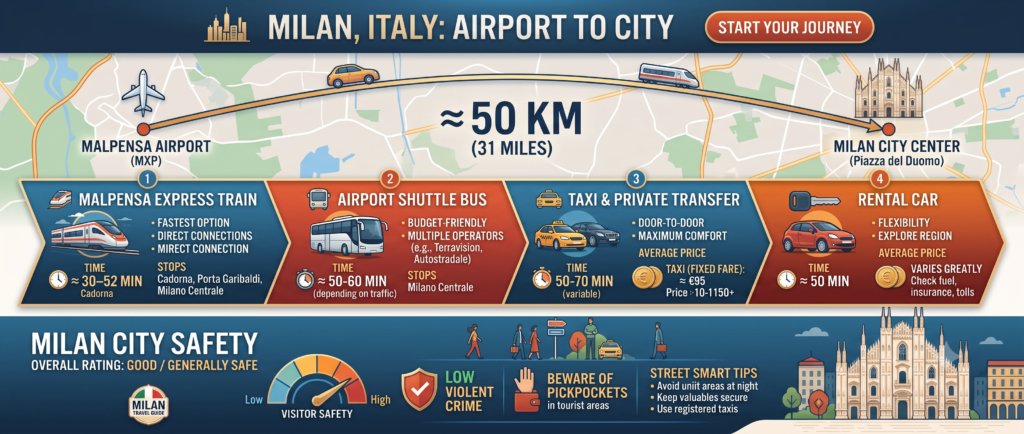
The Malpensa Express train is the right default for almost every layover traveller: fast, frequent, and immune to the road traffic that can double a taxi’s journey time. Pick your destination station by where you’re actually headed, since the two termini serve different sides of the city.
| Option | To | Time | Cost | Notes |
|---|---|---|---|---|
| Malpensa Express to Cadorna | Milano Cadorna | ~40 min | €15 one-way | Closer to the Duomo and historic centre. The best choice for a short layover. |
| Malpensa Express to Centrale | Milano Centrale | ~52 min | €15 one-way | Milan’s grand central station, better connected to onward rail, slightly further from the Duomo. |
| Airport shuttle bus | Milano Centrale | 50–90 min, traffic-dependent | ~€10 one-way | Cheaper than the train but no faster in practice, since it runs on the same congested road. |
| Official flat-rate taxi | Milan city centre | 40 min or more | €110 flat rate | Fixed rate regardless of traffic, published by the airport authority. Confirm the driver engages the flat rate, not the meter, before departure. |
| Pre-booked private transfer | Milan city centre | 40 min or more | From ~€180, fixed at booking | Costs more than the taxi flat rate, but the driver meets you inside the terminal and the price is locked before you land. |
Pay for gelato, market stalls and the odd espresso the smart way. Italy is broadly card-friendly, but dynamic currency conversion at tourist-area terminals (being offered a charge in your home currency instead of euros) quietly adds several per cent to every purchase. A Wise or Revolut card, set to always charge in euros, avoids that markup automatically.
Planning an onward leg to Lake Como, Turin or Venice rather than flying? Italy’s regional and high-speed rail network can be compared and booked in English on Omio, which is considerably easier to navigate for a first-time visitor than Trenitalia’s own booking flow.
The Entry/Exit System’s biometric fingerprint and facial-scan check became mandatory across every Schengen border, MXP included, on 10 April 2026. If this is your first Schengen entry, your biometrics are not yet on file, and the process runs slower than the manual stamp older guides describe. SEA, Malpensa’s operator, has publicly acknowledged security and immigration bottlenecks at peak periods in 2026 and is reinforcing biometric gates as part of an ongoing terminal expansion. Build a genuinely conservative buffer, especially on morning and late-afternoon arrival banks, and do not assume last year’s transit time still applies.
Your phone needs to work from the moment you land, not least because the Last Supper’s ticket confirmation and the Malpensa Express e-ticket both live in your inbox. Install an Airalo Italy or Europe-wide eSIM before boarding and it activates the moment you land. For a short layover where a fixed plan wastes money, Roamless pay-as-you-go data covers a half-day visit for a few euros.
What to Do in Milan on a Layover
The Duomo is the honest centre of a Milan layover: everything else worth doing on a short window sits within a 15-minute walk of it, and the Malpensa Express to Cadorna drops you close enough to start there immediately.
Duomo di Milano and the rooftop terraces
The third-largest church in Europe took nearly six centuries to complete, begun in 1386 and still maintained by the same institution, the Fabbrica del Duomo, founded a year later. Basic entry runs around €10; the rooftop terraces, roughly 8,000 square metres of walkways threaded between 135 marble spires and some 3,400 statues, cost €19 to €26 depending on stairs versus lift and whether the museum is bundled in. On a clear winter or early spring day the full Alpine arc is visible from the terrace; summer haze usually hides it. Book ahead: weekend slots sell out, and time-slot tickets are the only way in.
Galleria Vittorio Emanuele II
A glass-domed 19th-century shopping arcade directly beside the Duomo, generally credited as one of the world’s oldest shopping malls in continuous operation, opened in 1877. Walking through costs nothing, and the architecture alone, iron and glass on a scale that felt genuinely radical for its era, justifies the ten-minute detour even if the luxury storefronts don’t.
The Last Supper (Cenacolo Vinciano)
Leonardo da Vinci’s mural has survived deterioration, a Napoleonic stable conversion, and a direct WWII bombing raid that destroyed the rest of the room around it. Every ticket requires a reserved 15-minute time slot, released quarterly and prone to selling out within hours for popular months. There is no walk-up option, ever, for any visitor. If you have a slot already booked, it’s a 20-minute Malpensa Express-plus-metro combination from the Duomo. If you don’t, do not plan around getting one same-day: it will not happen.
Navigli canal district
Milan’s surviving canal network, partly engineered under Leonardo da Vinci’s own involvement in the city’s waterway system, is now the city’s aperitivo district: bars and restaurants lining the water, busiest from early evening onward. It’s a genuine change of pace from the Duomo’s Gothic density, about 20 minutes on foot or a short metro ride, and rewards an unhurried wander more than a checklist stop.
Castello Sforzesco
A 15th-century Sforza-family fortress turned museum complex, a 15-minute walk from the Duomo through the Galleria and past La Scala. The exterior courtyards are free to wander; the museums inside (including a late Michelangelo sculpture) require a ticket. On a tight layover, the courtyard alone is worth the walk.
Between roughly 16:30 and last ascent, the Candoglia marble turns amber and the shadows between the spires stretch long, the single best light of the day up there. Shoot south toward Piazza del Duomo and the Galleria’s glass dome, both clearly visible from the terrace edge. Flat shoes matter: the marble is uneven and genuinely slippery when wet.
Stand directly under the central glass octagon and shoot straight up: the iron ribwork and the four mosaic-floor sections representing Europe, Africa, Asia and America (Milan itself, standing in for Europe) are best framed from dead centre. Morning light through the glass avoids the crowd density of peak afternoon.
Itineraries by Time Window
Only attempt the Last Supper on a layover if you already hold a booked time slot: tickets release quarterly, sell out within hours for peak months, and there is no walk-up option under any circumstances. If you do have a slot, it adds roughly 40 to 60 minutes round trip from the Duomo area via metro, plus the mandatory 30-minute early arrival at the ticket office. Build this into your itinerary as a fixed, non-negotiable time block, not a flexible add-on, since the museum enforces its schedule strictly and will not admit late arrivals.
Travel Scenarios: Real Situations at MXP
You land at MXP on your first-ever Schengen entry since the EES biometric system went fully mandatory in April 2026, with a 6-hour layover planned around an older guide’s transit-time estimates.
First-time biometric enrolment takes longer than a returning traveller’s scan, and MXP’s own operator has publicly flagged peak-hour immigration queues running past an hour in 2026. A 6-hour layover budgeted on pre-2026 numbers can lose its entire margin before you reach the train platform.
Treat any guide’s transit-time numbers written before April 2026 as outdated, and add a genuine 30 to 45 minutes of immigration buffer if this is your first Schengen entry. If the maths doesn’t work, stay in the terminal rather than risk the connection.
Your inbound EasyJet flight lands at Terminal 2 and your onward full-service carrier departs from Terminal 1, booked as two separate tickets.
EasyJet checks nothing through to another airline, so you’re collecting a bag, riding the free shuttle between terminals, and checking in again from zero, all while a separate-ticket misconnect is entirely your financial risk, not the airlines’.
Treat any T2-to-T1 self-connect under 2.5 hours as high-risk, and carry cover that pays out if it collapses: World Nomads covers missed connections on separately booked itineraries.
You have an 8-hour layover and decide, on landing, to try your luck at the Cenacolo Vinciano ticket office without a booking.
There is no same-day walk-up sale, ever, for any visitor. Tickets release in quarterly blocks and routinely sell out within hours. You will not get in, and the metro trip to find that out has cost you real layover time.
Book a slot weeks or months ahead of travel via GetYourGuide‘s official-partner allocation if the direct site is sold out, or skip the Last Supper entirely this trip and default to the Duomo and Galleria circuit instead.
You tap your home debit card for a coffee near the Duomo and the terminal asks whether you’d like to pay in your home currency instead of euros.
Saying yes to that prompt (dynamic currency conversion) locks in a marked-up exchange rate on the spot, typically several per cent worse than your card’s own rate, on every tap for the rest of the day if you keep accepting it.
Always choose to pay in euros, never your home currency, at the terminal. A Wise card set to euros by default removes the decision entirely.
Your Last Supper ticket, Malpensa Express e-ticket and Duomo terrace booking all live in your email, and you land with no working data.
Airport Wi-Fi gets you through the terminal, then drops you exactly when you need to pull up a QR code at a ticket validation desk that enforces its schedule strictly.
Install an Airalo Europe eSIM before you board so every booking confirmation is reachable the moment you land.
You stayed overnight in central Milan and your departure is at 06:30, before the first Malpensa Express of the day has you at the airport with enough buffer for EES-era queues.
The earliest Cadorna departures land around 5:40am at the airport; miscount the schedule by one train and you’re negotiating a 49km taxi ride at whatever rate applies before the flat-rate booth opens.
Fix the price the night before with a Welcome Pickups transfer confirmed in advance, driver waiting at your hotel, cost known before you sleep.
What to Eat: Milan in Four Dishes
Everything below is realistic within a short walk of the Duomo or a quick metro ride to Navigli.
Risotto alla milanese
Saffron-yellow risotto, the city’s signature dish, traditionally served alongside ossobuco (braised veal shank). The saffron tradition reportedly traces back to a glassmaker’s apprentice joke about adding gold-leaf pigment to a wedding dish in the 16th century. A proper plate at a mid-range trattoria near the Duomo runs €14 to €20.
Panzerotti
A fried, pocket-shaped pastry stuffed with tomato and mozzarella, essentially a deep-fried folded pizza, sold hot from stands and small shops across the city centre. Luini, a few steps from the Duomo, has served them since 1888 and remains the benchmark. Expect a short queue and a €3 to €4 price for a fast, standing-up bite that fits any layover window.
Aperitivo
Not a dish but a ritual: a drink (classically a Negroni, invented in nearby Florence but adopted wholesale by Milan’s bar culture) ordered between roughly 6 and 9pm, which comes with a spread of small snacks included in the price at many Navigli bars. It’s the single best way to eat and drink well in a compressed evening window without sitting down for a full meal.
Gelato
Milan takes gelato as seriously as any Italian city, and a scoop from a genuine gelateria (look for muted, natural colours rather than neon pistachio) near the Galleria is the easiest five-minute stop on this entire list, €3 to €5 for a small cup.
Staying Inside the Airport: The Under-6-Hours Plan
If the gauge says stay, Terminal 1 has the stronger amenity build-out of Malpensa’s two terminals: a wide food court, duty-free retail, and free Wi-Fi throughout, though speed varies by location and time of day. Terminal 2, EasyJet’s exclusive base, is more compact and functional than scenic. Neither terminal offers the kind of architectural spectacle found at some Gulf or Asian hubs, so a short layover here is comfortable rather than an attraction in itself.
Working on shared airport Wi-Fi for several hours, at an airport whose own operator has publicly flagged 2026 congestion pressure, means your banking and saved passwords are travelling over a busy shared network. A VPN closes that exposure in one tap: NordVPN covers the laptop-and-phone combination most travellers carry.
Layover Gear: Connectivity and Power
Your phone needs to work from the moment you land, since almost every Milan attraction on this page requires a time-slot booking you’ll need to pull up on arrival.
Hotels for Overnight Layovers
The overnight decision at MXP is straightforward: stay near the airport for an early departure, or stay in central Milan for a proper evening, given the 49km distance makes a late-night airport dash genuinely risky either way.
Tours Worth Booking in Advance
Luggage Storage, Transfers and Insurance
Luggage storage
Both Malpensa terminals have storage counters, but for a Duomo-centred day, storing the bag before boarding the train means arriving in central Milan hands-free rather than hauling luggage through the Galleria’s crowds.
Airport transfers
A pre-booked transfer earns its price at MXP specifically for pre-dawn departures before the first Malpensa Express, and for anyone travelling with enough luggage that the 49km distance makes the train genuinely awkward.
Insurance
Italy is generally safe for tourists, but the EES transition has added a genuine new failure point (a longer-than-planned immigration queue eating into a tight connection), and medical care for foreign visitors outside the EU’s own reciprocal health arrangements is billed directly.
If something goes seriously wrong, lost passport, medical emergency, legal situation, you need your country’s consular representation. Our embassy and consulate guide lists every consular office in every city we cover, with direct phone numbers.
More Layover Guides
MXP Layover FAQ
Official MXP and Milan Resources
Primary sources for live flight, transport and entry information. Bookmark these before you fly.
Safety and Help in Milan
Sources and Citations
- Milan Malpensa Airport, Wikipedia and SEA/Assaeroporti traffic reporting: 2025 passenger totals (31.38 million, up 8.6%), terminal structure, EasyJet’s exclusive Terminal 2 use
- VisasHQ / Voyages d’Affaires reporting, December 2025 and March 2026: record 2025 traffic, new long-haul routes (Delta Boston, American Philadelphia, Vietnam Airlines Hanoi), SEA’s public statements on security/immigration bottlenecks
- Malpensa Express official site and Trainline: current fares (€15 one-way as of August 2025 pricing), schedules, Cadorna/Centrale routing
- MilanobyCar official taxi tariff guide, updated February 2026: €110 flat-rate taxi fare confirmation
- Schengen Traveler / Fragomen immigration law updates: EES full operational status confirmed 10 April 2026; ETIAS Q4 2026 launch timeline, transitional/grace period structure, €20 fee
- Cenacolo Vinciano (Last Supper) official site: quarterly ticket release structure, mandatory reservations, no walk-up sales, admission pricing
- Duomo di Milano official site and independent ticket guides: rooftop terrace pricing (€19–€28 depending on access type), 135 spires, 3,400 statues, construction history (begun 1386)
- Wikipedia, “The Last Supper (Leonardo)”: WWII bombing account, sandbag protection, 1999 restoration completion
- ww2historybook.com / Santa Maria delle Grazie official site: 15 August 1943 bombing detail, 24-metre distance from bomb impact, near two-year exposure before reconstruction
- Galleria Vittorio Emanuele II: general historical reference, 1877 opening
Fares, admission prices, timetables and entry requirements were verified in July 2026 and change without notice, particularly EES and ETIAS timelines, which remain subject to EU scheduling updates. Always confirm critical details against the official sources above before travelling. Some links on this page are affiliate links: they cost you nothing and help keep EpicLayover’s guides free and current.
