
7 Unforgettable Rome Layover Experiences Beyond the Airport
The Pantheon’s dome has stood since around 128 AD, and it is still, nineteen centuries later, the largest unreinforced concrete dome on Earth. No modern engineer has built one bigger without steel rebar to hold it up, and Roman concrete, it turns out, may actually strengthen over time as seawater reacts with the volcanic ash mixed into it. You can be standing under that dome within 45 minutes of touching down, and from there, the Colosseum, the Trevi Fountain and the Spanish Steps are all close enough to walk between in a single afternoon. No other city in this guide series packs this much continuous, structurally verifiable history into a radius this walkable.
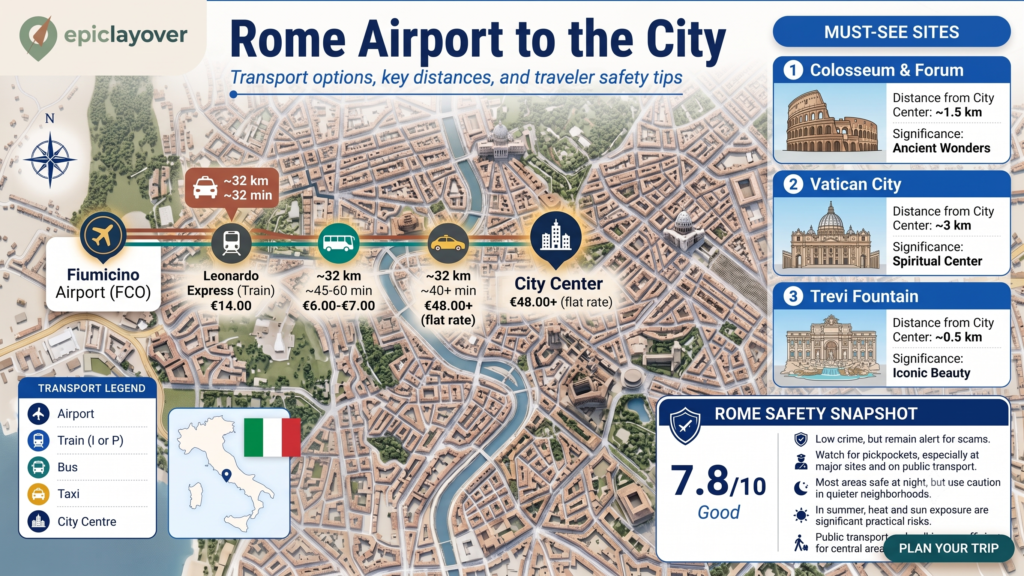
Rome is the answer sentence first: FCO’s Leonardo Express train runs non-stop to Roma Termini in exactly 32 minutes, departing every 15 minutes, dropping you at the city’s central hub with the Colosseum a short Metro ride away. Fiumicino handled around 41 million passengers in its most recent full year, Italy’s busiest airport by a wide margin, and the rail link is genuinely one of the best airport-to-city connections in this entire series.
The context worth knowing for 2026: Rome just finished hosting a Catholic Holy Year, the 2025 Jubilee, which brought more than 30 million extra visitors to the city and pushed queues, hotel rates and Vatican bookings to genuinely difficult levels through most of last year. That crowding has eased substantially by mid-2026: standalone Vatican Museums queues are shorter than they’ve been in three years, hotel rates near St. Peter’s are back to pre-Jubilee levels, and the Ottaviano Metro station serving the Vatican was renovated with better signage and flow. If you’re picturing 2025’s crowds, plan for 2026’s reality instead.
Below: the honest transit maths, how much time the Colosseum and the Pantheon genuinely need, why the Vatican Museums still deserve a booked slot even with crowds down, and where to eat cacio e pepe the way Romans actually eat it.
Italy, as a Schengen member, admits most non-EU visa-exempt nationalities for stays up to 90 days within any 180-day period, no advance visa required. The EU’s Entry/Exit System, a biometric fingerprint and facial-scan check, became mandatory at every Schengen border on 10 April 2026: budget extra time at immigration if this is your first Schengen visit. ETIAS, a separate pre-travel authorisation, has not launched as of this writing. Not sure what applies to your nationality? Our layover visa guide covers transit and entry rules by nationality, or use iVisa if your nationality does require a visa and you want a guided application with human review before your travel date.
Airlines at FCO: Who Flies Here
Fiumicino handles roughly 41 million passengers a year, Italy’s busiest airport by a wide margin, spread across four terminals (T1, T2, T3 and T5) serving more than 200 airlines to destinations worldwide.
ITA Airways: the hub carrier based at FCO
ITA Airways, Italy’s flag carrier and successor to Alitalia, runs its primary hub from Fiumicino, anchoring both domestic Italian routes and long-haul international connections. If your itinerary is ITA-to-ITA or a SkyTeam partner, expect a straightforward connection within FCO’s terminal structure.
Should You Leave the Airport? The Decision Guide
Six hours is the realistic floor for a Rome layover. The maths: EES-era immigration runs 20 to 45 minutes, the Leonardo Express is a fixed, reliable 32 minutes each way, and a 90-minute return buffer covers the transit comfortably given how consistent the train schedule is compared to road traffic.
How much time do you actually have?
Enter your arrival and departure and we calculate the real usable window after immigration, transit and buffer time. Most people have less than they think.
Getting Into Rome: Every Option, Priced
The Leonardo Express is the obvious default: fast, frequent, and immune to the traffic that makes a taxi a genuine gamble at the wrong hour.
| Option | To | Time | Cost | Notes |
|---|---|---|---|---|
| Leonardo Express | Roma Termini | 32 min | €14 one-way | Non-stop, every 15 minutes, station inside the airport. The clear best choice for almost every layover. |
| FL1 regional train | Trastevere / Ostiense / Tiburtina | 25–45 min depending on stop | Cheaper than Leonardo Express | Doesn’t reach Termini directly; useful only if your onward plans specifically involve one of its stops. |
| Airport bus (Terravision and others) | Roma Termini | 50–55 min | ~€11 | Cheapest option, roughly a third of the train fare, but slower and less frequent. |
| Fixed-rate taxi | Within the city’s ring road (GRA) | 40–60 min, traffic-dependent | €55 flat rate | An official flat fare applies for trips within the ring road. Confirm the driver is using the fixed rate, not the meter. |
| Pre-booked private transfer | Anywhere in the city | 40–60 min, traffic-dependent | Fixed price, booked in advance | Driver waits in arrivals with a name sign, useful for early departures or heavy luggage. |
Pay for the train and a gelato the smart way. Italy is thoroughly card-friendly, but a home bank card can still add foreign transaction fees on every purchase. A Wise or Revolut card set to euros avoids that markup entirely.
Planning an onward leg to Florence, Naples or Venice rather than flying? Italy’s high-speed rail network reaches all three directly from Roma Termini, and tickets can be compared and booked on Omio.
Your phone needs to work from the moment you land, since your Colosseum or Vatican Museums timed-entry ticket and the Leonardo Express e-ticket both live on it. Install an Airalo Europe eSIM before boarding and it activates the moment you land. For a short layover, Roamless pay-as-you-go data covers a half-day visit for a few euros.
What to Do in Rome on a Layover
The Pantheon-Trevi-Piazza Navona triangle is the honest centre of a Rome layover: all three sit within a 15-minute walk of each other, and the Colosseum is a short Metro ride beyond that.
The Pantheon
Completed around 128 AD under Hadrian, the Pantheon’s dome remains the largest unreinforced concrete dome ever built, nearly two thousand years on. Free to enter, and the oculus at the dome’s centre, the building’s only light source, still floods the interior exactly as it did in antiquity. A five-minute stop or a slow half-hour, depending on your window.
Trevi Fountain
An 18th-century Baroque fountain, the largest in Rome, where tradition holds that throwing a coin over your shoulder guarantees a return to the city. The roughly €1.5 million tossed in every year is collected and donated to Caritas, a Catholic charity, to fund food assistance for Rome’s poor. Free to visit, best early morning or evening when the crowds thin.
The Colosseum, Roman Forum and Palatine Hill
A single ticket (€18, valid 24 hours, usable across two consecutive days) covers all three. Standard tickets go on sale 30 days ahead and, following 2025 booking reforms, are considerably easier to secure than they used to be. Budget at least 90 minutes for a proper visit; the surrounding Forum and Palatine Hill genuinely reward the extra time if your window allows it.
Piazza Navona
A long, oval Baroque square built over the ruins of a 1st-century Roman stadium, still visible in the piazza’s distinctive shape, anchored by Bernini’s Fountain of the Four Rivers. Free to visit, lively with street artists and cafés, and a natural stop between the Pantheon and Trevi Fountain.
Vatican Museums and the Sistine Chapel
Only realistic on a longer layover: the museums require a booked timed slot (currently €20 standard, rising with skip-the-line options), and a proper visit runs 2.5 to 3 hours minimum for the highlights route alone. The post-Jubilee crowd drop has helped in 2026, but the standalone queue without a pre-booked slot can still run an hour or more. Attempt this only on a 10-plus-hour window.
Stand near the arch and frame the Colosseum’s full curved facade behind it, ideally in early morning light before the crowds build. This angle captures both structures, roughly 1,700 years of history, in a single, uncluttered shot.
Arrive right at opening hours, before the tour groups arrive, for a genuinely rare uncrowded shot of the full fountain facade. The white travertine catches the early sun particularly well from the piazza’s main viewing steps.
Itineraries by Time Window
The Vatican Museums are genuinely extraordinary, but they demand a pre-booked timed slot and a real half-day, not a slice squeezed between other stops. On anything under 10 hours, the Pantheon-Trevi-Colosseum core delivers more Rome per hour with far less booking risk. Save the Vatican for a trip where you can give it the morning it deserves.
Travel Scenarios: Real Situations at FCO
You read about 2025’s multi-hour Jubilee-driven Vatican Museums queues and decide the whole idea is too risky for any layover, even a long one.
You skip something genuinely achievable in 2026 based on outdated crowd information; standalone queues have shortened considerably since the Jubilee ended.
On a 10-plus-hour layover, a pre-booked timed slot via GetYourGuide still removes the standalone queue entirely and makes the visit genuinely workable.
You land at FCO on your first-ever Schengen entry since EES became mandatory, with a 6-hour layover planned around older transit-time estimates.
First-time biometric enrolment takes longer than a returning traveller’s scan, and a tight 6-hour window can lose real margin before you reach the train platform.
Add a genuine 20 to 30 minutes of immigration buffer if this is your first Schengen entry, even at an airport with a train link as reliable as FCO’s.
You land with a 7-hour layover and, wanting to move fast, take a taxi instead of the Leonardo Express.
A taxi’s 40-to-60-minute range depends entirely on Rome’s notoriously unpredictable traffic, while the Leonardo Express delivers the same fixed 32 minutes every single time.
Default to the train on the way in, every time. Save the taxi or a pre-booked transfer for situations where door-to-door convenience genuinely matters more than reliability, like heavy luggage or a very early departure.
You land with a 7-hour layover and a carry-on your airline wouldn’t check through, planning to walk the historic centre with it.
Much of central Rome is genuine cobblestone (sanpietrini), miserable underfoot with a rolling bag, and narrow streets around the Pantheon and Trevi get genuinely crowded.
Store it at a Bounce partner location near Termini the moment you arrive, and walk the historic centre hands-free.
You tap your home card for a gelato near the Pantheon, and the terminal offers to charge you in your home currency instead of euros.
Accepting dynamic currency conversion locks in a marked-up exchange rate on the spot, a small but real loss on every tap you accept it for.
Always choose to pay in euros, never your home currency. A Wise card set to euros by default removes the decision entirely.
A rare train delay or a longer-than-expected immigration queue eats into your return buffer, and your onward international leg is on a separate ticket.
On a separately booked itinerary, a missed connection’s replacement cost is entirely yours, and a short-notice long-haul fare out of a major European hub is rarely cheap.
Carry cover that pays out on missed connections before you fly: World Nomads or comparison via InsureMyTrip.
What to Eat: Rome in Four Bites
Cacio e pepe
Rome’s defining pasta: just pecorino romano cheese, black pepper and pasta water, emulsified into a sauce with no cream and no butter, deceptively difficult to get right. A proper plate at a Termini-area or centro storico trattoria runs €12 to €18, and it’s the single best test of a Roman kitchen’s actual skill.
Carbonara
Guanciale (cured pork cheek), egg, pecorino and black pepper, no cream, despite what most versions outside Italy suggest. Order it where locals eat, not directly outside the Colosseum, and expect to pay €14 to €20.
Supplì
Fried rice balls with a molten mozzarella centre, Rome’s answer to Sicily’s arancini, sold from stands and pizza-by-the-slice counters across the city. A quick, cheap, genuinely satisfying bite for €2 to €4, ideal on a tight window.
Gelato
Look for muted, natural colours rather than neon pistachio, a reliable sign of quality over tourist-trap sugar. A scoop near the Pantheon or Trevi runs €3 to €6, and it’s the easiest five-minute stop on this entire list.
Staying Inside the Airport: The Under-6-Hours Plan
If the gauge says stay, FCO’s terminals have genuinely strong Italian food options and duty-free shopping reflecting the country’s design and fashion industries, plus free Wi-Fi throughout. Terminal 3, the largest, has the strongest amenity build-out of the four.
Working on shared airport Wi-Fi for a few hours means your banking and saved passwords are travelling over a network shared with thousands of strangers. A VPN closes that exposure in one tap: NordVPN covers the laptop-and-phone combination most travellers carry.
Layover Gear: Connectivity and Power
Your phone needs to work from the moment you land, since your Colosseum or Vatican timed-entry ticket and the Leonardo Express e-ticket both live on it.
Hotels for Overnight Layovers
Rome’s fast, reliable train link makes the overnight decision simple: almost any Termini-area or historic-centre hotel keeps you comfortably close to the airport for a morning departure.
Tours Worth Booking in Advance
Luggage Storage, Transfers and Insurance
Luggage storage
FCO has storage options, but for a historic-centre day, storing the bag near Termini before walking Rome’s cobblestones means arriving in the centro storico hands-free.
Airport transfers
The train wins on almost every Rome journey, but a pre-booked transfer earns its price for pre-dawn departures, heavy luggage, or groups where the per-person train fare starts to add up.
Insurance
Italy is broadly safe for tourists, and the practical risk on a Rome layover is more about a rare travel delay or a booking mishap for a timed-entry attraction than anything else.
If something goes seriously wrong, lost passport, medical emergency, legal situation, you need your country’s consular representation. Our embassy and consulate guide lists every consular office in every city we cover, with direct phone numbers.
More Layover Guides
Rome Layover FAQ
Official FCO and Rome Resources
Primary sources for live flight, transport and entry information. Bookmark these before you fly.
Safety and Help in Rome
Sources and Citations
- Aeroporti di Roma (ADR) official site — Leonardo Express fare (€14), schedule (32 min, every 15 min, 05:38-23:27), FL1 regional alternative
- Wikipedia, “Leonardo Express” — service history, journey distance (37km), rolling stock detail, 2023 combined rail-air ticket initiative
- RomeToolkit and ItaliaRail transport guides — Terravision bus fare (~€11), fixed-rate taxi confirmation (€55 within the GRA ring road), FL1 stop detail (Trastevere, Ostiense, Tiburtina)
- Colosseum official ticketing (ticketing.colosseo.it) and multiple 2026 ticket guides — current pricing (€18 standard, €22-24 Full Experience), 2025 booking reforms, first-Sunday-of-month free entry policy
- Vatican Museums official site (museivaticani.va) and ArtVisitGuide, “Official Vatican Museums Ticket Price 2026” — May 2026 price update (€17 to €20), booking window (60 days advance), dress code enforcement
- Vatican Museums post-Jubilee visitor guide, May 2026 — 2025 Jubilee visitor surge (30+ million extra visitors), 2026 crowd normalisation detail, Ottaviano Metro station renovation, hotel rate recovery
- Wikipedia, “Pantheon, Rome” — construction date (~128 AD under Hadrian), dome engineering detail (unreinforced concrete, oculus, drainage system), status as largest unreinforced concrete dome
- General reference: Trevi Fountain coin donation to Caritas (~€1.5 million annually), Piazza Navona’s Domitian Stadium origin, Roman cuisine (cacio e pepe, carbonara, supplì)
- General reference: FCO terminal structure (T1/T2/T3/T5), Ciampino (CIA) as Rome’s secondary airport
- Original EpicLayover research, July 2026
Fares, admission prices, timetables and entry requirements were verified in July 2026 and change without notice, particularly attraction pricing and post-Jubilee crowd levels, which continue to normalise through 2026. Always confirm critical details against the official sources above before travelling. Some links on this page are affiliate links: they cost you nothing and help keep EpicLayover’s guides free and current.
