El Niño Travel Guide: How It Could Disrupt Your 2026 Trips
Category: Weather & Travel PlanningUpdated: July 2026Read time: 16 minApplies to: All international travelers
⚠️
July 2026 — A Super El Niño is developing. NOAA officially declared an El Niño Advisory on June 11, 2026. The event is strengthening with a 97% probability of persisting through early spring 2027, with some models forecasting a very strong event ranking among the largest in recorded history. If you are planning travel for late 2026 or into 2027, read this guide before you book.
El Niño is not a storm. It is a shift in how the entire planet distributes heat, rainfall, and weather — a reorganization of atmospheric patterns that turns reliable dry seasons wet, calm regions turbulent, and predictable travel destinations into logistical unknowns. Understanding it is not optional for serious travelers in 2026.
The phenomenon has been reshaping global travel since before modern aviation existed. Peruvian fishermen named it after the Christ Child — El Niño — because the warm water they noticed around Christmas would disrupt their catch. Two centuries later, we understand the mechanism in detail but still cannot predict its intensity with certainty until it is already underway. What we do know, for 2026 specifically, is that conditions are building toward a significant event, and that the regions most affected are also some of the world’s most-visited travel destinations.
This guide covers what El Niño actually is, which regions face which risks, how it disrupts flights and travel infrastructure, what you should be doing right now to protect your upcoming trips, and the specific planning decisions — booking policies, insurance, routing — that separate prepared travelers from stranded ones.
80%
Probability of El Niño strengthening through late 2026
US$5.7T
Economic cost of the 1997–98 El Niño event globally
600K
People displaced by El Niño flooding in Brazil in 2024
9–18 mo
Typical duration of an El Niño cycle once established
What Is El Niño
What El Niño Actually Is — and Why It Matters for Travel
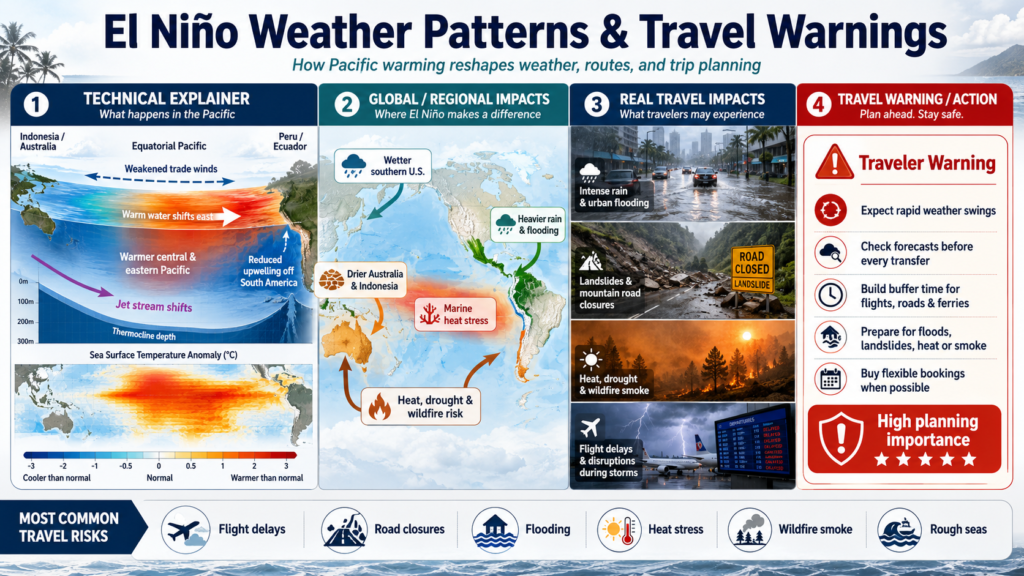
Under normal Pacific Ocean conditions, trade winds blow warm surface water westward from South America toward Asia and Australia. Cold water rises from the ocean depths to replace it — a process called upwelling that brings nutrients to the surface and sustains one of the world’s most productive fisheries. When El Niño develops, these trade winds weaken. Warm water accumulates in the central and eastern Pacific instead of being pushed west. The ocean surface temperature across a vast stretch of the tropical Pacific rises by 0.5°C or more. This temperature anomaly releases additional heat and moisture into the atmosphere, and what follows — over weeks and months — is a reorganization of rainfall patterns, jet streams, and storm tracks across every continent.
El Niño is part of the ENSO cycle — the El Niño–Southern Oscillation — which alternates between three phases. Understanding which phase is active is the first step in understanding what weather to expect, and therefore where to go and what to insure against.
The ENSO Cycle — Three Phases Explained
El Niño
Warm Phase · Active 2026
Active · El Niño Advisory declared June 11, 2026
Trade winds weaken. Warm water accumulates in the eastern Pacific. Global temperatures rise. Southeast Asia, Australia, and southern Africa get drier. South America’s Pacific coast and the southern US get wetter. Hurricane activity in the Atlantic typically decreases but Pacific storm activity increases.
La Niña
Cool Phase
Trade winds strengthen. Warm water is pushed further west than normal. The opposite effects of El Niño — Southeast Asia gets wetter, the US South gets drier, Atlantic hurricane activity increases. The 2021–2023 period saw an unusually long La Niña event. 2026 is transitioning out of La Niña into El Niño.
Neutral
Normal Conditions
Trade winds and sea surface temperatures are near average. Weather patterns follow their historical seasonal norms. Destinations behave roughly as guidebooks describe. Neutral conditions are the baseline against which El Niño and La Niña disruption is measured.
Official monitoring organizations: The following bodies publish current El Niño data and regional forecasts used as primary sources for this guide. All links open official government or intergovernmental sites.
Why 2026 is different: The world is transitioning directly from a multi-year La Niña period into El Niño — a “La Niña to El Niño transition” that climate scientists note tends to produce particularly strong effects, especially on monsoon patterns in India and Southeast Asia. Combined with underlying global warming trends, the 2026 El Niño is developing on top of a baseline global temperature that is already at near-record levels — meaning the heat anomalies it adds are compounded rather than isolated.
Regional Impact
Where El Niño Hits — The Interactive Regional Guide
Select a region to see the specific risks, affected destinations, and travel planning implications for the 2026 El Niño event. The risk ratings reflect the projected intensity for this specific cycle, not El Niño events in general.
🌍 El Niño Regional Impact Finder — 2026
Southeast Asia High Risk
🔴
HighDrought and heat: Indonesia, Thailand, Vietnam, Philippines, and Myanmar face drier-than-normal conditions during El Niño. Reduced rainfall during what should be wet seasons.
🔥
HighWildfire and air quality: Sumatra and Kalimantan in Indonesia face elevated wildfire risk — forest fires create smoke haze that can blanket Singapore, Malaysia, and Thailand for weeks, dramatically degrading air quality.
🌡️
HighExtreme heat: Thailand, Vietnam, and the Philippines already saw record temperatures in the La Niña transition. El Niño compounds this — heat index values in Bangkok can exceed 50°C in April–May.
🦟
MediumDisease risk: Dengue fever outbreaks increase during El Niño as temperature changes affect mosquito populations. Peru saw record-high dengue outbreaks during the 2023–24 event.
Affected Destinations
🇹🇭
Thailand (Bangkok, Chiang Mai, Phuket): Drought risk in north, heat extremes nationwide. Rainy season (May–October) may be shortened or erratic.
🇮🇩
Indonesia (Bali, Lombok, Java): Drought, wildfire risk, and potential water shortages. Bali’s dry season (Apr–Sep) becomes even drier, which can sound good but stresses local water supply.
🇵🇭
Philippines: El Niño typically reduces typhoon frequency but increases intensity of those that do develop. Severe drought on Mindanao.
🇸🇬
Singapore / Malaysia: Haze from Indonesian fires is the main risk — can close outdoor attractions and affect flight visibility.
📋
Planning advice: Book flexible cancellation on accommodation. Check Indonesia’s BMKG fire hazard map before travel. Carry quality air filtration masks (N95 minimum) for Indonesia, Malaysia, Singapore.
Australia & New Zealand High Risk
🔴
HighDrought: El Niño consistently brings drier conditions to eastern and southern Australia. The 2019–20 Black Summer fires were preceded by and intensified by El Niño drought conditions.
🔥
HighWildfire season: Australia’s fire season (October–March in the south, year-round in the north) is significantly more severe during El Niño years. Smoke can close national parks, reduce visibility at airports, and create serious health risks.
💧
MediumWater restrictions: Some regions may face water use restrictions during extended drought. This can affect resort and hotel amenities.
Affected Destinations
🇦🇺
Queensland (Great Barrier Reef, Cairns): Drier than average. Fire risk in hinterland areas. The reef itself sees elevated bleaching risk from warming ocean temperatures.
🇦🇺
New South Wales / Victoria: Primary wildfire risk zones. Travel disruptions from fire closures and smoke are possible from October onwards.
🇳🇿
New Zealand: El Niño typically brings drier conditions to the north of the North Island and wetter to the South Island — moderate impact overall.
📋
Planning advice: Check fire danger ratings at australiafireseasons.com before visiting national parks. Book fully refundable accommodation in fire-risk regions. Travel insurance covering wildfire closure is essential.
South & Central America High Risk
🔴
HighFlooding — Pacific Coast: Peru, Ecuador, and Colombia’s Pacific coast face severe flooding and landslides during El Niño. The 2023–24 event killed 84 people and displaced 47,000 in Peru alone. Road closures and infrastructure damage can strand travelers for days.
🔴
HighBrazil: The 2024 El Niño caused flooding in southern Brazil that killed 180 people and displaced 600,000. Amazon drought in the north creates wildfire conditions simultaneously.
🟡
MediumBolivia / Paraguay: El Niño typically brings drier conditions to these landlocked nations — crop failures and water stress rather than flood risk.
Affected Destinations
🇵🇪
Peru (Machu Picchu, Lima, Cusco): Landslides along the Inca Trail and the rail line to Aguas Calientes are a documented El Niño risk. The route has been closed for weeks during past events.
🇧🇷
Brazil (Amazon, Rio Grande do Sul): Northern Amazon drought; southern Brazil flooding. Rio de Janeiro and São Paulo are less directly affected but regional travel can be severely disrupted.
🇨🇴
Colombia / Ecuador: Pacific coast regions most vulnerable. Cartagena (Caribbean coast) is less affected. Galapagos Islands experience warmer waters that can disrupt diving and wildlife patterns.
📋
Planning advice: For Peru/Machu Picchu, monitor the Aguas Calientes rail line status. Book the Inca Trail with cancellation protection. Check PromPeru’s official advisories for road and trail closures.
North America Mixed Risk
🟡
High — SouthSouthern US flooding: California, Arizona, New Mexico, Texas, and Gulf states face above-average rainfall during El Niño winters. Flash flooding in California and the Southwest is a documented risk.
🌡️
Low — NorthNorthern US and Canada — warmer, drier: The northern tier typically gets milder winters during El Niño — often perceived as positive for travel, though inconsistent snowpack affects ski destinations.
🌀
LowAtlantic hurricanes suppressed: El Niño typically reduces Atlantic hurricane activity through increased wind shear — a relative benefit for Caribbean and eastern US coastal destinations during peak hurricane season (August–October).
Affected Destinations
🇺🇸
California: Heavy rainfall and flooding in winter months. Highway 1 and mountain passes subject to closure. Ski resorts in the Sierra Nevada may benefit from increased snowfall.
🇺🇸
US Southwest: Flash flooding risk in desert areas — the Grand Canyon and Zion can experience trail closures and flash flood warnings.
🌴
Caribbean: Relatively lower hurricane risk during El Niño years — a modest positive for winter travel. However, local rainfall patterns can still be erratic.
📋
Planning advice: Southern US winter travel: book flexible options October–March. Check NOAA’s seasonal forecasts at climate.gov for current El Niño advisories.
Africa Mixed Risk
🔴
HighSouthern Africa drought: South Africa, Zambia, Zimbabwe, Mozambique, and Botswana face severe drought during El Niño. The 2024 El Niño reduced hydropower generation at the Kariba Dam, affecting power supply in Zambia and Zimbabwe.
🌧️
MediumEast Africa flooding: Kenya, Ethiopia, Tanzania, and Somalia typically see above-average rainfall during El Niño — flooding, road closures, and disrupted safari access are possible.
🦟
HighDisease risk: Cholera and typhoid incidence has been found to increase threefold in El Niño-sensitive East Africa areas due to flooding. Malaria zones can shift.
Affected Destinations
🇰🇪
Kenya / Tanzania Safari: Increased rainfall can create exceptional game viewing (green season) but also disrupts road access to parks. Masai Mara in particular can be difficult to access during heavy rains.
🇿🇦
South Africa: Drought risk in Western Cape (Cape Town) — water restrictions possible. Kruger National Park access typically reliable, though river levels affect river-crossing road routes.
🇳🇦
Namibia / Botswana (Okavango): Drought conditions can reduce water levels in the Okavango Delta, affecting mokoro (dugout canoe) safari access — a significant visitor experience impact.
📋
Planning advice: Book reputable safari operators who can offer alternative activities if primary park access is disrupted. Confirm road access conditions within 72 hours of arrival.
Europe Lower Direct Risk
🟡
MediumHeatwaves: European summer temperatures are primarily driven by climate change and Atlantic weather patterns rather than ENSO directly — but El Niño’s contribution to elevated global temperatures can amplify heatwave intensity.
🌨️
LowSki resorts: El Niño’s effects on European Alpine snowpack are inconsistent — some events bring above-average snow, others do not. Do not book non-refundable ski holidays based solely on El Niño forecasts.
🌊
LowMediterranean: Some El Niño events bring wetter winters to the western Mediterranean (Portugal, Spain, parts of Italy). Summers remain primarily hot and dry.
Practical Implications
🌡️
European summer 2026 is forecast to be significantly above-average temperature. Book accommodation with reliable air conditioning, particularly in southern Europe (Spain, Italy, Greece, Portugal).
🔥
Southern Europe’s wildfire risk — Algarve, southern Spain, Greek islands — is elevated by El Niño-driven global temperature rise. Check European Forest Fire Information System (EFFIS) before visiting rural or forested areas.
✈️
Europe serves as a connecting hub for onward travel to high-risk El Niño regions. Disruptions in SE Asia, South America, or Africa may cascade through CDG, Heathrow, and Frankfurt hubs.
📋
Planning advice: European travel itself carries lower El Niño risk but book flexible options if connecting onward to high-risk regions. Confirm air conditioning at accommodation May–September in southern Europe.
Pacific Islands High Risk
🔴
HighDrought and water shortage: Many Pacific island nations face severe water scarcity during El Niño. Smaller islands with limited water infrastructure are most vulnerable — water rationing is documented during strong events.
🌊
HighSea level and coral: Warmer Pacific temperatures bleach coral reefs — affecting diving and snorkelling, which drive significant tourism revenue. The Maldives, French Polynesia, and Fiji all see elevated bleaching risk.
🌀
MediumCyclone patterns: El Niño shifts cyclone activity — typically reducing risk in the western Pacific (near the Philippines and Japan) but increasing risk in the central Pacific (near Hawaii, French Polynesia).
Affected Destinations
🇲🇻
Maldives: Coral bleaching events during El Niño have devastated sections of reef, affecting the dive and snorkel experience that drives most tourism. Book with operators who can advise on current reef health.
🇫🇯
Fiji: El Niño typically brings drier conditions and drought risk to Fiji’s main islands. Water scarcity can affect resort operations. Some years see unusual cold-water upwelling reducing marine life visibility.
🇵🇫
French Polynesia (Bora Bora): Elevated cyclone risk in the central Pacific during El Niño. Peak cyclone season (November–April) aligns with the developing 2026 event.
📋
Planning advice: For dive-focused Pacific trips, check reef health reports before committing. November–April bookings in French Polynesia should include hurricane/cyclone insurance cover.
India & South Asia High Risk
🔴
HighWeakened monsoon: El Niño typically weakens India’s southwest monsoon (June–September) — particularly significant in 2026 because this follows directly from a La Niña period, a transition that experts warn produces especially weak monsoon rainfall. Drought risk across much of India.
🌡️
HighPre-monsoon heat: April–June 2026 is forecast to see extreme heat across India. Wet-bulb temperatures in some regions may approach physiological limits for outdoor activity.
🌊
MediumSri Lanka / Bangladesh: Sri Lanka’s two distinct monsoon seasons can both be disrupted by El Niño. Bangladesh faces increased cyclone risk in the Bay of Bengal.
Affected Destinations
🇮🇳
Rajasthan, Delhi, Agra (Golden Triangle): April–June is already extreme heat season. El Niño amplification makes outdoor sightseeing at the Taj Mahal and Jaipur forts genuinely hazardous before 7am and after 4pm during the peak of summer 2026.
🇮🇳
Goa / Kerala: Monsoon timing may be delayed or reduced. The traditional “best season” calculation may not hold for 2026 — check the India Meteorological Department (imd.gov.in) before booking.
🇱🇰
Sri Lanka / Maldives: Elevated ocean temperatures affect the Maldives dive experience. Sri Lanka’s dry northeast season (December–March) is typically less affected by El Niño.
📋
Planning advice: Avoid India April–June 2026 if outdoor sightseeing is the primary activity. Winter travel (October–March) remains viable. Early morning departure for outdoor sites is mandatory, not optional.
Flight Impact
How El Niño Disrupts Flights and Travel Infrastructure
The disruption El Niño causes to flights is less obvious than its impact on destinations, but equally significant for layover and connecting travelers. Airlines do not route flights through weather — they route around it, and when El Niño shifts where the severe weather is, it shifts where the delays are. Understanding the mechanism helps you predict where your itinerary is most vulnerable.
🌩️
Jet Stream Disruption
El Niño shifts the Pacific jet stream southward, altering the most efficient flight paths between North America and Asia. Transatlantic routes can also be affected as connected atmospheric patterns shift. This can increase flight times, add fuel costs, and create turbulence on routes that are normally smooth.
🌊
Hub Airport Flooding
Several of the world’s most important connecting airports sit in El Niño-affected zones. Bangkok (BKK), Manila (MNL), Jakarta (CGK), and Sydney (SYD) have all experienced operational disruptions during past El Niño events. A major flooding event at a hub creates cascading delays across dozens of downstream connections.
🔥
Smoke and Visibility
Wildfires in Indonesia, Australia, and California have caused airport closures and reduced visibility below instrument landing minimums — grounding flights entirely or forcing diversions. Singapore’s Changi Airport has been affected by Indonesian fire smoke during El Niño events, with reduced operations during periods of severe haze.
🏔️
Mountain Airport Landslides
Regional airports serving mountainous destinations — particularly in Peru, Nepal, Bhutan, and Colombia — are accessed by roads that are vulnerable to landslides during El Niño rainfall events. Even when the airport itself is operational, travelers cannot reach or leave it if access roads are blocked.
⚡
Power Outages
El Niño-driven drought reduces hydroelectric power generation in countries dependent on it — Zambia, Zimbabwe, and parts of Southeast Asia and South America. Power disruptions affect airport operations, hotel services, and the ability of local travel operators to function reliably.
🦟
Disease Outbreak Response
Health emergencies triggered by El Niño — cholera, dengue, typhoid outbreaks — can trigger government travel advisories, border restrictions, and health screening at airports that slow processing times and add uncertainty to travel planning.
Separately booked flights are your biggest vulnerability: When El Niño disrupts a flight and causes you to miss a connection, what happens next depends entirely on whether your flights are on a single booking or separately purchased. On a single booking, your airline is obligated to rebook you. On separate bookings, you bear the full cost of a replacement ticket — at peak demand prices, during a weather event that may have other travelers doing the same thing simultaneously. This is the most financially significant El Niño risk for independent travelers.
Risk Finder
Is My Destination Affected? — Quick Look Up
🔍 El Niño Destination Risk Finder — 2026
Select your destination for a specific risk assessment and planning advice
HIGH RISK
Bali, Indonesia
El Niño brings drought conditions to Bali — drier than normal during what should be the wet season, and severe water stress during the dry season (April–September). The more serious risk is Indonesian wildfire smoke from Sumatra and Kalimantan blanketing the island and reducing air quality to hazardous levels.
Book accommodation with flexible cancellation — fires can develop rapidly
Pack N95 masks (not surgical) for potential haze conditions
Check Indonesia BMKG air quality forecast within 48 hours of arrival
Travel insurance should cover evacuation and trip disruption due to natural disaster
HIGH RISK
Thailand
Drought and extreme heat are the primary risks. Bangkok can hit heat index values exceeding 50°C in April–May during El Niño events. Northern Thailand (Chiang Mai) faces haze from agricultural burning and reduced air quality. Rainy season timing may be disrupted.
Avoid outdoor activity April–May between 10am and 4pm
Carry oral rehydration salts — heat illness risk is real
Chiang Mai February–April: check AQI before booking outdoor activities
Dengue fever risk elevated — use DEET repellent consistently
HIGH RISK
Peru — Machu Picchu & Inca Trail
One of the highest-risk destinations for El Niño travel disruption. Flooding and landslides have closed the Aguas Calientes rail line and the Inca Trail during past events. The 2023–24 El Niño killed 84 people and caused widespread infrastructure damage. Peru’s Pacific coast bears the brunt of ENSO-related flooding.
Book rail and accommodation with 100% refundable cancellation terms only
Have a contingency itinerary that doesn’t depend on the Aguas Calientes train
Monitor PromPeru official advisories and the Peru Rail operational status
Travel insurance must cover missed connections and natural disaster disruption
HIGH RISK
Australia
Drought and elevated wildfire risk across eastern and southern Australia. The 2019–20 Black Summer fires — during an El Niño year — burned 18.6 million hectares and directly affected tourism across NSW, Victoria, and Queensland. Smoke can close airports and create hazardous air quality.
Check Australian Bureau of Meteorology (bom.gov.au) seasonal outlooks
Monitor fire danger ratings before national park visits (October–March)
Book accommodation with flexible cancellation in fire-adjacent regions
The Great Barrier Reef faces elevated bleaching risk — check reef health before diving
HIGH RISK
Maldives
Coral bleaching is the primary El Niño risk — warmer ocean temperatures cause the coral to expel symbiotic algae, turning white and eventually dying. The 2016 and 2024 El Niño events caused mass bleaching events in the Maldives. If diving or snorkelling is the primary reason for your visit, current reef health matters significantly.
Ask your resort or dive operator for current reef health status before booking
February–April is historically when bleaching risk is highest during El Niño years
Consider resorts with access to deeper reefs (20m+) which bleach less severely
Travel insurance: check that it covers “destination not as described” for reef condition
HIGH RISK
India
Weakened monsoon (June–September) and extreme pre-monsoon heat (April–June) are the two primary risks. The 2026 transition from La Niña to El Niño is flagged by meteorologists as particularly likely to suppress monsoon rainfall. Heat-related illness is a genuine risk for outdoor sightseers.
Avoid outdoor sightseeing April–June — Taj Mahal and Golden Triangle in extreme heat is hazardous
October–March is the optimal India travel window during an El Niño year
If visiting in monsoon season, expect disruption — not the lush green experience of neutral years
Check India Meteorological Department forecasts at imd.gov.in
MEDIUM RISK
Kenya Safari
El Niño brings above-average rainfall to East Africa — which can mean exceptional green season game viewing but also disrupted road access to parks. The Masai Mara is particularly prone to access issues during heavy rain, as the main routes are unpaved.
The “green season” (El Niño’s gift) can mean fewer tourists and lush scenery
Confirm vehicle type with your operator — 4WD essential, not recommended
Flooding can close airstrip access — have contingency days in your itinerary
Disease risk (cholera, malaria) elevated — vaccinations and prophylaxis are essential
LOWER RISK
Japan
Japan is less directly affected by El Niño than tropical destinations, though some patterns are documented. Warmer winters can affect skiing in Hokkaido. Summers are already hot — El Niño’s global temperature contribution makes already extreme summer heat more intense. The main Japan risk is as a transit hub: Narita and Haneda connect to high-risk SE Asia destinations.
Summer travel (July–August): book accommodation with reliable air conditioning
Ski season (January–March in Hokkaido): snowpack may be reduced in El Niño years
Japan itself is a relatively safe destination — main risk is typhoons (July–October), frequency of which may shift during El Niño
LOWER RISK
Caribbean
El Niño suppresses Atlantic hurricane activity through increased wind shear — this is a relative positive for Caribbean travel during peak hurricane season (August–October). However, “lower hurricane risk” does not mean “no risk,” and erratic rainfall patterns can still disrupt beach conditions.
Hurricane season 2026 may be less active than a La Niña year — a modest advantage
Still purchase travel insurance covering hurricane disruption — individual storms still develop
Coral bleaching from warmer Atlantic temperatures is a risk for diving destinations
MEDIUM RISK
California, USA
El Niño typically brings above-average rainfall to California — welcome after years of drought but also introducing flooding risk. Highway 1 and mountain passes are vulnerable to closure. Winter and spring 2026–27 travel in California should account for this.
Highway 1 coastal road: check Caltrans road conditions before driving
Grand Canyon / Zion: flash flood risk in slot canyons — check warnings before entering
Sierra Nevada ski resorts may benefit from additional snowfall
Book flexible accommodation for January–March California travel
LOWER RISK
Europe
Europe is less directly affected by ENSO than tropical regions. The primary El Niño connection is through elevated global temperatures amplifying already-extreme European summer heat. Southern Europe (Spain, Portugal, Italy, Greece) faces a hot summer 2026 regardless of El Niño.
Book accommodation with confirmed air conditioning for May–September in southern Europe
Wildfire risk elevated in Algarve, southern Spain, Greek islands — check EFFIS before rural visits
Europe as a connecting hub: disruptions in SE Asia/Africa may affect connections through CDG, LHR, FRA
HIGH RISK
Brazil
The 2024 El Niño caused the most severe flooding in Brazil’s recorded history — 180 deaths and 600,000 displaced, primarily in the southern state of Rio Grande do Sul. Simultaneously, the Amazon north experienced severe drought and record wildfire seasons.
Southern Brazil (Porto Alegre region): flood risk October–April, book fully refundable options
Amazon: dry season fire risk means smoke and reduced wildlife visibility in drought years
Rio de Janeiro and São Paulo are less directly affected but monitor national advisories
Travel insurance covering natural disaster disruption is essential
Planning & Preparation
The El Niño Travel Planning Guide — What to Do Right Now
Most of the disruption El Niño causes is predictable in advance. The 2026 event has been developing since early in the year and will continue through at least the end of 2026. This is a remarkable amount of advance notice — far more than you get for a specific hurricane or monsoon event. Travelers who act on this information now, before they book, will have materially better experiences than those who book normally and deal with consequences later.
Before You Book
📋 Pre-Booking El Niño Checklist
0 / 8
Check NOAA’s current El Niño advisory at climate.gov/enso before booking any trip to affected regions. The advisory updates monthly and gives the current phase, intensity forecast, and regional impacts. It takes five minutes and changes what you book.
Cross-reference your destination’s specific forecast — El Niño affects regions differently. “El Niño is developing” does not mean your specific destination is higher risk. Use the Regional Impact section above and the destination finder to assess your specific trip.
Check the season timing — El Niño’s effects are seasonal. A November booking to Bali may be fine while an April booking faces haze risk. The specific months of your trip matter more than the destination alone.
Only book flights with free cancellation or change on affected-region itineraries during El Niño. Check the airline’s change fee policy before purchasing — not after. Low-cost carriers typically charge US$50–150 per change, which can make flexibility meaningless.
Book accommodation with free cancellation — Booking.com and Agoda both allow filtering for free cancellation. Pay slightly more for this option in El Niño-affected destinations. It is not optional risk management — it is table stakes.
Consider shoulder season travel — if your destination is at high risk during its peak travel season (e.g., Bali in April–May), the shoulder months before or after the peak may have lower El Niño impact. Research whether this applies before committing to your dates.
For connecting travel through El Niño-affected hubs (Bangkok, Manila, Jakarta, Sydney): build in minimum 3-hour connection buffers rather than the standard 90-minute minimum. A delayed inbound flight during an El Niño weather event does not care about your connection time.
Book experiences through verified platforms — Klook offers weather-related refund policies on many tours. If El Niño disrupts a safari, a Machu Picchu trek, or a Barrier Reef dive, you want a booking you can modify — not cash paid to a local operator who disappears.
Insurance — The Non-Negotiable
El Niño is the clearest possible argument for travel insurance. It is a documented, forecast, quantified weather pattern that will cause disruptions in specific regions during specific months — and you can know this before you book. That is an unusually good position to be in for risk management. The tools exist. Use them.
The one rule that El Niño makes urgent: Buy travel insurance the day you make your first booking payment — not the week before departure. Once a weather event is named or classified, insurers may exclude it as a “known event.” El Niño itself is already named and classified. The window for full coverage may be narrowing. Purchase now.
Not sure which plan fits your trip? Our Travel Insurance Comparison Guide covers every major provider — SafetyWing, Faye, IMG Global, VisitorsCoverage, and more — with a 60-second quiz that matches your trip type and destination to the right plan.
On the Ground
When You’re Already Traveling — What to Do
Preparation before departure handles most of the risk. But El Niño develops over months, and a trip booked before the event intensified may land you in a destination experiencing conditions worse than the forecasts suggested. Here is how to manage it on the ground.
🌏 On-the-Ground El Niño Response Checklist
0 / 7
Download the local meteorological authority’s app before leaving your hotel each day — Thailand’s TMD, Indonesia’s BMKG, Australia’s BOM, India’s IMD, Japan’s JMA. These are faster and more accurate for local conditions than international weather apps.
Register with your government’s travel notification system — US STEP (step.state.gov), UK FCDO alerts, Australian Smartraveler (smartraveler.gov.au). During a weather emergency, these systems notify registered travelers with evacuation and support information that is not available elsewhere.
Know your insurance emergency line — not the app, not the website, but the 24-hour international collect call number printed on your policy card. In a flooding or evacuation scenario, apps require internet that may not be available. Have the number written down on paper.
For flooding and landslide situations: Do not attempt to drive through flooded roads regardless of how shallow they look. Flash floods in mountainous regions can develop in minutes. Never enter a slot canyon during rain or when rain is forecast upstream.
For wildfire smoke: Check the Air Quality Index (AQI) at iqair.com before outdoor activities. AQI above 100 is Unhealthy for Sensitive Groups; above 150 is Unhealthy for all. N95 masks (not surgical masks) filter particulate matter — carry them in El Niño wildfire regions.
Stay connected — eSIM before Wi-Fi: In a weather emergency, hotel and public Wi-Fi networks can be overwhelmed or go down entirely. Your own data connection via Airalo or Roamless eSIM continues to function independently.
If your flight is canceled due to El Niño weather: Same booking — go to the airline desk, not airport information. Separately-booked flights — call your insurer first, then buy the next available seat and save all receipts for your claim. Document everything: photos, timestamps, airline reference numbers.
Flexible booking is not optional during El Niño. Filter for “Free cancellation” on every accommodation booking in an affected region — both Booking.com and Agoda have a dedicated toggle for this. The slight premium is irrelevant compared to the cost of a non-refundable booking in a flooded or fire-affected destination.
Money and Practical Preparation
Weather emergencies are financial emergencies if you are not prepared. Power outages affect ATMs. Flooding affects access to bank branches. Emergency rebooking requires immediate access to funds across multiple currencies, often at short notice. The travelers who manage El Niño disruptions best are those who have planned for this in advance.
Carry emergency cash in local currency — approximately one day’s accommodation and transport cost. In a power outage, card payments fail and ATMs go offline. Cash is the fallback that always works.
Use a fee-free travel card (Wise or Revolut) with the instant freeze function available in-app. If your card is lost or stolen during the disruption, being able to freeze it from a phone in 30 seconds matters.
Keep two separate cards in separate locations. If your primary wallet is lost in a flood event, a backup card in your luggage or hotel safe is the difference between manageable and stranded.
Screenshot all booking references before leaving your hotel. In an emergency rebooking situation, offline access to your booking numbers and airline references is faster than waiting for email on a degraded connection.
Know your insurance emergency line — the 24-hour international collect call number, not just the app. Write it down. Apps require internet that may not be available in a weather emergency.
Full financial preparation guide: Our Travel Safety Guide covers the complete money safety framework — emergency cash, card strategy, ATM selection, and what to do when your wallet is stolen or your card fails abroad.
The Bottom Line
What El Niño Actually Means for Your 2026–2027 Travel
El Niño does not make travel impossible. The 1997–98 event — the strongest in modern recorded history — did not stop people from traveling to Southeast Asia, Australia, or Peru. What it did was make the difference between a prepared traveler and an unprepared one extremely clear, and extremely expensive.
The 2026 El Niño is developing in a world that is already warmer than at any point in recorded human history. Its effects are being layered on top of baseline climate conditions that are themselves already extreme. The heat anomalies it adds to India’s April temperatures, the rainfall it adds to Peru’s flood-prone Pacific coast, the drought it extends across southeastern Australia — all of these are amplified versions of what would already be significant weather.
The preparation is not complicated. Check the regional forecasts for your destination. Book flexible options where flexibility is available. Purchase travel insurance before the event is classified as a known risk. Carry your own data connection. Know your embassy’s emergency number. Have cash for the day the ATMs go down. These are not dramatic precautions — they are the difference between a disrupted trip and a managed one.
The world is still worth seeing. El Niño is one of the most documented, well-forecast, and well-understood climate phenomena in meteorological history. You have more advance warning of its effects than you will ever have of a specific storm, a specific landslide, or a specific flooding event. Use it.