
12 Hour Adventurous Layover in South Korea
Seoul’s grandest palace burned to the ground in 1592 — and the fire wasn’t started by the invading army. It was started by the palace’s own enslaved workers, trying to destroy the documents that proved they were owned.
As Japanese forces advanced on Hanyang (now Seoul) during the 1592 Imjin War, King Seonjo fled the capital before the army arrived. According to the historical record, it was enraged Korean citizens — many of them enslaved labourers attached to the palace itself — who set Gyeongbokgung ablaze before the Japanese ever reached it, specifically to destroy the legal status records kept there that documented their bondage. The palace, “Palace Greatly Blessed by Heaven,” the seat of the Joseon dynasty since 1395, sat in ruins for the next 270 years — not because anyone destroyed it out of military strategy, but because the people who’d been forced to build and maintain it had, in one decisive act, burned the proof of their own ownership rather than let an invading army leave it standing.
It wasn’t even the last time the palace was deliberately destroyed for political reasons. When Japan annexed Korea in 1910, the colonial government demolished more than 90% of Gyeongbokgung’s remaining structures and built its own administrative headquarters directly in front of the throne hall — a calculated architectural insult, placing the seat of foreign rule literally in front of where Korean kings once received their court. Korea is still in the middle of undoing this: the current restoration plan runs through 2045, and only around 90 of the palace’s original 500+ buildings have been reconstructed so far. Most layover visitors walk through Gyeongbokgung’s main gate, watch the changing-of-the-guard ceremony, and take photos without ever learning that the building in front of them is a palimpsest of two separate acts of deliberate destruction — one by the people it enslaved, one by the empire that colonised it.
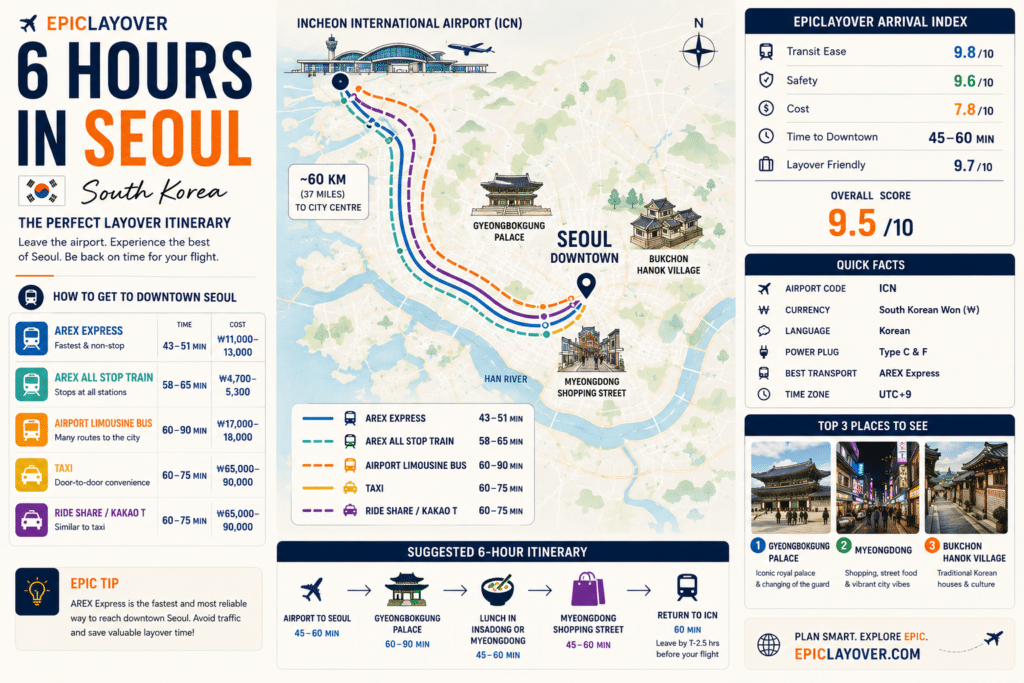
Incheon International Airport (ICN) is South Korea’s primary international gateway and one of the most consistently highly-rated airports in the world, located roughly 48km west of central Seoul. As of 14 January 2026, Asiana Airlines completed a full move of all its operations from the older Terminal 1 to the newer, expanded Terminal 2 — a major structural change that affects routing for anyone who’s flown Asiana through ICN before and is assuming the old layout still applies. The airport’s AREX (Airport Railroad Express) rail line connects both terminals directly to Seoul Station in 43-51 minutes, and the broader ICN ecosystem — culture centres, nap zones, and even an on-site resort — makes it one of the more genuinely pleasant airports to simply wait inside, if your layover window doesn’t support a city trip.
Leaving the airport means officially entering South Korea, which requires either a valid visa or an approved K-ETA (Korea Electronic Travel Authorisation) depending on your nationality — apply at least 72 hours in advance, since same-day approval isn’t guaranteed. Some nationalities have had temporary K-ETA exemptions extended through 31 December 2026; verify your specific status on the official K-ETA portal rather than assuming. Separately, as of 2026, all foreign visitors must also complete a mandatory digital e-Arrival Card via the official portal at least three days before landing — this is a new, additional requirement layered on top of the K-ETA/visa process, and missing it can complicate or delay your entry.
If your itinerary involves Asiana Airlines, or you’ve flown through ICN before and remember Asiana at Terminal 1, that information is now outdated. Verify your specific terminal on your current boarding pass before you fly. If your inbound and outbound flights use different terminals, the free Intra-Airport Transit (IAT) train connects T1 and T2 in roughly 20 minutes including walking, running every 5 minutes — budget the full 20 minutes, not just the train ride itself.
6 hours is the realistic minimum for a single-district city exit — this accounts for the 43-51 minute AREX transit each way and a genuinely required 3-hour return buffer for security and boarding. Under 6 hours, the safer and still enjoyable play is staying within the ICN ecosystem itself rather than risking a city trip.
AREX Express, without much debate. It’s the only option immune to Seoul’s genuinely unpredictable traffic, runs non-stop to Seoul Station in 43 minutes (T1) or 51 minutes (T2), and costs roughly 11,600-13,000 KRW. Taxis and buses are both workable for less time-critical legs, but for the return journey specifically — when missing your flight is the real risk — the train is the only choice that guarantees your timing.
Gyeongbokgung Palace and the surrounding historic district, reachable via AREX Express to Seoul Station plus a short taxi or subway ride. It delivers Korea’s deepest, most complex history in a single compact visit, alongside the genuinely excellent Bukchon Hanok Village just behind it.
Cards are very widely accepted in Seoul, and a T-money transit card (rechargeable, used for subway/bus/some taxis) is genuinely useful even for a short visit. Carry some Korean won as backup for smaller vendors and palace ticket booths, but you won’t be stuck without cards at most legitimate businesses.
Should You Leave? The Seoul Layover Gauge
Under 4 hours, don’t attempt a city trip — but ICN makes this less of a sacrifice than most airports. The Korean Traditional Culture Centre (free crafts, traditional costume try-ons) sits in both terminals, the Digital Gym is genuinely novel, and the nearby Paradise City resort is reachable in 5 minutes for travellers with the time to explore the broader airport ecosystem.
If you want to leave the airport but 6+ hours isn’t realistic, Songdo Central Park (20-25 minutes by taxi) offers water taxis, a Hanok village, and a low-risk, low-traffic round trip without committing to the full Seoul transit chain. Genuinely the right call on this window rather than rushing a Seoul attempt.
With 6+ hours, AREX Express to Seoul Station puts Gyeongbokgung, Bukchon Hanok Village, and the historic core within reach for a focused 3-4 hour visit. With 8+ hours, add a proper meal and either Myeongdong’s shopping or Hongdae’s youth-culture energy on the way back through.
Work out your Seoul window precisely
Enter your ICN landing time and departure gate-close. If you’re connecting between Terminal 1 and Terminal 2 — especially now that Asiana has moved — the calculator accounts for the full IAT transfer, not just the train ride.
Getting from ICN to Seoul
| Option | Time | Cost | Notes |
|---|---|---|---|
| AREX Express Train Recommended | 43 min (T1) / 51 min (T2) | ~11,600-13,000 KRW | Non-stop to Seoul Station, reserved seating, free Wi-Fi, dedicated luggage storage on board. Buy at the kiosk, online, or via Klook/KKday for advance booking. Immune to traffic — the only reliable choice for the return leg. |
| AREX All-Stop Train | 59-66 min | ~4,150-4,750 KRW | Cheaper, makes 13-14 stops including Hongik University (Hongdae) and Gimpo Airport. The better choice if your destination is along the line rather than Seoul Station itself. |
| Limousine Bus | 60-80 min (traffic-dependent) | 5,000-15,000 KRW | Multiple routes to various Seoul districts. Comfortable with luggage, but genuinely vulnerable to traffic — not recommended for a tight return window. |
| Taxi (KakaoTaxi or Standard) | 60-90 min (traffic-dependent) | ~60,000-80,000 KRW + tolls | International taxis (20% premium, English/Japanese/Chinese-speaking drivers) are available for travellers wanting language support. Workable for the inbound leg; risky for the return given Seoul’s unpredictable traffic. |
The ICN Smart Pass app streamlines security on your return through the airport — genuinely worth the two minutes it takes to set up before you land, particularly given how much pressure the return leg of a layover plan carries.
What to Do in Seoul on a Layover
Gyeongbokgung Palace
The largest and most symbolically important of Seoul’s Five Grand Palaces, built in 1395 as the first royal residence of the Joseon dynasty. Burned by its own enslaved workforce in 1592, left in ruins for 270 years, rebuilt in 1867 only to be deliberately demolished again under Japanese colonial rule — what stands today is an active, ongoing restoration (the current plan runs through 2045) rather than a single intact historical artefact. The Gyeonghoeru Pavilion, depicted on the 10,000 won banknote, sits on 48 stone pillars over an artificial pond and survived the 1592 fire in partial ruin for 270 years as a literal physical symbol of the destruction, before being rebuilt in 1867. The changing-of-the-guard ceremony at Heungnyemun Gate runs at scheduled times daily, recreating Joseon-era royal guard uniforms and ritual. Entry roughly 3,000 KRW; closed Tuesdays.
Bukchon Hanok Village
Immediately behind Gyeongbokgung, a still-residential neighbourhood of traditional hanok houses dating largely to the late Joseon and early modern period, with narrow alleys offering some of the best skyline-and-traditional-roofline views in the city. A natural, walkable extension of a Gyeongbokgung visit — allow 45-60 minutes, and be mindful that this is a real residential area, not a museum, so keep noise down out of respect for residents.
Myeongdong
Seoul’s dense shopping and street-food district, packed with cosmetics shops, fashion retailers, and food stalls selling everything from grilled skewers to Korean-style hotteok (sweet filled pancakes). A strong choice if you want energy and food density over historical depth, and conveniently positioned for a return route toward Seoul Station.
Hongdae
Named for nearby Hongik University, Hongdae is Seoul’s youth-culture, indie-art, and live-busking district — directly on the AREX All-Stop line at Hongik University Station, making it one of the more transit-efficient districts to add onto a layover without needing a transfer at Seoul Station. Yeonnam-dong, just beside it, has a café-and-park strip along the old Gyeongui rail line, genuinely photogenic and a calmer counterpoint to Hongdae’s energy.
Noryangjin Fish Market
A genuinely raw, working wholesale seafood market where you pick live seafood from the tanks and have it prepared fresh at an adjoining restaurant on the spot — a completely different register from the polished palace circuit, and a strong option for visitors specifically chasing an authentic food experience over a historical one.
A Korean Bathhouse (Jjimjilbang)
A traditional Korean bathhouse and sauna complex — genuinely one of the better jet-lag antidotes available anywhere in this guide series, with hot pools, heated rooms at varying temperatures, and (at the larger ones) sleeping areas, making this a legitimate option even for an overnight or red-eye-adjacent layover. Note that traditional jjimjilbangs involve nudity in single-sex bathing areas, which is a normal, unremarkable part of the culture but worth knowing in advance if it’s your first time.
Gyeongbokgung — Gyeonghoeru Pavilion Reflection
From the pond’s edge, the two-storey pavilion reflects in the still water, with Bugaksan mountain visible behind on a clear day. Morning light before the crowds build gives the calmest water surface for the cleanest reflection shot.
Morning, before 10am. From the pond’s southern edge, pavilion and mountain both in frame.
Bukchon Hanok Village — Traditional Roofs Against the Skyline
From one of Bukchon’s elevated viewpoints (Bukchon-ro 11-gil is the most commonly cited), the curved tile roofs of the hanok houses sit in the foreground with Seoul’s modern skyline visible behind — a genuinely strong visual contrast between old and new Korea in one frame. Keep voices down; this is a residential street, not a photo set.
Mid-morning. From an elevated viewpoint on Bukchon-ro 11-gil, roofs in foreground, skyline behind.
The Seoul Layover Itinerary
Immigration off-peak: 30-40 minutes. AREX Express: 43-51 minutes depending on terminal.
15-20 minutes from Seoul Station.
90 minutes including the changing-of-the-guard ceremony if timing aligns.
A short walk from the palace. 45-60 minutes.
75-90 minutes. Don’t rush this — Korean food is a genuine highlight, not a side note.
Taxi/subway back to the station (15-20 min) plus the 43-51 minute train. Build in a 3-hour airport buffer once back at ICN.
As above — immigration plus the train.
90 minutes for a focused visit.
Back to Seoul Station, then AREX Express. Build in the full 3-hour airport buffer.
Seoul Layover Scenarios — Real Situations, Specific Solutions
Asiana Airlines completed a full move from Terminal 1 to Terminal 2 as of 14 January 2026. If you’ve flown Asiana through ICN before, or you’re relying on an older guide, the terminal information you remember is now wrong.
Heading to the wrong terminal building costs real time at a sprawling airport, particularly if discovered late.
Always verify your specific terminal on your current boarding pass before travelling, regardless of past experience with this airline at this airport. If you do need to switch terminals, the free IAT train takes about 20 minutes including walking, running every 5 minutes.
K-ETA requirements and temporary exemptions vary by nationality and have changed — some exemptions were extended through 31 December 2026, but this doesn’t apply universally.
Arriving without the correct authorisation can mean being denied the ability to leave the airport at all.
Verify your specific nationality’s current K-ETA status on the official portal at least 72 hours before flying, and don’t assume last year’s rules still apply. Apply early — same-day approval is not guaranteed.
As of 2026, all foreign visitors must complete a mandatory digital e-Arrival Card via the official portal at least three days before landing — this is separate from and in addition to K-ETA or visa requirements.
Missing this additional, newer requirement can complicate or delay your entry processing.
Complete both K-ETA/visa AND the e-Arrival Card well before your flight — treat them as two genuinely separate steps, not one combined process.
Seoul’s road traffic is genuinely unpredictable, and a taxi journey that should take 60 minutes can run considerably longer during peak periods or unexpected congestion.
Relying on a taxi for the return leg, when missing your flight is the actual risk, is the single most commonly cited mistake in Seoul layover planning.
Use AREX Express for the return journey specifically — it’s immune to road traffic and the only option that guarantees your timing. Save taxis for the inbound leg or less time-critical movements within the city.
Some Korean apps, including ride-hailing options, can have friction points for foreign-issued cards or phone numbers not anticipated by first-time visitors.
App friction at the exact moment you need a ride wastes time on a tight layover.
Activate an Airalo South Korea eSIM before landing, and have a backup plan (standard taxi rank, or AREX/subway) ready in case an app doesn’t cooperate.
Bukchon Hanok Village’s alleys are narrow and occasionally have steps, making a rolling bag genuinely impractical.
Minor, but it slows you down and disrupts the residential character of the area.
Use ICN’s luggage storage counters before heading into the city, or Bounce locations near Seoul Station.
Food in Seoul
Korean BBQ (Gogigui)
Grilled meat — bulgogi (marinated thin-sliced beef) and samgyeopsal (pork belly) among the most popular — cooked tableside and wrapped in lettuce with rice, garlic, and ssamjang paste. A genuinely communal, slower meal worth prioritising over a third sightseeing stop if your time forces a choice.
Tteokbokki
Chewy rice cakes simmered in a sweet-and-spicy gochujang-based sauce, often with fish cakes, boiled eggs, and scallions — one of Korea’s most beloved street and casual-dining dishes, found everywhere from market stalls to sit-down restaurants.
Kimbap
Seaweed-wrapped rice rolls filled with vegetables, egg, and often tuna or beef — visually similar to Japanese sushi but distinctly Korean in seasoning and preparation, and a genuinely good, portable option for a layover where time is tight.
Korean Fried Chicken
Double-fried for a distinctively crispier texture than Western fried chicken, often glazed in soy-garlic or spicy gochujang sauce — a Hongdae and Myeongdong staple, and worth seeking out specifically rather than treating as generic fried chicken.
The people who burned Gyeongbokgung in 1592 had nothing to gain from the fire except the destruction of paper — registers and ledgers that recorded, in ink, that they belonged to someone else. They didn’t wait for the invading army to do it. They lit the fire themselves, in the capital of the kingdom that owned them, while the king who’d just abandoned the city was still fleeing north. The palace sat in ash for nearly three centuries after that, not rebuilt, not really discussed, until a regent with his own political reasons decided the dynasty needed its symbol back. Then, just as it stood whole again, a different empire tore most of it down a second time and built its own headquarters directly in front of the throne room — not as a side effect of occupation, but as a specific, deliberate message about whose authority now sat where the kings used to. The reconstruction happening today, building by building, with a finish date still nineteen years out, is the third act of the same building’s life: erased by the people it enslaved, erased again by the empire that colonised it, and now, slowly, being put back by neither of those forces, but by the country that survived both.
Gear, eSIM, and Connectivity
South Korea-specific data for navigation and ride-hailing apps. Activate before landing.
Get an eSIM →ICN terminal Wi-Fi and Seoul café networks are both open. Banking access on a public network — covered in under a minute.
Get NordVPN →Download before your trip to streamline security on your return through the airport.
ICN Smart Pass Info →Luggage storage available at both ICN terminals and near Seoul Station — drop your bag before Bukchon’s narrow alleys.
Find Storage →Tours and Experiences
A guided visit covering the palace, the changing-of-the-guard ceremony, and Bukchon Hanok Village, with a guide explaining the full destruction-and-rebuilding history most visitors never hear about independently.
Book via KKday →A private guided tour with a hard “turn back” time and a dedicated driver, built specifically around protecting your return flight — particularly useful given the genuine risk of underestimating Seoul’s traffic.
Book via GetYourGuide →A guided tasting through Myeongdong or Hongdae’s food scene, with a local explaining the dishes and the ordering etiquette.
Book via KKday →Insurance and Hotels
Standard travel cover including missed-connection protection — relevant given Seoul’s genuine traffic variability on the return leg.
Get a Quote →Same-day activation medical cover for South Korea. Worth arranging for any city visit beyond a same-day airport-only layover.
Get a Quote →Capsule rooms inside the secure area, sold in blocks from 32,000 KRW (daytime) — the right choice for resting through a layover without leaving the airport at all.
Check availability →For a longer overnight layover where the palace circuit or Myeongdong shopping is the priority — roughly an hour from ICN via AREX Express plus a short subway/taxi ride.
Check availability →What’s your real Seoul window?
If you’re connecting between T1 and T2 — especially relevant now that Asiana has moved — the calculator accounts for the full IAT transfer time.
Calculate My Time →K-ETA and Entry Requirements
Most Western nationalities need K-ETA or a visa, plus the separate mandatory e-Arrival Card. Verify your specific requirement before travel.
Check Visa Requirements →Continuing elsewhere in Asia?
If your routing also touches Taipei, Manila, or Singapore, our other Asia layover guides cover those hubs’ very different logistics.
Taipei Layover Guide →Frequently Asked Questions
Gyeongbokgung was first burned in 1592 during the Imjin War — not by the invading Japanese army, but by enraged Korean citizens, including enslaved palace workers, who set the fire themselves specifically to destroy legal status records proving their bondage. It sat in ruins for 270 years before being rebuilt in 1867. It was then deliberately demolished a second time under Japanese colonial rule starting in 1910, with the colonial government’s own headquarters built directly in front of the throne hall. Korea’s current restoration plan runs through 2045, with roughly 90 of the original 500+ buildings reconstructed so far.
As of 14 January 2026, Asiana Airlines completed a full operational move from Terminal 1 to the newer, expanded Terminal 2. If you’ve flown Asiana through ICN before this date, the terminal you remember has changed. Always verify your current terminal on your boarding pass before travelling, and if your itinerary requires a T1-T2 transfer, use the free Intra-Airport Transit (IAT) train, budgeting roughly 20 minutes including walking time.
Most Western nationalities need either a valid visa or an approved K-ETA (apply at least 72 hours ahead; some nationalities have had exemptions extended through 31 December 2026, verify your specific status). Separately, as of 2026, all foreign visitors must also complete a mandatory digital e-Arrival Card via the official portal at least three days before landing — this is an additional, newer requirement layered on top of K-ETA/visa, not a replacement for it.
Because it’s the only option immune to Seoul’s genuinely unpredictable road traffic. A taxi journey that should take 60 minutes can run considerably longer during congestion, and on the return leg of a layover — when missing your flight is the real risk — that unpredictability is exactly what you can’t afford. AREX Express runs non-stop in 43 minutes (Terminal 1) or 51 minutes (Terminal 2), regardless of road conditions.
Incheon International Airport (ICN) — Official Resources
Flight information, terminal guidance, and transit details for South Korea’s primary international gateway.
Official application portal for Korea Electronic Travel Authorisation, with current eligibility and exemption status by nationality.
k-eta.go.kr →Official train schedules, fares, and online booking for the Airport Railroad Express.
arex.or.kr →Current hours, ticket pricing, and the changing-of-the-guard ceremony schedule.
royalpalace.go.kr →Official city tourism information for current museum hours, event calendars, and travel advisories.
visitseoul.net →National emergency numbers for South Korea, valid throughout Seoul and the airport.
A major Seoul hospital with English-speaking international clinic staff, commonly used by foreign visitors.
Incheon International Airport passenger services — terminal information and connection assistance.
- KCulture.com / Creatrip / AirportHotelsNearby ICN Guides. Asiana Airlines completed full move from T1 to T2 as of 14 January 2026; IAT shuttle connects terminals in ~20 min including walking, runs every 5 min; AREX Express 43 min (T1) / 51 min (T2) to Seoul Station; Darakhyu capsule hotel from 32,000 KRW daytime. 2026.
- GoWithGuide / AskKoreaTravel Seoul Layover Guides. 6 hours minimum for viable city exit accounting for 45-60 min transit and 3-hour return buffer; K-ETA required for entry with some nationality exemptions extended through 31 Dec 2026; mandatory e-Arrival Card required 3+ days before landing as of 2026; ICN Smart Pass app recommended for streamlined return security. 2026.
- Wikipedia / GoAhead Tours / TheSeoulGuide Gyeongbokgung history. Built 1395 under King Taejo; burned 1592 during Imjin War by enraged citizens including enslaved workers seeking to destroy legal status records; ruins stood ~270 years; rebuilt 1867 under Regent Heungseon Daewongun; 90%+ of buildings demolished under Japanese colonial rule from 1910-1911; Second Gyeongbokgung Restoration Plan runs 2008-2045. 2026.
- VisitKorea official / English Visit Seoul. AREX connects ICN T1/T2 to Seoul Station and Gimpo Airport; All-Stop train makes 13-14 stops including Hongik University (Hongdae); distance ICN to Seoul Station ~60km.
Disclaimer: Terminal assignments, fares, K-ETA requirements, and entry rules verified June 2026 and subject to change — always verify your specific terminal and entry requirements before travel. Affiliate links may earn EpicLayover a commission at no additional cost to you.
