
Only a 6 Hour Layover in Paris? Here’s How to Make It Unforgettable!
A British family spent 11 hours at Charles de Gaulle this spring, missed their flight, and went through border control twice. This is not a rare horror story — it is the current, documented reality of a 6-hour Paris layover in 2026, and almost no older guide to this airport accounts for it.
Since the EU’s Entry/Exit System (EES) became fully mandatory across the Schengen Area on 10 April 2026, Charles de Gaulle has been repeatedly described by travel press as the single worst-affected major hub in Europe for non-EU arrivals. Terminal 2E — the long-haul terminal that receives most US, UK, and Canadian arrivals — has been processing roughly 35% fewer travellers per hour than projected. Reported wait times have ranged from “just under 2 hours” on an ordinary Wednesday morning to 4+ hours during peak periods, with airport authorities and IATA officials publicly warning that delays could stretch to 5 or 6 hours at the busiest summer gateways. This is not a temporary launch glitch a few unlucky travellers hit in the first week — Groupe ADP, the Paris airport operator, has said meaningful relief is unlikely before October 2026, and a senior Frontex official has suggested the system could take one to two years to fully stabilise.
This changes the entire calculation for a Paris layover. The old advice — “the RER B takes 30-45 minutes, so a 6-hour layover gives you 2-3 hours in the city” — assumed an immigration process that, for many non-EU travellers in 2026, simply no longer exists in that form. This guide gives you the honest, current version of that calculation, with the real numbers and the real risk, before it gives you the Eiffel Tower and the croissants. Paris is still extraordinary on a layover. But right now, more than almost any other city in this entire guide series, knowing what you’re actually walking into at the airport matters more than knowing what to do once you’re in the city.
Charles de Gaulle Airport (CDG), 23km northeast of central Paris, is France’s primary international gateway and one of the busiest airports in Europe, handling over 67 million passengers a year across multiple terminals (1, 2, and 3, with Terminal 2 itself split into halls A through G). It’s also currently the airport this guide must spend the most words on getting you to take seriously, because the single biggest variable in whether your Paris layover works is not the city — it’s how long EES keeps you standing at a kiosk before you’ve even reached baggage claim.
If you hold a non-EU/non-Schengen passport (this includes the US, UK, Canada, Australia, and most other Western nationalities) and this is your first Schengen entry since the system went live, you must complete biometric registration — fingerprints and a facial scan — at a kiosk or manned booth. Reported 2026 wait times at CDG specifically: typically 2-4 hours at peak (the 6-10am long-haul arrival wave is consistently the worst), with documented cases up to 5-7 hours during system outages or exceptionally busy periods. Global Entry, TSA PreCheck, and other non-EU pre-clearance programmes provide zero benefit here — EES is a completely separate EU system. If you’ve already registered on a prior 2026 trip, re-entry is much faster (a quick face check rather than full enrolment) — but first-time registration is genuinely the bottleneck to plan around.
Given current EES conditions, a connection that would have been comfortable in 2024 may now be genuinely risky. If your total layover is under 3 hours, plan to stay inside the secure area entirely — don’t attempt a city visit. If you’re connecting between two international flights, budget significantly more than the old “70-90 minute” guidance; treat 3 hours as an absolute floor for the EES process alone during peak periods, separate from anything else.
It depends entirely on EES conditions on your specific travel day, which genuinely vary. If you land outside the 6-10am peak wave and EES is running normally, you may still get 2-3 hours in the city after a roughly 1-1.5 hour clearance process plus the 50-minute RER B each way. If you land during a peak wave or EES is having a bad day (which has happened repeatedly through 2026), you may not clear the airport at all in 6 hours. Check live wait-time trackers (eeswait.com or similar crowd-sourced sites) before committing to a city plan.
Crowd-sourced tracking sites (EES Watch, A Buckeye in Paris’s tracker, and similar) post traveller-reported wait times updated regularly. These aren’t official Groupe ADP data, but they’re currently the best real-time signal available, since there’s no centralized official tool yet. Check shortly before you fly, and have a “stay airside” backup plan ready regardless.
RER B train, departing from Terminal 2’s station, roughly 50 minutes to central stops like Châtelet-Les Halles or Gare du Nord, €11.80 one-way (now a flat “Paris Region ↔ Airports” fare following 2025-2026 ticketing reform). It’s slower than the old guides claimed — the genuine “30-45 minutes” figure is now closer to 50 minutes including dwell time — but still the most reliable option, immune to road traffic.
No — Roissybus was permanently discontinued on 1 March 2026 as part of a wider Paris transit network restructuring. If you’ve used it before, that information is now outdated. The RER B remains the core option; a new Express bus service (9517) from Saint-Denis Pleyel has replaced some of that route’s function for travellers already in the city centre.
Should You Leave? The Paris Layover Gauge — 2026 EES Edition
This threshold is meaningfully higher than it would have been before April 2026. Under 6 hours, or if a live wait-time tracker shows 2+ hour EES queues, don’t risk a city trip. CDG has real infrastructure for this: Terminal 2E’s Espace Musées, multiple lounges with showers and rest areas, and decent dining across all terminals.
If current wait-time trackers show EES processing normally (under 90 minutes) on your travel day, a single landmark — the Eiffel Tower via Trocadéro, or Sainte-Chapelle’s stained glass — is achievable. Build in real buffer on both ends given the genuine uncertainty, and have a firm “abandon the plan” trigger if EES takes longer than expected on arrival.
With 9+ hours, or if you’re already in the EES system from a previous 2026 trip (meaning your border clearance is now much faster), a genuine Paris layover is achievable: Sainte-Chapelle, the Seine, and a proper meal, with real margin for the unpredictable parts of this airport.
Work out your Paris window precisely
Enter your CDG landing time and departure gate-close. Given the genuine uncertainty introduced by EES in 2026, the calculator builds in real, current buffer rather than the optimistic pre-2026 estimates still floating around online.
Getting from CDG to Central Paris
| Option | Time | Cost | Notes |
|---|---|---|---|
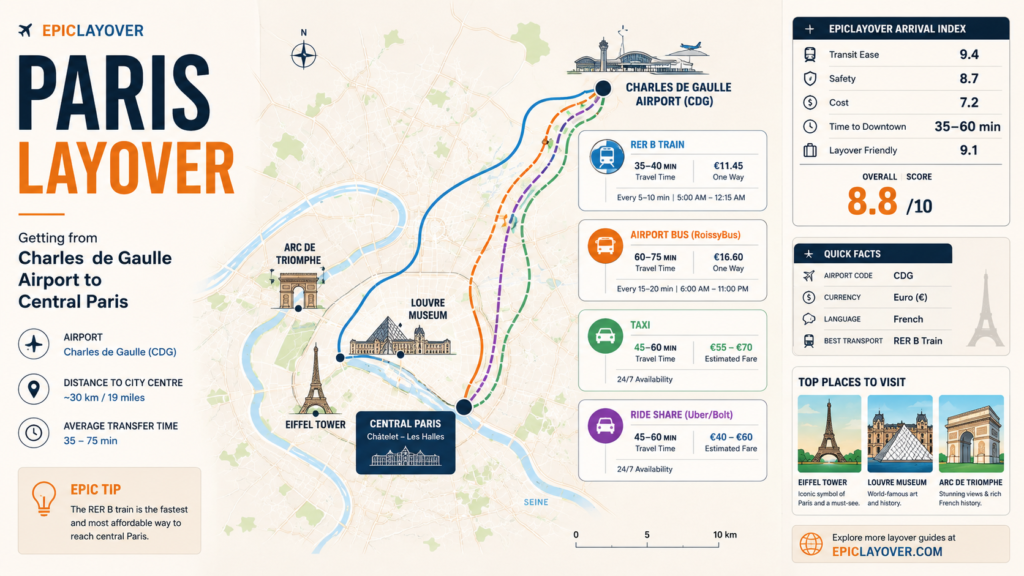
| RER B Train Recommended | ~50 min | €11.80 (flat Paris Region ↔ Airports fare) | Departs from Terminal 2’s station, direct to Châtelet-Les Halles, Gare du Nord, or Saint-Michel-Notre-Dame. Immune to road traffic — the most reliable option once you’ve actually cleared the border. |
| Taxi | 40-60 min (traffic-dependent) | €55-60 fixed zone fare | A fixed fare applies for central Paris destinations. Easiest with luggage or for direct hotel drop-off, but subject to genuine Paris traffic. |
| Private Transfer | 40-60 min | €60-80 | A driver tracks your flight and waits — the right call if your remaining time after EES is genuinely tight and you can’t risk a queue for a taxi or train ticket. |
| Roissybus Discontinued March 2026 | — | — | No longer operating. If you’ve seen this recommended elsewhere, that information predates March 2026 and is now incorrect. |
Following the 2025-2026 Paris transit ticketing reform, a single “Paris Region ↔ Airports” ticket (€14, or €11.80 if you’ve confirmed the current single fare) covers the full journey on RER B, Metro 14, or Orlyval as needed — buy it at the airport station kiosks before queuing, since ticket-machine lines can add unnecessary time on top of whatever the EES process has already cost you.
What to Do in Paris on a Layover — If EES Conditions Allow It
Sainte-Chapelle
Hidden behind the Palais de Justice on the Île de la Cité, Sainte-Chapelle is, by a genuine architectural and historical argument, the most underrated major sight in Paris on a time-constrained visit. King Louis IX commissioned it in 1239 specifically to house what he believed was Christ’s actual Crown of Thorns, purchased for 135,000 livres — roughly three times the cost of building the entire chapel — from the cash-strapped Latin Emperor of Constantinople. Louis reportedly walked the relic into Paris barefoot, dressed in a plain tunic rather than royal robes, in a deliberate act of public humility. The chapel was built in under seven years and consecrated in 1248 — a full century before Notre-Dame’s construction was even finished. What survives today is nearly 700 square metres of stained glass across 15 windows, depicting over 1,100 biblical scenes, two-thirds of it original 13th-century glass. The effect, when sunlight passes directly through it, is genuinely unlike anything else in the city, including Notre-Dame. Entry roughly €11.50; free for EU residents 18-25 and under-18s; often free on the first Sunday of the month (with correspondingly larger crowds).
Notre-Dame Cathedral
Reopened to the public in December 2024 following the 2019 fire and subsequent restoration, Notre-Dame’s Gothic façade and restored interior remain one of the most significant sights in Paris, even on a brief exterior visit if interior access timing doesn’t align with your window. The Crown of Thorns relic itself — the one Sainte-Chapelle was originally built to house — is now kept here, having been transferred in 1806.
Eiffel Tower (via Trocadéro)
If you only have time for one photo-defining stop and Sainte-Chapelle’s interior history doesn’t pull you in, Trocadéro Garden delivers the classic Eiffel Tower view without a ticket or a queue — genuinely achievable in 30-45 minutes including transit. Pre-booked tickets for the tower itself (allow 45+ minutes once inside) are essential if you want to go up; walk-up queues are long and unpredictable.
The Louvre — Highlights Only
Not realistic to “do properly” on any layover, but a focused 90-minute visit via the Porte des Lions entrance, targeting only the Mona Lisa, Venus de Milo, and Winged Victory of Samothrace, is achievable if EES and transit have left you enough margin. Pre-booked timed tickets are essential — walk-up access is not reliable.
Sainte-Chapelle’s Upper Chapel — The Stained Glass Wall
Stand near the centre of the upper chapel facing the apse, capturing as many of the 15 window bays as possible in one frame. Late morning to early afternoon on a clear day gives the strongest direct light through the glass, producing the kaleidoscope effect the chapel is known for. No flash needed or permitted — the glass itself is the entire light source worth capturing.
Late morning to early afternoon, clear weather. Centre of the upper chapel facing the apse.
Trocadéro Garden — The Classic Eiffel Tower Frame
From the Trocadéro terrace, the Eiffel Tower sits directly across the Seine, framed by the garden’s fountains in the foreground. Golden hour gives the warmest light on the tower’s ironwork; after dark, the tower’s hourly light show (on the hour, every evening) adds a second, completely different shot if your timing allows both.
Golden hour, or after dark for the light show. Trocadéro terrace facing the tower across the Seine.
The Paris Layover Itinerary — Conditional on EES Status
Budget 60-90 minutes for EES even on a “normal” day in 2026 — check live trackers before you fly. RER B: ~50 minutes.
Pre-booked or on-site entry, €11.50. 60-75 minutes for the stained glass and the history.
A short walk along Île de la Cité. 45-60 minutes.
A proper sit-down meal rather than a rushed pastry. 75-90 minutes.
~50 minutes. Build in a 2.5-3 hour total airport buffer for security and EES exit processing — yes, exit can also queue.
As above. Check live wait times first — if EES is showing 2+ hours, this plan should not proceed.
75-90 minutes total.
~50 minutes. Build in the full airport buffer on the way back.
Paris Layover Scenarios — Real Situations, Specific Solutions
Reported CDG EES queues have ranged from under 2 hours to 5+ hours through 2026, with no reliable way to predict which you’ll get on a given day.
Continuing to wait while hoping the city plan still works can mean missing your return flight entirely — this has documented, repeatedly, happened to other travellers in 2026.
Set a hard decision point before you fly: if you’re not clear of EES by a specific time (calculated backward from your departure with a 2.5-3 hour buffer), abandon the city plan entirely and head straight to your gate once processed. Don’t let sunk-cost thinking about the queue you’ve already waited in push you into a worse decision.
Self-transfer itineraries carry no airline rebooking protection, and current EES conditions make a sub-2-hour connection at CDG genuinely high-risk for any first-time non-EU registrant.
A delay caused entirely by border processing, not your airline, is still your problem to solve on a self-transfer ticket.
If at all possible, rebook onto a single connected itinerary, or add real buffer. World Nomads missed-connection cover is a sensible backstop specifically because of how unpredictable EES has made self-transfer connections at this airport in 2026.
EES kiosk technical failures have been repeatedly reported at CDG, particularly in Terminal 2E, sometimes forcing officers to revert to slower manual processing for an entire queue.
A kiosk outage can add significant unplanned time on top of an already-long queue, with zero advance warning.
Have your passport, return/onward ticket, and accommodation details ready in hand before you reach the front of the queue — manual processing moves faster when you’re not fumbling for documents. Stay patient; the officers are working with the same broken hardware you are.
Some travellers with existing EES biometric records have been mistakenly funnelled back into full first-time registration due to system inconsistencies across the 29-country rollout.
This can cost an unexpected 30-45+ minutes you weren’t planning for, since you assumed re-entry would be the fast “face check” version.
If staff direct you to a full registration kiosk despite a prior EES record, politely confirm you’ve already registered before complying — but don’t argue extensively if directed anyway; budget the extra time as a real possibility regardless.
Sainte-Chapelle, the Louvre, and most major Paris sights see genuine walk-up queues, particularly in peak season — time you don’t have on an already EES-compressed layover.
A 30-60 minute ticket queue on top of an already-tight window can eat the entire visit.
Pre-book timed entry online before you fly, for whichever single landmark you’ve committed to given current EES conditions.
If you’ve cleared customs with carry-on luggage, navigating the narrow streets around Sainte-Chapelle and Notre-Dame is more comfortable without it.
Minor, but it slows you down on a day where minutes genuinely matter.
CDG’s “Bagages du Monde” storage in Terminal 2 (TGV-RER station, Level 4), or Bounce locations near Gare du Nord or Gare de Lyon, both work — though given current conditions, only use these if your EES-adjusted timeline genuinely supports the detour.
Food in Paris
Macarons and Pastries, Quickly
Ladurée and Pierre Hermé both have central locations where a macaron or éclair takes minutes to grab — a reasonable, fast option if your remaining time after EES and transit is genuinely limited. Chain bakeries (Paul, Eric Kayser) near metro stations are a faster, cheaper alternative.
Coffee at the Counter
At Café de Flore, Les Deux Magots, or any traditional café, ordering “un café, au comptoir, s’il vous plaît” (a coffee, at the counter, please) is genuinely faster than table service and a small, real taste of Parisian café culture in under 10 minutes.
A Real Sit-Down Meal, If Time Allows
If your EES-adjusted timeline supports it, a proper Latin Quarter bistro lunch — steak frites, a croque monsieur, or onion soup — is a meaningfully better use of limited Paris time than another rushed pastry, and worth prioritising over a third landmark if you have to choose.
Louis IX paid more for a crown of thorns than it cost to build the building that would house it, then walked the relic through the streets of Paris on his own bare feet, dressed as a pauper, because the spectacle of humility mattered as much to him as the relic itself. Nine years later, a chapel that took less time to build than Notre-Dame’s foundation alone went up beside it — smaller, less famous, and arguably more extraordinary, holding more stained glass than almost any building of its size on earth. Nearly eight hundred years later, the same Crown of Thorns that justified all of it sits in a different building five hundred metres away, and the chapel that was purpose-built around an absence keeps doing the thing it was actually built to do: filling a small stone room with more colour than seems physically possible. None of this has anything to do with biometric kiosks or border queues. It’s still there, regardless of how long the line is outside.
Gear, eSIM, and Connectivity
France-specific data, or a Europe-regional plan if your trip continues elsewhere in Schengen. Activate before landing.
Get an eSIM →CDG terminal Wi-Fi and city café networks are both open. Banking access on a public network — covered in under a minute.
Get NordVPN →Crowd-sourced sites tracking current CDG EES queue reports — check shortly before you fly to set realistic expectations for your specific travel day.
Connection Time Guide →In-terminal storage at CDG Terminal 2 (TGV-RER station, Level 4), or Bounce locations near Gare du Nord and Gare de Lyon.
Find Storage →Tours and Experiences
Guided entry plus a walking tour of the Île de la Cité, with a guide explaining the Crown of Thorns history and the chapel’s construction — context the building’s own signage barely covers.
Book via GetYourGuide →Several private services now offer escorted fast-track through biometric control at CDG given 2026 conditions — genuinely worth the cost for a layover where the EES queue is the single biggest risk to your plan.
Book via GetYourGuide →Insurance and Hotels
Standard travel cover including missed-connection protection — genuinely more important right now at CDG than at almost any other airport in this guide series, given the documented EES-related missed connections in 2026.
Get a Quote →Same-day activation medical cover for France. Worth arranging for any visit beyond the airport, regardless of EES conditions.
Get a Quote →Hourly cabins inside the secure area — the right choice for resting through a long layover or an overnight connection without ever facing the EES queue at all.
Check availability →For a longer overnight layover where the Sainte-Chapelle/Notre-Dame circuit is the priority — roughly 50 minutes from CDG by RER B, once you’ve cleared EES.
Check availability →What’s your real Paris window in 2026?
Given current EES conditions, the effective window is genuinely shorter and less predictable than older guides suggest — enter your specifics and check live conditions before committing.
Calculate My Time →Schengen Entry and EES Requirements
Most Western nationalities are visa-free for up to 90 days, but ALL non-EU arrivals now face mandatory EES biometric registration. Verify current requirements.
Check Visa Requirements →Continuing to another European hub?
If your routing also touches Frankfurt, Madrid, or Budapest, our other European guides cover those hubs’ own EES-related conditions.
Madrid Layover Guide →Frequently Asked Questions
The EU’s Entry/Exit System (EES) became fully mandatory across the Schengen Area on 10 April 2026, requiring all non-EU travellers to complete biometric registration (fingerprints and a facial scan) on first entry. CDG, and specifically Terminal 2E, has been repeatedly reported as one of the worst-affected major airports, processing roughly 35% fewer travellers per hour than projected due to kiosk technical failures and understaffing relative to the new process’s throughput needs. Any guide written before April 2026 will not reflect this — treat pre-2026 “30-45 minute immigration” advice as obsolete for now.
Check a live, crowd-sourced EES wait-time tracker shortly before you fly — these aren’t official data, but they’re currently the best available signal, since there’s no centralized official tool. If reports show queues running long (2+ hours) on similar days/times to your own arrival, default to staying airside. The 6-10am long-haul arrival wave has consistently been the worst period reported throughout 2026.
No. EES is a completely separate EU biometric system, and US/other non-EU pre-clearance programmes provide no benefit when entering the Schengen Area. The only thing that meaningfully speeds up your second and subsequent EES crossings is having already registered on a prior 2026 trip — first-time enrolment is unavoidable and is the actual bottleneck.
For a time-constrained visit, yes, on a strong case: the Louvre genuinely cannot be “done” meaningfully in under 90 minutes even with a focused highlights route, and the Eiffel Tower’s main value on a short visit is the exterior photo rather than the climb itself. Sainte-Chapelle delivers a complete, self-contained experience — extraordinary stained glass and a genuinely compelling history — in about an hour, with shorter queues than either of the bigger-name sights. It’s a strong single-stop choice specifically because of the time constraints a layover imposes.
Charles de Gaulle Airport (CDG) — Official Resources
Flight information, terminal guidance, and current EES status for France’s primary international gateway.
Crowd-sourced sites tracking current CDG border queue reports — check before you fly given how significantly conditions vary day to day.
eeswait.com →Official EES and Schengen entry requirement information by nationality.
interieur.gouv.fr →Official RER B schedules, current ticketing, and real-time disruption alerts for the Paris transit network.
ratp.fr →Current hours, ticket pricing, and booking for the stained-glass chapel on Île de la Cité.
sainte-chapelle.fr →Single European emergency number, valid throughout France including Paris and CDG.
A major Paris hospital with English-speaking staff, commonly used by international visitors.
Charles de Gaulle Airport passenger services — terminal information and connection assistance.
- MyDriverParis / Wego Travel Blog / TravelTourister EES coverage. EES fully mandatory across Schengen Area 10 April 2026; CDG Terminal 2E processing ~35% fewer travelers/hour than projected; reported wait times 2-4 hours typical at peak, up to 5-7 hours during outages; Groupe ADP signals relief unlikely before October 2026; Frontex estimates 1-2 years for full system stabilisation. February-June 2026.
- AFAR Magazine / TravelPirates EES reporting. Documented case of UK family spending 11 total hours at CDG after 5-hour EES queue, missed flight, had to re-book and repeat the process; IATA warned of “three, four, five, and even six hour” waits; some EES-registered travelers mistakenly redirected to full registration on return visits. June 2026.
- Parisjetaime.com / European-traveler.com / RATP official. Roissybus permanently discontinued 1 March 2026 as part of network restructuring; RER B remains primary airport-city option, ~50 min CDG to Châtelet-Les Halles; new flat “Paris Region ↔ Airports” ticket (€14) introduced in 2025-2026 fare reform; CDG Express direct service (Gare de l’Est, 20 min) in pre-operational testing, full launch expected March 2027. 2026.
- Sainte-Chapelle official site / Wikipedia / Paris Perfect. Commissioned by Louis IX 1239 to house the Crown of Thorns purchased for 135,000 livres (vs ~40,000 livres construction cost); built in under 7 years, consecrated 1248 — a century before Notre-Dame’s completion; nearly 700m² stained glass across 15 windows, 1,100+ biblical scenes, two-thirds original 13th-century glass; Crown of Thorns relic transferred to Notre-Dame in 1806.
Disclaimer: EES wait times are genuinely volatile and change day to day — the figures in this guide reflect reported conditions as of June 2026 and should be verified against live trackers before you travel. Fares, hours, and entry requirements are otherwise verified June 2026 and subject to change. Affiliate links may earn EpicLayover a commission at no additional cost to you.
K
