
9 Amazing Madrid Layover Experiences for First-Time Visitors
On 15 April 2026, a new EU border system pushed waits at Madrid’s airport to three hours overnight. Most layover guides covering Madrid were written before this existed and have no idea it’s now the single biggest variable in your connection time.
Spain activated the EU’s new Entry/Exit System (EES) at Madrid-Barajas in stages through late 2025 and early 2026, replacing manual passport stamping with mandatory biometric registration — a facial scan and four fingerprints — for every non-EU arrival. When the system became mandatory across Spain in April 2026, Spanish airports hit genuine teething trouble: reports of three-hour queues at Madrid and Barcelona, more than 100 passengers missing connections in a single day at Palma de Mallorca, and an emergency meeting between EU officials and airport operators to coordinate fixes. The International Air Transport Association’s own projection is that first-time biometric enrolment takes roughly four times longer than a simple passport stamp ever did.
This is not a footnote. If you’re a non-EU national connecting through Madrid on a layover, EES is now the single most important variable affecting whether you have enough time to leave the airport — more important than the city’s genuinely excellent transit links, more important than the Royal Palace’s opening hours, more important than almost anything else in this guide. This article treats it as the headline fact it actually is, while still giving Madrid the credit it deserves: a city built around long lunches, slow plazas, and a market culture genuinely worth an afternoon detour, if your buffer actually holds.
Adolfo Suárez Madrid–Barajas Airport (MAD) is Spain’s busiest airport and the primary gateway between Europe and Latin America, serving as the operational fortress hub for Iberia. It sits just 12km from Puerta del Sol, the symbolic centre of the city, and operates across four terminal complexes: T4 and T4S (the newer, Iberia/oneworld terminal pairing, connected by an automated people mover) and T1/T2/T3 (older, functional, home to most non-oneworld international and budget carriers). Despite the short physical distance to the city, MAD’s sheer scale and current EES-driven queue unpredictability mean a strategic, time-aware approach is essential — this isn’t a small regional airport where you can wing it.
If you hold a non-EU passport, expect a facial scan and fingerprint registration at passport control on arrival, whether at a staffed desk or a self-service kiosk. Average processing was reported around 45 seconds once enrolment is complete, but real-world experience since the April 2026 mandatory rollout has included waits of up to three hours during peak periods, and queue times remain genuinely unpredictable — described by experienced travellers as “5 minutes or 2 hours” with no reliable way to know in advance. EU residents and biometric TIE cardholders are exempt, but have occasionally been mistakenly funnelled into the EES queue anyway, adding further unpredictability. Build in significantly more buffer than you would have needed before October 2025, and treat any pre-EES travel advice you’ve seen online as outdated.
All non-Schengen long-haul departures from Madrid-Barajas operate from T4S, and arriving passengers connecting through T4 must clear passport control again inside T4S after the automated people-mover ride from T4 — a separate step from security that adds real time, particularly during peak morning and evening windows. Iberia recommends a minimum of 45-55 minutes for Iberia-to-Iberia connections within T4/T4S, and at least 60-75 minutes for non-Schengen departures specifically. Given current EES conditions, treat these as floors, not targets.
7+ hours is the genuinely comfortable threshold now, up from the 5-6 hours that was reasonable before EES went fully mandatory. Budget 45-75 minutes just for arrival processing (more if EES queues are running long), 25 minutes each way on the Cercanías train, and a 2.5-3 hour total return buffer. Under 5 hours, don’t attempt the city — the math doesn’t work reliably anymore.
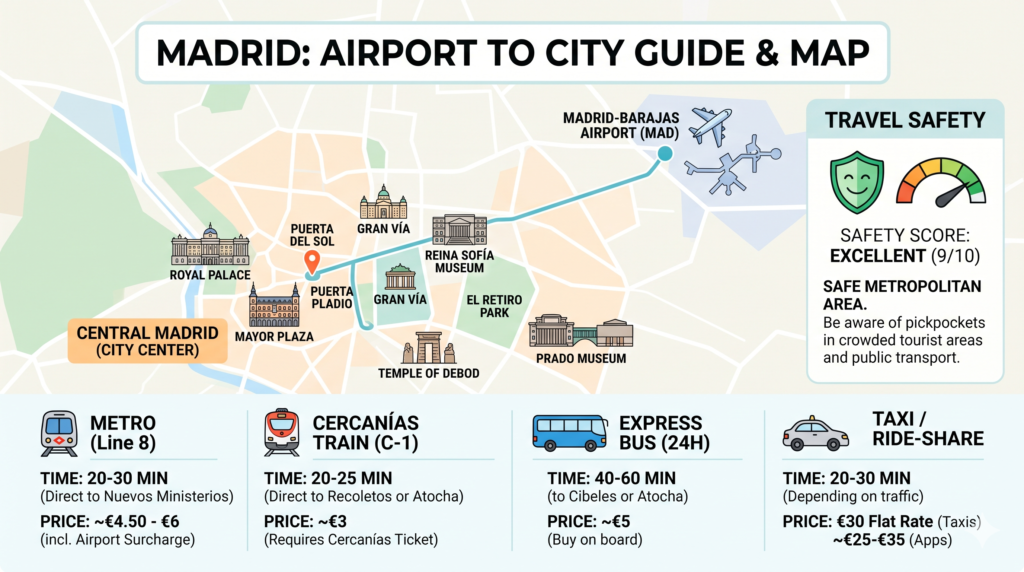
The Cercanías C1 train from T4, direct to Atocha or Sol in roughly 25 minutes for €2.60 — faster and cheaper than a taxi, and immune to Madrid’s traffic. From T1/T2/T3, Metro Line 8 to Nuevos Ministerios (20-30 minutes, ~€5) is the equivalent option, though it requires a change to reach the historic centre.
For a layover specifically, the Royal Palace’s exterior and the Plaza de Oriente viewpoint deliver a strong visual payoff in 30-45 minutes without a ticket. The Prado rewards a focused visit (Velázquez’s Las Meninas, Goya’s Black Paintings) but needs pre-booked tickets and at least 60-90 minutes to be worthwhile — only add it on a window of 8+ hours.
Mostly no — contactless payment is ubiquitous. Keep some small coins for traditional bars and market stalls (some Mercado de San Miguel vendors prefer cash), but you won’t be caught out card-only at the major sights or restaurants.
Should You Leave? The Madrid Layover Gauge
Given current EES queue unpredictability and T4S’s extra passport control step for non-Schengen departures, under 5 hours leaves no reliable margin. T4 has genuinely excellent infrastructure for this: the architecturally striking bamboo-ceilinged main hall, several Priority Pass and Iberia lounges (the Neptuno Lounge in T4S is well-regarded), and high-end shopping if you want to pass the time productively.
Take the Cercanías directly to Sol, stick close to the rail-connected historic core, see Plaza Mayor and the Royal Palace exterior, grab a quick meal, and head straight back. This window doesn’t comfortably fit a Prado visit or the Retiro Park on top — pick the compact historic loop, not a multi-stop circuit.
With 7+ hours and EES processing behind you, the full historic-core circuit is genuinely achievable: the Royal Palace, a proper tapas-and-vermouth stop at Mercado de San Miguel, and a walk through Retiro Park. With 9-10 hours, add a focused Prado visit (pre-booked tickets essential) on top.
Work out your Madrid window precisely
Enter your MAD landing time and departure gate-close. Given current EES processing variability, the calculator builds in real buffer rather than relying on pre-2026 estimates that no longer apply.
Madrid’s Hub Role — Iberia, Latin America, and Domestic Spain
Madrid-Barajas functions as Iberia’s fortress hub and, by extension, Europe’s most efficient transit point into Latin America — direct links to Mexico City, Buenos Aires, Bogotá, and most major Latin American capitals route through here at high frequency. Domestically, Iberia operates the historic “Puente Aéreo” (Air Bridge) — a high-frequency shuttle service to Barcelona that has run for decades. MAD also serves as the primary jumping-off point for Spain’s high-speed AVE rail network via Atocha Station, meaning a layover passenger with genuine flexibility could, in theory, swap an onward domestic flight for a rail connection to Barcelona, Seville, or Valencia.
Getting from MAD to Central Madrid
| Option | Time | Cost | Notes |
|---|---|---|---|
| Cercanías Train (C1) Recommended | ~25 min | €2.60 | Best from T4, direct to Atocha and Sol. Faster and cheaper than a taxi, and immune to road traffic — the single best option for a time-constrained layover. |
| Metro Line 8 | 20-30 min | ~€5.00 | Best from T1/T2/T3, terminating at Nuevos Ministerios — requires a change to reach the historic centre proper. |
| Taxi | 20-40 min (traffic-dependent) | €33 fixed fare | A genuine fixed fare to the city centre with no surprises — useful with heavy luggage, but slower and pricier than the train. |
| Uber / Cabify | 20-40 min | €25-40 | Variable pricing. Follow signage to the dedicated “VTC” pickup area, distinct from the standard taxi rank. |
Drop your bag at the Consigna (Excess Baggage Company) in the Arrivals hall of T1, T2, or T4 (Floor 0) before heading into the historic centre — roughly €10-15 per bag depending on duration. Madrid’s old-town cobblestones genuinely punish a wheeled carry-on, and the Royal Palace/Plaza Mayor circuit is far more enjoyable unencumbered.
What to Do in Madrid on a Layover
The Royal Palace (Palacio Real)
The largest functioning royal palace in Europe by floor area, though the current Spanish royal family doesn’t use it as a primary residence. Even without a ticket, the Plaza de Oriente and the viewpoint between the Palace and the Almudena Cathedral deliver genuinely stunning panoramic views — a strong choice if your time doesn’t allow the full interior tour. Allow 30-45 minutes for the exterior and viewpoint alone, or 90+ minutes with a pre-booked interior ticket.
Mercado de San Miguel
Opened in 1916 as a cast-iron-and-glass wholesale food market on the site of a church demolished in 1809, San Miguel fell into decline by the early 2000s before reopening in 2009 as Spain’s first gourmet market — now drawing over 10 million visitors a year and housing roughly 30 stalls from oysters and jamón ibérico to Michelin-connected paella. It sits a two-minute walk from Plaza Mayor, in the heart of Madrid de los Austrias (Habsburg Madrid). Vermouth hour (“la hora del vermut”) runs roughly midday into early afternoon, a genuine local pre-lunch tradition rather than a tourist invention, and La Hora del Vermut stall inside the market pours from over 80 different bottlings. Honest framing for a short visit: San Miguel is the polished, photogenic introduction to Spanish tapas culture — for where locals actually eat day to day, the nearby La Latina neighbourhood is the next step, just five minutes further on foot.
Plaza Mayor and the Historic Core
The grand porticoed square at the heart of Habsburg Madrid, anchored by the statue of King Philip III and the Casa de la Panadería. A natural anchor point connecting San Miguel, the Royal Palace, and Puerta del Sol — Spain’s official “Kilometer Zero” point and the famous Bear and the Strawberry Tree statue, a compact, walkable loop covering the city’s most essential historic ground in under an hour.
Retiro Park
A UNESCO World Heritage-listed park, home to the Glass Palace (Palacio de Cristal) — one of the finest examples of cast-iron architecture in the city — and a genuinely peaceful counterpoint to the historic centre’s density. Worth the detour only on a longer window (8+ hours), since it sits a meaningful walk or short metro ride from the Palace/San Miguel circuit.
The Prado Museum
One of the world’s premier art collections — focus a short visit specifically on Velázquez’s Las Meninas and Goya’s Black Paintings rather than attempting comprehensive coverage. Pre-booked tickets are essential; walk-up queues regularly exceed 60 minutes. Only add this on a 9+ hour window given the ticket logistics and the time needed to do it justice.
Plaza de Oriente — Royal Palace and Almudena Cathedral
From the viewpoint between the Royal Palace and the Almudena Cathedral, the panoramic angle captures both buildings in a single frame, with the Sabatini Gardens visible below. Late afternoon light catches the palace’s pale stone facade warmly; this spot is also notably less crowded than the main Plaza Mayor shots.
Late afternoon. From the Plaza de Oriente viewpoint, both buildings in frame.
Mercado de San Miguel — The Iron-and-Glass Interior
Step back near the entrance to capture the full cast-iron architecture and the warm glow of the stalls — the building’s structure is as photogenic as the food. A detail shot of a colourful tapas display or an oyster spread makes a strong second frame.
Weekday late morning (before the lunch crowd). Wide shot from near the entrance, then a food detail close-up.
The Madrid Layover Itinerary
45-60 minutes for processing given current EES conditions. 25-minute train to Sol or Atocha, €2.60.
Walk from Sol to Plaza Mayor, then on to the Plaza de Oriente viewpoint. 60-75 minutes.
A 5-minute walk back toward Plaza Mayor. Oysters, jamón ibérico, a vermouth at La Hora del Vermut. 60-75 minutes.
A short walk further south for a traditional tapas bar where Madrileños actually eat. 75-90 minutes.
25-minute train back. Build in a 2.5-3 hour total departure buffer given EES and T4S’s separate passport control step for non-Schengen flights.
As above — EES processing, then the 25-minute train.
90 minutes for the square, the Royal Palace exterior view, and a tapas/vermouth stop.
25 minutes back. Build in the full EES/T4S departure buffer.
Madrid Layover Scenarios — Real Situations, Specific Solutions
EES queues have been reported running from 5 minutes to 2-3 hours with no reliable way to predict which you’ll get, particularly during peak periods since the system became fully mandatory in April 2026.
A layover plan built around pre-EES estimates can collapse entirely if you hit a slow queue period.
If you’re still in the EES queue with less than 3 hours total before your departure, abandon the city plan and head straight to your gate once cleared. Don’t gamble the connection on optimistic queue assumptions — Fast Track passes (purchasable at serviciosvip.aena.es, or included for oneworld elite/Business passengers) can help on the security side, though they don’t bypass EES itself.
All non-Schengen long-haul departures operate from T4S, requiring an automated people-mover ride from T4 plus a separate passport control clearance inside T4S itself — distinct from security.
Treating this as a simple gate change underestimates the real transfer time, especially layered on top of EES delays.
Budget at minimum 60-75 minutes for the T4-to-T4S transfer specifically, on top of standard security and EES processing — Iberia’s own guidance, even before factoring in current EES conditions.
Many traditional shops and smaller museums close roughly 2-5pm for the midday gap, even though restaurants are at their busiest for the main Spanish lunch during this exact window.
Planning shopping or a smaller museum visit for mid-afternoon wastes time on a closed door.
Schedule shopping and smaller sights for morning or late afternoon (after 5pm), and use the 2-5pm window for exactly what locals use it for — a proper, unhurried lunch.
Madrid is genuinely safe with very little violent crime, but Sol, Plaza Mayor, and San Miguel specifically are known pickpocket hotspots given the dense tourist foot traffic.
A phone or wallet left on a market counter or in a loose pocket in a crowd is a real, common target.
Keep your phone in a front pocket or zipped bag, never on a counter or table at San Miguel’s stalls, and stay alert in the densest sections of Plaza Mayor and Sol specifically.
Madrid’s elevation produces genuinely extreme seasonal swings — sharp, biting winter wind and dry, exhausting summer heat, both more intense than visitors from milder climates expect.
An outdoor-heavy itinerary in either extreme season is genuinely uncomfortable and can shorten your effective sightseeing window.
In winter or summer extremes, build in an indoor pivot — the Prado, Reina Sofía, or a long lunch at a market hall — rather than committing to an entirely outdoor walking circuit.
Airport Wi-Fi can be spotty in spots, and Madrid’s old-town streets around Malasaña and La Latina genuinely wind in ways that benefit from reliable live navigation.
Getting lost in the historic core’s narrow streets eats real time on a tight layover.
Activate an Airalo Spain or Europe-regional eSIM before landing, and download an offline map of central Madrid as backup.
Food in Madrid
Cocido Madrileño
The defining dish of Madrid cuisine — a hearty chickpea and meat stew, traditionally served in courses (broth first, then the chickpeas and vegetables, then the meats). A genuine institution rather than a tourist invention, found at traditional restaurants throughout the city.
Bocata de Calamares
A fried calamari sandwich, the quintessential quick bite in and around Plaza Mayor — simple, cheap, and specific to Madrid in a way that surprises visitors expecting only tapas.
Vermouth and Tapas at San Miguel
“La hora del vermut” is a genuine pre-lunch ritual dating to the late 19th century, when Italian and French merchants introduced vermouth to Spain’s tapas bars and bodegas. La Hora del Vermut inside Mercado de San Miguel pours from over 80 bottlings, on tap and from the bottle — order one alongside pickled olives or banderillas for the full aperitivo experience.
Chocolate con Churros
Thick, rich hot chocolate with crispy fried churros for dipping — Chocolatería San Ginés, open 24/7 near Puerta del Sol, is the most cited destination for this specifically, a genuinely good late-layover or early-morning option given its round-the-clock hours.
The biometric kiosks at passport control capture a face and four fingerprints in under a minute once you’re actually at the machine — the bottleneck isn’t the scan itself, it’s the queue building up behind thousands of people doing the same thing for the first time, at the same hour, on the same morning, at a border that processed people manually for decades before this April. A few kilometres away, inside a cast-iron market building completed in 1916, on the site of a church that burned down in 1809, people are doing something that hasn’t fundamentally changed in over a century: standing at a counter, ordering a small glass of fortified wine, eating something salted and cured, talking to whoever happens to be standing next to them. Both things are true about Madrid on the same afternoon — a brand-new digital border system working out its teething problems in real time, and a market tradition old enough that nobody alive remembers when it started. Most travellers passing through only ever see one of the two.
Gear, eSIM, and Connectivity
Spain-specific data, or a Europe-regional plan if your trip continues elsewhere in the Schengen area. Activate before landing.
Get an eSIM →MAD terminal Wi-Fi and city café networks are both open. Banking access on public Wi-Fi — covered in under a minute.
Get NordVPN →Available at T1, T2, and T4, purchasable in advance at serviciosvip.aena.es. Included automatically for Business class and oneworld elite members on eligible Iberia Group flights.
Aena Fast Track →In Arrivals at T1, T2, and T4 (Floor 0). €10-15 per bag — essential before tackling Madrid’s cobblestones with rolling luggage.
Find Storage →Tours and Experiences
A guided 2.5-hour walk through Sol, Plaza Mayor, San Miguel, and the Royal Palace area, with a guide explaining Habsburg Madrid’s layout and history.
Book via GetYourGuide →A guided tasting through San Miguel’s gourmet stalls plus a step into La Latina’s authentic local tabernas — the exact “introduction then graduation” progression worth doing if you have the time.
Book via Eatwith →Pre-booked skip-the-line tickets — essential given walk-up queues regularly exceed 60 minutes, which a layover simply can’t absorb.
Book via Klook →Insurance and Hotels
Standard travel cover including missed-connection protection — particularly relevant given current EES processing variability and the T4/T4S transfer step.
Get a Quote →Same-day activation medical cover for Spain. Spanish healthcare is excellent but billed in full to uninsured non-EU visitors.
Get a Quote →Soundproof rooms inside the terminal itself — the right choice for a short nap and shower without clearing immigration at all.
Check availability →A free shuttle and a 10-minute distance from the terminals — the right balance of convenience and comfort for an overnight layover.
Check availability →For a longer overnight layover where the full historic-core circuit is the priority — walking distance to Plaza Mayor, San Miguel, and the Royal Palace.
Check availability →What’s your real Madrid window?
EES processing variability and the T4/T4S transfer make the effective window meaningfully shorter than the raw connection time suggests — enter your specifics for the real number.
Calculate My Time →Schengen Entry and EES Requirements
Most Western nationalities are visa-free for up to 90 days, but all non-EU arrivals now face mandatory EES biometric registration. Verify current requirements before travel.
Check Visa Requirements →Continuing to another European hub?
If your routing also touches Frankfurt, Amsterdam, or Budapest, our other European layover guides cover those hubs’ very different logistics.
Amsterdam Layover Guide →Frequently Asked Questions
EES is the EU’s new biometric border system, requiring non-EU nationals to register a facial scan and four fingerprints at passport control on entry to the Schengen Area. It became fully mandatory across Spain by 10 April 2026, and Madrid-Barajas was the first Spanish airport to trial it, starting in October-November 2025. Since becoming mandatory, queue times have been genuinely unpredictable, with reports ranging from a few minutes to up to three hours during peak periods. For layover planning, this means budgeting significantly more buffer than pre-2026 guides suggest, and treating EES processing as the primary risk factor in your connection timing.
All non-Schengen long-haul departures from Madrid-Barajas operate from T4S specifically, even if your inbound flight arrived at T4. You’ll need to take the automated people-mover (APM) between the two, then clear a separate passport control step inside T4S itself — distinct from the standard security checkpoint. Iberia’s own guidance recommends at least 60-75 minutes for this transfer specifically, on top of whatever EES processing time you’ve already used.
It’s genuinely worth a focused 60-90 minute visit — the cast-iron architecture dates to 1916, the food quality is high, and the vermouth-hour tradition is authentically Spanish, not invented for tourists. The honest caveat: it’s polished and tourist-heavy by design, the “gourmet introduction” to Spanish tapas culture rather than where locals eat day to day. For a more authentic follow-up, the nearby La Latina neighbourhood, a five-minute walk further south, is where Madrileños have eaten tapas for generations.
Realistically, 7 hours minimum given current conditions — roughly 1 hour for EES/passport control and immigration, 25 minutes each way on the Cercanías train, 3-4 hours of actual city time for a focused historic-core visit, and a 2.5-3 hour return buffer accounting for EES variability and the T4S non-Schengen passport control step if applicable. This is meaningfully more conservative than pre-2026 Madrid layover advice, reflecting the genuine operational change EES has introduced.
Adolfo Suárez Madrid-Barajas Airport (MAD) — Official Resources
Flight information, terminal guidance, and EES updates for Spain’s busiest airport and Iberia’s primary hub.
Official Schengen visa exemption, EES, and entry requirement information by nationality.
exteriores.gob.es →Official Cercanías, Metro, and bus schedules and fare information.
crtm.es →Official airport app for real-time gate, terminal, and flight status updates — download before you fly.
aena.es →Official city tourism information for current museum hours, event calendars, and attraction details.
esmadrid.com →Single European emergency number, valid throughout Spain including Madrid and the airport.
A major Madrid hospital with English-speaking staff, commonly used by international visitors.
Madrid-Barajas Airport passenger services — terminal information and connection assistance.
- VisaHQ / TheSpanishEye / FlyerTalk EES coverage. EES piloted at Madrid-Barajas from 10 November 2025; mandatory across all Spanish external Schengen borders by 10 April 2026; captures facial image and four fingerprints, average processing under 45 seconds once enrolled. 2025-2026.
- VisaHQ.news / The Guardian EES rollout reporting. 15 April 2026: waits up to 3 hours at Madrid-Barajas and Barcelona; 100+ EasyJet passengers missed connections at Palma de Mallorca on 14 April; IATA projects first-time enrolment takes ~4x longer than passport stamping. April 2026.
- ThePointsAnalyst / Iberia official guidance. All non-Schengen departures operate from T4S; passport control required inside T4S after APM transfer from T4; Iberia recommends 45-55 min for T4/T4S connections, 60-75 min for non-Schengen departures; Fast Track available T1/T2/T4. March 2026.
- Walk and Eat Spain / Madrid All Included / EsMadrid official. Mercado de San Miguel opened 1916 on site of church demolished 1809, ~30 stalls, 10M+ annual visitors, reopened as gourmet market 2009; La Hora del Vermut 80+ vermouth varieties; vermouth tradition dates to late 19th century Italian/French merchant influence. 2026.
Disclaimer: EES processing times, fares, and entry requirements verified June 2026 and subject to ongoing change as the system stabilises — always confirm current conditions before travel. Affiliate links may earn EpicLayover a commission at no additional cost to you.
