
10 DESTINATION LAYOVERS
Some Places on Earth Can Only Be Reached With a Layover. Here Is How to Plan the One You Can’t Skip.
The Maldives. Bhutan. The Galápagos Islands. Bora Bora. The Faroe Islands. These are not destinations with inconvenient connections — they are destinations that require a connection, structurally and permanently. The geography, the airport infrastructure, the airline economics, and in some cases the deliberate government policy mean that no nonstop flight exists from most of the world and none is coming. The layover is not a delay. It is part of the route.
Most travel guides treat this as a logistical problem to be managed. This guide treats it as an opportunity to be planned. When you accept that you will spend 6 to 24 hours in Doha, Dubai, Singapore, Bangkok, Papeete, or Auckland before reaching your final destination, you stop resenting the connection and start making it count. The ten destinations below all require at least one connecting city. For each one, we have documented the real routing options, the best connecting hubs, the timing traps that catch visitors out, and what to do in the layover city before the final leg. Because the trip that takes you to Bhutan or the Galápagos is, more often than not, the trip you remember most — and the layover city is part of that.
Before diving into each destination: the distinction between a place that “usually” requires a connection and a place that “always” requires one matters. New York to Tokyo technically has nonstop options, but the Galápagos Islands have no international flights landing directly on the islands from any country in the world. Bhutan has two airlines serving 16 airports globally. Bora Bora has no runway capable of accepting an aircraft larger than the Air Tahiti ATR 72. These are structural facts, not scheduling gaps. The destinations in this guide are all in the second category — always connection-required from most of the world, with the exception of a small number of nearby markets.
Every destination in this guide involves entering at least two countries: the layover hub and the final destination. Bhutan requires a daily fee permit. Galápagos requires a transit card. Cuba has specific entry restrictions for US passport holders. Before booking any itinerary in this guide, check the visa requirements for both the hub country and the final destination for your specific nationality. Our layover visa guide covers the hub cities. Use iVisa for assisted applications on complex multi-entry itineraries.
The 10 Final Destinations — Quick Reference
| # | Destination | Best Hub City | Best Airline | Why a Connection Is Required | Layover Sweet Spot |
|---|---|---|---|---|---|
| 1 | Maldives (MLE) | Doha, Dubai | Qatar Airways, Emirates | Indian Ocean location; no North American or European nonstop financially viable year-round | Doha 8–16h |
| 2 | Bhutan (PBH) | Bangkok, Delhi | Druk Air only | Only 2 airlines permitted; 8 international destinations total globally; visual conditions only | Bangkok 6–24h |
| 3 | Galápagos (GPS/SCY) | Quito, Guayaquil | LATAM, Avianca + domestic | No international flights to the islands; mandatory Ecuador transit for all visitors | Quito 4–12h |
| 4 | Faroe Islands (FAE) | Copenhagen | Atlantic Airways monopoly | Tiny airport; only Atlantic Airways operates international routes; ~18 weekly flights total | Copenhagen 6–24h |
| 5 | Bora Bora (BOB) | Papeete, Tahiti | Air Tahiti domestic only | Runway too short for international aircraft; all visitors enter French Polynesia via Papeete (PPT) | Papeete 4–24h |
| 6 | Seychelles (SEZ) | Dubai, Nairobi | Emirates, Kenya Airways | Indian Ocean island chain; most routing flows through Gulf or East African hubs | Dubai 6–24h |
| 7 | Palawan (PPS/ENI) | Manila (MNL) | Philippine Airlines + Cebu Pacific domestic | Most international flights route through Manila; El Nido (ENI) has no paved runway | Manila 4–12h |
| 8 | Komodo Island (LBJ) | Bali (DPS) | Garuda, Citilink, Wings Air | Labuan Bajo served only from Indonesian domestic airports; Bali is the only practical hub | Bali 6–24h |
| 9 | Cook Islands (RAR) | Auckland (AKL) | Air New Zealand monopoly | Air NZ operates all international flights; Pacific routing means Auckland or Sydney only | Auckland 6–24h |
| 10 | Cuba (HAV) | Mexico City, Toronto | Aeromexico, Air Canada | US commercial flights exist but are restricted; most Western travellers route via MEX or YYZ | Mexico City 4–8h |
The Maldives is 1,190 coral islands spread across 90,000 square kilometres of Indian Ocean, of which 200 are inhabited and 150 have been developed as resort islands. The international gateway is Velana International Airport on Hulhulé Island — a separate island from the capital Malé, connected by a 1.4km bridge opened in 2018. When you land at MLE, your final destination is almost certainly not Malé itself. It is a resort island somewhere in one of 26 atolls, reached either by speedboat (15 minutes to 2 hours depending on atoll) or by seaplane (15 to 45 minutes). The seaplane is the critical timing variable that most itineraries get wrong.
Maldivian Air Taxi and Trans Maldivian Airways operate the world’s largest seaplane fleet from a dedicated terminal at MLE. Seaplanes operate on daylight visual conditions only — first flight approximately 06:00, last takeoff approximately 15:30 local time. If your flight lands after 15:30 Maldives Standard Time, you will spend your first night in Malé or in the MLE transit hotel (Aerotel) before taking the seaplane the following morning. This is not a problem — Malé itself has a concentrated old town, the National Museum, the Grand Friday Mosque, and the Malé Fish Market, all within 30 minutes of the airport. But it requires planning around the seaplane window, and most booking platforms do not flag it.
The Qatar Airways QR676 is the reference flight for timing-conscious Maldives travellers from most Western countries. It departs Doha at approximately 02:30–03:00 local and lands at MLE between 10:00 and 10:30 — comfortably inside the seaplane operating window with 5 hours to spare before the last takeoff. From North America, Europe, or Africa, any routing that gets you into MLE before 14:00 local time allows same-day seaplane transfer. Any routing that delivers you after 14:30 should budget for an MLE overnight.
Seaplanes at MLE take off and land on a lagoon beside the terminal. The last takeoffs depart at approximately 15:30 Maldives Standard Time (GMT+5) and operations depend on visibility and sea conditions. If your international flight arrives after 14:00 local, you have entered the grey zone where the seaplane connection may not be available. The solution is not to change your flight — it is to book the correct flight in the first place. Check the local MLE arrival time of every candidate itinerary before confirming. An extra £80 for a morning connection through Doha versus an afternoon connection through Dubai is the difference between arriving at your overwater villa the same day and spending your first Maldives night in an airport hotel.
If you do arrive late: the Aerotel transit hotel at MLE (inside the terminal) is bookable for short stays and provides a comfortable overnight. Most resort operators expect this scenario and will have a speedboat transfer (not seaplane) ready for Malé Atoll resorts the following morning. Outer atolls (Baa, Ari, Raa) require the seaplane regardless — plan accordingly.
Many Maldives itineraries involve three or more flights: origin to hub, hub to MLE, MLE to domestic island airport (for some atolls). If these are booked as separate tickets rather than a single itinerary, a delay on any leg can result in a missed connection with no automatic protection. For a trip where the resort transfer is time-critical and the seaplane runs to a fixed schedule, World Nomads or Visitors Coverage should cover missed connections on the policy. Verify this specifically before booking, as coverage for missed onward domestic connections varies by policy.
Your layover hub: Doha (DOH) or Dubai (DXB)
Both are among the best-connected airports in the world with exceptional stopover programmes. If you have 6+ hours before your MLE connection, leave the terminal.
Paro International Airport sits at 2,235 metres above sea level in a narrow valley on the banks of the Paro Chu River, surrounded by peaks reaching up to 5,400 metres. The runway is 1,900 metres long. The approach requires a steep left bank followed by an immediate right bank through the valley — a sequence visible from the cabin on the right side in clear conditions that is genuinely one of the most dramatic approaches in commercial aviation. Only two airlines are licensed to operate into Paro: Druk Air (Royal Bhutan Airlines, the state carrier) and Bhutan Airlines (Tashi Air, a private operator). No other carrier has ever received operating permission. The combined route network covers 16 international airports in 7 countries — Bangkok, Delhi, Kolkata, Kathmandu, Singapore, Mumbai, Dhaka, and Dubai are the international gateways. There are approximately 42 weekly flights into Paro in total, from all operators combined.
Flights into Paro operate under Visual Meteorological Conditions only — no instrument approaches, no night operations. All arrivals and departures happen between sunrise and approximately one hour before sunset. On days with cloud cover in the valley, flights are delayed or cancelled. This is not a rare event. Paro weather is genuinely unpredictable, and a two-day weather delay at the beginning or end of a Bhutan trip is something experienced travellers budget time for rather than fight. Build at least one flexible buffer day into any Bhutan itinerary at both ends.
Bhutan also has a specific visitor policy: all tourists (except Indian, Bangladeshi, and Maldivian nationals) must book through a licensed Bhutanese tour operator and pay a Sustainable Development Fee (SDF) of USD 100 per person per night. This fee was reduced from USD 200 in 2023 and covers tourist infrastructure, carbon offsetting, and conservation. The SDF is mandatory and is not included in standard flight booking platforms — it must be arranged separately through your licensed Bhutanese operator before arrival.
The Paro approach is one of the most specific seat recommendation situations in commercial aviation. On the final approach from the south (most Bangkok and Delhi flights), the aircraft banks steeply left and then right through the Paro valley. The Himalayas at eye level, the dzong (fortress monastery) visible below on the right bank, then the valley walls close enough to read the juniper trees on the slope — it lasts approximately 90 seconds and it is unlike any other approach in scheduled service. The correct seat: right side of the cabin, window, rows 10–20 depending on aircraft type. On the Druk Air Airbus A319 (most common aircraft), rows 14–20 right window give the clearest sightlines through the final bank. Row 1 right (bulkhead) is also excellent for those who want to record it.
Flights into Paro that arrive in morning light (08:00–11:00 local) have the best visibility in the valley before afternoon cloud builds from the south. The Bangkok early-morning departure (approximately 08:00 BKK) arrives Paro approximately 10:30–11:00 — optimal for both the approach view and clear afternoon weather for the drive to Thimphu.
Bhutan itineraries work well as open-jaw tickets — fly in via Bangkok, exit via Delhi (or vice versa), connecting the two hub cities to either side of the Bhutan stay. This removes the Bangkok return journey and replaces it with a Delhi to home connection, which is often more efficient depending on your origin city. Ask your Bhutanese tour operator about open-jaw pricing when booking, as Druk Air tickets through operators are sometimes priced differently than direct bookings.
Your layover hub: Bangkok (BKK) — and make it count
Most Bangkok-Paro routings have 6–24 hours in Bangkok. Khao San Road and the Grand Palace are 45 minutes from BKK on the Airport Rail Link. Do not sleep through Thailand.
The Galápagos Islands have no international flights. None. Every person who visits the Galápagos Islands arrives at one of two domestic airports — Seymour Airport on Baltra Island (GPS, serving Santa Cruz) or San Cristóbal Airport (SCY) — on a domestic Ecuadorian flight operated by LATAM, Avianca, or EMETEBE from either Quito (UIO) or Guayaquil (GYE). This is not a scheduling limitation. The islands have no runway capable of handling an international wide-body aircraft, the airspace is protected as part of the UNESCO World Heritage designation, and the Galápagos Special Law of 1998 requires all visitors to enter Ecuador through mainland Ecuador before continuing to the islands. There is no route around this. Ecuador is not a layover on the way to the Galápagos — Ecuador is the gateway, and Quito or Guayaquil is a required stop for every visitor on earth.
The practical implications: you need a valid visa or visa-free entry for Ecuador before arriving in Quito or Guayaquil (most Western nationalities receive 90-day visa-free entry). You then need a Transit Control Card (TCT) — purchased at the Quito or Guayaquil airport before your domestic Galápagos flight for $20 USD. Your bags will be inspected for prohibited items before boarding the domestic flight (no fresh produce, soil, or living animals). On arrival in the Galápagos, all visitors pay a $200 USD National Park entrance fee in cash or card at the airport before exiting to the island. Factor these as non-negotiable costs into any Galápagos budget.
Quito’s Mariscal Sucre International Airport (UIO) sits at 2,400 metres above sea level — higher than Bogotá, higher than most airports in Europe and North America. First-time visitors from sea level sometimes experience altitude effects (headache, mild breathlessness) on arrival. The Quito airport hotel sector is 45 minutes from the city centre by taxi or the Aeroservicios bus. If your layover between landing at Quito and departing for the Galápagos is 8 hours or more, the Mariscal (La Mariscal neighbourhood) has excellent Ecuadorian food, craft markets, and the Parque El Ejido within 20 minutes of the historic centre.
Quito is the capital and gets the most publicity, but Guayaquil has real practical advantages for Galápagos travellers. It sits at sea level, so there is no altitude adjustment period between landing and functioning normally. The domestic flight to Baltra is 30 minutes shorter than from Quito. Guayaquil’s José Joaquín de Olmedo International Airport (GYE) is more modern and easier to navigate than Quito’s Mariscal Sucre. And the city of Guayaquil — the Malecón 2000 riverfront, Las Peñas hilltop neighbourhood, the iguana park at Parque Seminario — is genuinely worth 6–8 hours of your time if your connection is long enough. The main disadvantage is fewer international flights into Guayaquil directly, meaning most visitors arriving from Europe or North America still pass through Quito or a South American hub first.
The TCT (Tarjeta de Control de Tránsito) costs $20 USD and must be purchased at the Quito or Guayaquil airport before boarding your domestic Galápagos flight. You cannot board without it. The card controls visitor numbers under Ecuador’s special regime for the islands and is checked at departure, on arrival, and again when you leave the Galápagos to return to the mainland. Keep it with you throughout your time in the islands. A separate $200 USD National Park entrance fee is payable on arrival at GPS or SCY — have this in cash or a functioning card before landing. Neither fee is included in flight booking platforms or tour operator invoices as standard.
Your layover hub: Quito (UIO)
Read the full guide before booking your connection through this hub.
The Faroe Islands are 18 volcanic islands in the North Atlantic between Iceland and Norway, with a combined population of approximately 55,000. Vágar Airport (FAE) is the only airport in the country and sits on Vágar Island at sea level beside a glacier-fed lake, with the North Atlantic ocean visible on the approach. Atlantic Airways, the Faroese national carrier, operates almost all international flights into FAE — it is a genuine airline monopoly in the traditional sense. From most of the world, the routing goes through Copenhagen (CPH), which Atlantic Airways serves multiple times daily. Reykjavík Keflavík (KEF), Bergen (BGO), Edinburgh (EDI), and London Gatwick (LGW) also have Atlantic Airways connections, as does Billund (BLL) for Danish domestic connectivity.
Atlantic Airways also codeshares with SAS, which allows Star Alliance Gold members to use SAS miles and status on Faroe Islands routes. For travellers from North America, the most efficient routings are through Reykjavík (via Icelandair or United’s Newark-KEF route) or through Copenhagen (via SAS, Norwegian from certain cities, or Scandinavian connections). The Faroe Islands are part of the Kingdom of Denmark but not part of the EU — Schengen Area rules apply for entry from EU states, but border controls may be present when entering from non-EU countries.
Faroe Islands weather is the defining variable of any visit. The islands experience all four seasons in a day, frequently. The famous grass-roofed villages, the sea stack at Drangarnir, the lake-within-a-cliff at Sørvágsvatn (also written Vágar lake), and the village of Gásadalur with its waterfall over the cliff edge are all genuinely photogenic — and all require some degree of cooperation from the weather. Budget at least three full days to guarantee that at least two of them have usable outdoor conditions. The Faroe Islands tourism authority has a “Visit Faroe Islands” weather forecast specifically calibrated for hiking conditions per island — check it the morning of each planned hike.
For North American travellers, the most efficient itinerary is: US origin to Keflavík (KEF) via Icelandair or United — Iceland layover or stopover (use our Iceland Stopover Guide) — then KEF to FAE on Atlantic Airways — Faroe Islands — then FAE back to CPH and home on SAS or Atlantic Airways. This uses KEF as an arriving hub and FAE as a departing hub, routing through two of the most dramatic landscapes in the North Atlantic on a single itinerary without backtracking. Icelandair’s Iceland Stopover programme allows a free stop of up to 7 nights in Reykjavík on the outbound, turning this into a three-destination itinerary for the price of a return transatlantic fare plus the FAE-CPH leg. Use Omio to compare ferry options from Denmark or Norway if you prefer the North Atlantic crossing by sea.
Your layover hub: Copenhagen (CPH) — Scandinavia’s best food city
Copenhagen connections to FAE typically have 3–8 hours. Noma-era dining, the Tivoli Gardens, and Nørrebro street food all within 25 minutes of CPH by Metro.
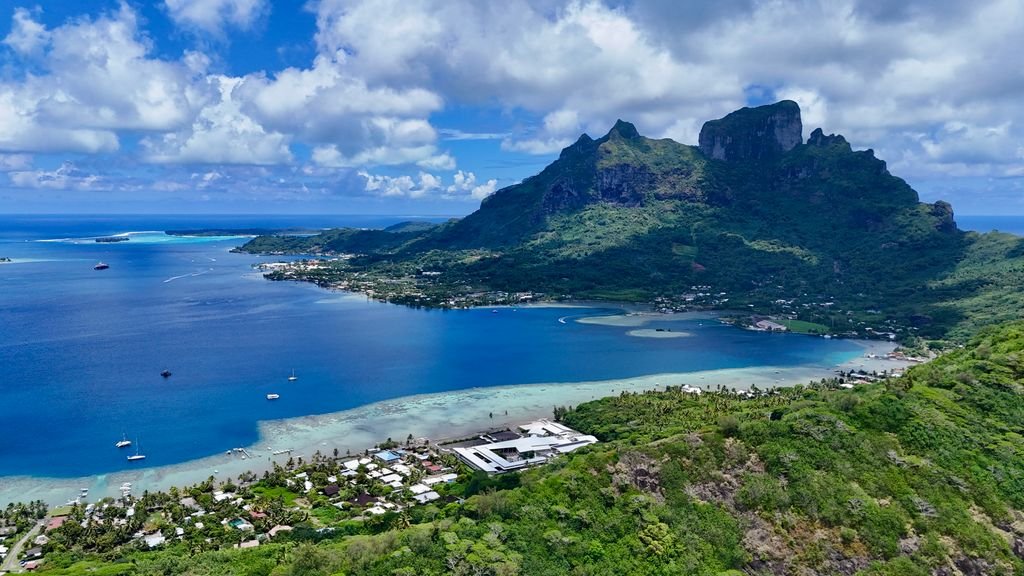
Bora Bora’s Motu Mute Airport (BOB) is on a motu (small coral island) separated from Bora Bora’s main island by a lagoon. Its runway is 1,600 metres long — significantly below the minimum required for international operations. Air Tahiti, the French Polynesia regional carrier, operates the route from Papeete’s Faa’a International Airport (PPT) in approximately 45 minutes on an ATR 72 or ATR 42. Every visitor to Bora Bora arrives first at Papeete on an international long-haul flight, clears French Polynesian customs, and then connects on a separate Air Tahiti ticket to Bora Bora. There is no alternative. Even Air Tahiti Nui, which flies direct from Los Angeles and Paris to Papeete on wide-body aircraft, does not continue to Bora Bora. The Papeete connection is mandatory.
Papeete’s Faa’a Airport has a transit option: Air Tahiti interisland departures operate from a domestic terminal adjacent to the international terminal, and passengers on back-to-back bookings can transfer without leaving the secure zone if the connection is managed correctly. However, most itineraries arrive on a long-haul from Los Angeles (Air Tahiti Nui LA-PPT ~8h), Paris (Air Tahiti Nui CDG-PPT ~16h direct or with stopover in LAX), or Auckland (Air Tahiti Nui AKL-PPT ~4h) and then wait 2–8 hours for the next Air Tahiti BOB departure. Papeete itself rewards those who leave the airport: the Marché de Papeete (covered market) in the city centre, the Musée de Tahiti et des Îles, and the Paofai Gardens are all worth the 15-minute taxi ride from the airport.
At Bora Bora airport, the second transfer awaits: a boat across the lagoon to the main island or your resort’s private motu. Every resort on Bora Bora operates its own boat transfer — you clear the small BOB terminal, collect bags, and board a launch operated by your hotel. This is usually included in the resort rate but should be confirmed at booking. The boat crossing takes 5–20 minutes depending on which side of the lagoon your resort is on, and the approach across the lagoon with Mount Otemanu visible above the reef is where most guests take the photograph they came for.
Tahiti (of which Papeete is the capital) is routinely treated as a waiting room for Bora Bora. This is a mistake. Papeete’s Marché de Papeete sells fresh vanilla beans, black pearl jewellery, pareo fabric, and local food from early morning — open weekdays from 05:00 and Sundays from 04:00 for the fresh produce market. The covered section upstairs has craft vendors and local prepared food from local mamans. The Paul Gauguin Museum (in Tahiti’s interior, 45 minutes from the airport) holds original works and letters from Gauguin’s time in French Polynesia from 1891 to 1903. The Belvédère lookout above Papeete gives a full view of the city and Moorea Island across the strait. If your connection in Papeete is 6 hours or more, the city justifies the taxi ride. Use a Wise card for CFP franc payments — French Pacific Franc is pegged to the euro and Wise handles the conversion at mid-market rate.
Your layover hub: Papeete (PPT)
Read the full guide before booking your connection through this hub.
The Seychelles archipelago sits in the western Indian Ocean northeast of Madagascar, and Mahé’s international airport (SEZ) is one of the better-connected remote island airports in the world — Emirates, Qatar Airways, Air France, Ethiopian Airlines, Kenya Airways (via Nairobi), and Turkish Airlines all serve Mahé with direct routes from their respective hubs. The Seychelles is unique among the destinations in this guide in that it requires no visa for any nationality on earth — visitors receive a Visitor’s Permit on arrival, valid for up to 30 days and extendable to 3 months. No advance application, no fee. This is the most straightforward entry requirement in the series.
What is required, however, is a hub connection for most visitors. Nonstop services to SEZ exist from Dubai (Emirates, ~4.5h), Doha (Qatar Airways, ~5h), Istanbul (Turkish Airlines, ~8h), Paris CDG (Air France/Air Austral, ~10.5h), Nairobi (Kenya Airways, ~3h), and Addis Ababa (Ethiopian Airlines, ~4h). From North America, the realistic routing is through Dubai or Doha with a layover, then direct to Mahé. From Australia or Southeast Asia, the most efficient option is via Dubai on Emirates or via Nairobi on Kenya Airways. The layover city is built into almost every itinerary, and the Gulf hub options (Dubai and Doha) are where most long-haul travellers from the Americas and Asia find themselves before the final Seychelles leg.
From Mahé, most resorts on outer islands (Praslin, La Digue, Denis, Bird Island, Alphonse) require a further domestic connection — Air Seychelles operates turboprop flights to Praslin (15 minutes) from where the Cat Cocos ferry reaches La Digue in 15 minutes more. Denis Island, Bird Island, and the outer atolls require a charter flight or the carrier’s scheduled service. The domestic connection is almost always arranged through your resort and included or offered at booking — confirm before arrival, as schedules are limited.
Your layover hub: Dubai (DXB) — make it a proper stopover
Dubai to Mahé is 4.5 hours. Most Seychelles-bound travellers have a genuine Dubai layover window. The Burj Khalifa observation deck, the Gold Souk, and the Dubai Frame are all within reach of a 6-hour stopover.
Palawan is the westernmost major island in the Philippines, stretching 450km in a thin strip between the South China Sea and the Sulu Sea. Puerto Princesa (PPS) is the capital and has a small international airport with direct services from Singapore (Scoot, AirAsia), Kuala Lumpur (AirAsia), and a small number of other regional cities. For the vast majority of visitors — especially from North America, Europe, Australia, and East Asia — the routing goes through Manila (MNL), where Philippine Airlines, Cebu Pacific, and AirAsia Philippines all operate frequent PPS and El Nido domestic connections.
El Nido (ENI) is the tourism centre for the Bacuit Archipelago in northern Palawan — limestone karst islands, enclosed lagoons, and what National Geographic has called “the most beautiful island in Asia.” El Nido Airport has a small airstrip served by AirSWIFT, a boutique carrier operating small turboprops from Manila (Francisco Bangoy, Davao), Cebu, and a handful of Philippine cities. The airstrip is unpaved in portions and operations depend on weather. Flights to El Nido are limited, book well in advance, and are frequently delayed or rerouted in the wet season (June to November). Puerto Princesa with a 5-hour van transfer north to El Nido is the reliable alternative when El Nido flights are unavailable or weather-affected.
The Manila layover is almost always part of the journey. Ninoy Aquino International Airport (MNL) handles all major international arrivals and has four terminals — NAIA 1 (international, older airlines), NAIA 2 (Philippine Airlines international), NAIA 3 (international, Singapore, Gulf, AirAsia), and NAIA 4 (Cebu Pacific domestic, some international). The terminals are not connected by landside walkway and require a bus or taxi between them, which adds 20–40 minutes to any transfer between international and domestic flights. Build a minimum 3-hour connection at Manila to guarantee a domestic Philippine connection — 4 hours is more comfortable.
Manila’s reputation as a transit city understates what it offers on a 6–12 hour layover. Intramuros — the walled city built by the Spanish in 1571, now containing Fort Santiago, the San Agustin Church (oldest stone church in the Philippines, built 1589), and the Rizal Shrine — is 45 minutes by taxi from NAIA 3. The Binondo district (one of the oldest Chinatowns in the world, established 1594) is another 15 minutes north of Intramuros. If your Manila layover is 8 hours or more, the historic quarter is accessible and genuinely rewarding. BGC (Bonifacio Global City) near NAIA 3 is the upscale alternative for food and shopping without the traffic of central Manila — Mercato Centrale on weekend mornings is Bonifacio’s food market with 100+ vendors. For a layover meal: Manam restaurant on Sgt. Esguerra Avenue (30 minutes from the airport) serves excellent modern Filipino food including the lechon that defines the Manila food canon.
Komodo Island itself has no airport. The gateway to Komodo National Park is Labuan Bajo (LBJ) on the western tip of Flores island, 50km from the national park boundary. Labuan Bajo’s airport, upgraded in 2021 to Premium airport status by the Indonesian Ministry of Transportation, now has direct flights from Bali (DPS), Jakarta (CGK), Surabaya (SUB), and a handful of other Indonesian cities. There are no international commercial flights to LBJ from outside Indonesia. The routing is therefore always: international flight to Bali (or Jakarta) → Indonesian domestic to Labuan Bajo → boat to Komodo Island or a liveaboard to the national park.
Bali (Ngurah Rai International, DPS) is the correct hub for most visitors. DPS has direct international flights from Australia (Sydney, Melbourne, Perth), Singapore, Kuala Lumpur, Tokyo, Seoul, Hong Kong, Dubai, and several European cities (including Amsterdam on KLM and London on British Airways seasonally). The LBJ domestic flight from DPS is 1.5 to 2 hours on Garuda Indonesia, Citilink, Wings Air, or TransNusa. Flights depart multiple times daily. Given that Bali is itself one of the world’s most visited destinations, most travellers to Komodo build a Bali layover into the outbound or return, using it as a natural base before the Flores leg.
From Labuan Bajo, Komodo National Park is accessed by boat. Organised day trips to Komodo Island and Rinca Island (where Komodo dragons are also found) depart from Labuan Bajo harbour daily. A full day trip to see Komodo dragons, snorkel the pink beach (Pantai Merah), and dive the Komodo channel costs approximately USD 50–150 depending on boat quality and group size. Liveaboard dive boats offer multi-day national park circuits that are the preferred option for scuba divers — Komodo is consistently rated among the top 5 dive sites in the world for manta ray encounters and drift diving.
Komodo National Park introduced a booking system and visitor caps in 2022 after years of unchecked visitor growth. Entry to the national park requires purchasing a permit in advance — the fee structure changed in 2023 and again in 2024. As of June 2026, verify current permit requirements and pricing at the official BTNK (Balai Taman Nasional Komodo) website before arrival. Walk-up access to Komodo Island and Rinca Island is not guaranteed and in peak season (June–September) spaces fill well ahead. Book your guide and park entry through your Labuan Bajo accommodation or through a licensed operator in advance — Klook has verified Komodo day trip operators with confirmed park entry included. The Komodo dragon encounters on Rinca Island (shorter boat ride from LBJ, 1.5h versus 2h to Komodo Island) are equivalent to those on Komodo itself and require shorter travel time — useful if your window is tight.
Your layover hub: Bali (DPS)
Read the full guide before booking your connection through this hub.
The Cook Islands lie in the South Pacific between Samoa and French Polynesia, and Rarotonga International Airport (RAR) is served almost exclusively by Air New Zealand — a near-monopoly that has operated the Auckland-Rarotonga route without significant competition for decades. Air New Zealand flies AKL-RAR daily (approximately 3.5 hours) and operates seasonal direct services from Sydney (SYD), Los Angeles (LAX), and a small number of other international points during peak season (October to April). The Auckland connection is the one consistent, year-round gateway for visitors from most of the world.
For North American travellers, the most common routing is via Los Angeles or San Francisco to Auckland on Air New Zealand or Qantas, then connecting to Rarotonga. The LAX-AKL flight is approximately 12 hours, making Auckland a natural stopover point for 12–24 hours before the Rarotonga connection — and Auckland rewards the time. For Australian visitors, the Sydney-RAR seasonal route is the most direct option in summer; the Auckland connection works year-round. Air Rarotonga operates domestic interisland services to the Cook Islands’ outer islands (Aitutaki is the most visited — famous for its lagoon, often described as the most beautiful in the Pacific).
The Cook Islands have no visa requirements for most Western nationalities — visitors from over 100 countries enter visa-free for stays up to 31 days. The Cook Islands dollar is pegged at parity to the New Zealand dollar, and NZD is accepted everywhere. An Airalo New Zealand or Pacific eSIM covers connectivity from Auckland through to Rarotonga on arrival.
Rarotonga is the gateway island, but Aitutaki is what many visitors came for. Air Rarotonga operates RAR-AIT (45 minutes, several times daily) and the Aitutaki lagoon — a vast shallow turquoise expanse with multiple uninhabited motu (islets) accessible by boat tour — is genuinely one of the most beautiful places accessible by scheduled air service. A day trip from Rarotonga is possible; an overnight on Aitutaki is substantially better. The lagoon cruise to One Foot Island (Tapuae-o-te-ra) — where the local postmaster stamps your passport with the Aitutaki postmark — is one of the more memorable small rituals in Pacific travel.
Your layover hub: Auckland (AKL)
Read the full guide before booking your connection through this hub.
Your layover hub: Manila (MNL)
Read the full guide before booking your connection through this hub.
Cuba’s José Martí International Airport (HAV) has regular commercial flights from most of the world — European capitals, Canadian cities, Mexico City, and various Latin American hubs all serve Havana directly. The complexity arises specifically for US passport holders, for whom travel to Cuba requires compliance with US Department of Treasury OFAC licences. General Tourism is not an authorised category for US citizens — travellers must fall under one of 12 authorised categories (Support for the Cuban People, Educational Activities, Journalistic Activity, Family Visits, and others) and self-certify accordingly. Direct flights from the US to Cuba exist on American Airlines, Southwest, JetBlue, and American Airlines from several US cities — these operate under the OFAC framework and are legal for US citizens in qualifying categories.
For US citizens who prefer the simplicity of the Mexico City or Toronto routing: fly to MEX or YYZ, purchase a Cuban tourist card (tarjeta del turista, approximately $25–30 USD/CAD) from the airline at check-in, fly to Havana as a tourist, enter on the tourist card. This routing has historically been used to avoid a Cuba stamp in a US passport — Cuba no longer stamps passports as of 2013, so the stamp concern is moot, but the MEX and YYZ routings remain popular for their simplicity and the absence of any OFAC paperwork. Cuba specialists and travel agents in both cities sell the tourist card and can advise on current entry requirements, which have shifted multiple times since 2021.
Havana itself is the reason anyone goes to Cuba: the Malecón seawall along the waterfront, the 1950s American cars (maintained as taxis because the trade embargo prevented new car imports), the Habana Vieja UNESCO old town with its Spanish colonial plazas, the Fábrica de Arte Cubano (FAC), and the rum distilleries and live music venues that operate without the tourist-facing sanitisation found in most Caribbean destinations. Havana is not a beach destination — it is a city destination, and the city is unlike anywhere else in the Western hemisphere.
Travel to Cuba by US citizens is legal under OFAC-licensed categories but requires compliance with US regulations. General Tourism is not an authorised category. Before booking any Cuba itinerary as a US passport holder, read the current OFAC Cuba travel authorisation requirements at treasury.gov. The categories change periodically based on US-Cuba diplomatic relations. Direct flights from US cities to HAV on US carriers exist and are legal under the framework — the Mexico City and Toronto routings are an alternative, not a requirement. Speak to a Cuba travel specialist or check the current OFAC guidance before booking. Use iVisa for tourist card assistance if booking through a third country.
Your layover hub: Mexico City (MEX) — don’t just transfer
Mexico City to Havana is 2 hours. Most MEX connections have 4–8 hours. The Templo Mayor, the Zócalo, and the best tacos in the Americas are 25 minutes from MEX by Metro.
Planning a Final Destination Trip — The Practical Framework
Every destination in this guide shares the same core challenge: multiple bookings, multiple carriers, multiple currencies, and a connection structure that standard booking engines do not handle well. A direct Expedia or Google Flights search for “New York to Bora Bora” will return an itinerary — it will not tell you that the Air Tahiti domestic leg to Bora Bora is a separate booking on a separate platform with a separate baggage allowance, that the seaplane timing from PPT to BOB is a constraint on which PPT departure times are viable, or that the boat transfer from BOB airport to your resort on the other side of the lagoon adds 20 minutes and needs to be arranged directly with the resort. That is what this section addresses.
Draw the full itinerary: origin → hub 1 → (hub 2?) → final airport → transfer to island/village/park. Identify which segments are international (on your main carrier), which are domestic (on a local carrier with separate booking), and which are transfers (boat, seaplane, ferry). Know the complete picture before you commit to the international leg. For hub city transfers, Welcome Pickups provides fixed-price transfers in Doha, Dubai, Mexico City, Toronto, and other hub cities in this guide — useful when your hub arrival is time-sensitive before a final leg connection.
Maldives seaplanes stop at 15:30. Paro Airport operates daylight only. Komodo day trips depart at 07:00. The Faroe Islands have only a handful of weekly flights. Identify the time constraints at the final destination end of the journey and work backwards to select your hub arrival time — not the other way around.
A Bhutan trip via Bangkok requires entry permission for Thailand and Bhutan. A Galápagos trip requires Ecuador entry and the TCT card. A Cuba trip requires a Tourist Card before boarding the connecting flight. Check every country in the itinerary, not just the destination. Use our layover visa guide for hub city requirements and iVisa for complex multi-entry applications.
The Galápagos National Park entrance fee ($200 USD) must be paid on arrival. Cuba operates on a cash economy for tourists. The Faroe Islands have limited ATM coverage outside Tórshavn. Bhutan resort payments are mostly handled by your tour operator, but tips, local purchases, and extras require ngultrum or Indian rupees. Plan your cash needs destination-by-destination. A Wise card handles mid-market conversions across all currencies in this guide.
Your home SIM will not roam cost-effectively in French Polynesia, the Faroe Islands, or Bhutan. Each destination in this guide has a different network and different eSIM coverage — check the specific country coverage before departure. Airalo covers most countries in this guide with country-specific plans. Drimsim offers 197-country coverage for travellers combining multiple destinations on a single itinerary.
A standard travel insurance policy covers the booked trip. A multi-leg trip with separate domestic and international segments has a much higher rate of missed connections, and not all policies cover the domestic leg booked independently. Read the specific missed connection clause before purchasing. For trips combining multiple countries, InsureMyTrip compares policies specifically for multi-destination trips. SafetyWing rolling monthly medical is most efficient for itineraries spanning 3 or more countries over 3 or more weeks.
Weather delays are part of Paro, the Faroe Islands, and Rarotonga. Boat cancellations affect the Komodo and Maldives transfers. Domestic airline delays in the Philippines and Indonesia are common. Build one buffer day at the beginning of the final destination stay and one at the end. A 7-night Bhutan trip should be planned on a 9-night itinerary window. The buffer day costs a hotel room; a missed international departure connection costs significantly more.
Travel Insurance for Multi-Leg Final Destination Trips
The trips in this guide have a higher rate of missed connections, weather disruptions, and logistical complexity than standard point-to-point travel. Insurance is not optional — it is the tool that converts a disruption into an inconvenience rather than a financial emergency. The right policy depends on the specific trip structure: the duration, number of countries, presence of adventure activities (diving, trekking), and whether you are booking segments as a single ticket or as separate bookings.
Connectivity and Currency — The Tools That Travel With You
Country-specific plans for French Polynesia, Philippines, Indonesia, Seychelles, Ecuador, and most other countries in this guide. Activate before landing. Plans from $4.50 USD.
Get an eSIM →For travellers combining multiple final destinations on a single trip — Bhutan plus Thailand plus Singapore, or Maldives plus Seychelles. One activation, all countries covered without plan switching.
Get an eSIM →Every destination in this guide uses a different currency. CFP franc (Bora Bora), Indonesian rupiah (Komodo), Bhutanese ngultrum, Cook Islands dollar, Cuban peso. Wise converts all at mid-market rate — no exchange bureau spread, no bank foreign fee.
Get a Wise Card →Hold multiple currencies simultaneously in separate pockets. Useful for multi-destination final trips where you need NZD for Cook Islands, THB for Bangkok, and AED for Dubai layover all loaded before departure.
Get Revolut →Leave heavy luggage in your hub city before the final leg. For Maldives trips, leave non-resort luggage in Doha or Dubai. For Galápagos, leave non-island gear in Quito or Guayaquil. Travel the island light.
Find Storage →Walk-up access at Bhutan’s Tiger’s Nest Monastery, Komodo National Park, and the Faroe Islands’ key viewpoints is limited. Pre-book guided tours and timed entry through GetYourGuide for the sites in this guide that require advance reservation — the difference between entering and being turned away at the gate.
Book Tours →Hub airports (Doha, Dubai, Bangkok, Manila, Auckland) all have shared public Wi-Fi. Banking access, resort booking confirmations, and permit downloads should not go through unprotected networks. NordVPN covers all countries in this guide.
Get NordVPN →There is a specific moment that happens on every trip to a final destination — the moment when the abstract place becomes real. It is not when you land. It is usually something smaller: the seaplane banking over the Maldives atoll and the water going from deep navy to shallow turquoise in a single turn. The aircraft dropping through the Paro valley with mountain walls close enough to count the trees on the slope. The moment the boat clears the Bora Bora reef and the lagoon opens in every direction. What all these moments share is that they required commitment — a series of flights, a hub layover, a domestic connection, a boat transfer, a permit purchased at a kiosk. They required patience and planning and a willingness to accept that some places are not easy to reach. That difficulty is precisely why the moment lands the way it does. The world rewards the people who decide that some things are worth the journey.
Plan Your Layover Hubs
More EpicLayover Tools
Layover Time Calculator
Any hub layover in this guide — Doha for the Maldives, Auckland for the Cook Islands, Bangkok for Bhutan — is worth planning. Enter your landing and departure times to find your real usable window.
Calculate My Time →Layover Visa Guide
Every trip in this guide involves at least two countries. Know the entry requirements for your hub city before you book the final destination — a denied entry at Bangkok means no Bhutan.
Check Visa Requirements →Free Stopover Finder
TAP Air Portugal and several other carriers offer free stopovers that can be combined with a final destination trip — a Lisbon stopover on the way to the Maldives or Seychelles, for example.
Find Free Stopovers →Frequently Asked Questions
Three structural reasons. First: geography. The Maldives, Seychelles, and Cook Islands sit so far from major population centres that no airline can economically operate a nonstop service from most origin cities — the demand and aircraft range economics do not support it for most markets. Second: infrastructure. Bora Bora’s runway is 1,600 metres — too short for an international jet. Komodo Island has no runway at all. These cannot be changed without massive environmental and logistical interventions that no government or airline is pursuing. Third: policy. Bhutan limits its airline operations to two Bhutanese carriers by law, restricting the route network structurally. The Galápagos Special Law mandates mainland Ecuador transit for all visitors as part of the conservation framework. These are deliberate choices that will not change on a commercial lobbying timetable.
For most of the domestic connections in this guide, English-language booking is available directly: Air Tahiti (English website, international credit cards accepted), Air Rarotonga (English, credit cards accepted), Air Seychelles (English, credit cards accepted), Garuda Indonesia (English, cards accepted). The Philippine carriers (Cebu Pacific, AirAsia Philippines) have English interfaces and accept international cards but check baggage allowances carefully as they differ from your international carrier. Druk Air and Bhutan Airlines tickets to Paro are most reliably booked through your licensed Bhutanese tour operator as part of the mandatory permit package — independent booking is possible but requires careful coordination. For all cases, Omio aggregates some regional connections and can simplify comparison.
The answer depends entirely on how you booked. If the international flight and the domestic connection are on a single ticket issued by the same carrier, the carrier is obligated to rebook you on the next available service at no charge. If they are on separate tickets — which is common for the domestic segments in this guide, since Air Tahiti, Air Rarotonga, and AirSWIFT are not codeshared with most long-haul carriers — the domestic carrier has no obligation to you, and you will need to purchase a new domestic ticket at whatever the next available fare is. Travel insurance with a missed connection benefit specifically covering separately booked segments is the correct protection. InsureMyTrip allows you to compare policies that include this coverage. Always build the longest practical connection time at the hub airport when the domestic segment is on a separate ticket.
Yes, with some nuance per destination. The Maldives is one of the best-value redemptions in credit card points programmes — Qatar Airways Avios to Doha then Qatar cash fare to MLE, or Emirates Skywards miles LAX-DXB then separate DXB-MLE, are both well-documented redemptions. The Cook Islands are bookable on Air New Zealand’s Airpoints programme. Bhutan is difficult on points because Druk Air is not part of any alliance and has limited partnerships. The Faroe Islands via Copenhagen can be booked on SAS EuroBonus points to CPH, then a cash Atlantic Airways ticket for the FAE leg. Bora Bora is accessible via Air Tahiti Nui on Flying Blue (Air France-KLM’s programme) miles or on American AAdvantage via Oneworld Pacific routing. The general rule: use points for the long-haul hub leg, pay cash for the short domestic connection that no alliance partner operates.
The Seychelles. It has the most international airlines serving Mahé directly (Emirates, Qatar, Air France, Ethiopian, Kenya Airways, Turkish), no visa requirement for any nationality, no mandatory transfer beyond the hub, no specific timing constraints (no seaplane cutoff, no daylight-only operations), and no permit or special fee beyond the standard Visitor’s Permit issued on arrival. A traveller from New York connecting through Dubai on Emirates and continuing to Mahé is dealing with exactly two flights and a standard customs arrival — comparable in complexity to a Caribbean or Mediterranean resort trip. The destination itself (granite boulders, Aldabra giant tortoises, coral reefs, the Coco de Mer palm that produces the world’s largest seed) is genuinely remote and extraordinary, but the logistics of getting there are the most straightforward of any destination in this guide.
Almost always worth spending time, when the window allows it. The travellers who remember their final destination trips most vividly are almost always the ones who used the hub city properly — who had a meal in Doha’s Souq Waqif the evening before the Maldives flight, who walked Papeete’s Marché de Tahiti the morning before the Bora Bora connection, who saw Intramuros in Manila before the El Nido flight. The hub city is part of the journey, not an obstacle to it. The EpicLayover guides for Doha, Dubai, Iceland (for Faroe Islands routing), Mexico City, and Toronto — all destinations used as hubs in this guide — document specifically what is achievable in 4, 6, and 10-hour windows. The only situations where rushing the connection makes sense: when the domestic leg timing is genuinely tight, when you have health reasons to minimise travel, or when the hub city is one you have visited many times already and the final destination is calling.
- FlightConnections.com. Flights to Paro (PBH) — 3 airlines, 16 airports, Druk Air and Bhutan Airlines only carriers licensed to operate into Bhutan, May 2026. Retrieved June 2026. flightconnections.com
- Drukair Singapore. Singapore–Paro direct flights — KB541, twice weekly, technical stop Guwahati; increased to three times weekly from April 2026. Retrieved June 2026. drukair.com.sg
- Bhutan Travel Bureau. Getting to Bhutan — Druk Air and Bhutan Airlines route network, Paro international airport operations, visual conditions only. Retrieved June 2026. bhutantravelbureau.com
- Flightradar24 Blog. Expert mode: flying the precision approach into Paro — 42 weekly flights, 31 Druk Air / 11 Bhutan Airlines, only ~30 certified pilots globally authorised for Paro approach. Retrieved June 2026. flightradar24.com
- Secret Flying / Maldives Airports Guide. Velana International Airport (MLE) 2026 — Middle East hubs most common, seaplane operations daylight only, Aerotel transit hotel, Air Tahiti Nui Papeete gateway. January 2026. secretflying.com
- ResortLife Maldives. Doha to Maldives — QR676 departs DOH ~02:30, arrives MLE ~10:30, ideal seaplane window; afternoon arrivals past seaplane cutoff ~15:30. Retrieved June 2026. resortlife.travel
- Maldives Magazine. Maldives flights from USA — Emirates SFO-DXB-MLE, Qatar Airways via DOH, Turkish via IST recommended routes; seaplane timing constraints for outer atoll resorts. Retrieved June 2026. maldives-magazine.com
- EpicLayover. Stopover Doha Guide (DOH), Stopover Dubai Guide (DXB), Stopover Iceland Guide (KEF), Stopover Lisbon Guide (LIS), Mexico City Layover Guide (MEX), Toronto Layover Guide (YYZ), Taipei Layover Guide (TPE). June 2026. epiclayover.com
Disclaimer: This guide is for informational purposes only. Flight routes, airline policies, permit requirements, and entry regulations for all destinations in this guide change regularly — always verify with official sources before booking. US citizens travelling to Cuba must verify current OFAC authorisation requirements independently. Bhutan SDF and permit requirements are set by the Bhutan government and subject to change. Affiliate links may earn EpicLayover a commission at no additional cost to you.