
10 Epic Vancouver Layover Experiences You Can’t Miss
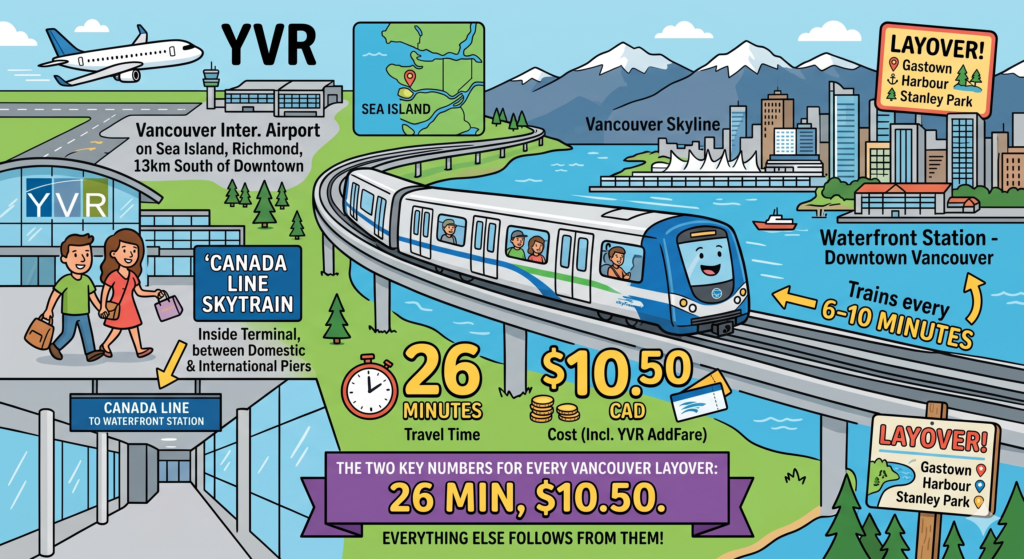
Vancouver International Airport is 13 kilometres south of downtown, on Sea Island in the city of Richmond, and the Canada Line SkyTrain takes 26 minutes to get you to Waterfront Station at the foot of the city. That train runs every six to ten minutes, costs around $10.50 CAD with the YVR AddFare surcharge, and the station is inside the terminal building between the International and Domestic piers. Those are the two numbers that govern every Vancouver layover: 26 minutes, $10.50. Everything else follows from them.
What makes a Vancouver layover genuinely different from most North American gateway cities is the compression. Gastown, the city’s oldest neighbourhood, is a 10-minute walk from Waterfront Station — cobblestoned blocks of Victorian brick warehouses, the steam clock that’s been operating on the corner of Water and Cambie since 1977, and the specific atmosphere of a neighbourhood that became fashionable by becoming itself rather than by trying to. Granville Island Public Market is 20 minutes from the Canada Line by Aquabus ferry across False Creek — a covered market hall with 50-plus food vendors, a fishmonger selling live spot prawns in season, a cheese counter, a bakery, and a farmers’ market running alongside. Stanley Park’s 10-kilometre seawall is a 15-minute walk or cycle from the city centre, tracing the edge of a 1,001-acre temperate rainforest peninsula with the North Shore mountains behind it and the Strait of Georgia in front. None of these require a car, a tour, or advance planning. They require a Canada Line ticket and a working knowledge of what time your return flight boards.
This guide covers the Canada Line in the specific detail it requires — including the YVR AddFare surcharge that catches most first-time visitors, the eTA entry requirement for visa-exempt foreign nationals (CAD $7, approved in minutes, required even for a short layover), and the exact combination of Gastown, Granville Island, and Stanley Park that works within a 4-, 6-, or 8-hour window. It also covers where the airport’s first-class Fairmont hotel sits (inside the terminal, between the International and Domestic piers), which pier your gate is most likely to be in, and where to eat if you are not leaving the airport at all.
Canada Line SkyTrain from the station inside the terminal — 26 minutes to Waterfront Station. Fare is approximately $10.50 CAD including the $5 YVR AddFare surcharge (rising to ~$12 CAD from July 1, 2026 when the AddFare increases to $6.50). Pay by Compass Card, tap-to-pay credit or debit card, or at the platform ticket machines. Trains every 6–10 minutes, 5 a.m. to 1 a.m. International travellers: a Wise or Revolut card eliminates foreign transaction fees on every Canadian transit and food payment.
Yes, if you are a visa-exempt foreign national (UK, EU, Australia, Japan, South Korea, and most other countries from which you do not normally need a visa to enter Canada). You need a Canadian eTA to board your flight into YVR and to clear customs on arrival. The eTA costs CAD $7, takes minutes to apply for at canada.ca, and is valid for 5 years. US citizens are exempt and need only a valid passport. Canadian permanent residents are also exempt. Apply before departure — not at the airport.
For a 4-hour window: Gastown. Walk from Waterfront Station, cover the steam clock, Water Street, and Blood Alley, eat a Japadog from a street cart, and return. For 5–6 hours: add Granville Island by Aquabus across False Creek. For 7+ hours: Stanley Park seawall by rental bike from the West End. Capilano Suspension Bridge and Grouse Mountain require 8+ hours and a taxi or bus north — only realistic on a full-day connection.
One main terminal with five piers. Piers A and B are domestic. Pier C is domestic and some international (Air Canada). Pier D is international departures. Pier E is US transborder with pre-clearance — you go through US customs at YVR before boarding a US-bound flight. The Canada Line station is between the International and Domestic sections. The Fairmont Vancouver Airport hotel is inside the terminal, between the two sections. A separate South Terminal handles BC regional and charter flights — free shuttle from the main terminal.
Most foreign nationals need a Canadian eTA to fly into or transit through YVR. Applying takes minutes online at canada.ca — CAD $7, valid 5 years — and approval is usually immediate. If the government portal gives you trouble, our layover visa guide covers Canadian eTA rules for every nationality, and iVisa offers a guided application if you want a verified status confirmation before boarding.
Airlines at Vancouver International (YVR)
YVR is Canada’s second-busiest airport and Air Canada’s primary West Coast hub. The airport handled over 26 million passengers in 2025 and serves as a key transpacific gateway, with nonstop routes to Tokyo, Seoul, Hong Kong, Sydney, and major Chinese cities operating alongside Air Canada’s dense domestic and transborder network. The single main terminal with five piers makes YVR one of the more navigable large airports in North America — the Canada Line station is the spine around which the whole building is organised.
Air Canada operates YVR as its primary Pacific hub and secondary domestic hub (after Toronto Pearson), running the airport’s highest-frequency domestic network alongside the widest transpacific route portfolio of any Canadian carrier. Nonstop routes to Tokyo Narita, Seoul Incheon, Hong Kong, Shanghai, Beijing, Taipei, Sydney, Auckland, and Melbourne make YVR the most Pacific-connected airport in Canada. The Air Canada Maple Leaf Lounge in the International Terminal is accessible to Aeroplan 35K and above, Star Alliance Gold card holders, and eligible credit cardholders — one of the better domestic lounges in Canada with decent hot food service and shower rooms. Air Canada’s Connector flights (operated by Jazz Aviation and Sky Regional) cover BC regional routes from the South Terminal via a free shuttle.
For layover travellers, Air Canada’s Star Alliance membership means YVR connections to United, Lufthansa, Singapore Airlines, ANA, and Thai Airways are all integrated — missed connection recovery at YVR is straightforward given the frequency and network depth. The Pier E US preclearance concourse means transborder connections to US destinations clear customs at YVR before boarding, which significantly simplifies the US arrival experience.
Other Airlines at YVR
Canada’s second carrier with significant YVR domestic and transborder presence. WestJet covers Calgary, Edmonton, Toronto, and major US leisure markets from YVR with strong reliability and a no-frills product that competes directly with Air Canada on core routes. The WestJet Rewards card offers companion fares on domestic bookings.
Cathay’s Vancouver route connects YVR to Hong Kong Chek Lap Kok — a key Pacific Rim connection for British Columbia’s large Hong Kong and Chinese-Canadian community. Business Class on this route is the Cathay Pacific Aria Suite on newer 777s. The Cathay Pacific Lounge at YVR reopened in June 2023 after a pandemic closure and is accessible to Oneworld Emerald and Sapphire cardholders.
BA operates nonstop Vancouver-London Heathrow, making YVR one of a small number of Canadian airports with a direct transatlantic connection outside of Toronto. Good for UK and European passengers routing through Vancouver. Avios earn on all BA flights; the route qualifies for Avios redemption as a partner flight from BA’s website.
Both JAL and ANA serve Tokyo from YVR — JAL to Narita (Oneworld partner with Avios), ANA to Haneda (Star Alliance partner with Aeroplan and United miles). This dual Tokyo presence makes YVR the best-connected Canadian airport for Japan itineraries. Both carriers operate long-haul premium products on this route.
Korean Air connects YVR to Seoul Incheon — a key hub for onward connections throughout Southeast Asia, South Asia, and the Pacific. ICN as a connection point for Australian and New Zealand-bound travellers has become increasingly efficient since Korean Air’s IT network improvements in 2024. The SkyTeam Lounge at YVR is accessible to eligible SkyTeam Elite Plus members.
Alaska connects YVR to Seattle, Los Angeles, San Francisco, and other West Coast US cities via the Pier E pre-clearance concourse. Highly relevant for Canada-to-US connections where passengers clear US customs at YVR before boarding. Mileage Plan earns on all Alaska flights and partners with British Airways, Cathay Pacific, and American Airlines on Oneworld routes.
Should You Leave the Airport? — Vancouver Layover Decision Guide
Under 3 hours, the Canada Line round trip consumes 55 minutes and leaves you less than 90 usable minutes in the city before you need to return. That is not a visit to Vancouver; it is a commute. YVR is consistently rated one of the top airports in North America and has enough going for it to make the stay worthwhile: the First Nations art collection throughout the terminal is museum-quality (the Bill Reid Spirit of Haida Gwaii: The Jade Canoe sculpture in the International departures building is the second casting of the original, which is in the Canadian Embassy in Washington), the food is better than most airports, and if you are eligible for the Air Canada Maple Leaf Lounge or the SkyTeam Lounge you have access to shower rooms and real hot food. The Fairmont Vancouver Airport hotel inside the terminal also opens its lobby bar to non-guests and has a Pacific Northwest cuisine restaurant worth eating in.
Three to five hours is viable with a clear plan and no checked bags. Canada Line from YVR to Waterfront Station (26 minutes). Walk east 10 minutes to Gastown along Water Street. The steam clock is on the corner of Water and Cambie — it operates on steam pressure from a city steam heating system and chimes every quarter hour. Walk Blood Alley for the contrast (a narrow cobblestone alley where most of Gastown’s wholesale food businesses operated in the early 20th century, now independent restaurants and bars). Japadog from a street cart on Hastings or Richards for $6–9. Walk back to Waterfront, Canada Line back to YVR. Allow 70 minutes from Waterfront Station to your gate. Do not attempt Granville Island in this window — the Aquabus is 20 minutes each way and the market adds another hour minimum.
Five to seven hours: Gastown first (60 minutes), then Aquabus from the waterfront south to Granville Island (12 minutes, $5.50 CAD each way). The Granville Island Public Market is open daily 9 a.m. to 7 p.m. — smoked salmon, spot prawns in season (late April to June), the Stuart’s Bakery sourdough, and the Stock Market soup counter. Allow 90 minutes here. Aquabus back to the Waterfront, Canada Line to YVR. Seven-plus hours with a clear morning: Stanley Park by rental bike. Cycle the 10-kilometre seawall from the West End — Prospect Point for the Lions Gate Bridge view, Siwash Rock (a 10-million-year-old sea stack the park was redesigned around when it was laid out in 1888), and Third Beach for the North Shore mountain panorama. Heading to Seattle, Portland, or San Francisco after Vancouver? Omio compares Amtrak Cascades, BC Ferries, and FlixBus connections from downtown Vancouver in one search.
How much time do you actually have?
The Canada Line takes 26 minutes each way, plus the platform wait, plus a 60-minute security buffer on return. Most travellers have less usable time than they think. Enter your YVR arrival and departure to find out exactly what you are working with.
Getting from YVR to Vancouver — All Transport Options
The Canada Line station is inside the main terminal, between the International and Domestic piers — follow signs from either arrivals area. You do not need to go outside or catch a shuttle; the platform is in the building. The YVR AddFare is charged only on journeys that originate at the airport — the return from downtown back to YVR costs the standard zone fare with no surcharge. International travellers: a Wise or Revolut card works on all Canadian tap-to-pay transit without foreign transaction fees.
| Option | Time to Downtown | Cost (CAD) | Notes | Best For |
|---|---|---|---|---|
| Canada Line SkyTrain | 26 min to Waterfront Station | ~$10.50 | Station inside the terminal. AddFare ~$5 applies outbound from airport (rising to $6.50 from July 1, 2026). Return from downtown has no AddFare. Trains every 6–10 min, 5 a.m.–1 a.m. Pay with Compass Card, tap credit/debit card, or ticket machine (cash or card). Monthly pass holders and day pass holders exempt from AddFare. | Solo travellers; all city visits; fastest and cheapest |
| Taxi (metered) | 20–40 min (traffic-dependent) | $35–$55 | Taxi rank outside both International and Domestic arrivals. Metered only — all Richmond and Vancouver taxis licensed at YVR. Significantly slower during peak hours on Highway 99 and the Arthur Laing Bridge. 24 hours. Faster than Canada Line to the West End (for Stanley Park) or to Coal Harbour hotels that are a walk from Waterfront Station. | Groups; late night; direct to West End or Coal Harbour |
| Uber / Lyft | 25–45 min | $30–$55 | Designated pickup zones at both terminals. App required. Surge pricing during morning and evening peak, and during events at Rogers Arena, BC Place, or the Convention Centre. Uber works from YVR to all Metro Vancouver destinations including North Vancouver (Capilano, Grouse Mountain) where transit is cumbersome. | North Shore; Capilano Suspension Bridge; off-peak |
| Aquabus / False Creek Ferry | N/A — city only, not from YVR | $5.50 one-way | Does not run from YVR. Take Canada Line to downtown first, then catch the Aquabus from the Waterfront or Hornby Street dock to Granville Island. 12–20 minutes crossing. One of the most pleasant ways to reach Granville Island — the ferry gives you the False Creek waterfront perspective that the road does not. | Granville Island; False Creek waterfront |
The $5 YVR AddFare surcharge (rising to $6.50 on July 1, 2026) is charged only on journeys that start at YVR Airport, Sea Island Centre, or Templeton stations. The return trip from downtown Vancouver to YVR costs just the standard two-zone fare — approximately $4–5 CAD with a Compass Card or tap-to-pay. This means the return to the airport is about half the price of the outbound trip. Factor this asymmetry into your budget and your time planning.
You need a working data connection to run the TransLink trip planner or the Moovit app for real-time Canada Line departures. Get a Canadian eSIM active before landing: Airalo and Roamless both cover Canada and activate before boarding.
What to Do on a Layover in Vancouver
Vancouver’s geography works for layover visitors. The useful destinations are compressed into a walkable downtown core connected to YVR by a single Canada Line ride. Everything on this list is accessible without a car, a taxi, or a pre-booked tour — although a taxi does open Capilano Suspension Bridge and Grouse Mountain on longer layovers.
Gastown
Gastown is Vancouver’s oldest neighbourhood, named after John “Gassy Jack” Deighton who opened the city’s first saloon in 1867 at the corner of what is now Water and Carrall Streets. The district runs along Water Street from Waterfront Station east to the edge of Chinatown — cobblestoned, Victorian brick, with the Pacific Central Railway viaduct running overhead at the eastern end. The neighbourhood went through decades of dereliction after the downtown shifted west, became a wholesale district, and was saved from demolition by a heritage designation in 1971. The steam clock at Water and Cambie, installed in 1977, operates on steam pressure from the city’s underground steam heating system and chimes every 15 minutes. Blood Alley, a narrow lane one block south of Water Street, is where the wholesale meat and poultry businesses operated in the early 1900s — the name is literal. It is now independent bars and restaurants. The walking distance from Waterfront Canada Line station to the steam clock is 10 minutes east on Water Street. Everything in Gastown is within 15 minutes’ walk of that station.
Granville Island Public Market
Granville Island is a former industrial peninsula under the Granville Street Bridge in False Creek, converted into a public market and arts district starting in 1979. The Public Market at 1689 Johnston Street is the centre: a covered market hall open daily 9 a.m. to 7 p.m. with no entry fee. Inside: the Salmon Shop for wild BC sockeye and smoked salmon, the Market Grill for chowder and fresh fish and chips, Stuart’s Bakery for sourdough and pastries, Oyama Sausage Company for house-made charcuterie, and the Stock Market for 30 varieties of stock, soups, and prepared meals. If you visit between late April and late June, the spot prawn season is running and the fishmongers sell live prawns off the boats in the False Creek marina directly behind the market building. The fastest way from downtown is the Aquabus mini-ferry from the Hornby Street Dock — 12 minutes, $5.50 CAD each way, departures every 15 minutes. From YVR, take the Canada Line to Waterfront Station, walk 10 minutes south along the Seawall to Hornby Street, and board the Aquabus. Total time from YVR gate to the market: 55 minutes. Book return Aquabus tickets via GetYourGuide if you want to combine it with a False Creek kayak or sailing tour that departs from the same area.
Stanley Park Seawall
Stanley Park is a 1,001-acre temperate rainforest peninsula at the north end of the West End neighbourhood, established as a public park in 1888. The 10-kilometre seawall running around its perimeter is the most-used recreational corridor in Canada, hugging the shoreline from Coal Harbour in the east, past Brockton Point (where the totem poles are — six poles from the Haida, Squamish, and other Northwest Coast nations, moved here in the early 20th century from their original locations), around the tip of the peninsula past Third Beach and Second Beach. Rental bikes are available from multiple operators in the West End at the park entrance — Spokes Bicycle Rentals on West Georgia Street is the most central, typically $15–25 CAD per hour or $50 for a half-day. The full seawall circuit takes 1.5 hours cycling or 3 hours walking. For a shorter option: the path to Prospect Point at the tip of the peninsula (45 minutes each way from the West End entrance) gives the Lions Gate Bridge view from below, with the North Shore mountains behind it. This is the photograph most associated with Vancouver. The Hollow Tree, a 700-year-old Western red cedar snag near the south end of the seawall, is the most photographed natural object in the park.
Capilano Suspension Bridge
Capilano Suspension Bridge is in North Vancouver, 11 kilometres from downtown across the Lions Gate Bridge. The bridge spans 70 metres above the Capilano River and has been on this site in various forms since 1889. The current park complex includes the 137-metre suspension bridge, Cliffwalk (a series of cantilevered walkways along the granite cliff face of the canyon), and Treetops Adventure (seven suspension bridges connecting eight Douglas fir trees 30 metres above the forest floor). Adult admission CAD $70 in 2026 — significant for a 45-minute attraction, but the forest environment and the bridge itself are genuinely impressive. Book in advance via GetYourGuide to lock in timed entry — summer weekend queues at walk-up can be 30–45 minutes. Getting there: Uber from downtown ($25, 20 minutes) or free shuttle from Canada Place (seasonal). Only viable on a 7+ hour layover.
Gastown Steam Clock — Water and Cambie Streets
The steam clock at the corner of Water and Cambie Streets in Gastown has been photographed more times than any other object in Vancouver. It stands 5 metres tall, is powered by a system of steam pressure from the city’s underground district heating network, and chimes on the quarter hour with a steam whistle. The best photograph is from the west side of Cambie looking north-east, with the clock in the foreground and the Gastown brick streetscape behind it. Early morning (before 8 a.m.) gives you the cobblestones and the clock without the tour groups. By 10 a.m. it is busy. The clock was commissioned in 1977 primarily to cover a steam vent that would otherwise have been an eyesore — the engineer who built it, Ray Saunders, never intended it to become a civic symbol.
“Built to cover a steam vent. Now Vancouver’s most photographed object. That tracks.” — #EpicLayover #VancouverLayover #Gastown
Prospect Point — Lions Gate Bridge from Below, Stanley Park
Prospect Point is at the northern tip of the Stanley Park peninsula, where the Lions Gate Bridge spans the First Narrows between the park and North Vancouver. The viewpoint at Prospect Point gives you the bridge from below and to the east — the three suspension towers rising above the water, the North Shore mountains behind them, and the cargo ships passing underneath on their way to and from the Port of Vancouver. The snack bar and viewpoint platform are accessible by bike (45 minutes from the West End park entrance), by taxi directly ($15), or on foot (2 hours). The best light is in the morning when the mountains are clear and the east-facing view picks up the early sun. On overcast days the clouds sit at the mountain level and the bridge profile still reads well against the water and sky below.
“The North Shore mountains are behind the bridge. The Pacific is in front of you. The Stanley Park seawall is under your bike.” — #EpicLayover #YVRLayover #StanleyPark
Vancouver Layover Itineraries — By Time Window
The Spirit of Haida Gwaii: The Jade Canoe is a 3.9-metre bronze sculpture by Haida artist Bill Reid, installed in the International Terminal departures building in 1994. It depicts thirteen figures from Haida mythology in a single canoe — the Raven at the stern, the Bear and the Bear Mother amidships, the Shaman, the Dogfish Woman, the Ancient Reluctant Conscript, and others. The original is in the Canadian Embassy in Washington DC. The one at YVR is the second casting. Reid died in 1998; his design for the $20 Canadian bill also remains in circulation. The terminal’s broader First Nations art collection, assembled over 30 years, includes weavings, prints, and carvings from Musqueam, Squamish, Haida, and other Northwest Coast nations — more substantial than most regional museums.
The Fairmont Vancouver Airport is inside the terminal between the International and Domestic piers. The lobby restaurant serves Pacific Northwest cuisine — BC spot prawns in season, Pacific salmon, and Vancouver Island products — at hotel prices but with genuine food quality. The lobby bar is open to non-guests. For a cheaper option: the terminal food hall in the International departures area has an outpost of Cactus Club, a Vancouver restaurant group with consistently good food, and a White Spot (BC’s oldest restaurant chain, established 1928) counter in the domestic departures area.
Walk from arrivals to the Canada Line station inside the terminal (signs throughout both piers). Buy a ticket or tap your card at the gate. Board any northbound Canada Line train. Exit at Waterfront Station — the last stop on the line, at the foot of Granville Street. No transfer needed. YVR has no terminal luggage storage — if you need to explore hands-free, Bounce has partner locations near Waterfront Station in downtown Vancouver. From ~$6 per bag per day.
Exit Waterfront Station at the Granville Street exit. Walk east on Water Street 10 minutes to the steam clock at Water and Cambie. Continue east to Blood Alley (turn right between Water and Cordova, look for the narrow cobblestone lane). Walk back west along Hastings Street for a different angle through the neighbourhood’s western end — this puts you through the older commercial strip before it meets the waterfront piers. Buy a Japadog from a cart on Richards Street near the corner of Hastings — the Terimayo (bratwurst, teriyaki sauce, Japanese mayo, dried seaweed) is the original. Return to Waterfront Station and catch the Canada Line back to YVR. Allow 70 minutes from Waterfront Station back to your gate.
Vancouver Layover Scenarios — Real Situations, Specific Solutions
The Canada Line is direct from YVR International station (beneath the terminal, no shuttle) to Waterfront Station in downtown Vancouver in 26 minutes. It is reliable. But service disruptions — maintenance on the Richmond branch, incidents at Bridge Station — do occur, and the standard YVR train frequency of every 3–5 minutes drops to every 12–15 minutes during disruptions.
On a return journey with a hard connection, a 10-minute train delay plus slower boarding at Waterfront can compress your airport buffer below comfortable for an international departure. YVR’s US Preclearance requirement adds 20–30 minutes to the pre-departure process for US-bound flights.
Use the Canada Line for the outbound journey — it is excellent. For the return on a US connection requiring Preclearance, pre-book a fixed-price transfer via Welcome Pickups. The additional cost over the $4.55 Canada Line fare is the cost of certainty on a journey where the train and Preclearance together have two unpredictable variables.
Capilano Suspension Bridge in North Vancouver is 137 metres long, 70 metres above the Capilano River, and suspended between old-growth forest. It is genuinely worth the visit. The entrance queue on a summer weekend morning is 20–30 minutes before you cross. You have 6 hours in Vancouver.
The Capilano Bridge requires a bus from downtown Vancouver (40 minutes total transit) plus the queue. On a 6-hour window, 30 minutes at the gate is meaningful time taken from the bridge walk, the treetops adventure, and the return journey.
Book timed entry via GetYourGuide before your flight. The advance booking skips the general queue and gets you across the bridge at the start of your visit rather than 30 minutes into it. The Cliffwalk extension and treetops are included — add both before the return bus.
Stanley Park’s seawall is a 9km paved loop around the park perimeter with views of the North Shore mountains, English Bay, and the Lions Gate Bridge. Renting a bicycle or inline skates is the best way to do it. With a carry-on, you are on foot for a fraction of the circuit at best.
YVR has no public left-luggage service landside. Waterfront Station has no secure storage. You arrive in Vancouver with the bag and it stays with you unless you plan a drop point between the Canada Line exit and the park entrance.
Bounce has partner locations in the Gastown and Coal Harbour area — directly between Waterfront Station and the Stanley Park seawall entrance. Drop the bag after the Canada Line, rent a bicycle, collect on the way back to the train.
YVR’s Canada Line station accepts Compass Card, contactless bank card, or mobile pay. Contactless bank card is the simplest — tap and go. But the tap-to-pay at YVR adds a $5.00 YVR surcharge on top of the $4.55 Canada Line fare, making the total $9.55. Pre-loading a Compass Card via the TransLink app avoids the surcharge. Without data, you use contactless and pay the extra $5.
The $5 YVR surcharge is not enormous, but on a budget layover it is the difference between a second coffee at Granville Island and the transit fare you thought you were paying.
An Airalo Canada eSIM activated before landing — from $4.50 USD — gives you data from the jet bridge. Load the TransLink app, buy a day pass before reaching the Canada Line platform, and the $5 surcharge is avoided on both directions.
Same circuit as the 4-hour plan. Aim to arrive at Waterfront Station by 9 a.m. — Gastown’s coffee shops and bakeries open from 7 a.m. and the steam clock area is calm before 9 a.m. Have a proper breakfast at Revolver Coffee on Cambie Street (Vancouver’s most precise coffee roastery, espresso and filter only, standing or window stools, no wifi — intentional) or grab a butter croissant from Beaucoup Bakery on Seymour Street on the way.
Walk south 10 minutes from Waterfront to the Hornby Street dock. Aquabus to Granville Island (12 minutes, $5.50 each way — cash or card on the ferry). Enter the market from the False Creek side. The Salmon Shop counter is immediately left as you enter — order smoked sockeye with cream cheese and a sourdough slice ($12–15). The Stuart’s Bakery almond croissant is available from 9 a.m. and sells out by early afternoon. If it is spot prawn season (late April to late June), the outdoor seafood stalls on the marina side of the market sell live prawns cooked on site. Aquabus back to Hornby Street dock after market visit.
If time permits after Granville Island: take the Aquabus or walk 15 minutes north-west from the Hornby dock to Spokes Bicycle Rentals at the West End entrance to Stanley Park. Rent a bike ($20–25/hour), ride the seawall to Prospect Point and back (45 minutes at a comfortable pace) or commit to the full 10km loop (90 minutes). Then return the bike, walk or taxi 15 minutes to Waterfront Station, and Canada Line back to YVR. Allow 80 minutes from Waterfront Station to your gate including AirTrain and security.
What to Eat on a Vancouver Layover
Vancouver’s food identity is built around the Pacific. Wild BC salmon, Dungeness crab, spot prawns, and oysters from the Strait of Georgia form the ingredient foundation. The large Japanese, Chinese, Korean, and South Asian communities in Metro Vancouver have made the city one of the best places in North America for sushi, dim sum, ramen, and Indian regional cooking. These are the five most specific food experiences available on a layover visit.
Japadog
Japadog started as a single street cart on Burrard Street in Vancouver in January 2005, founded by Noriki Tamura, a Japanese immigrant who saw no reason why a hot dog could not be a Japanese street food. The core menu: a standard North American wiener in a steamed bun, topped with Japanese condiments — teriyaki sauce and bonito flakes on the Terimayo, wasabi and seaweed on the Oroshi, house-made Karashi yellow mustard on the Edo. Prices $6–9. Carts operate on Burrard, Richards, and Robson Streets in downtown Vancouver. The combination reads as a novelty but the execution is precise — the teriyaki sauce is made to a specific recipe, the bonito flakes move in the heat from the sausage, the bun is from a Japanese bakery. The lineup at peak lunch is 15 minutes.
Smoked Wild Salmon at Granville Island Public Market
BC wild salmon is a specific product — sockeye, chinook, coho, and pink, all harvested from the Fraser River system and the coastal waters of British Columbia. The Salmon Shop at Granville Island is the most direct source for a layover visitor: hot-smoked and cold-smoked sockeye fillets, salmon jerky, smoked salmon cream cheese, and whole sides vacuum-packed for travel. A 200g piece of hot-smoked sockeye costs $15–20 CAD. Eat it at the market with bread from Stuart’s Bakery or carry it as travel food. The Stuart’s sourdough with smoked salmon and cream cheese, assembled at the market counter, is one of the better portable meals in Vancouver.
Spot Prawns in Season (Late April to Late June)
BC spot prawns (Pandalus platyceros) are harvested in the deep fjords off the BC coast and are widely regarded as the finest cold-water prawns in the world — sweeter and firmer than their Atlantic equivalents, with a translucency and texture that deteriorates significantly when frozen. The spot prawn season is short: approximately 8 weeks from late April to late June, controlled by quota and sustainable harvest limits. During season, the Granville Island marina and several waterfront fish markets in Vancouver sell live prawns direct from the boats. The standard preparation is a simple 3-minute boil in heavily salted water. Outside of season, frozen spot prawns are available year-round but are a different product.
Ramen at Ramen Danbo
Ramen Danbo is a Fukuoka-origin ramen chain that operates multiple Vancouver locations, the most accessible being at 1333 Robson Street in the West End, 15 minutes’ walk from Waterfront Station. Fukuoka-style tonkotsu — cloudy white pork-bone broth cooked for 12 hours, thin straight noodles, chashu pork, soft-boiled egg — priced at $15–18 a bowl. The broth is adjustable for richness (1–5 scale), the noodle firmness is specifiable, and the wait at peak lunch in summer is 20–30 minutes. For a layover visitor with time in the West End before the Canada Line home, this is the right ramen stop.
Sushi at Tojo’s
Hidekazu Tojo has operated a sushi restaurant in Vancouver since 1988. He is widely credited with inventing the California Roll — at the time, a practical adaptation for North American diners who were reluctant to eat visible nori on the outside of a roll. The inside-out roll with avocado, cucumber, and crab meat became the foundational gateway dish for North American sushi consumption. Tojo’s current restaurant at 1133 West Broadway is a destination reservation (book weeks ahead), but the omakase at the sushi bar is the right way to eat it. For a layover visitor without a reservation, the Tojo’s lunch counter does a simplified menu. Budget CAD $80–120 per person with sake. Only realistic on an 8+ hour layover with pre-booking via OpenTable or the restaurant website.
Inside YVR — If You Are Not Leaving
YVR is consistently rated one of the top five airports in North America and the best in Canada. The terminal’s First Nations art collection throughout all piers is the first reason to stay. The Fairmont Vancouver Airport hotel inside the building is the second — it has a lobby restaurant and bar accessible to non-guests with Pacific Northwest food at hotel prices. The Air Canada Maple Leaf Lounge in the International Terminal is accessible to Aeroplan 35K and above, Star Alliance Gold, and eligible credit cardholders. The SkyTeam Lounge is in Pier D near gate 53, open variable hours (check on arrival). The Plaza Premium First lounge opened in December 2024 in the International Terminal as a premium pay-per-use lounge (approximately $110 for 2 hours) with gourmet dining, premium spirits, and shower suites. Free Wi-Fi throughout. The Cactus Club restaurant in the International departures area serves proper food from a reliable BC restaurant group. White Spot in domestic arrivals has been serving BC comfort food since 1928.
Douglas Coupland was born in a Canadian Forces base in Germany in 1961 and grew up in West Vancouver, on the North Shore visible from Stanley Park’s seawall. He published Generation X in 1991, a novel that gave its name to an entire demographic cohort, and has since written 14 novels along with cultural criticism, public art installations, and extensive writing about Vancouver. His bronze sculpture Terry Fox Memorial, installed outside BC Place Stadium in 2011, depicts Fox mid-stride on his Marathon of Hope — the 1980 cross-Canada run that raised $24 million for cancer research before Fox was forced to stop in Thunder Bay, Ontario, when the cancer returned to his lungs. Fox died in June 1981, aged 22. The Terry Fox Run is now held annually in 20 countries. The sculpture is 10 minutes’ walk from Waterfront Station, on BC Place’s northern plaza facing False Creek.
Connectivity, Security, and Gear for a Vancouver Layover
Vancouver has full 5G and LTE coverage throughout the city and at YVR. Free Wi-Fi throughout the terminal. You need the TransLink or Moovit app working before you reach the Canada Line platform — knowing the next train departure saves real time when every minute of your layover window matters.
eSIM Options for Canada
Canadian eSIM plans from $4.50 USD. The Canada Line station is inside YVR — you need TransLink real-time departures working from the platform, not from outside the airport. Activate on the plane before landing.
Get an eSIM →Pay only for what you use. For a tight Gastown-only layover where you need Canada Line tracking and maps but won’t stream anything, pay-per-use keeps costs proportionate to a short city visit.
Get an eSIM →Covers Canada, US, and Mexico with a single plan. Right for transpacific travellers who connect from YVR to a US city and do not want two separate eSIM plans for two legs of the same journey.
Get an eSIM →One SIM for 197 countries. For YVR layovers as part of a transpacific itinerary across multiple countries — Japan, Korea, Australia, Canada — where separate country plans become administratively unmanageable.
Get an eSIM →VPN and Security
YVR’s public Wi-Fi is a shared network. For banking, work logins, or sensitive data access during your Vancouver layover, a VPN encrypts your connection across the terminal and city networks.
Get NordVPN →Swiss-based, independently audited no-logs policy. Free tier available. The privacy-first option for travellers who want verifiable data handling on YVR’s public network and the Granville Island and Gastown café Wi-Fi.
Get Proton VPN →Power and Luggage
A full Vancouver day — Canada Line tracking, Aquabus schedules, Stanley Park bike navigation, Granville Island market map, food photography — is 6–7 hours of moderate phone use. Vancouver’s cool, overcast climate extends battery life slightly, but data usage on mapping counters this.
View on Amazon →YVR has no terminal luggage storage. Bounce has partner locations near Waterfront Station in downtown Vancouver. Drop bags after the Canada Line, walk Gastown and False Creek hands-free, pick them up before boarding the return train. From ~$6 per bag per day.
Find Storage →Where to Stay for an Overnight Vancouver Layover
For an overnight layover, staying downtown is almost always right. The Canada Line brings you back to YVR in 26 minutes the next morning. The most useful neighbourhood is Coal Harbour or the West End — both give you immediate access to the waterfront, Stanley Park, and the Canada Line at Waterfront Station. For very early departures or very late arrivals, the Fairmont inside the terminal is the rare exception where staying at the airport makes genuine sense.
The Fairmont is inside the terminal building, connected airside to both the International and Domestic piers. You do not go through security again when returning to your gate from the hotel. For very early departures (5 a.m. or earlier) or very late arrivals where a Canada Line trip to downtown is impractical, this is not just convenient but logistically correct — you check in from the arrivals hall and walk to your gate the next morning. The restaurant serves Pacific Northwest cuisine with BC salmon and local produce. The difference from an airport hotel that requires a shuttle is meaningful at 4 a.m.
Check availability at Fairmont YVR →The Pan Pacific sits on the roof of Canada Place — Vancouver’s landmark sail-roofed convention centre and cruise terminal on Burrard Inlet. The hotel connects directly to Canada Place’s indoor walkway and is a 5-minute walk from Waterfront Canada Line station. Upper-floor harbour-view rooms look directly onto Burrard Inlet with the North Shore mountains behind it. For a layover traveller who wants a 30-second commute to the next morning’s Canada Line and a harbour view between checking in and boarding, the location is as precise as accommodation in Vancouver gets.
Check availability at Pan Pacific →The chateaux-style copper-roofed landmark at Robson and Burrard is Vancouver’s historic flagship hotel, opened in 1939, 10 minutes’ walk from Waterfront Canada Line and one block from the major downtown shopping district. The Notch8 restaurant sources from BC suppliers and runs a properly good breakfast service that is useful when you need to eat before catching an early Canada Line. For a traveller who wants a proper Vancouver hotel stay rather than an airport property, this is the most centrally located full-service option.
Check availability at Fairmont Hotel Vancouver →A boutique property in Yaletown with an art-forward design sensibility — the rooms are notable for their size (large by Vancouver standards) and the neighbourhood puts you at the edge of False Creek, a short walk from the Aquabus to Granville Island. The Canada Line stops at Yaletown-Roundhouse station, two stops from Waterfront, so the commute to YVR the next morning is 30 minutes total. For a layover traveller who wants Granville Island as a morning activity before catching the flight, Yaletown is the right base.
Check availability on Agoda →For layover travellers planning a Grouse Mountain or Capilano Suspension Bridge visit, staying on the North Shore eliminates the cross-harbour commute entirely. The Pinnacle at the Pier is in the Shipyards District at Lonsdale Quay — SeaBus from Waterfront Station is 15 minutes and $5.65 CAD each way. The harbour views from the North Shore looking back at the Vancouver skyline are the best water-level panorama of the city available without a boat. Budget extra travel time back to YVR: SeaBus to Waterfront plus Canada Line to airport is 50 minutes total.
Check availability on Agoda →Hotels 1–3 link to Booking.com live pricing. Hotels 4–5 link to Agoda for competitive Vancouver and North Shore rates. Free cancellation available on most properties when layover duration depends on an incoming flight.
Tours and Activities for a Vancouver Layover
Gastown, Granville Island, and the Stanley Park seawall are all self-guided and free to enter. Where a guided tour adds specific value is the Capilano Suspension Bridge (the park’s layout and Cliffwalk sequence is confusing without context), a harbour sailing or kayaking trip (gives you the False Creek and Coal Harbour perspective that no land viewpoint replicates), and a food tour of Granville Island that covers the vendor history and sourcing rather than just the obvious stalls.
The 137-metre suspension bridge spans 70 metres above the Capilano River in North Vancouver. The current park complex includes the main bridge, Cliffwalk (cantilevered walkways along the granite cliff face), and Treetops Adventure (7 suspension bridges between Douglas fir trees 30 metres above the forest floor). Summer weekend walk-up queues are 30–45 minutes. Book timed entry in advance to walk straight in — your layover does not have that margin to waste standing in a queue.
Book timed entry on GetYourGuide →A guided boat tour of Burrard Inlet from Canada Place marina covers the downtown Vancouver skyline from the water, the Lions Gate Bridge approach from the harbour, Coal Harbour’s float plane terminal (YVR’s float plane base for Harbour Air to Victoria, Nanaimo, and Seattle), and the North Shore mountains reflected in the Inlet on clear days. The water perspective is what changes your understanding of why Vancouver is where it is — a protected deep-water harbour at the edge of the Pacific, surrounded by mountains on three sides. Multiple operators run daily departures from Canada Place Pier.
Book on Klook →A guided 2-hour walk through the Public Market covering the island’s industrial history (before 1979 it was a federal government industrial site producing ropes, chains, and paper), the specific vendors and their BC sourcing relationships, and tastings at the Salmon Shop, Stuart’s Bakery, Oyama Sausage Company, and the Stock Market. Guides explain which vendors have been in the market since opening and which are seasonal or newer entrants — context that turns a market visit into an understanding of how BC’s food economy works.
Book on GetYourGuide →A 2-hour guided walk connecting Gastown (the original 1867 townsite) and Chinatown (established 1884, when Chinese railway workers settled after completing the CPR’s BC sections), covering the Great Vancouver Fire of 1886, the 1907 anti-Asian riots, the Woodward’s Building collapse and neighbourhood decline, and the 1971 heritage preservation campaign that saved Gastown from a freeway. The guide covers the Indigenous history of the site before European settlement, the multiple waves of immigration that built both neighbourhoods, and the current gentrification dynamics that are reshaping both areas in ways that are continuing today.
Book on Viator →A guided 2-hour cycling tour of the Stanley Park seawall with a local guide covering the park’s history (established 1888 as Canada’s first urban park, named after Lord Stanley who opened it with the words “to the use and enjoyment of peoples of all colours, creeds and customs for all time”), the First Nations sites within the park (Siwash Rock, the totem poles at Brockton Point), and the ecology of the temperate rainforest. The guided version adds meaningful context to a circuit that most solo cyclists complete too quickly to absorb. Rental bikes are included.
Book on GetYourGuide →Luggage Storage in Vancouver
YVR has no terminal luggage storage. The Bounce partner locations near Waterfront Station are the most practical option for city visits — drop bags on arrival from the Canada Line, explore hands-free, pick up on the way back to the train.
Airport Transfers — YVR to and from the City
The Canada Line is the right default for all non-group, non-late-night, non-North-Shore layover visits. For pre-5 a.m. arrivals before the Canada Line starts, groups where the per-person Uber cost is comparable to the train fare, or travellers going directly to Capilano Suspension Bridge or Grouse Mountain where transit adds an extra connection, a pre-booked transfer removes the uncertainty.
Travel Insurance for a Vancouver Layover
Vancouver’s weather is mild but the Pacific weather systems affecting YVR produce reliable winter fog and low cloud that can cause approach delays and diversions, particularly November through March. For international travellers on separate tickets connecting through YVR, missed connection cover is the most relevant policy feature. Canadian emergency medical is expensive for non-residents without prior coverage.
More From EpicLayover
Vancouver Layover Calculator
Enter your YVR arrival and departure. Get your real usable window accounting for the 26-minute Canada Line each way, the platform wait, and the security buffer on return.
Calculate My Time →Layover Packing Essentials
Vancouver’s weather means 12°C and overcast in June and 8°C and raining in November. The packing guide covers the light waterproof layer and carry-on setup for a city where you may walk 10km along a seawall.
Read the Guide →Stay Connected at YVR
Canadian eSIM options and how to get the TransLink app working before you land. The Canada Line every 6–10 minutes means knowing the next departure before you reach the platform saves real layover time.
Get Connected →More Layover Guides
Frequently Asked Questions — Layover in Vancouver
Yes, if you are a visa-exempt foreign national (most European, UK, Australian, Japanese, South Korean, and other passport holders who do not normally need a visa to visit Canada). The Canadian eTA is required to board any flight to Canada, including short layovers where you plan to leave the terminal. It costs CAD $7, is applied for at canada.ca, and is usually approved within minutes. Once approved, it is linked electronically to your passport and is valid for 5 years or until the passport expires. US citizens and Canadian permanent residents are exempt from the eTA and need only a valid passport. Apply before departure — not at the airport. Or use iVisa for a guided application with status confirmation.
The YVR AddFare is a surcharge added to all SkyTrain trips that originate at YVR Airport, Sea Island Centre, or Templeton stations. It funds the Canada Line’s public-private partnership — when the Canada Line was built (opened 2009), the construction contract included a revenue guarantee to the private consortium, and the AddFare is part of that arrangement. The surcharge is currently $5 CAD and will increase to $6.50 CAD on July 1, 2026. Combined with the standard two-zone fare ($4–5 CAD), the total one-way airport fare is approximately $10.50 CAD before July 1, 2026, and approximately $12 CAD after. The surcharge only applies to trips leaving the airport, not to trips returning from downtown to YVR. Monthly Compass Card pass holders, day pass holders, and BC Bus Pass holders are exempt from the AddFare.
Approximately 55 minutes from your gate to the Public Market entrance. Canada Line from YVR to Waterfront Station (26 minutes), walk south along the Seawall to the Hornby Street dock (10 minutes), Aquabus ferry across False Creek (12 minutes), walk from the Granville Island ferry dock to the market entrance (5 minutes). The Aquabus departs every 15 minutes from Hornby Street and costs $5.50 CAD each way. Factor the same 55 minutes for the return trip, plus a 60-minute security buffer at YVR. A Granville Island visit is feasible on a 5-hour-plus layover. On a 4-hour layover, the time does not work comfortably.
Only on a 7-hour-plus layover. Capilano is in North Vancouver, across the Lions Gate Bridge from downtown — Uber from downtown takes 20 minutes and costs approximately CAD $25 each way. There is a seasonal free shuttle from Canada Place. Add 90 minutes inside the park for the bridge, Cliffwalk, and Treetops Adventure, plus transit time each way, and you are looking at 3.5 hours minimum for the Capilano excursion alone before accounting for getting downtown from YVR and returning. Adult admission is CAD $70. Book timed entry in advance via GetYourGuide — summer weekend walk-up queues can be 30–45 minutes, which you cannot afford on a layover budget.
Vancouver receives 1,153mm of rain per year — more than London (601mm) and comparable to Glasgow, but delivered differently. The Pacific climate brings persistent low cloud and drizzle from November through March rather than heavy downpours. Summer (July, August, early September) is reliably dry and genuinely warm — average daytime temperature of 22°C, with several periods of 28–30°C. For a layover visitor, the practical implication: between November and March, carry a light waterproof shell. The rain is usually light enough that you can walk Gastown and the waterfront without getting significantly wet. Granville Island and Stanley Park are enjoyable in overcast weather — the low clouds on the North Shore mountains give the landscape its specific quality rather than ruining it. The worst weather for a layover is January: short days, persistent grey, and the highest rainfall months.
Japadog is a Vancouver street food that started in January 2005 as a single cart on Burrard Street, founded by Noriki Tamura, who adapted the North American hot dog with Japanese condiments. The Terimayo — a bratwurst with teriyaki sauce, Japanese mayo, and dried seaweed — is the original and still the most popular. Other options include the Oroshi (grated daikon radish and ponzu) and the Tokyo Dog (short rib with wasabi). Price $6–9. Carts operate on Burrard, Richards, and Robson Streets in the downtown core. For a layover visitor, yes: it is quick, it is specific to Vancouver, the execution is better than the concept implies, and the lineup at peak lunch is only about 15 minutes. It is the one food that exists in this form only because Vancouver is what it is.
Pier E at YVR is a US Customs and Border Protection pre-clearance facility — one of eight Canadian airports where US-bound passengers go through US immigration and customs before boarding, rather than upon arrival in the US. This means that when you fly from YVR to a US destination on a domestic ticket, you arrive as a domestic passenger at the US airport and do not queue at US immigration. For layover travellers connecting from a transpacific flight through YVR to a US city, this is operationally significant: the YVR-to-US connection clears customs at YVR, not at the US arrival city. Allow additional time at YVR before your US departure — pre-clearance queues can be 30–60 minutes during peak periods, and the US CBP officers are the same officers you would encounter at a US port of entry.
Whistler is 125 kilometres north of Vancouver on the Sea to Sky Highway. By car or bus it takes 2 to 2.5 hours each way from downtown Vancouver, more from YVR. The Whistler Mountaineer bus and Snowbus operate seasonal services. Even on a 12-hour layover, a Whistler day trip leaves you almost no margin — 4+ hours in transit, a few hours on the mountain, and the constant anxiety of highway delays affecting your return. Whistler is not a realistic layover destination for anyone catching a flight the same day. For the mountain experience on a long layover, Grouse Mountain is 30 minutes from downtown Vancouver by bus and taxi, has a gondola, hiking, and views of the city from 1,231 metres elevation, and is operationally manageable on an 8-hour window.
Official Vancouver and YVR Resources
Transport fares, terminal details, and attraction prices verified from primary sources as of June 2026. Verify all fares and hours before travel — the Canada Line AddFare increases on July 1, 2026.
Vancouver International Airport — Official Website
yvr.ca — live flight status, terminal maps, ground transport guide, and current airport services including lounge hours and Fairmont hotel access.
Official TransLink site for Canada Line schedules, fare calculator, Compass Card guide, and real-time service alerts. The TransLink trip planner covers all Canada Line, SkyTrain, SeaBus, and bus connections in Metro Vancouver. Check July 2026 fare increases before travel.
translink.ca →Official Granville Island site — vendor directory, market hours (daily 9 a.m.–7 p.m.), seasonal events, and Aquabus ferry schedules from the False Creek docks. Check spot prawn season dates if visiting April to June.
granvilleisland.com →Official Stanley Park information — seawall trail maps, bike rental locations, seasonal facilities, and hours for the rose garden, totem pole site at Brockton Point, and Prospect Point viewpoint. Free to enter, no admission fee.
vancouver.ca/stanley-park →Official Government of Canada eTA application portal. Required for most visa-exempt foreign nationals flying to or through Canada. Costs CAD $7. Usually approved in minutes. Valid 5 years. US citizens and Canadian PRs exempt. Apply before travel — not at the airport.
canada.ca/eta →Environment and Climate Change Canada’s forecast for Metro Vancouver — the most reliable source for precipitation outlook, low cloud and fog advisories affecting YVR, and visibility conditions relevant to airport operations and outdoor plans.
weather.gc.ca →Official Vancouver visitor bureau — neighbourhood guides, current events calendar, and seasonal information. Useful for confirming current Granville Island market hours, Stanley Park seasonal closures (winter storm damage is common), and temporary attraction closures.
tourismvancouver.com →Safety, Help, and Emergency Resources
Gastown, the waterfront, Granville Island, and Stanley Park are all visitor-appropriate areas with no particular safety concerns during daylight hours. The stretch of East Hastings Street east of Gastown (the Downtown Eastside) has a significant drug and homelessness concentration and is not a destination for layover visitors. Standard urban awareness applies elsewhere.
If something goes wrong during your Vancouver layover — a lost passport, a medical emergency, a legal situation — you need your country’s consular contact. Our embassy and consulate guide lists every relevant consular office in Vancouver with direct phone numbers and after-hours emergency contacts.
Canada’s emergency number for all services. Works from any phone without an active SIM. In Vancouver, state your location by nearest intersection or landmark. The Canada Line trains also have emergency intercoms in each car. At YVR, dial 911 or contact the airport security desk directly at the information counters in all piers.
Vancouver General Hospital (899 West 12th Avenue) is the primary Level I Trauma Centre for Metro Vancouver and British Columbia’s largest hospital. Non-Canadian visitors: Canadian emergency medical costs without coverage are significant. Visitors Coverage offers same-day Canadian medical policy activation.
Official YVR airport information line — general enquiries, lost and found in the general terminal area, accessibility assistance, and ground transport questions. For security checkpoint lost items, contact the CATSA (Canadian Air Transport Security Authority) directly. For Customs and Immigration assistance, CBSA is at 1-800-461-9999.
For non-emergency situations in Vancouver — theft reports, lost property, general assistance. The VPD Downtown Community Policing Centre covers Gastown and the waterfront. The RCMP covers Richmond (where YVR is located) — Richmond RCMP non-emergency: 604-278-1212.
Environment Canada’s Vancouver forecast for current conditions, precipitation outlook, and fog advisories affecting YVR. Low cloud and drizzle are common November through March. Summer weather (July–September) is generally reliable for outdoor plans but can change quickly off the Strait of Georgia.
General terminal areas: 604-207-7077. Security checkpoint items: CATSA Lost and Found at catsa.gc.ca or call the YVR main number. Canada Line lost property: TransLink Lost Property at 604-953-3334 or lost.property@translink.ca. Uber or Lyft: report through the app immediately after your trip ends.
Sources and Citations
Transport fares, terminal details, and attraction prices verified as of June 2026. All figures subject to change — verify with official sources before travel. Note: Canada Line YVR AddFare increases from $5 to $6.50 CAD on July 1, 2026.
- Vancouver International Airport. Official Airport Website — Terminal Guide, Ground Transport, and Passenger Statistics. Retrieved June 2026. yvr.ca
- TransLink. Canada Line — YVR Airport Connection: Fares, Schedules, and YVR AddFare Information. Retrieved June 2026. translink.ca
- Daily Hive Urbanized. TransLink hiking Canada Line prices by 30% on trips from YVR — AddFare rising from $5 to $6.50 from July 1, 2026. Retrieved June 2026. dailyhive.com
- Tourism Vancouver. Essential Vancouver Transportation Guide 2026 — Canada Line $10.50 CAD fare, 26 minutes to Waterfront Station. Retrieved June 2026. vancouvertourism.org
- Government of Canada — IRCC. Electronic Travel Authorization (eTA) — Application Requirements and Eligibility. Retrieved June 2026. canada.ca
- Granville Island Public Market. Vendor Directory and Market Hours. Retrieved June 2026. granvilleisland.com
- Secret Flying. Vancouver Airport Guide 2026 — Terminal Layout, Piers A–E, and Ground Transport Options. Retrieved June 2026. secretflying.com
- Vancouver Park Board. Stanley Park — Seawall Trail Information, Facilities, and Totem Pole Site. Retrieved June 2026. vancouver.ca
- Destination Canada. A Foodie’s Guide to Vancouver — Japadog Origins, BC Seafood, Tojo’s and Vij’s. Retrieved June 2026. destinationcanada.com
- Environment and Climate Change Canada. Metro Vancouver Weather Forecast and Climate Data. Retrieved June 2026. weather.gc.ca
Disclaimer: This guide is for informational purposes only. Transport fares, attraction prices, visa rules, and operating hours change regularly — always verify with official sources before travel. Canada Line AddFare increases July 1, 2026. Affiliate links may earn EpicLayover a commission at no additional cost to you. See our full disclosure policy at epiclayover.com.
