
Brussels Between Flights: Chocolate, Castles & Grand Squares
There is a 55-centimetre bronze statue of a small boy in Brussels with a wardrobe of more than 1,000 outfits, dressed and undressed roughly 130 times a year by a non-profit society founded specifically for the job. He has worn a tuxedo, a kimono, an Elvis jumpsuit and the uniform of at least one foreign head of state. He has also, at various points, been rigged to a beer keg so the crowd could drink from the fountain. This is Brussels distilled into one landmark: a serious European capital, headquarters of the EU itself, that has never once taken itself too seriously. You are 18 minutes from him by train.
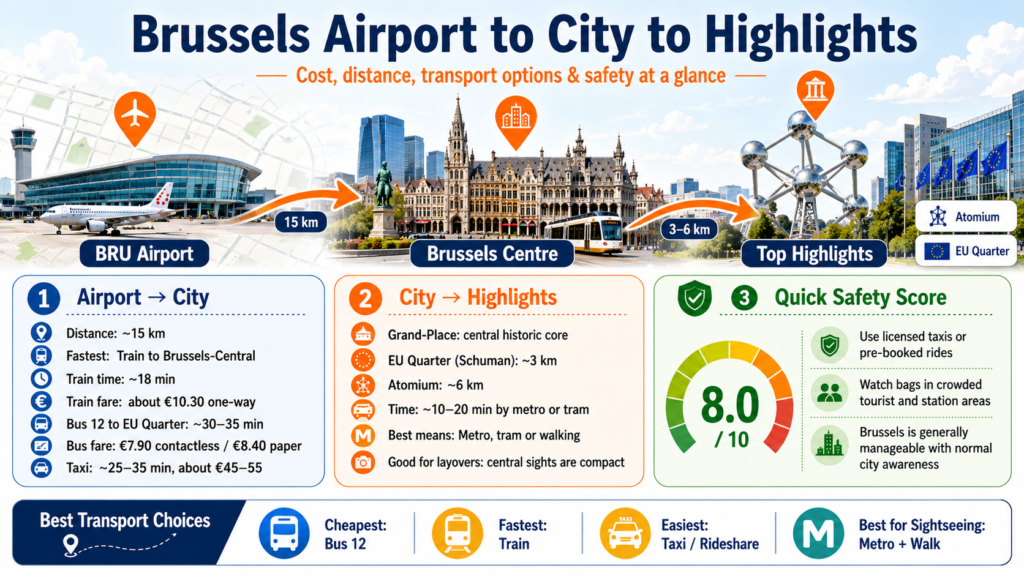
Brussels is the answer sentence first: BRU sits directly beneath the terminal, with a railway station on level -1, meaning the fastest way into the city is also the most obvious one. The airport handled 24.4 million passengers in 2025, and the train to Brussels-Central takes about 18 minutes, six times an hour, from early morning until close to midnight.
The pain point in Brussels isn’t distance or traffic, both of which are genuinely manageable here compared to most cities in this series. It’s a fee most travellers don’t expect: every train ticket to or from the airport carries a mandatory €6.90 Brussels Airport Supplement (formerly the “Diabolo fee”) on top of the ticket price, and it isn’t always obvious it’s been added until you’re looking at a total that seems too high for an 18-minute ride. Knowing this before you buy avoids a moment of confusion at the ticket machine.
The second thing worth knowing before you plan: since 10 April 2026, the EU’s Entry/Exit System, the biometric fingerprint and facial-scan check, has been mandatory at every Schengen border, Brussels included. First-time Schengen visitors should budget extra time at immigration, the same caution that now applies at every Schengen hub in this guide series.
Below: the honest transit maths, what the Diabolo/Brussels Airport Supplement actually costs, how much time the Grand Place and Manneken Pis genuinely need, and how to see the city’s comic-strip murals without missing your gate.
Belgium, as a Schengen member, admits most non-EU visa-exempt nationalities (US, UK, Canada, Australia and around 60 others) for stays up to 90 days within any 180-day period, no advance visa required. The EU’s Entry/Exit System, a biometric fingerprint and facial-scan check, became mandatory at every Schengen border on 10 April 2026, replacing the manual passport stamp for first-time entrants: budget extra time at immigration if this is your first Schengen visit. ETIAS, a separate pre-travel authorisation, has not launched as of this writing. Not sure what applies to your nationality? Our layover visa guide covers transit and entry rules by nationality, or use iVisa if your nationality does require a visa and you want a guided application with human review before your travel date.
Airlines at BRU: Who Flies Here
BRU served 24.4 million passengers in 2025, a 3.3% increase on the prior year, and continues expanding both its short-haul European network and long-haul reach, adding new direct connections to North America and Asia through 2025-2026. As “the heart of Europe” and headquarters of the EU, transfer traffic makes up a meaningful share of the airport’s business, with travellers increasingly choosing BRU as a calmer alternative to larger, more congested hubs like London or Paris.
Brussels Airlines: the Star Alliance hub carrier
Brussels Airlines operates the airport’s largest network, anchoring it as a Star Alliance hub with particularly strong connections to Central Africa (a legacy of Belgium’s colonial-era routes, now a genuine commercial strength few European carriers can match) alongside dense European short-haul. If your itinerary is Brussels Airlines-to-Brussels Airlines or a Star Alliance partner, expect a straightforward single-terminal connection.
Should You Leave the Airport? The Decision Guide
Five hours is the realistic floor for a Brussels layover, and the maths here is more forgiving than most cities in this series: EES-era immigration runs 20 to 45 minutes, the train is a genuinely fast 18 minutes each way, and a 90-minute return buffer covers nearly any scenario given how short the transit distance is.
How much time do you actually have?
Enter your arrival and departure and we calculate the real usable window after immigration, transit and buffer time. Most people have less than they think.
Getting Into Brussels: Every Option, Priced
The train is the obvious default here, and there’s little reason to consider anything else for a standard layover: it’s fast, frequent, and the station sits directly under the terminal.
| Option | To | Time | Cost | Notes |
|---|---|---|---|---|
| Train to Brussels-Central | Brussels-Central | ~18 min | €11.20 one-way (includes the €6.90 supplement) | 6 trains per hour, early morning to midnight. The clear best option for almost every layover. |
| Train to European Quarter | Schuman/EU Quarter | ~20 min | Similar fare, supplement included | 2 trains per hour run direct to the EU institutions area, useful if that’s specifically your destination. |
| Bus (Line 12/21) | Brussels city centre | 30–45 min, traffic-dependent | €2.50–4 | Cheaper than the train but slower and exposed to traffic. Rarely worth it given the train’s speed and reliability. |
| Taxi | Brussels city centre | 20–35 min, traffic-dependent | €45–55 | Official taxis available at a rank outside arrivals. Reasonable for groups or heavy luggage. |
| Pre-booked private transfer | Brussels city centre | 20–35 min | Fixed price, booked in advance | Driver waits in arrivals with a name sign, useful for pre-dawn departures or connecting flights. |
Every train ticket to or from Brussels Airport-Zaventem carries a mandatory €6.90 surcharge, officially the Brussels Airport Supplement and still widely called the “Diabolo fee” after the rail project it funds. It’s built into the standard €11.20 fare shown at ticket machines and the SNCB/NMBS app, so you’re not being overcharged, but it explains why an 18-minute train ride costs more than a typical short urban hop elsewhere in Europe. Off-peak and weekend travel qualifies for a discount on the base ticket price, though the supplement itself stays the same regardless.
Pay for waffles, chocolate and a Grand Place beer the smart way. Belgium is thoroughly card-friendly, but a home bank card can still add foreign transaction fees on every purchase. A Wise or Revolut card set to euros avoids that markup entirely.
Planning an onward leg to Bruges, Ghent or Amsterdam rather than flying? Belgium’s rail network reaches most of these directly from the airport station itself, and international connections onward to Paris, London or Cologne can be compared and booked on Omio.
Your phone needs to work from the moment you land, since the SNCB/NMBS app is the easiest way to buy and validate your train ticket. Install an Airalo Europe eSIM before boarding and it activates the moment you land. For a short layover, Roamless pay-as-you-go data covers a half-day visit for a few euros.
What to Do in Brussels on a Layover
The Grand Place is the honest centre of a Brussels layover: Manneken Pis, the Galeries Royales Saint-Hubert and the start of the Comic Strip Route are all within a 10-minute walk of it, and the train from the airport drops you close enough to reach it on foot.
Grand Place
A UNESCO World Heritage Site since 1998, ringed by roughly 40 guild houses representing medieval trades, with the 96-metre spire of the Gothic Town Hall anchoring one side. The square dates in its current form to a rebuild after a 1695 French bombardment, and it remains one of the most complete surviving guild-hall squares in Europe. Free to visit, floodlit at night, and the natural starting point for everything else on this list.
Manneken Pis and the GardeRobe Museum
A 5-minute walk from the Grand Place: a 55.5cm bronze statue of a urinating boy, first documented in the 15th century and redesigned in 1619, that has become one of Belgium’s most beloved symbols of self-deprecating humour. He’s dressed in one of over 1,000 costumes roughly 130 times a year, and the small GardeRobe MannekenPis museum around the corner displays a rotating selection, including the oldest surviving costume, a gift from King Louis XV of France in 1747. Free to view the statue; the museum charges a small admission.
Galeries Royales Saint-Hubert
Opened in 1847, generally credited as one of Europe’s first covered shopping arcades, with an elegant glass roof and ironwork that still functions as a genuine shopping and dining destination rather than a museum piece. A 3-minute walk from the Grand Place, and the natural spot for a coffee or chocolate stop.
The Comic Strip Route
Since 1991, more than 50 large-scale murals depicting characters from Belgian comics (Tintin, the Smurfs, Lucky Luke and others) have been painted across blank walls throughout the city centre, a deliberate effort to celebrate Belgium’s outsized role in European comic art, sometimes called the “ninth art” here. The famous Tintin mural sits a short walk from the Grand Place; following even a handful of the murals nearby adds real character to a walk you’d be taking anyway.
The Atomium
A 102-metre steel structure representing an iron crystal magnified 165 billion times, built for the 1958 World’s Fair and still one of Belgium’s most recognisable landmarks. It sits well outside the historic centre, a genuine metro trip away, so only attempt it with 9-plus hours and a firm return plan.
Stand near the centre of the square as the guild-hall facades floodlight against the darkening sky, roughly 30 minutes after sunset. The Town Hall’s spire and the gilded details on the guild houses catch the light best from this angle. Weeknight evenings are considerably quieter than weekend afternoons.
Frame the full height of the mural from across the street to capture the trompe-l’oeil effect (Tintin and Snowy descending an illustrated staircase painted directly onto the building’s blank wall). Morning light avoids the crowd density that builds around midday near the Grand Place.
Itineraries by Time Window
The Atomium is genuinely worth seeing, but it sits well outside the compact historic centre, and reaching it adds a dedicated metro trip each way that competes directly with time in the Grand Place area. Only attempt it with 9-plus hours and treat the Grand Place core as the honest default for anything shorter; it delivers more Brussels per hour than the Atomium does on a tight layover.
Travel Scenarios: Real Situations at BRU
You go to buy a simple train ticket at the airport station and the price shown seems too high for an 18-minute ride to Brussels-Central.
Confusion at the machine costs time, and second-guessing whether you’re being overcharged is an unnecessary stress on a layover clock.
Know before you land: the mandatory €6.90 Brussels Airport Supplement (Diabolo fee) is baked into the standard fare. The price is correct; it just isn’t obvious why.
You land at BRU on your first-ever Schengen entry since EES became mandatory, with a 5-hour layover planned around older, pre-2026 transit-time estimates.
First-time biometric enrolment takes longer than a returning traveller’s scan, and a tight 5-hour window can lose its entire margin before you reach the train platform.
Add a genuine 20 to 30 minutes of immigration buffer if this is your first Schengen entry, even at an airport as fast as Brussels.
You have a 7-hour layover and want to see both the historic centre and the Atomium, treating them as roughly equal priorities.
The Atomium sits far enough from the centre that splitting your window between both means neither gets the time it deserves, and the metro connection eats into the margin you need for the return train.
Pick one. Under 9 hours, the Grand Place core delivers more per hour; save the Atomium for a trip with a full day rather than a layover.
You land with a 7-hour layover and a carry-on your airline wouldn’t check through, planning to bring it into the historic centre.
The cobblestone streets around the Grand Place and the narrow alleys the Comic Strip Route winds through are genuinely awkward with a rolling bag, and crowded on any reasonably busy day.
Store it at a Bounce partner location near Brussels-Central the moment you arrive, and walk the rest of the day hands-free.
You bought your outbound ticket at the airport machine but plan to buy the return via the SNCB/NMBS app once you’re in the city, and land with no working data.
Without data, buying a ticket from a random Brussels-Central kiosk works fine, but real-time platform and delay information, which the app provides, does not.
Install an Airalo Europe eSIM before you board so the app and live platform information are available the whole day.
A rare train delay or a longer-than-expected immigration queue eats into your return buffer, and your onward international leg is on a separate ticket.
On a separately booked itinerary, a missed connection’s replacement cost is entirely yours, and a short-notice long-haul fare out of a European hub is rarely cheap.
Carry cover that pays out on missed connections before you fly: World Nomads or comparison via InsureMyTrip.
What to Eat: Brussels in Four Bites
Frites (Belgian fries)
Belgium, not France, is where fries as most of the world knows them actually originated, twice-fried in beef tallow for a genuinely different texture than a single-fry version. A proper cone from a dedicated fritkot, with mayonnaise rather than ketchup, costs €3 to €5 and is the single most Belgian thing you can eat standing up.
Mussels and fries
The national dish, moules-frites: a pot of mussels steamed in white wine, shallots and herbs, served with a side of fries for dipping in the broth. A proper sit-down plate at a Grand Place-area restaurant runs €22 to €30, and it’s worth the extra time it takes to eat properly rather than grabbing something faster.
Belgian waffles
Two genuinely distinct types exist: the crisp, rectangular Brussels waffle, usually topped with powdered sugar or cream, and the smaller, denser, caramelised Liège waffle, sold from street stands as a walking snack. Either runs €3 to €7, and both are worth trying if your window allows.
Belgian chocolate
Brussels takes chocolate as seriously as any city on earth, and the Galeries Royales Saint-Hubert houses several of the city’s best chocolatiers. A small box from a genuine chocolatier, rather than a mass-market airport shop, runs €10 to €20 and makes a far better souvenir than anything sold at the gate.
Staying Inside the Airport: The Under-5-Hours Plan
If the gauge says stay, BRU’s terminal has a genuinely strong selection of Belgian food and chocolate shops, reflecting the country’s culinary reputation rather than generic airport fare, plus solid duty-free retail. Free Wi-Fi covers the terminal, and the airport has been investing in automated border control gates as part of its ongoing modernisation.
Working on shared airport Wi-Fi for a few hours means your banking and saved passwords are travelling over a network shared with thousands of strangers. A VPN closes that exposure in one tap: NordVPN covers the laptop-and-phone combination most travellers carry.
Layover Gear: Connectivity and Power
Your phone needs to work from the moment you land, since buying and validating your train ticket is easiest through the SNCB/NMBS app.
Hotels for Overnight Layovers
Brussels’s short, reliable transit time makes the overnight decision simple: almost any central hotel keeps you comfortably close to the airport for a morning departure.
Tours Worth Booking in Advance
Luggage Storage, Transfers and Insurance
Luggage storage
The airport station has storage options, but for a Grand Place-focused day, storing the bag near Brussels-Central means walking the old town’s narrow streets hands-free.
Airport transfers
The train wins on almost every Brussels journey, but a pre-booked transfer earns its price for pre-dawn departures, heavy luggage, or groups where the per-person train fare (each paying the €6.90 supplement) starts to add up.
Insurance
Belgium is broadly safe for tourists, and the practical risk on a Brussels layover is more about a rare travel delay than anything else, though cover is always worth arranging before an international connection.
If something goes seriously wrong, lost passport, medical emergency, legal situation, you need your country’s consular representation. Our embassy and consulate guide lists every consular office in every city we cover, with direct phone numbers. As the EU’s de facto capital, Brussels hosts one of the densest diplomatic concentrations in Europe.
More Layover Guides
Brussels Layover FAQ
Official BRU and Brussels Resources
Primary sources for live flight, transport and entry information. Bookmark these before you fly.
Safety and Help in Brussels
Sources and Citations
- Travel And Tour World, “Brussels Airport 2025 Traffic Report: 24.4 Million Passengers & Cargo Trends,” January 2026 — passenger totals, network expansion, transfer traffic growth
- Brussels Airport official site (brusselsairport.be) — train station location, frequency (6 trains/hour to central stations, 2/hour to EU Quarter), journey times
- SNCB/NMBS official site (belgiantrain.be) — Brussels Airport Supplement (Diabolo fee) history and current €6.90 rate, standard fare structure, off-peak discount rules
- EU Travel to Europe portal — EES mandatory status confirmed 10 April 2026, ETIAS launch status
- Wikipedia, “Manneken Pis” — statue history, 1619 redesign, wardrobe growth timeline (5 costumes in 1756 to 1,000+ by 2018), Order of the Friends of Manneken Pis
- City of Brussels official site (brussels.be) — Manneken Pis municipal history, GardeRobe museum details
- Complete Guide of the Comic Strip Route in Brussels (2025) — 1991 founding, 50+ murals, “ninth art” framing
- Travel Curious / BRB Travel Blog — Grand Place UNESCO status (1998), Galeries Royales Saint-Hubert history (1847), Atomium detail (1958 World’s Fair, 102m height)
- Various independent Belgium food and culture guides — moules-frites, Belgian waffle types, fries origin debate
- Original EpicLayover research, July 2026
Fares, admission details, timetables and entry requirements were verified in July 2026 and change without notice. Always confirm critical details against the official sources above before travelling. Some links on this page are affiliate links: they cost you nothing and help keep EpicLayover’s guides free and current.
