
8 Epic Lima Layover Ideas for Food Lovers & Explorers
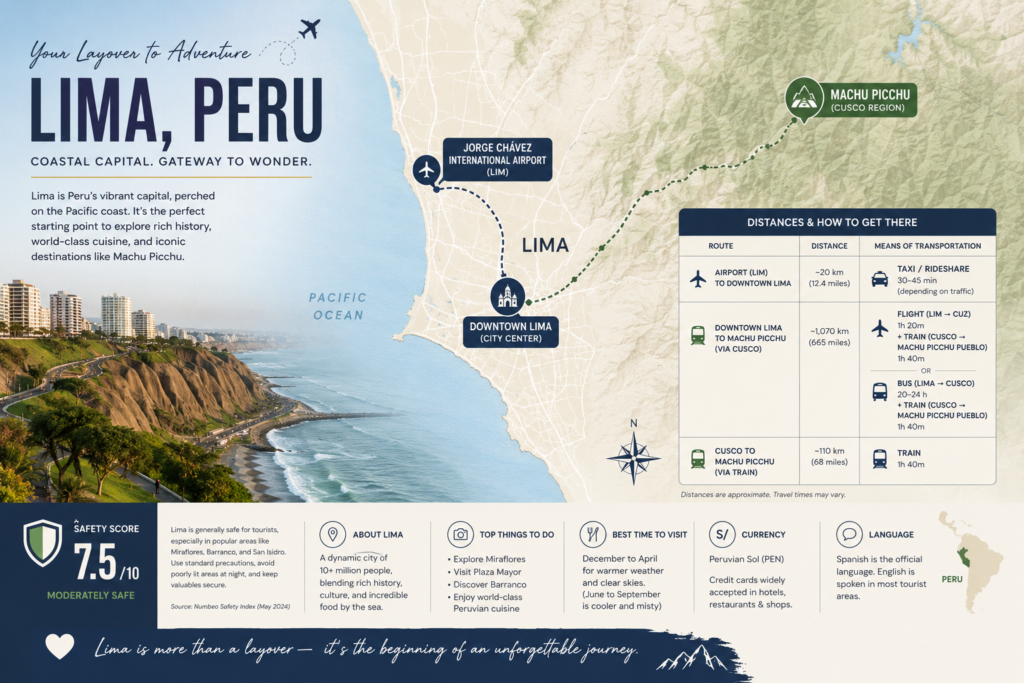
Somewhere inside Jorge Chávez’s brand-new terminal marketplace, a restaurant concept by Mitsuharu Tsumura is taking shape, the chef behind Maido, crowned the World’s Best Restaurant in 2025 by The World’s 50 Best. You read that correctly: the reigning best restaurant on the planet, according to the industry’s own ranking, has a namesake chef with a presence inside the airport you’re connecting through. Lima has spent years being dismissed as a stopover on the way to Machu Picchu. The city, and now even its airport, would like a word.
Lima is the answer sentence first, and it comes with a genuinely important 2026 caveat: Jorge Chávez opened an entirely new terminal on 1 June 2025, three times larger than the old one, and the original terminal building is now permanently closed to passengers. If you’ve flown through Lima before, or if a map or app still points you toward the old building, ignore it completely. Every flight, domestic and international, now uses the new terminal on Av. Morales Duárez.
The pain point that comes with a brand-new, much larger facility: there is no metro or public bus link into it, and the terminal itself is accessible only by vehicle across elevated bridges, with no pedestrian sidewalk. The official Airport Express Lima bus is the recommended default for nearly everyone, a fixed-fare coach that beats both the confusion of public transit (which doesn’t reach the terminal) and the cost of a private taxi.
Below: how the new terminal actually works, why an international-to-domestic connection needs a genuinely generous buffer here, how much time Miraflores and Barranco realistically need, and where to eat well without leaving airport property if your window is too tight to leave at all.
Jorge Chávez International Airport’s entire operation transferred to a brand-new terminal building on 1 June 2025, in a single 12-hour operational pause that moved more than 50 aircraft and every passenger service overnight. The new terminal sits on the north side of the runway, accessed via Av. Morales Duárez, roughly three times the size of the old building. The original terminal, on the south side, is permanently closed to passengers but still appears as “Lima Airport” on some maps and in some older travel content, including guides published before mid-2025. If you’re using a ride-hailing app or a printed itinerary, confirm it’s pointing to the new terminal specifically.
Peru admits most Western passport holders (US, UK, EU, Canada, Australia and others) visa-free for tourism, with immigration determining your specific allowed stay, commonly 90 to 183 days, at the point of entry. Not every nationality qualifies, and Peruvian consular visa processing can take weeks rather than days, so this isn’t something to leave until your layover. Our layover visa guide covers entry rules by nationality, or use iVisa for a guided application with human review if your nationality does require a visa.
Airlines at LIM: Who Flies Here
Jorge Chávez handled 24.5 million passengers in 2024, a record year, and the new terminal’s capacity, eventually reaching 40 million annually, is designed to cement Lima’s position as a genuine regional hub connecting North America, South America and Europe.
LATAM Perú: the dominant hub carrier
LATAM’s Peruvian operation runs the airport’s largest domestic network, connecting Lima to Cusco, Arequipa, Iquitos and dozens of other Peruvian cities, alongside long-haul international routes. If your itinerary is LATAM-to-LATAM, expect a straightforward connection within the new terminal’s single-building layout.
Should You Leave the Airport? The Decision Guide
Six hours is the realistic floor for a Lima layover. The maths: international processing runs 90 to 120 minutes (domestic is faster, 45 to 60 minutes), transit is 45 to 75 minutes each way with no rail alternative, and a 2-hour return buffer accounts for the airport’s genuinely variable road access via Av. Morales Duárez.
How much time do you actually have?
Enter your arrival and departure and we calculate the real usable window after immigration, transit and buffer time. Most people have less than they think.
Getting Into Lima: Every Option, Priced
With no metro or public bus reaching the new terminal, the choice is really between the official Airport Express Lima bus and a car. There is no genuinely bad option here, just a trade-off between price and door-to-door convenience.
| Option | To | Time | Cost | Notes |
|---|---|---|---|---|
| Airport Express Lima | Larcomar / Av. Larco / Parque Kennedy | 45–75 min | From S/15 (~$4–6) | Official, fixed-fare coach, hourly departures roughly 7am–10pm, Wi-Fi, no luggage limit. The recommended default for most travellers. |
| Licensed airport taxi | Miraflores / Barranco / San Isidro | 45–70 min | S/60–95 (~$18–30) | Booked at staffed counters inside arrivals, fixed price by district, escorted to a secure pickup bay. Higher at peak hours. |
| Uber / Cabify / DiDi | Anywhere in the city | 45–70 min, traffic-dependent | S/40–70 off-peak | Pickup from a designated zone at the new terminal, signposted in the app. Requires data and following the correct pickup instructions. |
| Pre-booked private transfer | Anywhere in the city | 45–70 min | From ~$20–30 fixed | Confirmed price before landing, driver meets you inside arrivals. Useful for late-night arrivals or heavy luggage. |
Peru’s international arrival processing typically runs 90 to 120 minutes, domestic 45 to 60 minutes, both longer than several other hubs in this guide series. If you’re connecting from an international flight onward to Cusco, Arequipa or another Peruvian destination, particularly for a time-sensitive Machu Picchu itinerary, book a minimum of 3 hours between flights, and treat anything less as genuinely risky.
Pay for the bus and a pisco sour the smart way. Peru is increasingly card-friendly in Lima’s tourist districts, but a home bank card can still add foreign transaction fees, and airport currency exchange counters run below the street rate. A Wise or Revolut card, or a withdrawal from an arrivals-hall ATM, both beat the exchange counter.
Planning an onward leg to Paracas, Nazca or Cusco rather than flying? Compare bus and transfer options on Omio, useful for the popular southern Peru overland route.
Your phone needs to work from the moment you land, since confirming your Airport Express Lima booking and your rideshare pickup zone both depend on it. Install an Airalo Peru eSIM before boarding and it activates the moment you land. For a short layover, Roamless pay-as-you-go data covers a few hours for a couple of dollars.
What to Do in Lima on a Layover
Miraflores is the honest centre of a Lima layover: a pre-Columbian pyramid, an oceanfront boardwalk and a genuine culinary capital’s core restaurants all sit within a compact, walkable district, and Airport Express Lima drops you directly into it.
Huaca Pucllana
A seven-tiered adobe and clay pyramid built by the Lima Culture between roughly 200 and 700 AD, standing incongruously in the middle of a modern residential neighbourhood, a few blocks from Miraflores’s high-rises. Guided tours run regularly and are the only way inside; the site includes a genuinely excellent restaurant if your window allows a proper sit-down meal with a view of the ruins themselves.
Malecón de Miraflores and Parque del Amor
A clifftop boardwalk running the length of Miraflores’s Pacific coastline, with paragliders launching from the cliffs on breezy afternoons and Parque del Amor’s mosaic-tiled sculpture, inspired by Gaudí, anchoring one section. Free to walk, and the ocean views alone justify the detour even on a short window.
Larcomar
A shopping and dining complex built directly into the Miraflores cliffside, invisible from the street above until you’re inside it, with ocean views from nearly every restaurant. A convenient, weatherproof stop directly on the Airport Express Lima route.
Barranco
Lima’s bohemian district, a short taxi or rideshare from Miraflores, known for colourful colonial-era houses, street art and the Bridge of Sighs (Puente de los Suspiros), a wooden footbridge tied to local romantic legend. Best attempted on an 8-hour-plus window given the extra transit time from Miraflores.
Larco Museum
Housed in an 18th-century vice-royal building built directly over a 7th-century pre-Columbian pyramid, in the Pueblo Libre district, the museum’s chronological galleries cover 4,000 years of Peruvian history. Further from Miraflores than the other options here, so only worth the detour on a longer window with a specific interest in pre-Columbian art.
Shoot the mosaic sculpture with the Pacific and the Miraflores cliffs behind it, ideally an hour before sunset when the light warms the tilework. Paragliders occasionally cross the frame on breezy afternoons, adding genuine motion to an otherwise static shot.
Frame the wooden footbridge from Bajada de Baños, the colourful stairway leading down toward the ocean, with Barranco’s painted houses visible on either side. Morning light avoids the crowds that build by afternoon in this compact, popular district.
Itineraries by Time Window
Lima’s Plaza Mayor and colonial-era historic centre are genuinely worth seeing, but they sit considerably further from the airport than Miraflores and require a dedicated taxi trip each way, adding real time. On a layover, Miraflores delivers more per hour: a pre-Columbian pyramid, an oceanfront walk and the city’s best food scene, all within a single compact district. Save the historic centre for a trip with a full day to spend on it.
Travel Scenarios: Real Situations at LIM
You’ve flown through Lima before 2025, or a friend’s old directions, a printed itinerary, or an outdated map points you toward the original Jorge Chávez terminal.
The old terminal is permanently closed to passengers. Arriving at the wrong building, or directing a pickup driver there, costs real time re-routing to the correct entrance on Av. Morales Duárez.
Confirm any pickup, app booking or printed direction specifically references the new terminal, opened June 2025, before you rely on it.
Your international flight lands with a 2-hour connection to a domestic flight to Cusco, timed against a pre-booked Machu Picchu entry ticket for the following morning.
International processing alone typically runs 90 to 120 minutes. A 2-hour buffer leaves essentially no margin, and missing the Cusco flight can cascade into a missed, non-refundable Machu Picchu slot.
Book a minimum of 3 hours between an international arrival and any onward domestic flight, more if your downstream plans (like a timed Machu Picchu entry) are inflexible. Cover the risk with World Nomads.
You get dropped off near the airport perimeter, planning to walk the rest of the way to save on a longer taxi fare.
The new terminal is accessible only by vehicle, over elevated bridges with no pedestrian sidewalk. Walking in simply isn’t possible, and attempting it near a busy access road is a genuine safety risk with luggage.
Always arrive by bus, taxi, rideshare or private transfer, no exceptions. This isn’t a walkable airport under any circumstance.
You tap your home debit card for the Airport Express Lima ticket, a ceviche lunch and a taxi back, all in soles your bank charges extra to convert.
Foreign transaction fees stack quietly across several small purchases in a single afternoon, exactly the pattern a layover produces.
A Wise card converts at the mid-market rate with no markup, worth setting up before any Peru layover.
You land with no working data and try to arrange a rideshare, relying on memory of how pickup worked at the old terminal.
The new terminal’s pickup zones and access roads are entirely reorganised from the old building, and the app’s in-terminal guidance depends on a live connection to display correctly.
Install an Airalo Peru eSIM before you board so the app’s current pickup instructions are available the moment you land.
Traffic on Av. Morales Duárez runs long on your return, and you miss a tight, separately booked onward international connection.
On a separate-ticket itinerary, the replacement flight cost is entirely yours, and a short-notice long-haul fare out of Lima is rarely cheap.
Carry cover that pays out on missed connections before you fly: World Nomads or comparison via InsureMyTrip.
What to Eat: Lima in Four Bites
Lima is widely regarded as South America’s culinary capital, and Maido, ranked the World’s Best Restaurant in 2025, is proof this isn’t just local pride talking.
Ceviche
Raw fish cured in lime juice with chile, onion and cilantro, traditionally eaten at lunch rather than dinner, since the freshest catch is used earliest in the day. A proper plate at a Miraflores cevichería runs S/35 to S/60, and it’s the single dish most worth prioritising on this list.
Lomo saltado
A stir-fry reflecting Peru’s significant Chinese immigrant influence: beef, onion, tomato and soy sauce, served over fries and rice, a genuinely unusual but beloved combination of textures. Widely available, S/25 to S/45 depending on the restaurant.
Pisco sour
Peru’s national cocktail, made from pisco brandy, lime, sugar, egg white and bitters, and the subject of the same friendly cross-border rivalry with Chile described in this series’s Santiago guide. A proper version at a Miraflores or Barranco bar runs S/25 to S/40.
Peruvian coffee and chocolate
Peru grows some of South America’s best cacao and coffee, and Miraflores and Barranco both have serious independent roasters and chocolatiers worth a stop if your window allows, S/10 to S/20 for a proper espresso or a small box of single-origin chocolate.
Staying Inside the Airport: The Under-6-Hours Plan
If the gauge says stay, LIM’s new terminal genuinely rewards the wait: the food hall reflects Lima’s culinary reputation directly, including concepts tied to some of the city’s most celebrated chefs, rather than generic airport chains. Free Wi-Fi covers the terminal, and Level 4 lounges (including The Club LIM and a LATAM lounge) offer a quieter alternative if you have access.
Working on shared airport Wi-Fi for several hours, at what is now one of South America’s largest and busiest terminals, means your banking and saved passwords are travelling over a network shared with thousands of strangers. A VPN closes that exposure in one tap: NordVPN covers the laptop-and-phone combination most travellers carry.
Layover Gear: Connectivity and Power
Your phone needs to work from the moment you land, since the new terminal’s rideshare pickup and the Airport Express Lima booking both depend on it.
Hotels for Overnight Layovers
The overnight decision at LIM depends on your priorities: stay near the airport for an early departure, or stay in Miraflores for a genuine evening built around Lima’s food scene.
Tours Worth Booking in Advance
Luggage Storage, Transfers and Insurance
Luggage storage
The new terminal has storage options, but for a Miraflores-focused day, storing the bag before boarding the bus means arriving hands-free.
Airport transfers
Given how much value the Airport Express Lima bus already delivers, a pre-booked transfer mainly earns its price for late-night arrivals, heavy luggage, or a preference for a driver meeting you by name rather than navigating the new terminal’s pickup zones.
Insurance
Peru is generally safe for tourists in Miraflores, Barranco and San Isidro, and the practical risk on a Lima layover is more logistical (a missed onward Cusco or Machu Picchu connection) than criminal.
If something goes seriously wrong, lost passport, medical emergency, legal situation, you need your country’s consular representation. Our embassy and consulate guide lists every consular office in every city we cover, with direct phone numbers.
More Layover Guides
LIM Layover FAQ
Official LIM and Lima Resources
Primary sources for live flight, transport and entry information. Bookmark these before you fly.
Safety and Help in Lima
Sources and Citations
- LimaEasy, “The Lima International Airport Jorge Chávez,” December 2025 — new terminal opening (June 2025), 270,000 sqm size, TUUA airport tax figures, transit TUUA postponement
- Passenger Terminal Today, “Lima Airport Partners opens new terminal at Jorge Chávez International,” June 2025 — terminal size, capacity figures (30-40 million passengers), investment amount
- Lima-Airport.com official press release, May 2025 — 1 June 2025 transition day operational details, 12-hour pause, passenger/luggage figures during transition
- TRBusiness, “Lima Airport CCO: Defining the new Jorge Chávez,” August 2025 — Maido/Mitsuharu Tsumura and Jaime Pesaque food concepts in the new terminal marketplace, World’s 50 Best Restaurants 2025 ranking context
- Wikipedia, “Jorge Chávez International Airport” — 2023-2024 passenger figures, terminal and route history
- The Only Peru Guide / How to Peru / Peru Hop, 2026 transport guides — Airport Express Lima fares and schedule, licensed taxi and rideshare pricing, new terminal vehicle-only access via Av. Morales Duárez
- LimaWalkingTour.com, “New Lima Airport Guide,” April 2026 — terminal level layout, old terminal closure confirmation
- Rome2Rio and Machupicchu Terra — Huaca Pucllana and Larco Museum detail, Miraflores distance and transit time figures
- General reference: Barranco district history, Bridge of Sighs, Peruvian visa-exemption policy by nationality
- Original EpicLayover research, July 2026
Fares, admission prices, timetables and entry requirements were verified in July 2026 and change without notice, particularly around the new terminal’s ongoing rollout and the transit TUUA fee’s uncertain reinstatement date. Always confirm critical details against the official sources above before travelling. Some links on this page are affiliate links: they cost you nothing and help keep EpicLayover’s guides free and current.
