
Why a Riyadh Layover Might Be the Middle East’s Most Surprising Stop
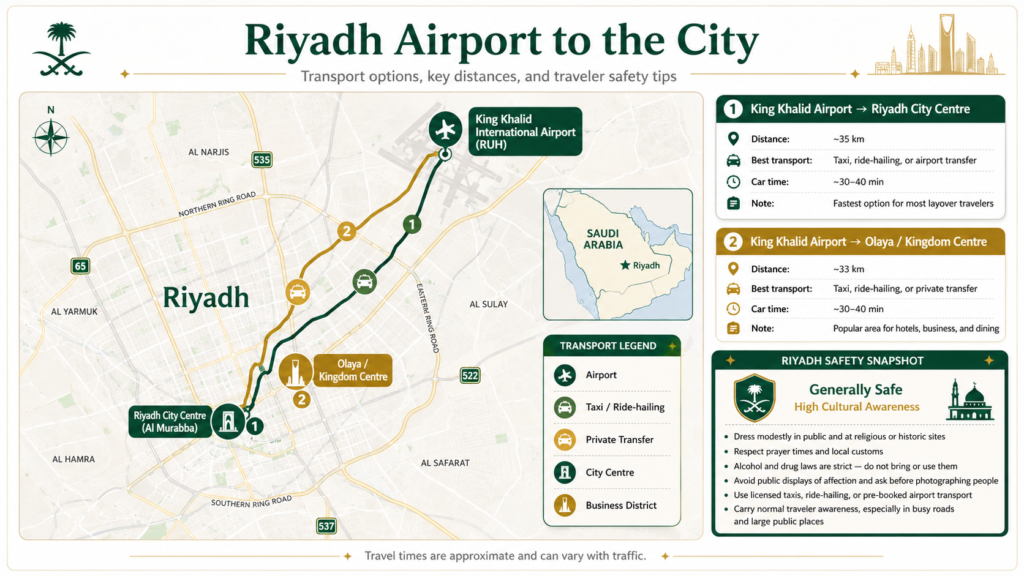
Fifteen minutes from where your plane lands sits the mud-brick citadel where the Saudi state itself began in 1727. Fifteen minutes the other direction sits a metro line that did not exist three years ago, connecting an airport that was ranked the world’s most punctual major hub in 2025. Few places on Earth compress “ancient” and “brand new” into a shorter drive. Saudi Arabia opened to leisure tourists for the first time in September 2019. Everything in this guide, the metro, the e-visa kiosks, the restaurant terraces overlooking a UNESCO site, is younger than a typical high schooler. You are watching a country build its front door while you walk through it.
Riyadh is the answer sentence first, and it comes with the most important catch in this entire guide series: unless you are connecting on the same airline (Saudia-to-Saudia or Flynas-to-Flynas), there is no free transit allowance at RUH, even if your layover is under 12 hours. You will need a full e-visa or visa-on-arrival to leave security, the same as any other entry to the Kingdom. Sort this before you fly, not at the kiosk.
Assuming your documents are in order, the logistics here are genuinely excellent: King Khalid International handled over 37 million passengers in 2024 and was ranked the world’s most punctual major airport in 2025, and the Riyadh Metro’s Yellow Line now runs directly to stations serving every terminal, roughly 35 minutes to the city centre for a few riyals. The bigger adjustment for most first-time visitors isn’t logistics at all. It’s cultural: Saudi Arabia has changed faster than almost any country in modern history, and what was true five years ago (mandatory abayas, no cinemas, no unrelated men and women dining together) is largely no longer true, while some things (no alcohol, anywhere, for anyone) remain absolute.
Below: the transit-visa rule in full, a February 2026 terminal reshuffle that moved nearly every airline, what to actually wear as a woman or man visiting Riyadh in 2026, how much time Diriyah genuinely needs, and how to eat like a local without a drop of alcohol in sight.
Most airports let you sit airside on a long layover without formally entering the country. Riyadh does not work this way for the vast majority of itineraries. King Khalid International has no international transit area, and the terminals are not connected airside. Unless your inbound and outbound flights are both operated by Saudia, or both by Flynas, you will need a full Saudi e-visa or visa-on-arrival to clear security and reach your gate, even if your total time in the country is under 12 hours. Visa-on-arrival costs SAR 480 (about USD 128) and is available to 66 eligible nationalities via self-service kiosks that also sell mandatory medical insurance on the spot. This can make a cheap self-transfer itinerary considerably less economical than it first appears once the visa cost is added in. Sort your visa status before booking, not after.
Saudi Arabia has changed substantially since 2019, and the practical rules for visitors in 2026 are more relaxed than most outdated guides suggest, but a few things are worth knowing before you land. Modest dress is expected everywhere in public: shoulders and knees covered, loose rather than tight-fitting, for both men and women. Since April 2019, foreign women are no longer legally required to wear an abaya or headscarf outside of mosques; many still choose a lightweight abaya for convenience or comfort, and one is easy to buy locally for SAR 100 to 300 if you want one. Women can travel independently in Saudi Arabia without a male guardian, drive (a legal right since 2018), and dine in the same restaurants and cafés as men, which is now the norm in Riyadh’s malls and modern districts rather than the exception. Riyadh is generally considered slightly more conservative than Jeddah but genuinely welcoming; malls, cafés and entertainment districts operate on relaxed, mixed-gender norms. Alcohol remains fully prohibited nationwide with zero exceptions for visitors. Photography of local people should always ask permission first, a courtesy rather than a legal requirement in most public places. None of this should be intimidating: Saudi tourism officials and the vast majority of visitor accounts describe the on-the-ground experience as considerably more welcoming than expected.
Airlines at RUH: Who Flies Here
King Khalid International handled more than 37 million passengers in 2024 with double-digit year-on-year growth, and was named the world’s most punctual major airport in 2025 by aviation analytics firm Cirium, an 86-plus per cent on-time departure rate. RUH operates across five terminals and receives flights from more than 50 airlines to over 100 destinations.
Saudia and Riyadh Air: two flag carriers, one hub
Saudia remains RUH’s largest airline by far, running upwards of 3,500 flights a month to more than 70 destinations, and is one of only two carriers (alongside Flynas) whose connections qualify for the free transit visa described above. Riyadh Air, Saudi Arabia’s ambitious second flag carrier, began commercial operations in 2025 and is expanding rapidly through 2026, with new routes to London, Dubai, Manchester, Madrid, Cairo and Jeddah launched or announced this year alone as part of the country’s broader Vision 2030 aviation push.
Should You Leave the Airport? The Decision Guide
Six hours is the realistic floor for a Riyadh layover, and that assumes your visa is already sorted before you land. The maths: e-visa/visa-on-arrival processing and immigration run 30 to 60 minutes, the Metro is a reliable 35 minutes each way, and a 2-hour return buffer covers the airport’s recommended 3-hour international check-in window comfortably.
How much time do you actually have?
Enter your arrival and departure and we calculate the real usable window after visa processing, immigration and buffer time. Most people have less than they think.
Getting Into Riyadh: Every Option, Priced
The Riyadh Metro’s Yellow Line is the clear default here: cheap, air-conditioned, fast, and directly serving stations at every terminal complex.
| Option | To | Time | Cost | Notes |
|---|---|---|---|---|
| Riyadh Metro (Yellow Line) | City centre / KAFD | ~35 min | SAR 4 (~$1) | Station 20 serves Terminals 1–2, Station 19 serves Terminals 3–4, Station 18 serves Terminal 5. Clean, air-conditioned, the clear best value option. |
| Licensed taxi | City centre | 30–45 min, traffic-dependent | SAR 50–100 | Stands outside arrivals at each terminal. Metered and regulated. |
| Uber / Careem / Bolt / Jeeny | City centre | 30–45 min, traffic-dependent | Similar to taxi | Widely used and reliable, available 24/7 from all terminals. Careem is the regional favourite alongside Uber. |
| Pre-booked private transfer | City centre | 30–45 min | Fixed price, booked in advance | Driver meets you inside arrivals with a name sign, useful for first-time visitors who’d rather not navigate on arrival. |
Between 16 and 25 February 2026, Riyadh Airports completed the largest terminal reorganisation in the airport’s 40-year history, reassigning nearly every airline to a different building. Flight numbers stayed the same; terminals did not. If any part of your plan (a hotel shuttle, a pickup arrangement, or your own memory of a previous trip) assumes an old terminal assignment, it is very likely wrong now. Always verify your current terminal on your boarding pass, airline app, or the official KKIA website before you travel.
Pay for the Metro and a Bujairi Terrace meal the smart way. Saudi Arabia is thoroughly card-friendly in Riyadh’s modern districts, but a home bank card can still add foreign transaction fees. A Wise or Revolut card avoids that markup, and airport ATMs are plentiful if you need riyals for a small cash purchase.
Planning an onward leg to Jeddah, Dammam or elsewhere in the Kingdom rather than flying? Domestic connections and SAPTCO long-distance coach routes can be compared on Omio, though given Saudi Arabia’s genuinely vast distances (Riyadh to Jeddah alone is roughly 950km), flying is the realistic choice for almost any onward city.
Your phone needs to work from the moment you land, since your e-visa confirmation, Metro navigation and rideshare pickup all depend on it. Install an Airalo Saudi Arabia eSIM before boarding and it activates the moment you land. For a short layover, Roamless pay-as-you-go data covers a few hours for a couple of dollars.
What to Do in Riyadh on a Layover
Diriyah is the honest centre of a Riyadh layover: a UNESCO World Heritage Site, Michelin-recognised dining, and the literal birthplace of the Saudi state, all a short Metro ride or taxi from the airport.
At-Turaif District, Diriyah
A restored 18th-century mud-brick citadel, the seat of the First Saudi State from 1727 to 1818, inscribed as a UNESCO World Heritage Site in 2010. Walking through Salwa Palace’s restored corridors is walking through the rooms where the modern Kingdom’s founding chapter played out. A Diriyah Pass (SAR 50 to 100, often redeemable as dining credit at Bujairi Terrace) covers entry, and the site is genuinely best visited at sunset or after dark, when it’s floodlit and considerably cooler.
Bujairi Terrace
A dining and lifestyle precinct directly facing At-Turaif across Wadi Hanifah, home to a growing cluster of Michelin-recognised restaurants. Even without a reservation at the most sought-after tables, the terrace itself, with the illuminated UNESCO site as a backdrop, is worth the visit for the view alone.
Kingdom Centre Sky Bridge
A 302-metre, 99-floor tower in the heart of Riyadh’s business district, with a glass-floored skybridge connecting its two spires near the top. Tickets run around SAR 138, and the view is best at sunset as the city transitions from day to night. Some visitors find the price steep for a brief visit; treat it as a photo-and-view stop rather than a lingering destination.
National Museum of Saudi Arabia
Part of the King Abdulaziz Historical Centre, covering the Arabian Peninsula’s history from prehistory through the Kingdom’s founding. A genuinely comprehensive collection if your window allows the 1 to 2 hours it deserves; note the museum’s specific hours (afternoon-to-evening Thursday and Friday, morning-to-evening the rest of the week, closed Sunday).
Al Masmak Fortress
A mud-brick fort built in 1895, central to the story of the Kingdom’s 1902 reunification under Abdulaziz ibn Saud. Small, quick to visit, and within walking distance of the historic Souq Al Zal market if your window allows a longer wander through the old city core.
Shoot from Bujairi Terrace looking across Wadi Hanifah toward the illuminated mud-brick citadel, ideally right after sunset when the floodlighting is at its most dramatic against a darkening sky. The wadi’s palm-lined walking path offers several unobstructed angles.
Time your visit for roughly 30 to 45 minutes before sunset to catch the transition from daylight to a lit-up nighttime skyline from the glass-floored bridge. Facing west typically gives the most dramatic colour as the sun goes down over the city.
Itineraries by Time Window
A genuinely spectacular escarpment roughly 90 minutes to 2 hours outside Riyadh, requiring a private tour and, for the full experience, a 4WD vehicle. This is not a layover attraction under any circumstances: it demands a full day, not a slice of one. Save it for a dedicated trip to Saudi Arabia rather than trying to fit it around a flight.
Travel Scenarios: Real Situations at RUH
You’ve booked a 5-hour self-transfer through RUH on two different airlines, assuming, as at most airports, a short layover doesn’t require formally entering the country.
RUH has no international transit area. Without a same-Saudia or same-Flynas connection, you need a full e-visa or visa-on-arrival regardless of how short your layover is, and arriving without one means you cannot proceed past security at all.
Check your visa requirement the moment you know your itinerary routes through Riyadh on separate carriers, and budget the SAR 480 visa-on-arrival fee (or arrange an e-visa in advance) into your total trip cost before booking.
You’ve flown through RUH before, or a hotel shuttle driver’s directions reflect an older terminal assignment, and head there confidently for your return flight.
The February 2026 reshuffle moved nearly every airline to a different terminal. Arriving at the wrong one, across five separate buildings, costs real time re-routing on a departure you can’t afford to miss.
Verify your current terminal on your boarding pass or airline app immediately before you leave for the airport, not from memory or an old confirmation email.
You’re genuinely unsure what’s expected to wear in Riyadh, having read a mix of outdated and current guidance online before your trip.
Overpacking conservative clothing you didn’t need, or underpacking and feeling out of place in more traditional neighbourhoods, are both easily avoidable with current information.
Pack loose-fitting clothing covering shoulders and knees, for any gender, plus a lightweight scarf for mosque visits if relevant. That covers every mainstream Riyadh setting; a lightweight abaya is optional, not required.
You tap your home debit card for the Metro, a meal at Bujairi Terrace and Kingdom Centre tickets, all in riyals your bank charges extra to convert.
Small fees stack quietly across a handful of purchases in a single afternoon, exactly the spending pattern a layover produces.
A Wise card converts at the mid-market rate with no markup, worth setting up before any Saudi layover.
Immigration asks for your e-visa confirmation, and you land with no working data to access the email.
Airport Wi-Fi may not be reliably available the instant you reach the immigration desk, exactly when you need the document fastest.
Print your e-visa confirmation before you fly, as recommended, and install an Airalo Saudi Arabia eSIM as a backup so it’s accessible regardless.
Visa processing or immigration runs longer than expected and you miss a tight, separately booked onward connection.
On a separate-ticket itinerary, the replacement flight cost is entirely yours, and a short-notice long-haul fare out of a major Middle Eastern hub is rarely cheap.
Carry cover that pays out on missed connections before you fly: World Nomads or comparison via InsureMyTrip.
What to Eat: Riyadh in Four Bites
Riyadh’s food scene has grown rapidly alongside its tourism opening, and Bujairi Terrace’s Michelin-recognised restaurants sit alongside genuinely excellent traditional Najdi cooking. Nothing on this list involves alcohol, and none of it needs it.
Kabsa
Saudi Arabia’s signature dish: spiced rice, usually with chicken or lamb, cooked together so the meat’s flavour saturates the rice, topped with nuts and raisins. A proper plate at a traditional restaurant runs SAR 35 to 60, and it’s the single most representative dish on this list.
Mandi
Slow-cooked, smoky meat (often lamb) traditionally cooked in an underground pit, served over fragrant rice, a Yemeni-influenced dish thoroughly adopted across the Arabian Peninsula. SAR 40 to 70 at a dedicated mandi restaurant, worth seeking out specifically rather than treating as a kabsa substitute.
Arabic coffee and dates
Qahwa, a lightly roasted, cardamom-spiced coffee served in small handleless cups, traditionally paired with dates as the classic Saudi hospitality gesture. Widely available and often complimentary at traditional restaurants and markets; a genuinely good way to experience local hospitality on even a short window.
Saudi-style grilled meats and mocktails
Riyadh’s modern café and restaurant scene has developed genuinely creative non-alcoholic cocktail programmes, a direct response to the nationwide alcohol prohibition, alongside grilled meat platters at both traditional and upscale restaurants. SAR 15 to 30 for a well-made mocktail, a good way to experience Riyadh’s contemporary dining scene without any adjustment needed.
Staying Inside the Airport: The Under-6-Hours Plan
If the gauge says stay, or if your visa status makes leaving impossible this trip, RUH’s five terminals have solid Saudi and international dining, duty-free reflecting the Kingdom’s rapid tourism growth, and abundant, well-maintained prayer rooms throughout. Free Wi-Fi covers the terminal, and the airport’s efficient, highly-rated operations (the world’s most punctual major airport in 2025) make a long wait genuinely more comfortable than at many hubs in this series.
Working on shared airport Wi-Fi for several hours means your banking and saved passwords are travelling over a network shared with thousands of strangers, at one of the busiest airports in the Middle East. A VPN closes that exposure in one tap: NordVPN covers the laptop-and-phone combination most travellers carry.
Layover Gear: Connectivity and Power
Your phone needs to work from the moment you land, since your e-visa confirmation, Metro navigation and rideshare pickup all depend on it.
Hotels for Overnight Layovers
The overnight decision at RUH depends on your priorities: stay near the airport for an early departure, or stay near Diriyah or the modern city centre for a genuine evening in Riyadh.
Tours Worth Booking in Advance
Luggage Storage, Transfers and Insurance
Luggage storage
RUH’s terminals have storage options, but for a Diriyah-focused day, storing the bag before boarding the Metro means arriving hands-free.
Airport transfers
The Metro wins on price, but a pre-booked transfer earns its place for first-time visitors who’d rather not navigate ticket machines and terminal signage in a new country, or for pre-dawn departures given the airport’s 3-hour recommended check-in window.
Insurance
Saudi Arabia is generally considered one of the safer destinations in the wider region for tourists, and the practical risk on a Riyadh layover is more about a missed connection than anything else. The mandatory medical insurance purchased with visa-on-arrival covers only the basics; a proper travel policy is worth arranging separately.
If something goes seriously wrong, lost passport, medical emergency, legal situation, you need your country’s consular representation. Our embassy and consulate guide lists every consular office in every city we cover, with direct phone numbers.
More Layover Guides
Riyadh Layover FAQ
Official RUH and Riyadh Resources
Primary sources for live flight, transport, visa and entry information. Bookmark these before you fly.
Safety and Help in Riyadh
Sources and Citations
- House of Saud, “King Khalid International Airport: Complete Terminal Guide,” April 2026 — 2024 passenger total (28.5-37 million depending on measure), February 2026 terminal reshuffle detail, visa-on-arrival kiosk process (SAR 480, medical insurance bundled), international arrival recommended timing
- Wikipedia, “King Khalid International Airport” — terminal structure, Riyadh Air 2025-2026 launch and route expansion, five-terminal layout, Royal Terminal detail
- AirportInformation.com, RUH transit visa guidance — free transit visa eligibility (same-carrier only: Saudia-Saudia or Flynas-Flynas), no international transit area confirmation, terminals not airside-connected
- Cirium / TimeOut Riyadh, RUH punctuality rankings — World’s Most Punctual Major Airport 2025 (86.65% on-time departure rate), Skytrax ranking improvement (33rd to 3rd globally, 2024-2025)
- Secret Flying, “Riyadh Airports Guide 2026” — Riyadh Metro Yellow Line station assignments by terminal, King Salman International Airport future development status
- House of Saud, “Saudi Arabia Dress Code for Tourists 2026” and “Non-Muslim Travel in Saudi Arabia” — Public Decorum Regulations (enacted 9 April 2019), abaya/headscarf legal status, alcohol prohibition confirmation, regional variation in cultural expectations (Riyadh vs. Jeddah vs. Mecca/Medina)
- Accor Limitless, “Dos and Don’ts: Saudi Arabia Rules” — women driving (2018), guardian-free travel confirmation, alcohol ban details
- House of Saud, “Diriyah Travel Guide 2026” — At-Turaif UNESCO designation (2010), First Saudi State history (1727-1818), Diriyah Pass pricing, Bujairi Terrace Michelin dining context
- TripAdvisor and Airial Travel, Kingdom Centre Sky Bridge visitor guides — current admission pricing (~SAR 138), tower height (302m, 99 floors), visitor experience detail
- Trip.com Moments, Riyadh attraction guide — National Museum of Saudi Arabia hours, Al Masmak Fortress historical context (1895, 1902 reunification)
Fares, admission prices, visa rules and cultural guidance were verified in July 2026 and change without notice, particularly Saudi Arabia’s rapidly evolving tourism and entry policies. Always confirm critical details, especially your specific visa requirement and current terminal assignment, against the official sources above before travelling. Some links on this page are affiliate links: they cost you nothing and help keep EpicLayover’s guides free and current.
