
9 Amazing Cairo Layover Experiences Beyond the Airport
Most layover passengers connecting through Cairo have no idea they may legally qualify to spend up to 96 hours seeing the only ancient wonder of the world still standing — for free, with EgyptAir picking up part of the tab.
EgyptAir runs a free 96-hour transit visa programme, extended through 2026, for passengers connecting on EgyptAir, Air Cairo, or Nile Air on both legs of their journey, with a layover of at least 8 hours and a qualifying nationality (the US, UK, Canada, Australia, India, Japan, and most EU countries among them). It’s a genuinely under-discussed programme — most travel content covering Cairo layovers treats the city as a quick same-day dash rather than mentioning that, for a meaningful number of passengers, the math actually supports something closer to a real multi-day visit, built entirely around a single connecting itinerary.
And the destination itself needs no embellishment: the Pyramids of Giza are the last surviving wonder of the ancient world’s original seven, built around 2560 BCE, and they sit just 30-45 minutes from the airport by taxi — genuinely one of the shortest airport-to-icon distances of any major historical site on earth. Most travel guides treat “see the Pyramids on a layover” as an exaggerated claim. At Cairo, it is, with the right timing, a literal and entirely realistic plan.
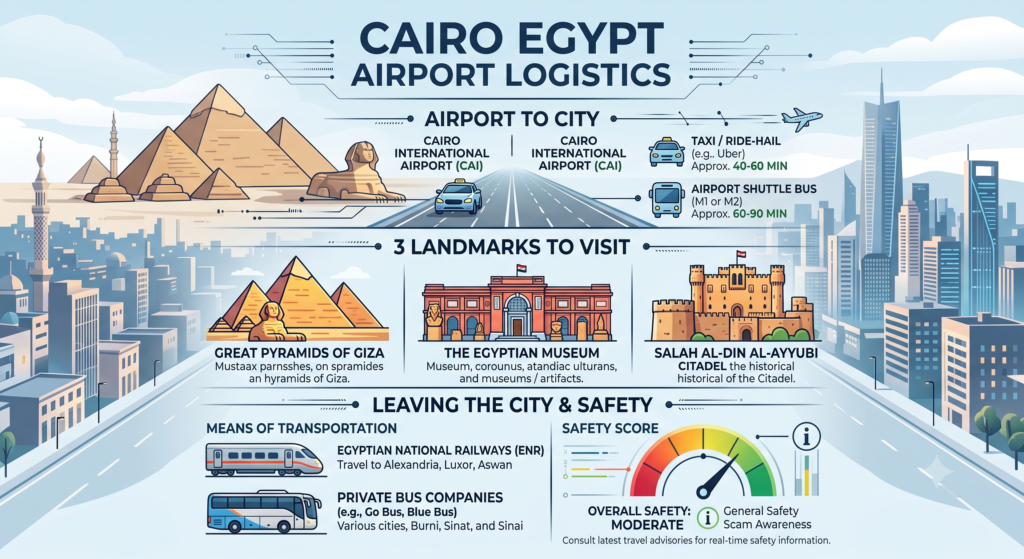
Cairo International Airport (CAI) is Africa’s busiest airport, handling nearly 31 million passengers in 2025, and the primary hub for EgyptAir, Star Alliance’s only carrier based in the MENA region. It sits in Heliopolis, roughly 15-20km northeast of central Cairo, and operates across three passenger terminals — T1 (older, Gulf and African carriers), T2 (smaller, primarily domestic), and T3 (the flagship terminal, EgyptAir and Star Alliance) — connected by a free automated people-mover running 24/7 at 5-10 minute intervals, with the T2-T3 walk doable in about 3 minutes via an interior corridor.
If you’re connecting on a single ticket, same airline, same terminal, your baggage transfers automatically and you stay airside in the transit corridor — genuinely simple. But if you’ve booked your own connection independently without a boarding pass for the next leg, you must purchase an Egyptian visa (USD 25, cash only, paid at a bank kiosk before passport control) and clear immigration, even for a short stay. Critically: do not exit the secure arrivals zone if you’re connecting to another international flight — ask EgyptAir ground staff to direct you to the airside transit corridor instead. Exiting unnecessarily means re-clearing security and immigration on the way back in.
Most Western nationalities can purchase a standard Egyptian visa on arrival for USD 25 (cash only) if leaving the airport for a city visit outside the free transit programme. Separately, EgyptAir’s free 96-hour transit visa applies specifically to passengers connecting on EgyptAir/Air Cairo/Nile Air on both legs with an 8+ hour layover and a qualifying nationality. Note: nationals of Afghanistan, Lebanon, Palestine, and the Philippines must remain in the transit zone regardless of layover length and cannot leave the airport. Verify your specific situation before booking any city plan.
8-10 hours minimum for a focused visit. Budget 45-60 minutes for the visa/immigration process, 30-45 minutes each way to Giza, 2-3 hours at the site, and a 3-hour return buffer given Cairo’s traffic variability and CAI’s genuine size.
If you’re connecting on EgyptAir, Air Cairo, or Nile Air on both legs, your layover is 8-96 hours, and your nationality qualifies for Egypt’s visa-on-arrival (US, UK, Canada, Australia, India, Japan, most EU), yes. Verify directly with EgyptAir before booking, since terms can shift.
Egyptian airspace has remained open throughout the 2026 regional tensions, with no NOTAMs or closures affecting Egypt specifically — disruptions at CAI have been caused by rerouted regional air traffic congestion, not Egyptian restrictions. Still, allow generous connection buffers (3-4 hours minimum) given schedule volatility, and check current conditions before you fly.
Bring cash, specifically USD for the visa fee (exactly USD 25, cash only, no exceptions) and Egyptian pounds for taxis, tips, and smaller vendors near the Pyramids. Card acceptance is inconsistent outside major hotels and chain restaurants.
Should You Leave? The Cairo Layover Gauge
Under 6 hours, stay in the transit zone. Terminal 3 has the airport’s best facilities — multiple EgyptAir Star Alliance lounges (Gienah, Alitoth, Almeisan, Eltier), a business centre, children’s play areas, and duty-free shopping across all terminals.
If you’re confident in your visa status and willing to move efficiently, a focused Pyramids visit (the Giza plateau and the Sphinx, no extended stops) is achievable on the tighter end of this window. Skip the Egyptian Museum or Old Cairo on this timeline — pick one site, not a circuit.
With 8-10 hours, the Giza Pyramids and Sphinx plus a stop at the Grand Egyptian Museum or the older Egyptian Museum downtown is comfortably achievable. If you’re eligible for the free 96-hour transit programme and have any flexibility, this stops being a “layover” question entirely — you have time for Giza, Saqqara, Old Cairo, and the Nile, properly paced.
Work out your Cairo window precisely
Enter your CAI landing time and departure gate-close. If you’re eligible for the 96-hour transit programme, the real question may be “how many days,” not “how many hours.”
Where CAI Actually Flies — EgyptAir’s Network and Major Destinations
EgyptAir, founded in 1932 as Africa’s first airline, is the only MENA-region carrier in Star Alliance, joining in 2008. As of June 2026, it serves 84 international and 9 domestic destinations across 56 countries. A major fleet shift took delivery of EgyptAir’s first Airbus A350-900 on 9 February 2026, making it the launch operator of the type in North Africa — and that aircraft directly enabled a genuine 2026 North American expansion: a Cairo-Los Angeles route launched 23 May 2026 (reviving a city pair Egypt lost after the 1999 loss of EgyptAir Flight 990), followed by Cairo-Chicago O’Hare on 21 June 2026, where EgyptAir is currently the sole carrier offering nonstop service. This brought EgyptAir’s North American network to six destinations: JFK, Newark, Washington Dulles, Toronto, Chicago, and Los Angeles.
Terminal 1 hosts Gulf and African carriers (Air Arabia, FlyDubai, Ethiopian Airlines, Kenya Airways, Air Algérie). Terminal 2 hosts Air France, British Airways, Emirates, Etihad, Qatar Airways, and other major international carriers. Terminal 3, alongside EgyptAir, hosts Star Alliance partners Lufthansa, Turkish Airlines, Swiss, Austrian, and China Eastern. As of March 2026, Star Alliance’s CEO visited EgyptAir’s Cairo headquarters specifically to discuss expanded cooperation, coinciding with the airline’s continued fleet and network growth.
Getting from CAI to Cairo City and Giza
| Option | Time | Cost | Notes |
|---|---|---|---|
| Official Limousine Service Recommended | 30-45 min to Giza | USD 25-40 fixed (varies by category) | Pick-up points curbside at all terminals. Category A (luxury, e.g. Mercedes E-Class), Category B (microbus, up to 7 passengers), Category C (midsize), Category D (London-style taxi). Prices vary by provider — confirm the fare before getting in. |
| Pre-Booked Private Transfer | 30-45 min | USD 25-50 | Driver meets you at the exact arrivals exit with a name board. The safer, more predictable option for a tight return window — particularly valuable given Cairo’s genuine traffic unpredictability. |
| Airport Shuttle Bus | 45-75 min | Low cost, route-dependent | Connects all terminals to the Cairo Airport Bus Terminal, with onward public bus connections to Abbasia and Tahrir Square. Budget option, not ideal for time-constrained connections. |
| Ride-Hailing (Uber/Careem) | 30-45 min | USD 15-30 | Both operate in Cairo. Requires a live data connection from the moment you exit — activate an eSIM before landing. |
If you need a standard visa on arrival (rather than qualifying for the free 96-hour transit programme), it costs exactly USD 25, cash only, paid at a bank kiosk before passport control. Cards are not accepted for this specific transaction. Have the exact amount ready to avoid delays at the kiosk.
What to Do in Cairo on a Layover
The Pyramids of Giza and the Sphinx
The last surviving wonder of the ancient world’s original seven, built around 2560 BCE for Pharaoh Khufu — the Great Pyramid alone originally stood 146.6 metres tall and remained the tallest human-made structure on earth for nearly 3,800 years. The Giza plateau holds three major pyramids (Khufu, Khafre, Menkaure) and the Great Sphinx, all visible and photographable within a focused 2-3 hour visit. Entry to the plateau is roughly USD 11-15; entering the interior of the Great Pyramid costs extra and requires a separate, timed ticket. Camel and horse rides are widely offered at the site — agree a price firmly before mounting, since overcharging tourists is a documented, common issue here.
The Grand Egyptian Museum
The newest major addition to Cairo’s cultural landscape, housing the complete Tutankhamun collection (over 5,000 artefacts displayed together for the first time) alongside thousands of other pieces, positioned directly adjacent to the Giza plateau — making it a natural pairing with the Pyramids visit rather than a separate trip. Allow at least 2-3 hours if you add this on a longer layover.
The Egyptian Museum (Tahrir Square)
The older, downtown museum, still home to a significant antiquities collection even after some pieces transferred to the Grand Egyptian Museum — a viable alternative if your timing or transport favours central Cairo over Giza specifically.
Khan el-Khalili Bazaar
A centuries-old market in Islamic Cairo, dense with spice stalls, jewellery, textiles, and traditional coffee houses — a genuinely different register from the Giza plateau’s open desert setting, and a strong choice if you want street-level Cairo rather than another monument.
The Giza Plateau — All Three Pyramids in One Frame
From the designated panoramic viewpoint on the plateau’s southern edge (most taxi drivers and guides know this spot specifically), all three major pyramids align in a single wide shot, with the desert and, increasingly, the encroaching edge of Cairo’s suburbs visible in the background. Morning light (before 10am) avoids both the worst heat and the haze that builds over the city later in the day.
Before 10am. Southern plateau viewpoint, all three pyramids in frame.
The Cairo Layover Itinerary
45-60 minutes for visa processing (or transit visa registration). 30-45 minute transfer.
2.5-3 hours for the plateau, the Sphinx, and photography.
A traditional Egyptian meal at a restaurant near the plateau. 60-75 minutes.
Adjacent to the Giza plateau. 2-2.5 hours, including the Tutankhamun collection.
30-45 minute transfer. Build in a 3-hour departure buffer given Cairo’s traffic variability.
As above.
2.5-3 hours for the pyramids and Sphinx.
30-45 minute transfer back. Build in the full 3-hour departure buffer.
Cairo Layover Scenarios — Real Situations, Specific Solutions
Some travellers, unfamiliar with CAI’s layout, exit the secure arrivals zone without realising they should have stayed airside for an international-to-international connection.
Re-entering means re-clearing security and immigration, costing real time you may not have.
Ask EgyptAir ground staff immediately upon disembarking to direct you to the airside transit corridor, before following general arrivals signage. If you’ve already exited, allow extra time to re-clear.
The standard Egyptian visa-on-arrival fee is exactly USD 25, cash only — no cards, no other currencies accepted at the bank kiosk.
Arriving without exact USD cash can mean delays or being turned away from the kiosk entirely.
Carry USD 25 in cash specifically for this before you fly — don’t assume an ATM or currency exchange will be conveniently positioned before the kiosk.
2026 regional airspace rerouting has caused schedule volatility at CAI even though Egyptian airspace itself has remained open and unaffected by closures.
Last-minute gate changes and delays have been more common than usual during the disruption period.
Check your flight status on your airline’s app the morning of departure, allow a minimum 3-4 hour connection buffer for international transfers, and stay near your gate area rather than wandering far once back at the airport.
Overcharging tourists for camel/horse rides and photo opportunities at the Giza plateau is a documented, common issue.
A vague or unconfirmed price before mounting can turn into a significantly inflated demand afterward.
Agree a firm, specific price in writing or with a witness before any ride or photo begins, and consider booking a reputable guided tour instead, where this is handled for you.
Eligibility requires EgyptAir, Air Cairo, or Nile Air on both legs, an 8-96 hour layover, and a qualifying nationality — conditions can shift, and the programme’s extension dates change.
Assuming eligibility without verifying could mean arriving without the documentation or status you expected.
Verify your specific eligibility directly with EgyptAir before booking, particularly the current extension date and your nationality’s status.
Ride-hailing apps require a live data connection, and international card acceptance at airport ATMs can be inconsistent.
Without working data, requesting a ride or confirming a fare stalls right when you need it most.
Activate an Airalo Egypt or Middle East eSIM before landing.
Food in Cairo
Koshari
Egypt’s national dish — a hearty mix of rice, lentils, chickpeas, and macaroni, topped with a spiced tomato sauce and crispy fried onions. Genuinely cheap, filling, and found everywhere from street stalls to sit-down restaurants.
Ful Medames
Slow-cooked fava beans, mashed and seasoned with cumin, garlic, and lemon — a breakfast staple eaten throughout the day, usually with flatbread for scooping.
Egyptian Tea and Coffee Culture
A proper Egyptian tea (often heavily sweetened) or a traditional coffee at a Khan el-Khalili coffee house is a genuine slice of daily Cairo life — worth the stop if your itinerary takes you through Islamic Cairo.
The Great Pyramid was the tallest structure built by human hands for roughly 3,800 years — longer than the entire span of recorded history that came after it was finished. It is, as of this morning and every morning for the past 4,500 years, still standing exactly where it was built, thirty-some minutes from a runway that didn’t exist for all but the last hundred of those years. Most of the people walking off a plane today and seeing it for the first time will spend less time at the pyramid than they spent in the immigration queue getting there. That ratio has nothing to do with the pyramid and everything to do with how short a layover actually is, set against something built to outlast every government, language, and airline that has ever flown over it.
Gear, eSIM, and Connectivity
Activate before landing for ride-hailing apps and navigation from the moment you exit the terminal.
Get an eSIM →CAI terminal Wi-Fi and city café networks are both open. Banking access on a public network — covered in under a minute.
Get NordVPN →Exactly USD 25, cash only, for the standard visa on arrival. Bring it before you fly.
Get Wise →Missed-connection protection, relevant given 2026 schedule volatility at CAI driven by regional rerouting.
Get a Quote →Insurance and Hotels
The most convenient on-site option, directly connected to Terminal 3 — ideal for an overnight layover or the start of a 96-hour transit stay.
Check availability →For a longer 96-hour transit stay where the Pyramids and Cairo’s wider sights are the priority.
Check availability →Frequently Asked Questions
Yes — the Giza Pyramids are 30-45 minutes from CAI by taxi, among the shortest airport-to-icon distances of any major historical site globally. An 8-10 hour layover comfortably supports a focused 2.5-3 hour visit to the plateau plus the transfers and immigration processing, with a safe return buffer.
A free transit visa run by EgyptAir, extended through 2026, for passengers connecting on EgyptAir, Air Cairo, or Nile Air on both legs of their journey, with a layover of 8-96 hours and a qualifying nationality (including the US, UK, Canada, Australia, India, Japan, and most EU countries). It allows you to leave the airport and explore Cairo for up to four days without a standard visa fee. Verify your specific eligibility directly with EgyptAir before booking.
No — Egyptian airspace has remained open throughout the 2026 regional tensions, with no NOTAMs or closures affecting Egypt. Disruptions at CAI have been caused by rerouted regional traffic congestion from neighbouring airspace restrictions, not by Egyptian restrictions themselves. Still, allow generous connection buffers (3-4 hours for international transfers) given the resulting schedule volatility, and check current flight status before heading to the airport.
Exactly USD 25, cash only — no cards accepted, no other currencies. Paid at a bank kiosk before passport control. This is separate from EgyptAir’s free 96-hour transit visa programme, which has different eligibility requirements and no fee.
Cairo International Airport (CAI) — Official Resources
Flight information, terminal guidance, and current operations for Africa’s busiest airport and EgyptAir’s home hub.
The official, current US travel advisory for Egypt — check before finalising any city-exit plans.
travel.state.gov →Official Egyptian visa and entry requirement information by nationality.
mfa.gov.eg →Current hours, ticket pricing, and booking for the new flagship museum adjacent to Giza.
grandegyptianmuseum.org →Booking, the 96-hour transit visa programme, and current route network for CAI’s hub carrier.
egyptair.com →National emergency numbers for Egypt, valid throughout Cairo and the airport.
A leading Cairo hospital with English-speaking staff, commonly used by international visitors.
Cairo International Airport passenger services — terminal information and connection assistance.
- Cestee / Cairo Airport Ride / Wikipedia CAI Terminal Guides. 3 terminals (T1, T2, T3) plus seasonal Hajj terminal; free people-mover 24/7, 5-10 min intervals; T2-T3 walkable in 3 min; T3 is EgyptAir/Star Alliance hub; 30.94M passengers 2025; standard visa USD 25 cash only. 2026.
- Wego Travel Blog. EgyptAir 96-hour free transit visa extended through April 2026; eligibility requires EgyptAir/Air Cairo/Nile Air both legs, 8-96 hour layover, qualifying nationality; Egyptian airspace remained open throughout 2026 US-Iran conflict, no NOTAMs or closures; disruptions caused by regional rerouting congestion. April 2026.
- Wikipedia / TravelAndTourWorld EgyptAir network coverage. 84 international + 9 domestic destinations, 56 countries as of June 2026; Star Alliance member since 2008, only MENA-based carrier; first A350-900 delivered 9 February 2026; Cairo-LAX launched 23 May 2026, Cairo-ORD launched 21 June 2026, EgyptAir sole carrier on both routes. 2026.
- SFO777 / Cestee traveler reports. Giza Pyramids 30-45 min from CAI; Great Pyramid built ~2560 BCE, tallest human structure for ~3,800 years; camel/horse ride overcharging documented common issue. 2026.
Disclaimer: Entry requirements, the 96-hour transit visa programme terms, and current regional conditions are subject to change — verify directly with EgyptAir and at travel.state.gov before travel. Fares and hours otherwise verified June 2026. Affiliate links may earn EpicLayover a commission at no additional cost to you.
