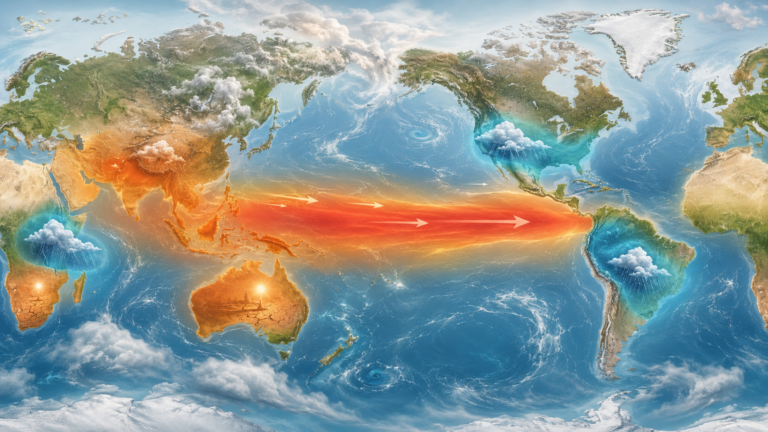
El Niño 2026–27: What Travelers Need to Know Before Booking
Most travelers know to check the weather before leaving home. Far fewer consider whether a climate pattern developing thousands of miles away could affect the road from the airport, the air at a national park, the water at a dive site, or the connecting flight home. That oversight is becoming more consequential as El Niño strengthens across the tropical Pacific.
The National Oceanic and Atmospheric Administration’s Climate Prediction Center reported in its August 13 advisory that El Niño conditions are firmly established and strengthening, with a greater than 90 percent probability of the event becoming very strong during Northern Hemisphere fall and winter 2026–27. NOAA has also placed the odds at 69 percent that this event will exceed the measured strength of every El Niño in its records dating to 1950. The World Meteorological Organization’s August update raised the probability of persistence through December 2026–February 2027 to nearly 100 percent.
NOAA cautions that the strength of an El Niño does not translate directly into the magnitude of impacts in any particular city or region. That uncertainty is itself a planning problem.
El Niño is not a storm moving toward a destination. It is a large-scale shift in ocean and atmospheric conditions that can alter the odds of drought, heavy rain, heat, and other weather patterns across very different parts of the world simultaneously — in contradictory directions. A trip does not need to encounter a natural disaster to be seriously disrupted. A flight might arrive normally in Peru while flooding makes the next leg difficult. A traveler in Australia could encounter bushfire smoke or extreme heat without ever seeing a fire. Someone in Indonesia could be hundreds of miles from a burning peat forest and still experience air that grounds plans and reroutes itineraries.
For people who have already committed to a cruise, safari, dive trip, guided tour, or a complicated international itinerary, those secondary effects can matter almost as much as the weather itself.
Peru and Australia Illustrate the Two Faces of One Event
Few destinations illustrate the geographic contradictions of El Niño as clearly as Peru and Australia — two countries on opposite sides of the Pacific, both already affected, in almost opposite ways.
Peru placed 893 districts across 22 regions under formal emergency on September 1, 2026. The Multisectoral Commission for the Study of the El Niño Phenomenon (ENFEN) has maintained a Coastal El Niño Alert since February. In its August 28 update, ENFEN assigned a 62 percent probability to an extraordinary-magnitude coastal event between September 2026 and January 2027. Rains linked to coastal El Niño conditions between January and March of this year killed at least 92 people and displaced more than 23,000, according to UN OCHA figures.
The concern for travelers is not simply whether it will rain. Heavy rainfall affects highways, bridges, and local transportation. Landslides have historically interrupted routes through mountainous terrain. A traveler could arrive in Lima successfully and find that another segment of the itinerary — a road to a trailhead, a highway through a mountain pass, a transfer to a departure point — has become impractical.
Across the Pacific, Australia faces a different problem from the same event. The Australian and New Zealand Council for Fire and Emergency Services published its seasonal outlook in August, identifying elevated bushfire risk across most states and territories for the coming spring. The Bureau of Meteorology’s seasonal guidance shows increased odds of below-average rainfall across southern and eastern Australia, and fire authorities are also monitoring a developing positive Indian Ocean Dipole — a combination that climate scientists describe as among the most dangerous conditions for fast-moving bushfires.
Smoke from a fire does not need to reach a hotel to affect a trip. It can affect air quality and visibility across a wide area, close parks and roads, and complicate long-distance itineraries that depend on conditions remaining stable across several days.
In Indonesia, the Threat May Be in the Air
Indonesia demonstrates why travelers should look beyond conventional destination forecasts.
Strong El Niño periods have historically been associated with reduced rainfall across parts of Sumatra, Kalimantan, and other Indonesian islands. During severe episodes, prolonged drought has created conditions in which forest and peat fires spread and sustain themselves for months. The 1997–98 El Niño produced fires that generated a vast regional haze event affecting communities and aviation operations across Southeast Asia — reaching Malaysia, Singapore, and Thailand.
For someone visiting Bali, the relevant question may not be whether there is a wildfire near the hotel. It may be what the air quality looks like across the route, and whether regional aviation could be affected if conditions deteriorate.
The Event Extends Well Beyond the Pacific
The effects of a strong El Niño reach across multiple continents, often in ways that don’t follow a single pattern.
In Ecuador, which often serves as a gateway for travelers heading to the Galápagos Islands or coastal destinations, flooding and landslides can interrupt the mainland connections that expensive onward reservations depend on. An operating airport in Quito does not necessarily mean an operating itinerary.
In India, El Niño can influence monsoon strength and timing, though the relationship is complex and no individual season can be predicted from El Niño conditions alone. Changes in rainfall carry consequences for extreme heat, water availability, and transportation.
Parts of the Philippines have historically experienced below-normal rainfall and drought during El Niño episodes — concerns that deserve consideration before a traveler commits to a set of nonrefundable island reservations.
El Niño can also shift the position of the Pacific jet stream and influence winter weather across North America. For travelers making tight connections through major U.S. airports, or heading into mountain regions for the ski season, flooded roads and delayed incoming aircraft can affect a journey even when the sky above the departure city is clear.
Parts of Brazil, Papua New Guinea, and southern Africa have experienced significant drought and heat during past strong El Niño events — relevant to wildlife tourism, river travel, and long overland itineraries.
The Airport Can Be Open and the Trip Can Still Fail
Travel planning has traditionally concentrated on the destination: What will the weather be like? Is the hotel open? Is the flight operating? A major El Niño argues for a different question: Where are the vulnerable points in the itinerary?
EpicLayover recommends that travelers visiting potentially exposed destinations during 2026–27 treat El Niño as a planning variable rather than a forecast. Before booking, research how a destination has historically responded to major El Niño events and identify whether the relevant risk involves flooding, drought, heat, smoke, marine conditions, or transportation disruption. Before committing to expensive nonrefundable arrangements, identify the segments that would be hardest to replace: a connecting flight, a ferry, a remote lodge, a cruise departure, a guided mountain trek, or a long overland transfer.
Travel insurance warrants careful reading rather than assumption. Purchasing a policy after a disruption has become a known event may be too late for some categories of coverage. The purpose is not to discourage travel. It is to avoid discovering a foreseeable problem after the journey has already begun.
EpicLayover El Niño Travel Advisory 2026–27
EpicLayover has published an El Niño Travel Advisory 2026–27 resource center to translate a complicated climate story into individual travel decisions — not by declaring every destination dangerous or safe, but by helping travelers understand what El Niño could mean for a specific place, in a specific month, on a specific kind of trip.
- El Niño Travel Advisory Hub: epiclayover.com/el-nino-travel-advisory
- El Niño Destination Risk Finder: 12-destination interactive risk assessment covering Bali, Thailand, Peru, Australia, the Maldives, India, Kenya, Japan, the Caribbean, California, Europe, and Brazil
- Pre-Booking Checklist: Eight-point planning guide for travelers visiting El Niño-exposed destinations
- 72-Hour Travel Checklist: Operational review guide for final preparations before departure
- Layover Cost Calculator: epiclayover.com/layover-cost-calculator
Travelers should continue to rely on official meteorological agencies, emergency authorities, airlines, and local governments for current operational conditions.
- NOAA Climate Prediction Center — ENSO Diagnostic Discussion, August 13, 2026. cpc.ncep.noaa.gov — greater than 90% probability of very strong El Niño, fall–winter 2026–27.
- World Meteorological Organization — El Niño/La Niña Update, August 2026. wmo.int — nearly 100% probability of persistence through December 2026–February 2027.
- ENFEN (Peru) — Official Update, August 28, 2026. 62% probability of extraordinary-magnitude coastal El Niño, September 2026–January 2027.
- Government of Peru — Supreme Decree, September 1, 2026. Emergency declaration covering 893 districts across 22 regions and Callao.
- UN OCHA / ECHO — At least 92 deaths and 23,000+ displaced in Peru, January–March 2026.
- AFAC — Seasonal Bushfire Outlook, August 2026. Elevated bushfire risk across most Australian states and territories for spring 2026.
- Australian Bureau of Meteorology — Seasonal Outlook, August 2026. Below-average rainfall odds across southern and eastern Australia; soil moisture deficits expanded as of July 2026.
- NOAA GFDL SPEAR — July 2026 El Niño experimental predictions. gfdl.noaa.gov
Source data last reviewed September 30, 2026. All forecasts subject to revision. Travelers should verify current conditions with official meteorological and emergency-management authorities before departure.
EpicLayover.com is a travel intelligence platform focused on helping travelers make better decisions before and during complex journeys. Its resources cover layovers, stopovers, destination risk, airport-to-city planning, travel disruption, calculators, and practical travel-planning tools. The El Niño Travel Advisory 2026–27 is available at epiclayover.com/el-nino-travel-advisory.