

Pet Passport Guide: UK, USA, Canada, Asia and India Rules
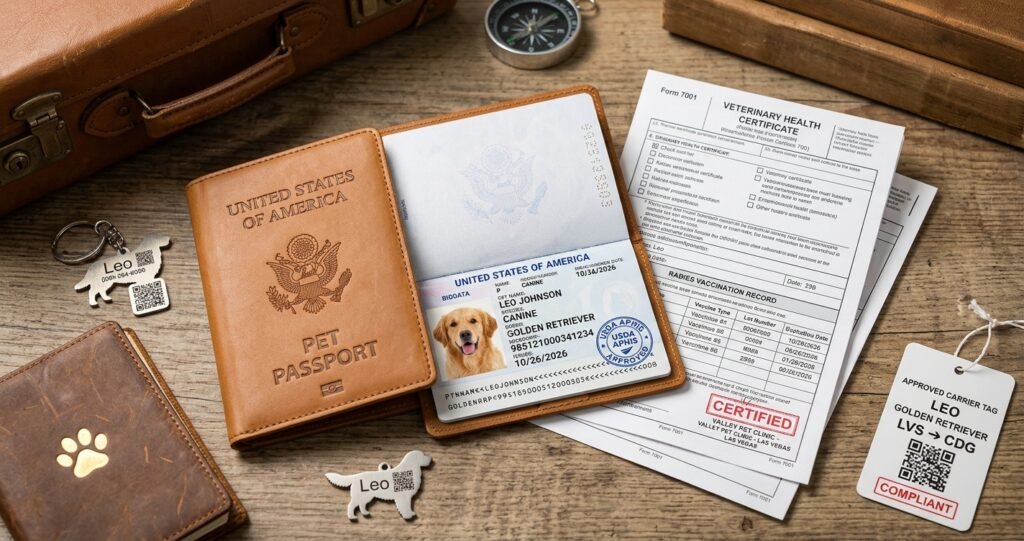
A pet passport is a real document only in the EU, where vets issue one to dogs, cats and ferrets whose owners live there. Elsewhere, “pet passport” means a document set: a microchip record, rabies proof, sometimes a blood test, a government-endorsed health certificate and, for much of Asia and India, an import permit issued before you fly.
That is why one-line answers go wrong. A US owner searching for a pet passport needs a USDA-endorsed health certificate. A UK owner needs an animal health certificate for each EU trip. An owner flying to Japan needs about seven months of preparation. This guide sets out who issues each document, who endorses it, where you go for it and how long it lasts, for the UK, the US, Canada, Japan, Singapore, Hong Kong, Thailand and India.
What is a pet passport, and who can actually get one?
An EU pet passport is a booklet issued by an authorized veterinarian in an EU country that records your pet’s microchip and rabies vaccinations, and lets the animal move between EU countries on a non-commercial trip. The European Commission’s rules for travel within the EU require a valid EU pet passport and, under the newest rules, a written declaration that the trip is non-commercial (European Commission: traveling with a pet within the EU[1]).
Who can get one is now narrower. GOV.UK says EU pet passports are issued only to people whose main home is in the EU, not to holiday-home owners or seasonal visitors, and that from April 22, 2026, Great Britain residents should no longer use EU pet passports to enter the EU (GOV.UK: new EU rules for GB residents[2]). GB residents can still use one for the journey back into Great Britain.
Key terms in this guide
- Non-commercial movement: travel with your own pet, with no sale or change of owner. The EU and UK cap it at five pets in most cases.
- Official veterinarian (OV): a vet authorized by the government to sign export and travel certificates, such as an animal health certificate in Great Britain.
- USDA-accredited veterinarian: a US vet authorized to issue international health certificates, which the USDA’s Animal and Plant Health Inspection Service (APHIS) then endorses.
- Endorsement: the government’s signature and stamp on a vet’s certificate. Without it, most countries treat the certificate as invalid.
- Rabies titer test (FAVN or RNATT): a blood test that proves the rabies vaccine worked. Japan, Singapore and Hong Kong’s higher-risk groups use one.
- Import permit: permission from the destination country, issued before departure. Singapore, Hong Kong, Thailand and India require one for dogs and cats.
Pet passport rules by country at a glance
Every country below accepts or requires a different document set, so read across the row for the place your pet will enter, not the place you live.
| Country | What replaces a “pet passport” | Who issues it | Who endorses or approves it | Lead time to plan for |
|---|---|---|---|---|
| United States (leaving) | International health certificate for the destination | USDA-accredited vet | APHIS, online through VEHCS or at an endorsement office | Weeks to months, depending on the destination |
| EU (from the US) | EU non-commercial animal health certificate | USDA-accredited vet | APHIS, within 10 days of arrival; original ink for France | Rabies at least 21 days before travel |
| United States (dogs returning) | CDC Dog Import Form receipt; extra forms after high-risk countries | You (online) | CDC | Before you leave the US |
| Great Britain (to the EU) | Animal health certificate (AHC), one per trip | Official vet | The official vet signs it | Issued within 10 days before you enter the EU |
| Great Britain (to non-EU) | Export health certificate (EHC) plus EXA form | Official vet you nominate | APHA process via GOV.UK | Depends on the destination |
| Canada (entering) | Rabies vaccination certificate (English or French) | Licensed vet | Checked at the border | Vaccination must be current on arrival |
| Canada (leaving) | Export certificate for the destination | Licensed vet | CFIA veterinarian, by appointment | Book as early as possible |
| Japan | Government-endorsed health certificate, titer result, advance notice | Your vet and a designated lab | Exporting country’s authority; Japan’s Animal Quarantine Service | About 7 months from a non-designated region |
| Singapore | Dog or cat license plus import license | NParks/AVS | AVS inspection on arrival | Titer drawn at least 90 days before export |
| Hong Kong | AFCD Special Permit plus animal health certificate | AFCD | AFCD on arrival | At least 3 to 5 working days for the permit |
| Thailand | Import permit plus endorsed health certificate | Department of Livestock Development (DLD) | DLD quarantine station on arrival | At least 7 business days before departure |
| India | No Objection Certificate (NOC) plus health certificate | AQCS station in India | AQCS on arrival | About 1 month if you need a DGFT license |
The rest of this guide explains each row, starting with the US, where most of our readers start.
United States: there is no US pet passport
The US doesn’t issue a pet passport. To take a dog or cat abroad, a USDA-accredited veterinarian completes the health certificate your destination requires, and APHIS endorses it. APHIS tells accredited vets that the process can take a few weeks to many months, depending on the destination country, and that the certificate covers the first country where the pet clears customs after leaving the US (APHIS: FAQ for accredited veterinarians[3]).
Where to get US documents endorsed
Most certificates now go through the Veterinary Export Health Certification System (VEHCS), APHIS’s online system. Your vet issues and signs the certificate in VEHCS and submits it to APHIS. Some countries accept APHIS’s digital endorsement. Others, including Thailand, still want an original paper certificate with an ink endorsement, so check the banner on your destination’s APHIS page before your vet starts. If your destination isn’t listed, APHIS says the foreign government hasn’t told it the requirements, and you’ll need to ask that country’s embassy or agriculture ministry directly.
Bringing a dog back into the US
The return trip is where US owners get caught out. Dogs entering the US from rabies-free or low-risk countries need a CDC Dog Import Form receipt, a microchip that a universal scanner can read, and must be at least six months old (CDC: dog import FAQs[4]). India and Thailand are both on CDC’s list of high-risk countries[5] for dog rabies (CDC: high-risk countries[5]), and a dog that has been in either during the past six months needs extra paperwork. For a US-vaccinated dog, that includes a rabies form your vet submits and APHIS endorses before the dog leaves the US, according to APHIS’s VEHCS guidance[6]. Sort the return before you book the outbound flight.
What a US endorsement costs
APHIS charges per certificate, not per pet: $101 when the certificate verifies no lab tests, $160 for one or two tests, $206 for three to six and $275 for seven or more, plus $10 to $21 for each extra pet on the same certificate. Vaccines don’t count as tests, and service dogs as defined by the ADA are exempt (APHIS: cost to endorse[7]). Our Pet Travel Cost Calculator works out the fee for you.
Entering the EU from the US: the closest thing to a pet passport
US pets enter the EU on an EU animal health certificate, which works like a single-trip pet passport. Since October 1, 2026, a new certificate format is required for non-commercial trips, following EU rules that took effect on April 22, 2026 (APHIS: US to Italy[8]).
The timing has two clocks. APHIS says the certificate is valid for 30 days after your USDA-accredited vet issues it, and USDA must endorse it within 10 days of your pet’s arrival in the EU. Once you’re in, it covers travel within the EU for up to six months from entry, as long as the rabies vaccination stays valid (APHIS: EU certificate rules[9]). France also wants an original ink endorsement, so check your destination’s APHIS page before your vet starts (APHIS: US to France[10]).
Two vet details trip people up. The microchip has to go in before the rabies shot, and APHIS advises a rabies vaccination at least 21 days before travel but less than a year before (APHIS: US to Italy[8]). That’s because a primary rabies vaccine given in the US counts for one year for EU travel (APHIS: US to France[10]). For the full route plan, including transit and the trip home, see the international pet travel guide.
United Kingdom: animal health certificates, not pet passports
Pet passports issued in Great Britain stopped working for EU travel in 2021. Since April 22, 2026, GB residents also shouldn’t rely on EU-issued pet passports to enter the EU. Instead, you need an animal health certificate (AHC) for every trip from Great Britain to the EU.
GOV.UK sets out the AHC rules (GOV.UK: getting an animal health certificate[11]):
- Who signs it: an official veterinarian. If your own vet isn’t an OV, they can help you find one.
- When: the certificate is valid for entering the EU for 10 days after the vet issues it.
- How long it lasts after that: six months for onward travel within the EU and six months for re-entry to Great Britain, provided the rabies vaccination stays valid.
- How many pets: up to five on one certificate.
- Rabies timing: if your pet needs a first vaccination, wait at least 21 full days after it before the AHC appointment, longer if the vaccine needs it.
GOV.UK’s own example: a pet vaccinated on October 1 with a vaccine that takes 30 days to work can get an AHC on November 1, then enter the EU on any day up to and including November 10.
UK to a country outside the EU
For a non-EU destination, you need an export health certificate (EHC) and, if you’re leaving from England, Scotland or Wales, an export application form (EXA). You nominate an official vet, who receives the EHC and checks that your pet meets the destination’s rules before you go (GOV.UK: traveling to a non-EU country[12]).
Coming into Great Britain
You can enter Great Britain with a Great Britain pet health certificate from any country, and your pet must arrive within 10 days of it being issued (GOV.UK: Great Britain pet health certificate[13]). Visitors flying in often miss the next rules. GOV.UK says pets have to travel as cargo[14] when entering by plane, so a cabin pet from the US isn’t an option (GOV.UK: travel routes[14]). GOV.UK also says your pet must be microchipped before its rabies shot, the first rabies vaccination must be at least 21 full days before travel, and dogs need tapeworm treatment no less than 24 hours and no more than 5 days before arrival (GOV.UK: bringing your pet to Great Britain[15]).
Canada: simple to enter, an appointment to leave
Entering Canada with a personal pet usually takes one document: a rabies vaccination certificate. Leaving Canada takes a CFIA-endorsed export certificate, and the CFIA can’t endorse it once your pet has left the country.
Entering Canada
For pets from the US, APHIS says pet dogs older than eight months need no health certificate, only proof of rabies vaccination, and pet cats don’t need a health certificate either (APHIS: US to Canada[16]). Dogs younger than eight months traveling with their owner also need only proof of current rabies vaccination, while one or two puppies under eight months traveling without the owner need a vet exam and health certificate within 72 hours of arrival. The rabies certificate must be signed by a licensed vet, and Canada’s border officers check it on arrival. APHIS adds that dogs under three months don’t need the vaccine, but proof of their age must be available to Canadian officials.
Leaving Canada
The CFIA says most pets leaving Canada need an export certificate issued by a licensed veterinarian and endorsed by an official CFIA veterinarian, and the endorsement must happen before the animal leaves (CFIA: pet exports[17]). Endorsement is by appointment only, and the CFIA asks for as much advance notice as possible (CFIA: book an endorsement appointment[18]). Take the vet-signed certificate and supporting records to your local CFIA animal health office.
Japan: the longest lead time on this list
From the US mainland, Canada, India and most of the world, plan on roughly seven months for Japan. Only six places count as “designated regions” with a shorter process: Iceland, Australia, New Zealand, Fiji, Hawaii and Guam (MAFF Animal Quarantine Service: designated regions[19]).
Japan’s Animal Quarantine Service (AQS) lists the steps for everywhere else (MAFF AQS: non-designated regions[20]):
- Microchip first. It must be an ISO 11784/11785 chip (15 digits), implanted before the first rabies shot.
- Two rabies vaccinations. The first at 91 days old or older, the second at least 30 days later. RNA and live-virus vaccines aren’t accepted.
- Rabies antibody test. Blood is drawn after the second shot and tested at a designated laboratory, with a result of at least 0.5 IU/ml. The result is valid for two years.
- 180-day wait. Your pet can arrive only after 180 days have passed since the blood draw.
- Advance notice. Notify AQS at least 40 days before arrival, online through NACCS.
- Final exam and certificates. A vet examines the pet within 10 days before boarding, and the exporting country’s government endorses the health certificates (for the US, that’s APHIS).
Dogs can arrive only through listed ports: 11 airports, including Narita, Haneda, Kansai and Fukuoka. A pet that doesn’t meet the rules can be held for up to 180 days at your expense or sent back.
Singapore: licenses before you land
Singapore issues no pet passport. Instead it wants two licenses from NParks’ Animal & Veterinary Service (AVS) before arrival, and its rules depend on the rabies risk of the country your pet is coming from (NParks AVS: importing dogs and cats[21]):
- Schedule I (UK, Ireland, Australia, New Zealand): no rabies vaccination or titer test needed.
- Schedule II (includes the US, Canada, Japan and Hong Kong): rabies vaccination, then a blood sample taken at least 28 days after it. The sample must be drawn at least 90 days and no more than 12 months before export.
- Schedule III (everywhere else, including India): the same tests, plus at least 30 days at the Animal Quarantine Centre.
Apply for the dog or cat license first, then the import license through the GoBusiness portal (S$50 normal, S$100 express, valid 90 days). Book the arrival inspection at least five days ahead. Your pet must be at least 12 weeks old at export, and several dog breeds, including pit bull types and Akitas, can’t be imported at all.
Hong Kong: no flights until the permit is in hand
Hong Kong requires a Special Permit from the Agriculture, Fisheries and Conservation Department (AFCD) for every dog and cat, and the AFCD says not to finalize travel until it’s granted (AFCD: import of dogs and cats[22]). The permit costs HK$432 for one animal and HK$102 for each extra animal on the same shipment. It’s valid for six months for one consignment, and the AFCD quotes three to five working days to issue it once it has the complete application and fee.
Where you’re coming from decides quarantine. Pets from Group I and Group II places are normally exempt if they meet every condition. Since 2024, Group IIIA places have had a 30-day quarantine instead of 120 days, provided the pet meets requirements such as rabies vaccination and testing (Hong Kong Government: LegCo reply on pet quarantine[23]). PetRelocation, a relocation company, lists the UK and Japan in Group I, continental USA in Group II, and mainland China, Macao, Malaysia and Thailand in Group IIIA (PetRelocation: Hong Kong quarantine and permits[24]). Confirm your group on the AFCD permit terms before applying.
You can apply at the AFCD’s Cheung Sha Wan Government Offices in Kowloon or through Hong Kong’s Trade Single Window. Overseas applicants pay by a Hong Kong-dollar bank draft from a Hong Kong bank, or through a Hong Kong agent.
Thailand: an emailed import permit and an ink-stamped certificate
Thailand doesn’t require a titer test, but it does want an import permit before departure and an original paper health certificate. The Royal Thai Consulate-General in Chicago sets out the process (Royal Thai Consulate-General, Chicago: bringing pets to Thailand[25]):
- Email for the permit at least seven business days before departure, to the Animal Quarantine Station at your arrival airport (Suvarnabhumi, Phuket or Chiang Mai). Send Form R1/1, your passport copy, a photo of the pet, your flight details, the vaccination record in English and the microchip certificate.
- Vaccinate at least 21 days before departure. Dogs need rabies, distemper, hepatitis, parvo and leptospirosis. Cats need rabies and feline panleukopenia.
- Get the health certificate endorsed. In the US, an accredited vet issues it and APHIS endorses it. The consulate says it’s valid for 10 days after endorsement, and only the original paper with an ink endorsement is accepted.
- Check in on arrival. At Suvarnabhumi, the station for hand-carried pets is next to baggage carousel 8 and is open 24 hours. You pay 500 baht per animal, in cash.
The permit is valid for 60 days, and pets must be at least four months old. The import license issued on arrival covers your stay, but you’ll need a new permit if you leave Thailand and come back.
India: an NOC for every pet, and a narrow set of reasons to import
Every dog or cat entering India needs a No Objection Certificate (NOC) from an Animal Quarantine and Certification Services (AQCS) station before it lands, whether it travels with you or as cargo (APHIS: US to India[26]). APHIS doesn’t endorse the NOC; you or your agent get it from India, and APHIS says it takes about five working days.
The harder question is whether your pet qualifies at all. Indian rules allow up to two pets as passenger baggage, without a license from the Directorate General of Foreign Trade (DGFT), only for people transferring their residence to India after two years of continuous stay abroad (PTI report via Udayavani: two-pet baggage rule[27]). A pet returning to India uses the re-import route, with its earlier AQCS export certificate. Shorter visits need a DGFT license before the NOC, and APHIS says it may take about a month.
On arrival, APHIS says healthy pets with correct paperwork are quarantined for 15 days. Pets on temporary visits are exempt if the owner presents the pet’s health card, passport, visa, return ticket and proof of the visit’s purpose; this exemption covers two pets at most. A copy of the NOC travels on the crate.
AQCS stations
APHIS lists six AQCS stations, and these are the airports where Indian quarantine officers handle pet arrivals:
| AQCS station | Typical arrival airport |
|---|---|
| New Delhi | Indira Gandhi International (DEL) |
| Mumbai | Chhatrapati Shivaji Maharaj International (BOM) |
| Kolkata | Netaji Subhas Chandra Bose International (CCU) |
| Chennai | Chennai International (MAA) |
| Bengaluru | Kempegowda International (BLR) |
| Hyderabad | Rajiv Gandhi International (HYD) |
Book a flight into one of these airports, and file the NOC with that station.
Where do you get pet travel documents in each country?
Use this table to find the office that issues or stamps each document, then confirm the address and hours on its official page.
| Country | Office | What it does | How you reach it |
|---|---|---|---|
| United States | USDA-accredited vet, then APHIS | Issues and endorses export health certificates | VEHCS online, or an APHIS endorsement office by state |
| Great Britain | Official veterinarian at a vet practice | Issues AHCs and receives EHCs | Your vet or one they refer you to |
| Canada | CFIA animal health office | Endorses export certificates | Appointment only, before the pet leaves |
| Japan | Animal Quarantine Service at the port of entry | Receives advance notice and inspects on arrival | NACCS online |
| Singapore | NParks/AVS | Issues licenses and inspects on arrival | PALS and GoBusiness portals |
| Hong Kong | AFCD Import & Export Division | Issues Special Permits | Cheung Sha Wan office or Trade Single Window |
| Thailand | DLD Animal Quarantine Station | Issues import permits and arrival licenses | Email the station at your arrival airport |
| India | AQCS station | Issues NOCs and quarantine clearance | Station for your arrival airport |
How to build your pet passport timeline
Work backward from your arrival date, because nearly every deadline counts from when the pet lands or is endorsed, not from when you book. Start with the longest-lead item on your route:
- Japan: about seven months (the 180-day wait after the blood draw, plus vaccination time).
- Singapore (Schedule II): at least 90 days between the titer blood draw and export.
- India on a short stay: about a month for the DGFT license, then the NOC.
- Thailand: at least seven business days for the permit, then a 10-day window for the endorsed certificate.
- US to the EU: vet certificate up to 30 days before arrival, USDA endorsement in the last 10.
- Great Britain to the EU: the AHC appointment in the 10 days before you enter the EU.
Our Pet Travel Document Deadline Calculator turns your arrival date into these windows, and the Pet Travel Document Checklist tracks each item. For the method behind the dates, see how to organize pet travel documents.
Common pet passport mistakes
The expensive mistakes are about order and timing, not missing forms.
- Vaccinating before microchipping. Japan wants the chip implanted before the first rabies shot. If the order is wrong, the vaccine may not count, and you start again.
- Getting the certificate signed too early. Thailand’s 10-day window and the UK AHC’s 10-day window both start at endorsement or issue, not at booking.
- Booking flights before the permit. Hong Kong says not to finalize travel until the permit is granted, and Singapore links the import license to your flight.
- Forgetting the trip home. A dog coming back to the US from India or Thailand needs CDC paperwork arranged before it leaves the US.
- Assuming a cabin pet can fly anywhere. Great Britain requires pets flying in to travel as cargo.
What can help with a pet passport trip
These partners fit specific gaps in an international pet trip. We earn a commission if you use them, at no extra cost to you, and we haven’t tested them.
Paying fees in local currency: Thailand’s entry fee is paid in cash and Singapore’s licenses are paid in Singapore dollars. Wise lets you hold and spend in those currencies. Partner link.
A pet-friendly room near the arrival airport: for Bangkok, Singapore and Hong Kong, Agoda has a deep Asia inventory; filter for pets and confirm the policy with the property before you book. Partner link.
Vet bills on the trip: Faye sells travel insurance with an optional pet care add-on; read the policy wording for what’s covered abroad. Partner link.
For more on cover, see pet travel insurance and costs, and save a clinic before you go with how to find a vet abroad.
Frequently asked questions
Can I get a pet passport in the US? No. The US doesn’t issue pet passports. A USDA-accredited vet issues the health certificate your destination requires, and APHIS endorses it, usually through VEHCS. For the EU, that’s an EU animal health certificate endorsed within 10 days of arrival.
Is a UK pet passport still valid? Not for travel from Great Britain to the EU. GB-issued pet passports stopped working for that in 2021, and since April 22, 2026, GB residents shouldn’t rely on EU-issued pet passports to enter the EU either. Get an animal health certificate for each trip.
How long does a pet passport take? It depends on the destination. Japan takes about seven months from most countries, Singapore needs at least 90 days between the titer blood draw and export, India can take about a month for a DGFT license, and Thailand needs a permit at least seven business days before departure.
Does my cat need a pet passport? Cats need the same kind of documents as dogs for most destinations: a microchip, rabies vaccination and an endorsed health certificate or permit. A few rules differ, such as Canada, where pet cats from the US don’t need a health certificate.
Do pets need quarantine in Asia? Not always. Japan, Singapore and Hong Kong waive quarantine for pets that meet every requirement from lower-risk countries. Singapore’s Schedule III and Hong Kong’s Group III mean quarantine, and India quarantines most pets for 15 days unless a temporary-visit exemption applies.
Related guides and tools
- International pet travel guide: the full route plan, including transit and return
- Pet-friendly countries and entry rules: how to score a destination before you commit
- Pet Travel Cost Calculator: budget the vet, endorsement, permit and airline fees
- Pet Travel Packing Checklist and Pet Travel Day Checklist
References
Every rule, fee and policy in this guide is attributed to the source below. We checked each source on November 3, 2026. Traveler accounts from Reddit are individual, unverified experiences, so we use them only to show the kinds of problems owners run into, never as evidence of a rule.
- European Commission. Travelling with a pet within the EU. Accessed November 3, 2026.
- GOV.UK (Defra and APHA). New EU rules for pet travel for GB residents. Accessed November 3, 2026.
- USDA APHIS. Frequently asked questions about pet travel for accredited veterinarians. Accessed November 3, 2026.
- U.S. Centers for Disease Control and Prevention (CDC). Frequently asked questions on dog importations. Accessed November 3, 2026.
- U.S. Centers for Disease Control and Prevention (CDC). High-risk countries for dog rabies (updated April 15, 2026). Accessed November 3, 2026.
- USDA APHIS. Using the Veterinary Export Health Certification System (VEHCS). Accessed November 3, 2026.
- USDA APHIS. Cost to endorse your pet's health certificate (last modified June 18, 2026). Accessed November 3, 2026.
- USDA APHIS. Pet travel from the United States to Italy. Accessed November 3, 2026.
- USDA APHIS. Pet travel from the United States to Switzerland (EU certificate rules). Accessed November 3, 2026.
- USDA APHIS. Pet travel from the United States to France (last modified September 1, 2026). Accessed November 3, 2026.
- GOV.UK. Taking your pet dog, cat or ferret abroad: getting an animal health certificate. Accessed November 3, 2026.
- GOV.UK. Taking your pet dog, cat or ferret abroad: travelling to a non-EU country. Accessed November 3, 2026.
- GOV.UK. Bringing your pet to Great Britain: Great Britain pet health certificate. Accessed November 3, 2026.
- GOV.UK. Bringing your pet to Great Britain: travel routes for pets. Accessed November 3, 2026.
- GOV.UK. Bringing your pet dog, cat or ferret to Great Britain. Accessed November 3, 2026.
- USDA APHIS. Pet travel from the United States to Canada. Accessed November 3, 2026.
- Canadian Food Inspection Agency (CFIA). Pets: exporting from Canada. Accessed November 3, 2026.
- Canadian Food Inspection Agency (CFIA). Book an appointment for CFIA pet export certification endorsement. Accessed November 3, 2026.
- Japan Ministry of Agriculture, Forestry and Fisheries, Animal Quarantine Service. Import dogs and cats into Japan (from the designated regions). Accessed November 3, 2026.
- Japan Ministry of Agriculture, Forestry and Fisheries, Animal Quarantine Service. Import dogs and cats into Japan (from non-designated regions). Accessed November 3, 2026.
- National Parks Board, Animal & Veterinary Service (Singapore). Importing dogs and cats. Accessed November 3, 2026.
- Agriculture, Fisheries and Conservation Department (Hong Kong). Import of dogs and cats. Accessed November 3, 2026.
- Hong Kong SAR Government. LegCo reply on quarantine arrangements for imported cats and dogs (June 11, 2025). Accessed November 3, 2026.
- PetRelocation (relocation company). Moving with pets to Hong Kong: quarantine and import permits. Accessed November 3, 2026.
- Royal Thai Consulate-General, Chicago. Bringing pets to Thailand. Accessed November 3, 2026.
- USDA APHIS. Pet travel from the United States to India. Accessed November 3, 2026.
- Udayavani (PTI report). Import of up to two pets allowed as passenger baggage without DGFT authorisation (Dec 20, 2022). Accessed November 3, 2026.
Rules, fees and policies change. This guide reflects sources checked on November 3, 2026, so confirm with the airline, authority or provider for your exact trip. We haven’t tested any product mentioned here, and the examples marked hypothetical aren’t real trips. This page contains partner links, marked as such; we may earn a commission at no extra cost to you.

One Comment