

Pet Travel Documents: How to Organize Them in 6 Steps
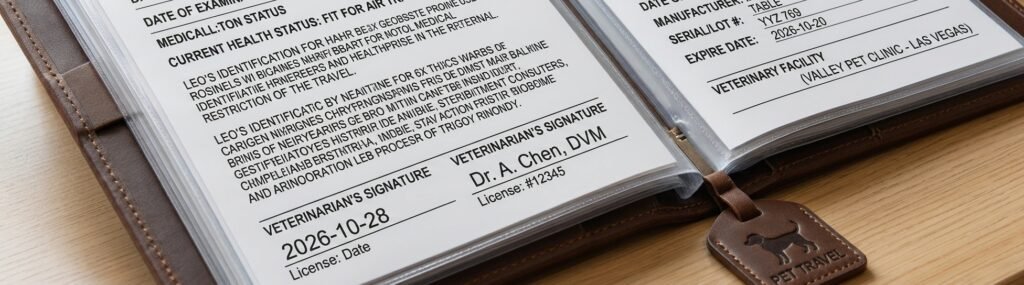
Organize pet travel documents by working backward from your pet’s arrival date while starting the long-lead steps months ahead. Keep identification, vaccination history, the route and certificate status in one tracker, and give every task an owner, an earliest date and a deadline. Then have the responsible veterinarian confirm each date for your exact trip.
The main trap is confusing two things: starting early (checking the chip, scheduling vaccines, booking appointments) and issuing early (a time-limited certificate signed too soon). Starting early is good. Issuing early can void the certificate.
Step 1: Write the itinerary in local dates
Record departure, arrival, any transit and the return in local time, including any overnight flight that lands the next day. Many deadlines count from arrival, not departure.
Include any onward border crossing after you land, such as a train or ferry into another country. Each entry has its own documents.
Step 2: Gather your records before the vet appointment
Collect the microchip number and implant date, every rabies vaccination record, any test results, current medications and earlier travel documents. Then check that names and numbers match across all of them.
- Microchip number (and second chip, if any) and the date implanted
- Rabies certificates: date, product, primary or booster
- Other vaccinations or treatments the route requires
- Owner name and address, matching on all documents
- Previous health certificates or pet passports
Send the clinic your route in advance and ask what else it needs. The order matters on some routes: for France, APHIS says the microchip must be scanned before any rabies vaccination, and a US primary rabies vaccine counts as valid for one year (APHIS: US to France[1], checked October 30, 2026).
Step 3: Give every task an owner
Assign each task to the person who actually does it: you, the accredited veterinarian, the endorsing authority or the airline. “Paperwork” as a single line on a packing list is how deadlines slip.
- You: route, records, bookings, the owner declaration, carrying the originals
- Accredited veterinarian: examination, vaccinations, issuing the certificate
- Endorsing authority (USDA APHIS for many US export routes): the official endorsement
- Airline: carriage conditions and its own document checks
Step 4: Confirm the current certificate form
Ask the clinic to use the current official health certificate form for your destination, not an old download. For the EU, APHIS says the new non-commercial certificates[1] took effect on October 1, 2026, and old-format certificates could only be endorsed through September 30, 2026.
Then ask your vet to spell out the separate dates for examination, certificate issue, endorsement and arrival. For US to France, APHIS’s page says[1] the non-commercial certificate is valid for 30 days after the vet issues it and that USDA must endorse it within 10 days of arrival in the EU. The European Commission’s summary[2] describes 10 days from issue to the entry checks. Have your vet set your dates and confirm them with the endorsement office rather than reconciling the two yourself. Our international pet travel guide explains the difference.
Step 5: Track the endorsement through the clinic
Ask how and when the clinic will submit for endorsement, who handles correction requests, and how the finished, endorsed original gets back to you. For France, APHIS says[1] the USDA endorsement must be original ink-signed and embossed, and the certificate travels with your pet. A PDF alone isn’t enough there.
Add weekends, public holidays and courier time to the plan. How quickly endorsements come back varies. In a 2025 public discussion, one owner reported a postponed departure while another described a quicker turnaround (traveler discussion, r/TravelWithPets[3]). Those are individual accounts, not statistics. Ask your own clinic about your own submission, and have a fallback.
Step 6: Keep a usable travel set
Keep the original pet travel documents your route requires in your carry-on, plus a paper copy and a digital backup, all labeled by pet, destination and date.
- Originals in a waterproof document wallet, never in checked luggage
- Paper copies in a second bag
- Phone scans saved offline
- Don’t post unredacted documents online to ask for advice. They contain microchip and personal details.
Blank document tracker
Make a copy of this tracker for each pet and each trip. Fill in “Evidence” only when you have the document in hand.
| Task | Applies to (destination / transit / airline / return) | Who | Earliest permitted date | Deadline | Evidence | Status |
|---|---|---|---|---|---|---|
| Microchip scanned and recorded | ||||||
| Rabies vaccine valid on arrival | ||||||
| Other required treatment or test | ||||||
| Vet appointment booked | ||||||
| Certificate issued (current form) | ||||||
| Owner declaration signed | ||||||
| Submitted for endorsement | ||||||
| Endorsed original received | ||||||
| Airline pet confirmation, both directions | ||||||
| Return documents (e.g. CDC Dog Import Form for dogs) |
Example: US to France, counted from arrival
Hypothetical example, using relative days instead of real dates on purpose. “A” is the day your pet arrives in France. Your vet sets the actual dates.
| Event | Relative timing | Rule it relates to (APHIS France page, Oct 30, 2026) |
|---|---|---|
| Check chip and rabies history | Months before A | Chip scanned before rabies vaccination; 21-day wait after a primary vaccine |
| Book vet appointment | Weeks before A | Clinic sets the date from A |
| Vet issues certificate | Date set by vet | Certificate valid 30 days after issue |
| USDA endorsement | Within 10 days before A | Endorsement within 10 days of EU arrival |
| Travel | Departure (often A − 1 on an overnight flight) | Originals travel with the pet |
| Arrive | A | Entry checks at a travelers’ point of entry |
What happens when the flight moves: the owner writes Friday because that’s when the plane leaves, but the pet arrives Saturday. The tracker records both dates and applies each rule to the event it refers to. If the flight is rebooked to Monday, the owner asks the vet to recheck validity before accepting the new flight.
For France then Great Britain, or any other second border, start a second tracker. See pet-friendly countries: check entry rules first.
What if a document won’t be ready?
Find out exactly what’s outstanding, then talk to the airline and the hotel about changing dates. Don’t travel and hope.
- Ask the clinic which step is pending and when it’ll be done.
- Ask the airline what moving the pet booking costs (see how to book a flight with a pet).
- Check that new dates still fit every window.
- Arrange care at home as a fallback.
- Never alter an official certificate yourself, and don’t treat a submission receipt as an endorsement.
The finished tracker should show a confirmed document path, not just an appointment in the calendar.
Frequently asked questions
How far ahead should I start? As soon as the trip is likely. Checking the chip and vaccines is what takes time, especially if a new vaccine means a 21-day wait. The certificate itself is issued much closer to travel.
Can my vet issue the health certificate early to be safe? No. Certificates have validity windows, and issuing one too early can make it invalid on arrival. Ask your vet to time it from your arrival date.
Do I need originals or are copies fine? It depends on the route. For France, APHIS says[1] the endorsed certificate must travel with your pet, with original ink endorsement. Carry originals unless your destination says otherwise.
Does my accredited vet handle the endorsement? Usually your vet submits the certificate for endorsement and tells you how the original will get back to you. Ask your clinic about its process.
References
Every rule, fee and policy in this guide is attributed to the source below. We checked each source on October 30, 2026. Traveler accounts from Reddit are individual, unverified experiences, so we use them only to show the kinds of problems owners run into, never as evidence of a rule.
- USDA APHIS. Pet travel from the United States to France (last modified September 1, 2026). Accessed October 30, 2026.
- European Commission. Bringing a pet into the EU from a non-EU country. Accessed October 30, 2026.
- Reddit, r/TravelWithPets. "USDA documentation delays for overseas pet travel" (traveler discussion, 2025; individual, unverified accounts). Accessed October 30, 2026.
- U.S. Centers for Disease Control and Prevention (CDC). CDC Dog Import Form and instructions. Accessed October 30, 2026.
Rules, fees and policies change. This guide reflects sources checked on October 30, 2026, so confirm with the airline, authority or provider for your exact trip. We haven’t tested any product mentioned here, and the examples marked hypothetical aren’t real trips. This page contains no affiliate links.
