
Argentina to Patagonia: Everything You Need for an Unforgettable Trip
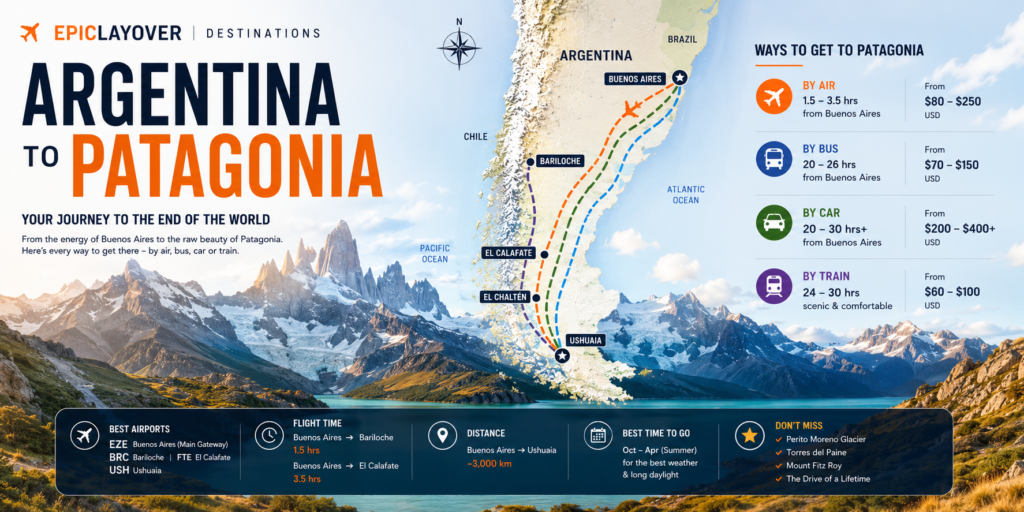
Argentina to Patagonia: How to Get There from Buenos Aires
Getting from Argentina to Patagonia means one thing in practice: getting roughly 2,000 km south of Buenos Aires. There is no single “Patagonia” airport — you fly, bus or drive to one of three gateway towns, and which one you pick decides your whole trip.
Almost everyone travelling from Argentina to Patagonia starts in Buenos Aires, because that is where the international flights and the domestic network meet. The good news is that the connections are frequent and, by 2026 standards, reasonably priced. The catch is a logistics trap that catches first-timers every season — and it has nothing to do with Patagonia itself and everything to do with the two airports in Buenos Aires.
This guide lays out the exact path from the city to the south: the airport you actually fly from, the three gateway towns and what each one unlocks, and the full cost-and-time picture for flying, bussing or driving. It is built the EpicLayover way — around the journey, so you arrive with a plan rather than a problem.
The exact path: Buenos Aires to Patagonia
Here is the whole journey from arrival in Argentina to standing in Patagonia, in order.
Arrive in Buenos Aires — usually at Ezeiza (EZE)
International long-haul flights land at Ministro Pistarini (EZE), about 22 km and 45–60 minutes south of the city. This is not where your Patagonia flight departs.
Cross the city to Aeroparque (AEP)
Aeroparque Jorge Newbery (AEP) sits on the riverfront 8 km from the centre and handles nearly all domestic flights to Patagonia. Allow 45–90 minutes to transfer EZE→AEP depending on traffic. If your onward flight is the same day, give yourself a wide buffer.
Fly south to your gateway
From AEP, fly to El Calafate (FTE, ~3h20), Bariloche (BRC, ~2h20) or Ushuaia (USH, ~3h40). Aerolíneas Argentinas runs the most routes; JetSMART and Flybondi add low-cost options.
Transfer from the gateway airport into town
Each gateway airport is a short hop from its town — FTE is ~8 km from El Calafate, BRC ~15 km from Bariloche. Shuttles, taxis and pre-booked transfers all work.
Range out to the wilderness
You base in the town and day-trip or trek out: Perito Moreno and El Chaltén from El Calafate, the Lake District from Bariloche, Tierra del Fuego from Ushuaia.
The mistake that costs people a flight: booking an international arrival at EZE and a same-day Patagonia departure from AEP without realising they are different airports on opposite sides of Buenos Aires. If you must connect same-day, leave at least 4–5 hours between landing at EZE and departing AEP. Better: spend a night in Buenos Aires and fly south fresh.
Pick your gateway airport
This is the decision that shapes the trip. You are not really choosing “Patagonia” — you are choosing which slice of it.
| From Buenos Aires (AEP) | Flight time | One-way (approx) | What it unlocks |
|---|---|---|---|
| El Calafate (FTE) | ~3h 20m | US$110–200 | Perito Moreno glacier, El Chaltén & Fitz Roy |
| Bariloche (BRC) | ~2h 20m | US$90–170 | Lake District, Seven Lakes, skiing |
| Ushuaia (USH) | ~3h 40m | US$120–220 | Tierra del Fuego, Antarctica cruises |
| Trelew / Puerto Madryn | ~2h | US$90–160 | Atlantic coast: penguins & whales |
El Calafate (FTE) — the classic choice
If your Patagonia is glaciers and granite, fly here. It is the base for the Perito Moreno glacier and a 3-hour drive from El Chaltén, Argentina’s trekking capital. It is also the launch point for the cross-border bus into Chile for Torres del Paine.
Bariloche (BRC) — the easy, scenic option
The shortest hop from Buenos Aires and a softer landing: alpine lakes, forests and chocolate shops rather than ice fields. Best if you want northern Patagonia, or are short on time.
Ushuaia (USH) — the end of the world
The southernmost city, and the port for almost all Antarctica cruises. Worth the longer flight for the symbolism and the sailings; a detour if you are only chasing mountains.
Option 1: Fly (the default, and usually the smartest)
Flying is how the overwhelming majority get from Argentina to Patagonia, and the maths backs it up: a 3-hour flight replaces a 30–40 hour bus, often for not much more money once you value your time. Book 5–6 weeks ahead for the best fares; peak summer (December–February) sells out and prices climb.
Booking tip: domestic fares for foreigners are charged in pesos and, since the 2025 currency reform, are far more reasonable than the old two-tier “tourist” pricing. Compare Aerolíneas Argentinas against JetSMART and Flybondi — the low-cost carriers undercut on fare but charge for bags, which matters if you are carrying trekking kit.
Welcome Pickups
The EZE→AEP cross-town transfer is the one leg worth pre-booking. Flight-tracked, fixed price, driver waiting — no taxi-rank scramble jet-lagged.
Book transferBooking.com
Taking an early Patagonia flight? A night near Aeroparque removes the morning cross-city dash. Free-cancellation rates worth holding.
Find a stayOption 2: Overland by bus
Argentina’s long-distance buses are genuinely comfortable — reclining cama seats, meals, the lot — but the distances are brutal. Buses leave Buenos Aires from the Retiro terminal. This is for travellers with time and a taste for the road, not anyone on a tight itinerary.
| Route from Buenos Aires | Mode | Time | Approx cost |
|---|---|---|---|
| → Bariloche | Direct bus (Via Bariloche, Chevallier) | 22–24 hrs | US$80–110 |
| → El Calafate | Bus, 1–2 changes (via Río Gallegos) | 36–48 hrs | US$120–170 |
| → Ushuaia | Multi-leg (transits Chile) | 40+ hrs | US$150+ |
The eastern Ruta 3 route down the Atlantic coast has a redeeming feature: you can break it at Puerto Madryn for Punta Tombo, home to one of the largest Magellanic penguin colonies on earth. If the journey is part of the point, that is the way to do it.
Omio
Compare and book long-distance bus routes across Argentina in one place, in English, instead of juggling individual operator sites.
Search routesAnker power bank
A 20,000mAh bank keeps phones and headphones alive across a 24-hour-plus bus leg where charging points are unreliable.
View on AmazonOption 3: Drive Ruta 40
Driving from Buenos Aires to Patagonia is a genuine road-trip adventure, but go in with eyes open. Buenos Aires to Bariloche is roughly 1,580 km (about 18 hours’ driving, realistically 2–3 days). The legendary Ruta 40, which runs the spine of Patagonia between Bariloche and El Calafate, is partly unpaved, prone to flooding, and has long gaps between fuel stations.
Two hard rules for self-drive: refuel at every station — the next one may be hundreds of kilometres away — and confirm written cross-border permission from your hire company before any plan to enter Chile. Dropping an Argentine hire car in Chile is effectively not allowed, so plan a loop, not a one-way.
Discover Cars
Compare Argentine rental firms and check the cross-border and one-way terms up front. Hire runs roughly US$60–120/day depending on vehicle.
Compare hire carsGetYourGuide
Prefer the scenery without the driving risk? Multi-day Ruta 40 bus-tours run Bariloche–El Chaltén–El Calafate with a guide.
See Ruta 40 toursReaching Chilean Patagonia (Torres del Paine)
Torres del Paine is on the Chilean side, and there is no direct Buenos Aires flight to it. The standard route is the one that makes Argentina to Patagonia such a satisfying loop: fly Buenos Aires to El Calafate, then take the paved cross-border bus to Puerto Natales (4–5 hours), the staging town for the park. The alternative is to fly to Punta Arenas in Chile, usually connecting through Santiago.
The architecture move: fly into Argentina and out of Chile (or vice versa). Buenos Aires → El Calafate → bus to Puerto Natales → Torres del Paine → fly home from Punta Arenas. One clean line through both countries, no backtracking, no wasted internal flights. Check your passport’s entry rules for both Argentina and Chile before you go.
iVisa
Confirm Argentina and Chile entry rules for your nationality and handle any cross-border paperwork in one place before you travel.
Check requirementsWorld Nomads
If Torres del Paine is the goal, make sure your policy covers multi-day trekking — many standard travel insurers exclude it.
Get a quoteHow long the journey really takes
Door to door from central Buenos Aires, allowing for the airport transfer and check-in:
| To | By air (realistic door-to-door) | By bus |
|---|---|---|
| Bariloche | ~5–6 hrs | 22–24 hrs |
| El Calafate | ~6–7 hrs | 36–48 hrs |
| Ushuaia | ~6–7 hrs | 40+ hrs |
Money for the journey
One thing that changed for the better recently: paying for Argentine flights, buses and transfers. After Argentina lifted most currency controls in 2025, foreign Visa and Mastercard are charged at the favourable MEP rate automatically, and the old “blue dollar” cash advantage has largely vanished. For booking transport, just pay by card. The only fee worth dodging is your home bank’s foreign-transaction charge.
Wise
Hold and spend Argentine pesos at the real rate with low fees — useful across flights, buses and the cross-border leg into Chile.
Get a Wise cardRevolut
A solid fee-free backup card to carry alongside your main one for a multi-country trip.
Open RevolutStaying connected on travel days
Buenos Aires and the gateway towns have decent coverage; the long bus and drive legs do not. An eSIM keeps you online for booking, navigation and check-ins on travel days — set it up before you fly.
Airalo
An Argentina or South America regional data plan, installed before departure — handy the moment you land and need a transfer.
Get an eSIMSaily
A competitive alternative for regional coverage and a useful backup if one network is weak in a given town.
Compare SailyCommon mistakes on the Argentina–Patagonia route
Mixing up EZE and AEP. The single biggest one. International in, domestic out, two different airports across town. Build the buffer.
Stacking no buffer days. Patagonian weather cancels flights and reshuffles plans. Do not book your international flight home the same day you fly back up from the south.
Underestimating the bus. “Buenos Aires to El Calafate by bus” sounds romantic until hour 38. Fly the long legs; save the bus for short, scenic hops like El Calafate to El Chaltén.
The first time I did this I nearly blew it — landed at Ezeiza off an overnight flight, strolled to find my El Calafate connection, and only then learned it left from an airport on the far side of the city with ninety minutes of traffic between us. I made it by running. The second time I booked a night in Buenos Aires, ate a slow steak in Palermo, and caught the morning flight south rested. Patagonia rewards the people who respect the distance before they ever reach it.
Argentina to Patagonia FAQ
From Buenos Aires, fly to a Patagonian gateway — El Calafate, Bariloche or Ushuaia — in 2 to 3.5 hours. Domestic flights leave from Aeroparque (AEP) in the city, not the international airport (EZE). Buses and self-drive are possible but take 18–48 hours.
Flying. Buenos Aires to Bariloche is about 2h20, to El Calafate about 3h20, and to Ushuaia about 3h40. Door to door, allow 5–7 hours including the airport transfer.
Aeroparque Jorge Newbery (AEP), the in-city domestic airport. International long-haul flights arrive at Ezeiza (EZE), about 45–60 minutes away, so most travellers must transfer across the city — leave plenty of time.
Roughly US$90–220 one-way from Buenos Aires depending on the gateway, airline and how far ahead you book. Aerolíneas Argentinas, JetSMART and Flybondi operate the routes. Book 5–6 weeks ahead for the best fares.
Yes. Comfortable long-distance buses leave from Retiro terminal: about 22–24 hours to Bariloche direct, and 36–48 hours to El Calafate with one or two changes. It is cheap and scenic but slow.
Fly Buenos Aires to El Calafate, then take the cross-border bus to Puerto Natales (4–5 hours), the gateway town for Torres del Paine. Alternatively fly to Punta Arenas in Chile, usually via Santiago.
El Calafate for glaciers and the big treks (Perito Moreno, Fitz Roy, and the route to Torres del Paine). Bariloche for lakes, forests and an easier, shorter trip. Many longer itineraries do both, linked by Ruta 40 or a short internal flight.
5–7 days for the highlights around one gateway, and 10–14 for a classic loop combining the Argentine icefields with Chilean Torres del Paine. Always include buffer days for weather.
Note for build: mark these as FAQ items in the block editor — FAQ schema is generated via RankMath, not inline JSON-LD.
Official resources
Sources & last verification (June 2026): AEP–FTE / BRC / USH flight times, frequencies and carriers (Aerolíneas Argentinas, JetSMART, Flybondi); Buenos Aires–Patagonia bus durations from Retiro; Argentina post-2025 card-payment guidance; cross-border El Calafate–Puerto Natales routing. Flight prices and bus timetables change frequently — verify current figures before publishing each update.
This guide contains affiliate links. If you book through them, EpicLayover may earn a commission at no extra cost to you — it helps keep our journey-planning tools free. Routes, prices and entry rules in this region change frequently; confirm current details with airlines, bus operators and official sources before you travel.
