

Dubai Layover The Stopover That Feels Better Than the Destination
Emirates Gives You a Free Hotel in Dubai. Most People Never Ask for It.
Dubai Connect is Emirates’ largely unknown programme that covers hotel accommodation, transfers, and meals for qualifying passengers with a connection of 6–26 hours at Dubai International Airport: completely free of charge. Separately, Emirates’ paid stopover packages offer discounted hotels for those who want 1–5 nights in the city. With over 180 nationalities entering Dubai visa-free or on arrival, and the world’s tallest building 25 minutes from the airport, a stopover in Dubai is one of the most straightforward additions you can make to a long-haul itinerary.
A stopover in Dubai divides neatly into two very different experiences depending on where you look. The Dubai of the Burj Khalifa, the Palm Jumeirah, and Dubai Marina is the Dubai that appears in every travel magazine, extraordinary modern architecture, luxury shopping, and beach resorts that have transformed a former pearling town into one of the most visited cities on earth. This version of Dubai is real and worth seeing. But the other Dubai, Al Fahidi Historic District, Deira’s Gold and Spice Souqs, the abra crossing on Dubai Creek, the shawarma at a Deira street stand, is equally real and almost more interesting. The best stopover in Dubai uses both. Two days achieves it comfortably. One day achieves the essentials.
The Emirates programme structure is unique among airline stopover offers in a critical way: Dubai Connect is genuinely free for eligible passengers, covering accommodation, meals, and airport transfers. This is different from Qatar’s subsidised-but-paid Doha programme. If your Emirates connection is between 8 and 26 hours and meets the fare class and ticket conditions, you may be entitled to a complimentary night in a 4 or 5-star hotel in Dubai without paying anything extra. The complication is that eligibility is strict, the flight must be the next available connection, not a deliberately extended one, but millions of passengers qualify every year without knowing it.
This guide covers both Emirates programmes in full, the visa landscape for a Dubai stopover, day-by-day itineraries for 1 to 3 nights, the two sides of Dubai that every stopover should try to touch, cultural context, the heat reality, food worth seeking out, and the practical details that determine whether your Dubai stopover is a highlight or a scramble.
Dubai Connect is Emirates’ programme offering a free hotel, meals, and transfers for passengers with an unavoidable 6–26 hour connection at DXB. To qualify, your booking must be on a single Emirates ticket, both flights must be Emirates-operated, and your connection must be the shortest available to your destination, you cannot extend it deliberately and still receive the benefit.
Over 180 nationalities receive visa-on-arrival or are visa-free in the UAE, including the US, UK, EU, Australia, Canada, and most of Asia. The visa-on-arrival is typically valid for 30 days. A smaller number of nationalities require a pre-arranged UAE transit visa, check the Emirates website for your specific passport.
November through March is ideal, temperatures of 20–28°C make outdoor exploration genuinely pleasant. April and October are workable. May through September is extreme, 38–45°C+ and high humidity make outdoor activity during the day difficult. Indoor Dubai (malls, museums, hotels) remains excellent year-round.
Yes, if you focus. One night covers either the Downtown Dubai cluster (Burj Khalifa, Dubai Fountain, Dubai Mall) or Old Dubai (Al Fahidi, Dubai Creek, Gold and Spice Souqs). Two nights covers both comfortably and adds a desert safari. Three nights lets you add the Marina, Palm Jumeirah, and a beach day.
The Emirates Stopover Programmes: Free vs Paid
Emirates offers two distinct options for passengers stopping in Dubai, and understanding the difference is the most important practical step in planning your Dubai stopover. Most travellers confuse them or do not know the free programme exists at all.
Dubai Connect covers a complimentary hotel room, all applicable meals, and airport-to-hotel-to-airport transfers for passengers whose Emirates connection is 6–26 hours. Emirates must have routed you through Dubai on the shortest available connection to your final destination, you cannot deliberately choose a longer connection to trigger the benefit. Both flights must be Emirates-operated on a single ticket. Apply online more than 24 hours before your incoming flight, or present your boarding pass at the Dubai Connect desk in Terminal 3 arrivals.
- Hotel accommodation included (4 or 5-star near airport)
- All meals at the hotel included
- Airport transfer both ways included
- Entry visa facilitated for eligible nationalities
- Must be the shortest available connection
- Single Emirates ticket required (ticket number starts 176)
- Both inbound and outbound must be Emirates or Qantas
- Economy, Premium Economy, Business, and First all eligible
The paid Dubai Stopover Package is for travellers who want to intentionally add 1 to 5 nights in Dubai as part of their journey. Emirates and its partners offer discounted hotel rates, flexible 24-hour check-in/check-out at many properties, curated tour packages, and visa assistance. This is the right programme if you are deliberately planning a Dubai stopover as a destination rather than managing an unavoidable connection. Book through emirates.com or the Dubai Experience platform at least 48 hours before departure.
- Wide hotel selection from budget to luxury
- Flexible 24-hour check-in/check-out at partner hotels
- Emirates boarding pass gives My Emirates Pass discounts at 500+ venues
- Optional airport transfers, tours, and desert safaris
- Available for all Emirates ticket holders
- Can be booked up to 48 hours before departure
- Fully flexible: choose your own hotels and duration
- Visit Hotels & Visas desk on arrival if not pre-booked
If your Emirates connection is between 8 and 26 hours on a qualifying single ticket, always check Dubai Connect eligibility before booking anything else. It is genuinely free, hotel, meals, and transfers at no extra cost. If you do not qualify (separate tickets, award booking, deliberately extended connection), use the paid Stopover Package instead. The paid package is still excellent value compared to booking independently, and the My Emirates Pass discounts on your boarding pass alone can save you significantly on attraction entry during a Dubai stopover.
How to Book: Step by Step
At emirates.com, ensure your Dubai connection is 6–26 hours. For the paid programme, use the multi-city search with your stopover duration. For Dubai Connect, book normally, the connection just needs to be the shortest available.
Use the Dubai Connect eligibility tool on emirates.com. If eligible, apply online more than 24 hours before your inbound flight. You will receive hotel and transfer vouchers by email. For paid packages, go to the Dubai Experience planner.
Over 180 nationalities are visa-free or receive visa-on-arrival. For nationalities that need a transit visa, Emirates can facilitate it through the booking process. Apply at least 3 days before travel.
Your checked bags travel directly to your final destination. Pack everything needed for your Dubai stopover in your hand luggage, change of clothes, toiletries, and swimwear if you have pool access. Store bags at a Bounce partner location near the Dubai Mall or the Marina, central storage points that work regardless of which DXB terminal you arrive at and depart from.
Exactly as with any airline stopover programme: your checked baggage travels directly to your final destination and is not accessible during your Dubai stopover. This applies whether you are on Dubai Connect or the paid stopover package. Pack your carry-on with everything you need for the duration, toiletries, a change of clothes, any medication, and swimwear if you have pool access. Emirates allows a generous carry-on allowance in most fare classes.
Adding Dubai to your Emirates journey
Check Dubai Connect eligibility first, it may already be free. For planned stopovers, use the Dubai Experience platform.
Visa and Entry for a Dubai Stopover
The UAE has one of the most open visa policies in the Gulf. Over 180 nationalities can enter without a pre-arranged visa, either through a visa-on-arrival stamp at Dubai International Airport or by being entirely visa-free. Processing at the airport is fast, typically 10–20 minutes, and the experience is smooth.
| Category | Example Nationalities | Entry | Validity |
|---|---|---|---|
| Visa-Free | GCC nationals (Saudi, Bahrain, Kuwait, Oman, Qatar), selected EU nationalities | Visa-Free | Varies by nationality |
| Visa-on-Arrival (30 days) | US, UK, Canada, Australia, New Zealand, Japan, South Korea, most EU, most of Asia, South Africa, Brazil, many others | On Arrival | 30 days, extendable |
| 48-hr Transit Visa | Nationalities not on the visa-on-arrival list, apply through Emirates or ICA portal before travel | Pre-Arranged | 48 hours from entry |
| 96-hr Transit Visa | Same nationalities as above, for longer Dubai stopovers. Apply through Emirates or the UAE ICA portal in advance. | Pre-Arranged | 96 hours (4 days) |
| Visa Required in Advance | A small number of nationalities requiring full tourist visa, apply well in advance via UAE ICA or Emirates. | Advance Visa | Varies |
Every Emirates passenger, on any fare class, any ticket, can use their boarding pass as a My Emirates Pass at over 500 restaurants, spas, attractions, golf courses, and retail outlets in Dubai. Discounts typically run 10–25%. Show your boarding pass on arrival or at the venue. The Burj Khalifa At The Top observation deck, Dubai Frame, Ski Dubai, and several major beach clubs all participate. Full list at emirates.com/myemiratespass before your Dubai stopover visit.
Getting from Dubai International Airport to the City
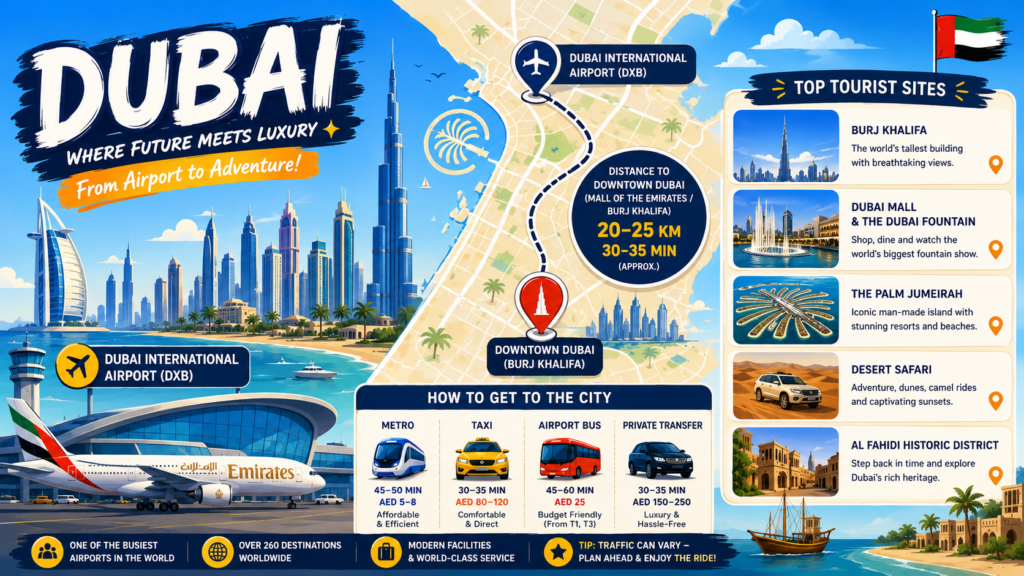
Dubai International Airport (DXB) is exceptionally well-connected to the city. The Dubai Metro’s Red Line runs directly from Terminal 1 and Terminal 3 to Downtown Dubai, Dubai Marina, and the full length of Sheikh Zayed Road. It is one of the best airport-to-city connections in the world, fast, air-conditioned, reliable, and inexpensive.
Stations at Terminal 1 (Airport Terminal 1) and Terminal 3 (Airport Terminal 3). Buy a Nol card from machines in the station, reusable, works on metro, buses, and trams. First class cabin available for AED 1 surcharge. Runs daily 05:30–00:00 Sun–Wed, until 01:00 Thu–Sat.
RecommendedBoth Careem and Uber operate widely in Dubai, cashless, reliable, and English interface. Pick-up from designated zones outside arrivals. Good for reaching areas not well-served by metro (Old Dubai / Deira) or late arrivals when metro is closed. Dubai traffic on Sheikh Zayed Road peaks 7–9 a.m. and 5–8 p.m.
If you are on the Dubai Connect programme, your airport-to-hotel and hotel-to-airport transfers are arranged and paid for by Emirates. Look for the Dubai Connect desk in T3 arrivals. The hotel is typically a 4 or 5-star property within 20–30 minutes of the airport.
A Nol card (AED 25 including AED 19 credit) works on the Dubai Metro, buses, Dubai Tram, and the Palm Monorail. Top up at any metro station machine. The Red Line runs the full length of Sheikh Zayed Road, the spine of Dubai, stopping at all major tourist areas: Union (for Deira), Burj Khalifa/Dubai Mall, Mall of the Emirates, Jumeirah Lakes Towers, and DMCC (for Dubai Marina). A single trip from the airport to Downtown is AED 6.50 in standard class.
The Two Sides of Dubai Every Stopover Should Touch
Dubai is not one city, it is two, separated by 30 years of development and 15 kilometres of Sheikh Zayed Road. The best stopover in Dubai makes time for both. If you only have one day, pick your side and commit. If you have two, do each properly.
Burj Khalifa: The Fountain View from Burj Park Bridge
Cross the pedestrian Burj Park bridge between Dubai Mall and the Burj Park island. Look north along the fountain lake toward the Burj Khalifa. The tower is framed by water on both sides and the fountain jets in front. From 6 p.m., the fountain show begins every 30 minutes, position yourself 15 minutes before the show starts for the cleanest unobstructed view. Shoot wide on a standard lens. The 5 p.m. to 6 p.m. window before the fountains start has the best light for the tower itself.
Dubai Creek: Abra Crossing at Dusk
Take the AED 1 abra from Bur Dubai waterfront toward Deira. As the boat crosses, look west from the water, the Al Fahidi wind towers are visible on the Bur Dubai side and the Deira skyline on the other. Shoot at dusk when the buildings are lit but the sky still has colour. The wooden dhows moored along the creek become silhouettes.
Top Attractions for a Dubai Stopover
Dubai has more headline attractions per square kilometre than almost any city on earth. These six earn their place in a stopover itinerary for different reasons, some for the spectacle, some for the contrast, some because nothing else like them exists anywhere.
The world’s tallest building at 828 metres. The observation deck at level 124 gives you Dubai in every direction, the Palm, the Marina, the Creek, the desert, and the Gulf. Book online (At The Top from AED 149; SKY level 148 from AED 369) at burjkhalifa.ae. Sunrise and sunset slots sell out, book 24–48 hours ahead during a Dubai stopover visit. Allow 90 minutes including queue and travel time.
The preserved heart of 19th-century Dubai, wind-tower courtyard houses built from gypsum and coral, now hosting the Dubai Museum, small galleries, and the excellent Coffee Museum. Free to wander. The streets are narrow, shaded, and genuinely ancient by Dubai standards. Best in the morning when it is quieter.
Two adjacent souqs in the Deira district, the Gold Souk (300+ jewellery shops, open mornings and evenings) and the Spice Souk (frankincense, saffron, cardamom). Cross from Bur Dubai on the AED 1 abra and walk five minutes north. Haggling is expected in both. Best in the morning before the heat peaks.
The building alone, a torus clad in Arabic calligraphy stainless steel panels, hovering over a green hill, is one of the most remarkable structures built in the 21st century. Inside, immersive exhibits on AI, sustainability, and humanity’s possible futures. AED 145. Book online, it sells out on weekends. Allow 2 hours.
The Palm Jumeirah monorail from Atlantis The Palm station to the mainland is worth the ride for the aerial view of the palm fronds. The Pointe on the Palm’s western crescent has the best public viewpoint of the Burj Al Arab across the water, and a good waterfront restaurant strip. Access via Red Line metro to DAMAC, then Palm Monorail.
An evening desert safari from Dubai is the most popular tour activity in the UAE. Dune bashing in 4WD vehicles, sandboarding, camel rides, and a dinner at a Bedouin camp with live music and performances. Most operators pick up from hotels at 3:30–4 p.m. and return by 9:30–10 p.m. Price ranges from AED 150 (budget) to AED 400+ (premium private). Best October through April.
Dubai Stopover Itineraries: Day by Day
All itineraries allow 3 hours for airport return and departure procedures at DXB. Dubai traffic is the most significant variable, build in extra buffer during morning (7–9 a.m.) and evening (5–8 p.m.) rush hours on Sheikh Zayed Road. The metro avoids all traffic and is the right choice for most Downtown and Marina journeys during a Dubai stopover.
The side of Dubai most stopover visitors skip. Start in the historic district and end in the souqs after dark.
If arriving on Dubai Connect, transfer to your hotel directly. Otherwise take the metro Red Line to Al Fahidi station. Walk the wind-tower district in the morning before the heat builds. The Coffee Museum on Al Fahidi Street is a genuine small gem, a 15-minute stop that explains the cultural weight of Arabic coffee. The Dubai Museum inside Al Fahidi Fort (AED 3) gives the city’s history in 45 minutes.
Walk north from Al Fahidi to the Bur Dubai abra landing. Pay AED 1 and ride the wooden boat across Dubai Creek to Deira. The crossing takes 5 minutes. On the Deira side, walk 5 minutes north to the Spice Souk, explore the spice stalls and pick up saffron or frankincense. Then walk east another 5 minutes to the Gold Souk. Even if you buy nothing, stand in the central arcade and absorb the extraordinary density of gold on display.
Take the metro from Union station (Deira) two stops south to Al Jafiliya, then a short taxi to Dubai Frame (AED 50, about 10 minutes). The 150-metre picture frame building stands on the border of old and new Dubai, from the glass sky bridge at the top, you see both simultaneously: Al Fahidi and the Creek to the north, the Burj Khalifa and Downtown to the south. Allow 60 minutes.
Return to the Bur Dubai creek waterfront for a 2-hour dhow cruise dinner. Most depart between 7 and 8 p.m. and run until 9:30–10 p.m. The covered wooden dhow has an open upper deck, sit there. The creek at night is lit on both banks: old Dubai illuminated on the left, the modern city gleaming on the right. Dinner is typically a buffet of Arabic and international dishes. Cost AED 100–200 per person.
The iconic skyline up close, the world’s tallest building from inside it, and the fountain show at dusk.
Book the 8 a.m. slot online at burjkhalifa.ae (from AED 149). The early morning crowds are thin and the light is excellent. Take the world’s fastest double-deck elevators to levels 124 and 125. The 360-degree view covers the entire Dubai geography. Allow 75–90 minutes total including travel from your hotel.
Dubai Mall is directly connected to the Burj Khalifa via a sky bridge. The Dubai Aquarium on the ground floor is a 10-million-litre tank visible without a ticket, worth 15 minutes. Lunch in the food court or one of the sit-down restaurants on the upper level, good value by Dubai standards (AED 80–150 per person). The Mall itself takes 2–3 hours to walk even at a shopping pace.
Choose one. Museum of the Future (metro: Emirates Towers) is 2 hours of genuinely engaging, well-designed immersive content. Or take the metro south to Dubai Marina DMCC station and walk the 7km marina promenade, lined with restaurants, boats, and a dense assembly of glass towers. The Marina walk is free; the Museum of the Future is AED 145.
Return to Downtown for the 6 p.m. fountain show. Stand on the Burj Park bridge or at the Dubai Mall waterfront terrace 15 minutes early for a good position. The fountain runs every 30 minutes from 6 p.m. until midnight. Dinner afterward at one of the terrace restaurants overlooking the lake and the Burj.
An afternoon desert safari followed by the Palm Jumeirah at night, two of Dubai’s most memorable experiences.
JBR Beach (Jumeirah Beach Residence), Kite Beach, or the public stretch near Burj Al Arab are all accessible by metro and taxi. Dubai’s public beaches are free and well-maintained. In cooler months (November–March), the water is 22–26°C and the beach is genuinely pleasant.
Most operators pick up from your hotel between 3:30 and 4 p.m. for the afternoon/evening desert safari. The route to the red dunes takes 45–60 minutes by 4WD. Dune bashing, driving up and down steep sand dunes at speed, is genuinely thrilling. Then the convoy stops at a desert camp at sunset: camel rides, sandboarding, henna painting, shisha, and a BBQ dinner. Return to your hotel by 9:30–10 p.m.
Take the metro to DAMAC and the Palm Monorail to Atlantis. Walk the Boardwalk around the western crescent. The view from Atlantis back to the Dubai skyline is best at sunset. Return via monorail and metro in the evening, the palm at night, lit from below, is worth a photograph.
What to Eat on a Dubai Stopover
Dubai is one of the most diverse food cities in the world by nationality, over 200 nationalities live here and most of them cook. A Dubai stopover that only eats in hotel restaurants misses what the city actually tastes like. These are the six stops worth prioritising.
A Bur Dubai institution since 1978, serving slow-roasted kebabs and Iranian rice dishes in a simple, packed restaurant near Al Fahidi. The koobideh and the joojeh are the standouts. Cheap by Dubai standards, AED 40–70 per person. No booking, just arrive.
Ravi in the Satwa neighbourhood has been serving Lahori-style Pakistani food since 1978. The chicken tikka, daal, and biryani are the anchors. It is perpetually full of Dubai’s South Asian workforce and Pakistani nationals who drive here specifically for the food.
Bu Qtair on the Jumeirah fishing harbour is one of Dubai’s most celebrated local institutions, a fish fry shack where the city’s fishermen and a loyal clientele share tables and eat fresh-caught fish fried in a simple spiced batter. Cash only, basic seating, no menu.
The Dubai Connect hotel breakfast is typically a 5-star all-inclusive buffet, international spread, Arabic dishes, fresh pastries and juices. Worth spending time at rather than rushing through, a genuine perk of the Emirates hotel programme.
A Lebanese flatbread baked to order in a wood oven, topped with za’atar, cheese, or minced lamb. The bakeries in Deira near the Gold Souk area serve them fresh for AED 3–8, eaten folded in half, warm from the oven.
The world’s highest restaurant in the world’s tallest building. The food is good rather than exceptional, but the views from 442 metres are the point. A 3-course dinner runs AED 500–700 per person without drinks. Book ahead, it fills.
Alcohol is available in Dubai but only in licensed venues, hotel bars, licensed restaurants, and some specific entertainment venues. It is not available in public spaces, supermarkets, or unlicensed restaurants. Most of Old Dubai’s restaurants (Deira, Bur Dubai, Al Fahidi) are unlicensed and do not serve alcohol. Public intoxication is illegal and taken seriously, drink only in licensed premises.
Cultural Etiquette for a Dubai Stopover
Dubai is significantly more relaxed in its cultural enforcement than many other Gulf cities, it is a global hub city and the norms reflect that. But there are specific rules that apply, and ignoring them can result in genuine legal consequences. The following are the ones that matter most for a short Dubai stopover visit.
Beaches and hotel pools: bikinis and swimwear are completely normal. Downtown Dubai, the Marina, and malls: Western clothing including shorts and short sleeves is fine. Al Fahidi, the Gold and Spice Souqs, mosques: cover shoulders and knees. Carry a light shawl in your bag during a Dubai stopover for the transition between zones.
Do not photograph Emirati nationals, particularly women, without clear permission. Do not photograph government buildings, military installations, or airport security areas. Photographing mosques from the outside is fine; ask before photographing inside. The Gold Souk is freely photographed.
Public displays of affection beyond hand-holding are technically illegal in the UAE, though enforcement in tourist areas is minimal. Swearing, insulting government or religion, and obscene gestures are illegal and can result in arrest. Keep public behaviour to what you would consider professional in a workplace context.
During Ramadan (dates shift by 11 days each year), eating, drinking, and smoking in public between sunrise and sunset is prohibited by law. Non-Muslims must comply. Most hotels and licensed restaurants serve food in dedicated areas. Dubai during Ramadan is actually excellent for an evening stopover visit, the city comes alive after iftar.
When to Visit: The Dubai Temperature Reality
Dubai’s climate has the same extreme summer as Doha, and the planning logic is identical: plan a Dubai stopover between November and March for outdoor activity; everything else requires adapting your itinerary around the heat.
Summer (May–September) stopovers in Dubai are still viable, they just require a different approach. All major attractions are indoor or air-conditioned. The Dubai Mall, Dubai Frame, Museum of the Future, and hotel pool are all excellent options in 40°C heat. Outdoor activity should be scheduled before 9 a.m. or after 6 p.m.
Packing for a Dubai Stopover
The same bag restriction applies as Doha: your checked luggage travels to your final destination. Pack everything you need for Dubai in your carry-on. Dubai’s public beaches and hotel pools make swimwear more essential here than in Doha.
The UAE has strict prohibited items beyond alcohol. Importing poppy seeds, certain prescription medications (including some codeine and tramadol products common in other countries), and any e-cigarette vaping products containing prohibited substances can result in serious legal consequences including detention. If you take prescription medication, check the UAE’s official prohibited medicines list at mohap.gov.ae before flying. Do not rely on information older than 2024.
Dubai Stopover Scenarios: Real Situations, Specific Solutions
Walk-up tickets require queuing at the ticket counter in the Dubai Mall, then queuing for the dedicated elevator, then queuing again at peak times for the deck itself. On a Friday or Saturday evening, the combined queue can be 75–90 minutes.
A 90-minute queue on a 6-hour Dubai layover window means arriving at the observation deck with 2 hours of city time remaining, not enough for the fountain show, the Gold Souk, and a return to DXB with the buffer accounted for.
Book a timed-entry slot via GetYourGuide before your flight. The timed-entry queue at the Dubai Mall is 5–10 minutes versus 90 at walk-up.
Emirates offers a Dubai Stopover package, flights plus hotel from around $100 per person for qualifying connections, that converts a transit into a structured short stay. Most connecting travellers never check whether their ticket qualifies.
A Dubai hotel in peak winter season (November–March) starts at $180–250 per night for a mid-range property near the Marina. Connecting passengers who book independently pay full rack rate.
Check the Emirates Stopover programme at emirates.com/stopover before booking a separate hotel. If it doesn’t cover your fare class, Dayuse offers short-stay half-day room rates significantly less than the full overnight rate.
Emirates operates from T3. Flydubai and most other carriers operate from T1 and T2. If your inbound and outbound flights use different terminals, the transit between them adds 30–45 minutes to your departure calculation.
A layover visitor who clears immigration at T3, stores bags in a T3 hotel transit service, and departs from T1 now needs to retrieve the bags and transit between terminals, adding 30 minutes they had not budgeted.
Luggage Hero has partner storage locations in the Dubai Mall and the Marina, central city locations equidistant from both terminal clusters by metro.
The Dubai Gold Souk operates on the principle that price is negotiated. Cash enables negotiation; cards reduce the vendor’s flexibility. The spice souk adjacent to it is entirely cash-based for small purchases.
DXB terminal exchange counters charge 8–12% over mid-market on AED withdrawals. On a $200 AED visit to the Gold Souk, overpaying on exchange adds $10–25 before you have started negotiating anything.
Use a Wise card to withdraw AED from the Emirates NBD or HSBC ATM in the DXB arrivals hall. Mid-market rate, small fixed fee.
The AED 1 abra crossing of Dubai Creek is one of the most frequently cited experiences by first-time visitors to Old Dubai, not for any particular attraction at either end, but for what the five-minute ride makes visible simultaneously: the 19th-century wind towers of Al Fahidi on one bank, the glass towers of the modern city visible behind the dhow repair yards on the other. Transport authorities operate the crossing continuously throughout the day; wooden boats carry passengers across in both directions from early morning until late at night. The fare has not changed significantly in years, the creek crossing remains one of the few things in Dubai that has not been upgraded, branded, or priced for tourism.
Connectivity and Gear for a Dubai Stopover
The UAE has excellent mobile coverage and one of the fastest LTE/5G networks in the world. Free Wi-Fi is available at Dubai International Airport, most hotels, and major malls. Google Maps works perfectly in Dubai, no restrictions or workarounds needed.
UAE data eSIM with coverage from the moment you land. A Middle East regional plan is better value if your itinerary continues to other Gulf countries.
Get an eSIM →Pay only for the data you use during your Dubai stopover. Covers the UAE and connects across 150+ countries.
Get Roamless →The Nol card app, Careem, Google Maps, and constant photography all drain your phone. In Dubai’s heat, batteries also discharge faster.
View on Amazon →Some VoIP services including WhatsApp calls and FaceTime are restricted in the UAE, text messaging works but internet calling may require a VPN. VPN use itself is legal in the UAE for personal use.
Get NordVPN →Travel Insurance for a Dubai Stopover
Dubai’s healthcare system is genuinely strong and available to visitors, but without cover you pay at full private rates, an ER visit at Mediclinic or American Hospital Dubai starts at AED 1,500–4,000 ($400–1,100 USD) for a basic consultation and assessment, before any treatment. For a stopover visitor who needs cover that activates on arrival and can be purchased the day before the flight, Visitors Coverage handles UAE entry requirements and provides medical cover from AED 1. For extended Emirates Stopover itineraries across multiple Gulf cities, Faye’s fast digital claims process is a strong fit given how little slack a short connection leaves for sorting out a problem.
Fast digital claims and coverage that includes trip disruption, a genuine fit for a stopover itinerary with tight connections and a short window to sort out a problem.
Get a Quote →The comparison tool, when you need the right policy for your specific nationality and routing rather than a single default answer. Medical and adventure-activity cover are the most relevant filters for a Dubai stopover.
Compare Policies →Book Your Dubai Stopover Hotel
If you are on the paid Emirates Stopover Package, hotels are booked through the Emirates portal. For independent bookings, or to compare prices alongside the Emirates programme rates, Booking.com and Agoda both have extensive Dubai inventory with same-day availability and generally competitive pricing. The Deira and Bur Dubai areas are the best value bases for a stopover focused on Old Dubai; Downtown and DIFC for modern Dubai proximity.
Book Tours and Activities for Your Dubai Stopover
The desert safari, the Burj Khalifa observation deck, a dhow cruise, and Old Dubai walking tours all benefit from advance booking, particularly on weekends and during UAE public holidays when capacity fills. Klook and GetYourGuide are the two most reliable platforms for Dubai stopover tours, with flexible cancellation and airport pickup available on many options.
More From EpicLayover
Dubai vs Doha Stopover
Both Gulf cities have excellent airline stopover programmes. How do they compare for value, activities, and what kind of traveller each suits?
Compare Programmes →Stopover Time Budget Calculator
How many nights in Dubai do you actually have? Enter your Emirates flights and get a day-by-day plan.
Calculate Now →Stopover Carry-On Packing Guide
How to pack for 1–3 nights in Dubai when your checked bag travels ahead to your final destination.
Read the Guide →Frequently Asked Questions: Stopover in Dubai
Dubai Connect is Emirates’ complimentary service providing hotel accommodation, meals, and airport transfers for passengers with a connection of 6–26 hours that is the shortest available connection to their final destination. Both inbound and outbound flights must be Emirates-operated, the entire journey must be on a single Emirates ticket (number beginning 176), and the connection must not have been deliberately extended. Apply online at emirates.com more than 24 hours before your inbound flight. If you did not apply in advance, present your boarding pass at the Dubai Connect desk in Terminal 3 arrivals.
Over 180 nationalities are visa-free or receive a visa-on-arrival for up to 30 days in Dubai. This includes the US, UK, EU, Canada, Australia, New Zealand, Japan, South Korea, most of Asia, South Africa, Brazil, and many others. Nationalities not on the visa-on-arrival list can apply for a 48-hour or 96-hour UAE transit visa through Emirates or the UAE ICA portal before travel, processing takes 2–3 days. Check current UAE entry requirements at icp.gov.ae for your specific passport, as the visa-on-arrival list updates frequently.
Yes, the hotel room, applicable meals, and airport transfers are genuinely free for eligible passengers. Emirates assigns the hotel (typically a 4 or 5-star property near the airport) and you may not have a choice of property. You will be asked for a credit card at check-in to cover any incidental charges, mini-bar, room service, spa, or dining not covered by the meal voucher. These extras are at your cost. The core accommodation, meals, and transfers are Emirates’ cost.
Both are excellent but suit different priorities. Dubai is larger, more developed, and has more headline attractions, the Burj Khalifa, the Palm, the desert safari ecosystem, and a significantly more developed international tourism infrastructure. Doha is smaller, more culturally coherent, and leans harder into a traditional Gulf Arab identity at the Museum of Islamic Art and Souq Waqif. For first-time Gulf visitors, Dubai’s scale and fame make it the natural choice. For those who want depth over spectacle, Doha edges ahead.
Yes, an afternoon or evening desert safari fits into almost any Dubai stopover of 24 hours or more. Most operators pick up from your hotel at 3:30–4 p.m. and return by 9:30–10 p.m. If you arrive in Dubai in the morning, you can spend it in Old Dubai or Downtown, be picked up for the desert safari in the afternoon, and return to the airport the following morning. On a 1-night Dubai stopover this is one of the best single-day combinations available.
Dubai has a reputation for expense that is partly deserved and partly overstated. The Burj Khalifa observation deck, the Museum of the Future, and a desert safari are moderately priced compared to equivalent experiences in London or New York. Where Dubai is genuinely expensive: hotel bars, rooftop dining, and anything on the Palm Jumeirah. Where Dubai is genuinely affordable: the metro (AED 3–8), the abra (AED 1), shawarma and local restaurants in Deira (AED 10–30 per meal), and the Gold and Spice Souqs. A moderate budget of AED 300–500 per day for food and activities is completely achievable.
My Emirates Pass is a benefit available to every Emirates passenger, on any fare class, simply by presenting your physical or digital boarding pass at participating venues in Dubai. Over 500 hotels, restaurants, spas, golf courses, beach clubs, and attractions participate, with discounts typically running 10–25%. Notable participants include the Burj Khalifa At The Top observation deck, Dubai Frame, and Ski Dubai. Check the full updated list at emirates.com/myemiratespass before your Dubai stopover. The pass is valid from check-in until the last day of your journey.
Dubai is consistently ranked among the safest cities in the world. Violent crime is extremely rare. The metro system is safe at all hours, Careem and Uber are reliable and trackable, and tourist areas are heavily policed. The main considerations for a Dubai stopover are the extreme heat (June–September, carry water, limit outdoor activity), road traffic (fast drivers, chaotic intersections, use pedestrian crossings), and the legal system (strict on public behaviour, err conservative in anything ambiguous).
Planning your Dubai stop
- Dubai Layover Checklist: everything to sort before you leave DXB.
