
7 Reasons a Kuala Lumpur Layover Is Worth Leaving the Airport
If you’ve ever booked an AirAsia flight anywhere in Southeast Asia, there’s a real chance your journey already passed through, or originated from, a single terminal here — the largest purpose-built low-cost airline terminal on earth.
klia2 opened in 2014 specifically to give AirAsia, the airline that pioneered budget flying across Asia, a home base built for its scale and its model — not a converted corner of an existing terminal, but a dedicated, purpose-designed facility roughly 2km from KLIA’s main building. From here, AirAsia and AirAsia X (now consolidating into a single unified brand) operate to over 166 destinations across 25 countries, all funneled through this one airport. If you’ve flown AirAsia between Bangkok and Bali, or Manila and Phnom Penh, or really almost anywhere within Southeast Asia on a budget fare, the odds are reasonable that a flight in your itinerary touched KLIA at some point — even if your actual trip never mentioned Kuala Lumpur at all.
This guide treats Kuala Lumpur specifically as what it functionally is for a huge number of travellers: not a destination people deliberately fly to, but the hub their cheap flight happened to route through. That’s not a complaint about the city — it’s the single most useful fact for anyone reading this. KLIA operates two physically separate terminal buildings 2km apart (KLIA, for full-service carriers, and klia2, the AirAsia hub specifically), and the city itself is genuinely worth a few hours of your connection time if you know what you’re doing and where the line is between “comfortable layover” and “risky connection.”
Kuala Lumpur International Airport (KUL) sits in Sepang, roughly 50km south of the city centre, and operates as two functionally separate facilities: KLIA, the main terminal serving full-service carriers (Malaysia Airlines, Emirates, Qatar Airways, Singapore Airlines, Air India, Cathay Pacific, IndiGo), and klia2, the dedicated low-cost terminal built specifically for AirAsia, AirAsia X, and a handful of other budget operators like Batik Air, Cebu Pacific, and Scoot. The two buildings are connected by a free 24-hour shuttle bus (15-20 minutes) or a paid 3-minute train, but they require separate check-in, and a transfer between them on separate tickets needs a genuine buffer — collecting bags, clearing immigration, and re-checking in at the other terminal.
This is the single most important practical fact in this guide. If you’re connecting between an AirAsia flight and any full-service carrier (or vice versa), you are almost certainly changing terminals, not just gates. Budget at least 45-60 minutes for the shuttle/train transfer alone, plus standard immigration and security time on top — for cross-terminal connections on separate tickets, experienced travellers recommend at least 3 hours total. Always confirm which terminal — KLIA or klia2 — your specific flight uses before you fly; don’t assume based on a previous trip, since airlines occasionally shift terminal assignments.
Most nationalities receive 30-90 days visa-free entry to Malaysia depending on passport (verify your specific allowance). Separately, some nationalities — Indian passport holders, for example — can use the eNTRI facility for stays up to 15 days, a streamlined alternative to a full visa. Ensure your passport has at least 6 months validity remaining. Use iVisa to confirm your specific nationality’s requirement before booking any city exploration.
Yes, but it’s the minimum, not a comfortable buffer. The KLIA Ekspres reaches KL Sentral in 28 minutes (RM55 one-way), putting the Petronas Twin Towers roughly 10 minutes further by Grab. At 6 hours, budget the full round trip plus immigration and a tight return buffer — enough for one major landmark, not a full circuit.
Yes, in one specific way: you’re almost certainly using klia2, not the main KLIA terminal, which is 2km away and requires its own shuttle or train ride before you even start your journey into the city. Factor this extra step into your timing — it’s not large, but it’s an additional 15-20 minutes most non-AirAsia layover guides don’t account for.
The Petronas Twin Towers, for the photo and the experience — still the world’s tallest twin towers at 452m, with a Skybridge and observation deck (RM98, pre-book online to avoid sold-out walk-up tickets). If you’ve already done the Towers on a previous trip, Merdeka 118 — now Southeast Asia’s tallest building and the world’s second-tallest, with a new observation deck offering an even higher vantage point — is the genuinely fresh alternative.
Helpful but not strictly essential — Grab (the dominant ride-hailing app) requires data to function, and without a local SIM or eSIM, you’re relying on your home carrier’s roaming or airport Wi-Fi, neither of which is guaranteed to work smoothly the moment you land. If your layover is short, sort connectivity out before you fly rather than hunting for a SIM counter on arrival.
Should You Leave? The Kuala Lumpur Layover Gauge
If your total window is under 5.5 hours, or your connection involves changing between KLIA and klia2 on separate tickets, don’t attempt a city visit. Both terminals are genuinely well-equipped for a comfortable wait: klia2 is essentially a large mall with runways attached, with extensive shopping at Gateway@klia2, capsule hotels (Sama-Sama Express, Tune Hotel), and Plaza Premium Lounges at both terminals.
KLIA Ekspres directly to KL Sentral, Grab to the Petronas Towers area, see the Skybridge/observation deck (pre-booked), grab a quick meal at Lot 10 Hutong food court nearby, and head straight back. This window doesn’t comfortably fit Batu Caves on top — that requires its own dedicated 3-4 hour round trip.
With 8+ hours, add either Batu Caves (the iconic 272 rainbow-painted steps and Hindu cave temple, free entry, roughly 45 minutes from the city by Grab) or a genuine Malaysian food crawl through Jalan Alor and the multicultural neighbourhoods that make KL’s food scene one of the most underrated in Asia. With 10+ hours, both become realistic.
Work out your Kuala Lumpur window precisely
Enter your KUL landing time and departure gate-close. If your connection involves a KLIA/klia2 terminal change, the calculator accounts for the extra shuttle/train time and security re-clearance most other tools miss.
klia2 and AirAsia — Why This Hub Matters
AirAsia is headquartered at RedQ, a purpose-built corporate campus immediately adjacent to klia2 — the airline’s literal home base, not just a hub among several. Founded in 1993 and commencing low-cost operations in 2001, AirAsia is now the largest airline in Malaysia by both fleet size and destination count, and one of the most consequential budget carriers in aviation history for having proven the low-cost model could work at scale across an entire region as geographically fragmented as Southeast Asia. The airline operates a network of affiliated regional carriers — Thai AirAsia (based in Bangkok), Indonesia AirAsia (Jakarta), Philippines AirAsia (Manila), and AirAsia Cambodia (Phnom Penh) — all feeding back into the same shared booking system, branding, and fleet standardisation (Airbus A320/A321 throughout, simplifying maintenance and crew training across the entire group).
For a layover passenger, the practical upshot is this: klia2 isn’t a generic “also-served” airport for AirAsia, it’s the actual control centre. Flight delays, schedule changes, and connection logistics across the entire AirAsia network frequently trace back to operational decisions made at this specific airport. If you’ve built a multi-city Southeast Asia trip entirely around AirAsia’s network — a genuinely common, cost-effective way to see the region — there’s a meaningful chance your itinerary touches KUL more than once, even if Kuala Lumpur itself was never the point.
As a budget carrier, AirAsia’s fares typically exclude checked baggage, meals, and seat selection by default — all addable for a fee. This matters directly for layover planning: if your AirAsia ticket doesn’t include checked baggage and you’re connecting to a different airline at KLIA’s main terminal, you’ll need to collect and re-check your bags regardless, since there’s rarely automatic baggage transfer between AirAsia and full-service carriers on separate tickets. Budget the extra time for this, and don’t assume a “layover” on a mixed AirAsia/full-service itinerary works the way a single-airline protected connection would.
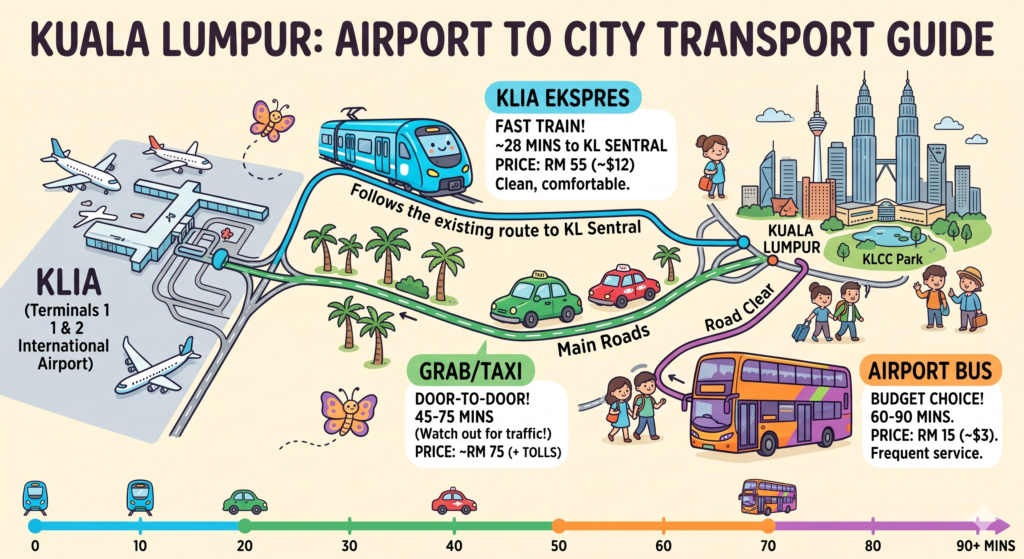
Getting from KUL to Kuala Lumpur City Centre
| Option | Time | Cost | Notes |
|---|---|---|---|
| KLIA Ekspres Recommended | 28 min direct to KL Sentral | RM55 one-way / RM100 return | Non-stop, 160 km/h, departs every 15-20 minutes from both KLIA and klia2 (klia2 trains stop briefly at KLIA en route). Buying the return ticket upfront saves RM10 versus two one-ways. |
| KLIA Transit | ~35-40 min to KL Sentral | Similar pricing to Ekspres | Same line, more intermediate stops. Useful if your destination is along the route rather than KL Sentral itself. |
| Grab | 45-75 min (traffic-dependent) | RM80-120 depending on traffic and surge | Requires data/local SIM. More flexible for direct hotel or landmark drop-off, but genuinely vulnerable to KL’s notorious traffic congestion. |
| Taxi Coupon System | 45-75 min | From RM100 inclusive of tolls (50% extra at night) | Purchase coupons at the taxi booths in Arrivals at either terminal — this fixed-coupon system makes the meter-tampering issues KL taxis have historically had much harder to pull off. |
| Airport Bus | 70-90 min to KL Sentral | RM10-14 one-way | Slowest option, only worth it if your layover is genuinely long (12+ hours) and budget is the priority over time. |
The free 24-hour shuttle bus takes 15-20 minutes; the paid KLIA Transit train covers the same distance in roughly 3 minutes for RM2. If you’re flying AirAsia inbound and a full-service carrier onward (or vice versa) on separate tickets, budget at least 3 hours total for the full transfer including immigration, baggage collection, and re-check-in at the second terminal — this is not a quick gate-to-gate walk.
What to Do in Kuala Lumpur on a Layover
Petronas Twin Towers
Still the world’s tallest twin towers at 452 metres, and the single most recognisable symbol of modern Malaysia. The Skybridge (41st floor) and observation deck (86th floor) tickets cost roughly RM98 for adults — pre-book online, since walk-up tickets routinely sell out by midday. The surrounding KLCC Park and Suria KLCC shopping mall make this a natural single-stop destination if your window is tight: landmark, food, and shopping all within the same complex.
Merdeka 118
At 678.9 metres, Merdeka 118 is now the world’s second-tallest building and Southeast Asia’s tallest, having recently overtaken the Petronas Towers in height (though not in cultural recognition — yet). Its observation deck, “The View at 118,” opened recently and offers a higher vantage point than the Towers themselves. If you’ve done the Petronas Towers on a previous KL layover, this is the genuinely fresh alternative — book through GetYourGuide or the official site, since it’s currently one of the most in-demand tickets in KL tourism and crowds accordingly.
Batu Caves
A limestone cave temple complex roughly 30-45 minutes from the city centre by Grab, marked by a 42.7-metre golden statue of Lord Murugan at the base and 272 rainbow-painted steps leading up to the main Temple Cave, which holds Hindu shrines inside a genuinely massive natural cavern. Free entry; dress code requires covered knees and shoulders. Go early, ideally before 9am, to beat both the heat and the tour bus crowds — this also matters for layover timing, since Batu Caves requires its own dedicated round trip rather than fitting neatly alongside the city-centre landmarks.
Jalan Alor and KL’s Multicultural Food Scene
Jalan Alor is KL’s most famous street food strip — open-air stalls and restaurants serving Chinese, Malay, and Indian-influenced dishes side by side, a direct physical expression of Malaysia’s multicultural makeup. For a deeper version of the same idea: Brickfields (KL’s “Little India”) for banana leaf rice, Petaling Street (Chinatown) for a lunch crawl, and any mamak stall (open-air, often 24-hour Indian-Muslim eateries) for roti and teh tarik (pulled milk tea). This braided food culture — distinct from anywhere else in the region — is arguably KL’s single most underrated layover activity.
Merdeka Square and the Colonial Core
Merdeka Square (Dataran Merdeka) marks the site where Malaysia’s independence was declared in 1957, flanked by the Moorish-style Sultan Abdul Samad Building (with its distinctive clock tower, one of the most photographed buildings in the city centre) and the River of Life, a convergence point of the Klang and Gombak rivers near the city’s oldest mosque, Masjid Jamek. A good 45-60 minute walking loop if you want history and architecture over height and modernity.
Petronas Towers from KLCC Park at Dusk
The classic KL shot: from KLCC Park’s lake area, the towers are reflected in the water as they illuminate after dark, with the park’s fountain show (running on a schedule most evenings) adding movement to the foreground. Arrive 20-30 minutes before sunset to catch both the daylight and illuminated versions in succession.
20-30 min before sunset, into early evening. KLCC Park lake area, facing the towers.
Batu Caves — The Rainbow Steps and Lord Murugan Statue
Shoot from the base looking up the 272 colourful steps with the golden Murugan statue in frame, ideally in the soft early morning light before 9am when both crowds and harsh midday sun are at their lowest. A wider shot from across the plaza captures the full scale of the statue against the limestone cliff face behind it.
Before 9:00am. From the base of the steps looking up, or across the plaza for full scale.
The Kuala Lumpur Layover Itinerary
Immigration off-peak: 30-40 minutes. KLIA Ekspres: 28 minutes direct. If departing from klia2, add the shuttle/train transfer time to KLIA first.
Grab from KL Sentral, 30-45 minutes each way. Climb the 272 steps, see the Temple Cave. 90 minutes total on-site plus transit.
Grab back toward the city centre for a proper multicultural food stop. 60-75 minutes.
Pre-booked Skybridge/observation deck tickets. 60-90 minutes including KLCC Park.
28 minutes back to KLIA, plus shuttle/train to klia2 if needed. Build in a 2.5-3 hour international departure buffer once back at the airport, longer if changing terminals.
As above — immigration plus the 28-minute train.
Grab from KL Sentral, 10 minutes. Pre-booked tickets essential for this tight window. 90 minutes.
45-60 minutes, staying close to the Towers complex to avoid burning transit time.
Grab back to KL Sentral, train back. Build in the full departure buffer.
Kuala Lumpur Layover Scenarios — Real Situations, Specific Solutions
KLIA and klia2 are separate buildings 2km apart, and showing up at the wrong one — particularly easy to do if you’re used to single-terminal airports — is a genuinely common mistake.
The shuttle/train transfer between terminals takes 15-20+ minutes minimum, which can be the difference between making and missing your flight if discovered late.
Always verify your terminal on your boarding pass or airline app before heading to the airport — don’t assume based on a previous trip. If you discover the mistake, the free shuttle or paid 3-minute train are both fast, but don’t delay once you realise.
AirAsia’s base fares typically exclude checked baggage by default, and on a mixed-airline itinerary (AirAsia plus a different carrier on separate tickets), there’s no automatic baggage transfer between airlines or terminals.
Assuming your bags will simply transfer, the way they might on a single-airline protected itinerary, leads to missing the collection and re-check step entirely.
On any mixed-airline KUL connection, plan to collect your bags, clear into the terminal, and re-check them for your onward flight — budget the full 3-hour transfer window for this, not a quick gate change.
Grab/taxi journey times to and from the city centre are genuinely variable, ranging 45-75 minutes depending on traffic — and Kuala Lumpur’s traffic is a real, frequently-cited issue, not an exaggeration.
Relying on Grab for the return trip on a tight layover risks a meaningfully longer journey than planned if you hit rush hour or an accident.
Use the KLIA Ekspres for the return leg specifically — at a fixed 28 minutes regardless of road traffic, it removes this entire risk. Save Grab for the more flexible, less time-critical legs of your trip.
Skybridge and observation deck tickets routinely sell out by midday, particularly during peak tourist season.
Arriving without a pre-booked ticket on a tight layover wastes the entire trip if you’re turned away at the door.
Pre-book Skybridge/observation deck tickets online before you fly, choosing a specific entry time that aligns with your layover window. Same logic applies to Merdeka 118’s observation deck, which is currently in even higher demand.
Grab is the dominant ride-hailing app in KL and requires a live data connection to request a ride — without it, you’re limited to the taxi coupon counters.
Hunting for a SIM counter on arrival eats into a tight layover’s usable time.
Activate an Airalo Malaysia or Southeast Asia-regional eSIM before landing — particularly useful if your itinerary continues through other AirAsia-network countries.
Kuala Lumpur is hot and humid essentially year-round, and walking extended outdoor routes between landmarks in the middle of the day is genuinely draining.
Underestimating the heat slows your pace and eats into your limited layover time.
Front-load outdoor activities (Batu Caves, the Towers’ exterior) into the morning, and use air-conditioned malls (Suria KLCC, Gateway@klia2) and Grab rides rather than walking during the hottest midday hours.
Food in Kuala Lumpur
Nasi Lemak
Malaysia’s national dish — coconut rice served with sambal (spiced chilli paste), fried anchovies, peanuts, cucumber, and a hard-boiled or fried egg, often with fried chicken added. Village Park Restaurant is among the most cited destinations specifically for this dish, though any reputable mamak stall serves a solid version.
Banana Leaf Rice
A South Indian-influenced meal served directly on a banana leaf — rice with a selection of curries, vegetables, and a papadum, eaten traditionally with your right hand. Brickfields, KL’s “Little India” district, is the natural neighbourhood for this specific dish.
Roti Canai and Teh Tarik
Roti canai — a flaky, layered flatbread, often served with dhal or curry for dipping — and teh tarik (“pulled tea,” a frothy, sweetened milk tea poured dramatically between containers to aerate it) are mamak-stall staples found at open-air, often 24-hour Indian-Muslim eateries across the city. A genuinely good, cheap, fast breakfast or snack option if your timing allows.
Jalan Alor at Night
If your layover extends into the evening, Jalan Alor transforms into a dense, lively open-air food street — Chinese, Malay, and broader Southeast Asian dishes side by side, plastic chairs and tables spilling onto the pavement, and a genuinely good barometer for how multicultural KL’s everyday food culture actually is.
klia2 is, by deliberate design, “essentially a giant mall with runways attached” — functional rather than beautiful, built for commercial throughput and passenger volume rather than the architectural ambition of KLIA’s main terminal a couple of kilometres away. That asymmetry says something real about what AirAsia actually is and what it set out to do: not to compete on prestige or ceremony, but to move an enormous number of people, cheaply, across a region where flying had previously been expensive enough to be a genuine luxury. The airline’s own headquarters, RedQ, sits immediately next door — not in some separate financial district, but physically attached to the terminal where the entire operation actually happens. Most people who’ve flown AirAsia somewhere in Southeast Asia have, at some point, passed through this exact building without registering it as anything more than a layover. It is, in a very literal sense, the place where a meaningful share of all budget travel across an entire region of the world gets routed through — at least once, on the way to somewhere else.
Gear, eSIM, and Connectivity
A Malaysia-specific eSIM covers the layover; a Southeast Asia-regional plan is better value if your AirAsia-network itinerary continues elsewhere in the region.
Get an eSIM →The fixed-time, traffic-immune option for both legs of your trip — particularly valuable for the return journey when timing matters most.
Book Tickets →KUL terminal Wi-Fi and city café networks are both open. Banking access on public Wi-Fi — covered in under a minute.
Get NordVPN →Lockers available at both KLIA and klia2 near Arrivals, and at Level 2 of Gateway@klia2 Mall, from roughly RM18.
Find Storage →Tours and Experiences
A guided pickup-and-return tour covering Batu Caves, Petronas Towers, the National Mosque, and Merdeka Square, designed specifically for layover timing — fetched from either KLIA or klia2 and returned to the airport before your flight.
Book via GetYourGuide →A guided tasting crawl through KL’s multicultural food scene, with a local explaining the Malay, Chinese, and Indian influences behind each dish.
Book via Eatwith →Pre-booked entry to “The View at 118,” currently one of the most in-demand tickets in KL tourism — essential booking given the genuine crowds.
Book via GetYourGuide →Insurance and Hotels
Standard travel cover including missed-connection protection — particularly relevant given KUL’s two-terminal structure and the real risk of underestimating transfer time.
Get a Quote →Same-day activation medical cover for Malaysia. Worth arranging if your AirAsia-network itinerary involves multiple stops across the region.
Get a Quote →Directly connected to the main KLIA terminal. The right choice for an overnight layover or early departure without crossing to klia2.
Check availability →A budget option directly connected to klia2 — the natural pairing for an AirAsia overnight layover, avoiding the terminal transfer entirely.
Check availability →For a longer overnight stay with the Towers and KLCC Park walkable from your hotel — roughly 60 minutes from KUL by KLIA Ekspres plus Grab.
Check availability →What’s your real Kuala Lumpur window?
If you’re changing between KLIA and klia2, the real connection time is longer than the gate-to-gate distance suggests — enter your specifics for the real number.
Calculate My Time →Malaysia Entry Requirements
Most nationalities receive visa-free entry for 30-90 days. Verify your specific allowance, and check eNTRI eligibility if applicable.
Check Visa Requirements →Continuing on AirAsia elsewhere in Asia?
If your AirAsia-network itinerary also touches Bangkok, Manila, or Bali, our other Southeast Asia layover guides cover those hubs’ very different logistics.
Bangkok Layover Guide →Frequently Asked Questions
klia2 opened in 2014 as a dedicated, purpose-built terminal specifically designed for AirAsia’s low-cost operating model — different gate turnaround requirements, different commercial space priorities, and different scale than the main KLIA terminal was originally designed for. It’s now the world’s largest purpose-built low-cost carrier terminal, located about 2km from KLIA and connected by a free shuttle bus or a paid 3-minute train. AirAsia’s corporate headquarters, RedQ, sits immediately adjacent to klia2.
At minimum, 45-60 minutes for the shuttle or train transfer itself. For a full cross-terminal connection on separate tickets — which requires clearing immigration, collecting baggage, and re-checking in at the second terminal — budget at least 3 hours total. This is meaningfully different from a same-terminal gate change, and underestimating it is a common, avoidable mistake.
Yes, but it’s tight. The KLIA Ekspres gets you to KL Sentral in 28 minutes, and the Petronas Towers are a further 10 minutes by Grab — so a 6-hour window realistically supports one major landmark (the Towers specifically, given their proximity to the train station) plus a quick meal, not a full multi-stop circuit including Batu Caves. For a fuller visit, 8-10 hours gives meaningfully more room.
Yes — verify this before you fly. AirAsia’s low-cost model typically doesn’t include automatic baggage transfer to a different airline on a separate ticket, even within the same airport. Plan to collect your bags after the AirAsia leg and re-check them for your onward flight, which also usually means a terminal change from klia2 to KLIA (or vice versa) plus the associated immigration and security re-clearance.
Kuala Lumpur International Airport (KUL) — Official Resources
Flight information, terminal guidance, and transport details for Malaysia’s primary aviation hub and AirAsia’s home base.
Official visa exemption, eNTRI eligibility, and entry requirement information by nationality.
imi.gov.my →Official train schedules, fares, and booking for the airport-to-city rail link.
kliaekspres.com →Booking, baggage policy, and current route network for the airline headquartered at this hub.
airasia.com →Official tourism site for current attraction hours, event calendars, and travel advisories.
malaysia.travel →National emergency number for Malaysia, covering police, fire, and ambulance.
A leading private hospital in KL with English-speaking staff, commonly used by foreign visitors.
Kuala Lumpur Airport passenger services — terminal information and connection assistance for both KLIA and klia2.
Most major nations maintain embassies directly in Kuala Lumpur. Find your embassy →
- Secret Flying / Cleartrip / Malaysia4u KLIA Guides. KLIA and klia2 separate buildings ~2km apart, connected by free 24hr shuttle (15-20 min) or paid KLIA Transit train (~3 min); KLIA serves full-service carriers, klia2 is dedicated AirAsia/AirAsia X low-cost terminal; cross-terminal separate-ticket connections require ~3 hours. 2026.
- Wikipedia / AirAsia official sources. AirAsia headquartered at RedQ adjacent to klia2; founded 1993, low-cost operations from 2001; 166+ destinations across 25 countries as of June 2026; May 2026 order of 150 Airbus A220-300; July 2025 agreement for 50 A321XLR aircraft enabling one-stop Europe and two-stop US routes via the Middle East.
- HappyFares / The Crowded Planet Kuala Lumpur Layover Guides. KLIA Ekspres 28 minutes to KL Sentral, RM55 one-way/RM100 return; Petronas Towers Skybridge/observation deck RM98, pre-booking recommended; layovers of 6+ hours support a city trip. 2026.
- WakaAbuja / Global Gallivanting KL Travel Guides. Merdeka 118 now world’s second-tallest building at 678.9m, Southeast Asia’s tallest, recently opened “The View at 118” observation deck; Batu Caves 272 steps, free entry, 42.7m Lord Murugan statue. 2026.
Disclaimer: Terminal assignments, fares, and entry requirements verified June 2026 and subject to change — always verify your specific terminal (KLIA or klia2) on your boarding pass before travel. Affiliate links may earn EpicLayover a commission at no additional cost to you.
