
Sun Between Flights Why a Layover in Miami Feels Like a Vacation
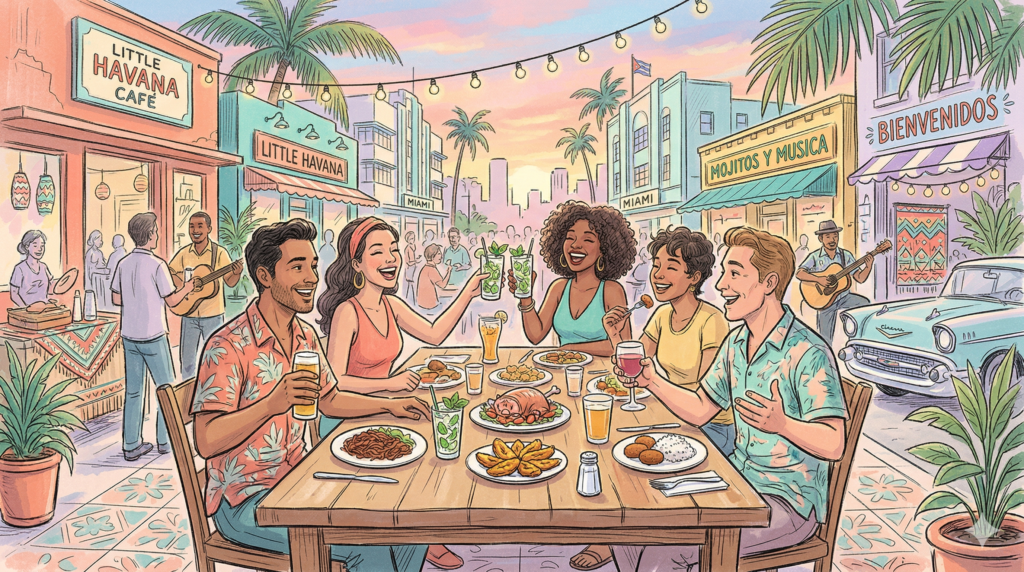
Most people flying through Miami spend their layover staring at the departure board. That’s understandable — Miami has a reputation as a city that requires time, money, and a hotel room to enjoy properly. But that reputation is wrong, or at least it’s wrong for Little Havana. You can be standing on Calle Ocho, drinking a $1.50 café cubano from a walk-up ventanita window, watching old men play dominoes in the shade, less than 25 minutes after leaving the terminal. No hotel, no tour guide, no advance planning beyond reading this guide.
MIA is one of the best-connected airports in the US for city access. The free MIA Mover skytrain takes you from any terminal to the Metrorail in under five minutes. From there, Downtown Miami is 8 minutes and Little Havana is 15. The city opens fast — the question is whether you have enough time to use it well.
This guide gives you the answer: a decision gauge calibrated to Miami’s specific transport reality, three itineraries built around what you can actually do without missing your flight, and honest opinions on where South Beach belongs in a layover plan (further down the list than you might think).
Quick Answers: Miami Layover FAQs
Yes. The free MIA Mover connects to the Metrorail Orange Line — Downtown is 8 minutes, Little Havana about 15. You need a minimum of 5 hours. Always allow 2.5 hours to return and clear security.
Yes. The US requires all international passengers to clear customs at MIA regardless of whether they plan to leave the airport. Citizens of Visa Waiver Program countries need an approved ESTA. All others need a valid US visa. Check your requirements at iVisa.com.
Only with 8+ hours. South Beach requires additional transit from the Metrorail — a bus connection or taxi adding 20–30 minutes each way. With 5–7 hours, Little Havana or Wynwood are faster to reach and more distinctly Miami.
Little Havana. It is the quickest culturally rich destination from MIA — a genuine Cuban-American neighbourhood that has nothing to prove to tourists. Versailles Restaurant, Máximo Gómez Domino Park, and the Calle Ocho ventanitas are all walkable from the same Metrorail stop.
The Layover Decision Gauge
Miami’s biggest layover variable is not the Metrorail — it’s South Florida traffic. The Metrorail runs independently of road congestion and is always the right choice. But if you take a taxi or rideshare to a neighbourhood not served directly by the line, a routine afternoon traffic delay can add 30–45 minutes you have not budgeted for. Build your plan around the train, not the road.
The MIA Mover and Metrorail together take 12–15 minutes to reach Downtown — add immigration clearing time and 2.5 hours to return, and under 5 hours leaves you almost nothing in the city. MIA has strong airside options: the American Airlines Admirals Club and Centurion Lounge (Concourse D) are both excellent, La Carreta serves authentic Cuban food in Concourse D, and the Yoga Room in the North Terminal is one of the few genuinely useful wellness spaces in any US airport. Use the time well airside.
You have time for one neighbourhood — not two, and definitely not South Beach. Take the Metrorail to Vizcaya Station for Little Havana (10-minute walk to Calle Ocho) or to Brickell and a short rideshare north to Wynwood. Have your café cubano, walk Calle Ocho or the Wynwood Walls, eat lunch, and be back on the Metrorail no later than 2.5 hours before your departure.
South Beach is now on the table. With 10+ hours you can do Little Havana in the morning, Wynwood in the afternoon, and South Beach by early evening. The 150 Express bus from the Metrorail station runs directly to South Beach for $2.25. With 12+ hours, add Bayfront Park and the Brickell waterfront. Start your return no later than 2.5 hours before your flight — more during morning and afternoon peak traffic windows.
Top 10 Things to Do During a Miami Layover
Ranked by accessibility from MIA and impact per hour. The first four are achievable on a 5-hour layover. South Beach appears at position 5 — not because it isn’t worth visiting, but because it requires more time than most layovers allow to do properly.
The heart of Cuban-American Miami — a mile of ventanitas serving $1.50 café cubano, cigar shops, murals, and the particular energy of a neighbourhood that has been exactly itself for 60 years. Walk east to west from SW 12th to SW 27th Avenue. Everything is free except what you eat and drink.
A small open-air park on Calle Ocho where Cuban exiles have played dominoes daily since the 1970s. Old men in guayaberas, arguing in Spanish, tiles clicking on concrete tables. It is a genuine living institution with no admission fee. Sit on the bench along the fence and watch for 20 minutes — it’s the most Miami thing you can do.
One of the world’s largest open-air street art installations — a full city block of murals commissioned from international artists, set inside a converted warehouse district. The surrounding streets extend the gallery for several blocks in every direction. Best on a weekday morning before the tour groups arrive. Admission is free to walk the exterior; the Wynwood Walls garden has a small entry fee.
The most famous Cuban restaurant in the world outside of Havana — a Little Havana institution since 1971, where presidential candidates have stopped for cafecito and every major event in Miami’s Cuban community ends up. Ropa vieja, Cuban sandwiches, black beans and rice, and a slice of tres leches. Go for lunch — the line moves fast and the food is the real thing.
The Art Deco district, the sand, the turquoise water, the people-watching. This is the Miami that everyone flies here to see. Worth every minute — but requires 8+ hours and a bus connection from the Metrorail. Take the 150 Express bus from the MIA area ($2.25, 35–40 min). Walk Ocean Drive, eat at a sidewalk café, and take a swim if the timing works.
A waterfront park and promenade on Biscayne Bay in Downtown Miami — palm trees, bay views, the downtown skyline behind you. Free, directly on the Metrorail line (Government Center station), and a pleasant 30-minute walk that gives you the feel of the city without needing to go further. The Bayside Marketplace is adjacent for food and drink.
A 1916 Italian Renaissance villa with formal gardens on Biscayne Bay — one of the most architecturally beautiful properties in Florida. The Vizcaya Metrorail station is on the Orange Line making it directly accessible. Unusual, genuinely impressive, and completely unlike anything else on this list. Best for longer layovers of 10+ hours when you want something beyond food and street art.
A restored 1930s jazz club on Calle Ocho with live salsa, Afro-Cuban, and Latin jazz most evenings from 8pm. No cover charge most nights, drinks from US$10. The most authentic Miami nightlife experience in the city — and genuinely accessible on a late-evening layover. A short walk from the Little Havana Metrorail connection.
A world-class contemporary art museum on the Biscayne Bay waterfront — striking architecture, excellent permanent collection, and rotating exhibitions that draw international names. The building’s hanging gardens alone are worth the walk from Government Center Metrorail station. Free on the first Thursday and second Saturday of each month.
A large, well-curated food hall near Lincoln Road in South Beach — the best single-stop eating destination in Miami for variety and quality under one roof. Vendors include top Miami chefs in a casual walk-up format. Combine with a walk on Ocean Drive. Requires the 150 Express bus connection — for 8+ hour layovers only.
Miami Neighbourhood Orientation
Miami is spread across a wide metro area but the Metrorail Orange Line connects MIA directly to the most layover-relevant areas. Here’s what’s accessible and how long it takes.
Getting from MIA to the City
The free MIA Mover is the starting point for every transit option. It runs on Level 3 of any terminal and connects to the Miami Intermodal Center — where you access the Metrorail, bus routes, taxis, and rideshare — in approximately 3 minutes.
| Option | Journey Time | Cost (one way) | Best For |
|---|---|---|---|
| MIA Mover + Metrorail Orange Line Recommended | 8 min to Downtown, 20 min to Little Havana | $2.25 (EASY Card) | All layover travellers. MIA Mover is free. Buy an EASY Card at any Metrorail station machine. |
| 150 Express Bus | 35–45 min to South Beach | $2.25 (EASY Card) | South Beach access for 8+ hour layovers. Runs from the MIA area. Slower but direct. |
| Uber / Lyft | 15–40 min (traffic dependent) | $20–45 to Downtown or Wynwood | Wynwood and neighbourhoods off the Metrorail line. Pickup from the MIA Intermodal Center rideshare zone. |
| Taxi (metered) | 15–40 min (traffic dependent) | $25–45 to Downtown, $35–55 to South Beach | Groups or heavy luggage. Subject to significant delays during peak hours (7–9am and 4–7pm). |
Miami’s Three Airports — Which One Are You At?
Miami International Airport (MIA) is the primary gateway — American Airlines hub, most international carriers, all Latin American routes. Located 8 miles northwest of Downtown. Directly connected to the city via the free MIA Mover and Metrorail Orange Line. This guide is built for MIA.
Fort Lauderdale-Hollywood International (FLL) is 40km north of Miami and serves Spirit, JetBlue, and low-cost carriers. A layover at FLL does not give practical access to Miami — it is a different city with its own attractions. Downtown Fort Lauderdale is 15 minutes from FLL by taxi, and Las Olas Boulevard is walkable from there. Do not attempt Miami from FLL on a short layover.
Opa-locka Executive Airport (OPF) handles private jets, charters, and cargo only. No scheduled commercial passenger service. If you are here, you already know it — and you have a driver waiting.
Miami Itineraries by Layover Length
All plans use the MIA Mover and Metrorail as the baseline. Always allow 2.5 hours to return — MIA’s international security can be busy and the MIA Mover adds a few minutes to the journey back.
The ventanita is a sliding window in a wall. Nothing more. On Calle Ocho there are dozens of them — small walk-up counters where you hand over coins and receive a thimble-sized paper cup of café cubano so sweet and strong that it rearranges your understanding of what coffee is. You drink it standing on the pavement. A man next to you is arguing with someone on his phone in rapid Cuban Spanish, gesturing with his free hand. A rooster walks past without any apparent concern. Two blocks away, old men are playing dominoes in a park they have occupied every day for fifty years. None of this is for you, which is exactly what makes it worth seeing — a neighbourhood that does not perform itself for tourists, because it has never needed to.
Miami Food Guide for Layover Travellers
Miami’s food scene is the most authentically Latin American in the United States — not Latin-inspired, not Tex-Mex, but Cuban food made by Cuban families using techniques brought from pre-Castro Havana. Add Venezuelan arepas, Peruvian ceviche, and Nicaraguan fritangas, and you have a city where a $10 lunch is genuinely one of the best meals you’ll eat anywhere.
What to Eat in Miami
MIA Airport Amenities — What’s Worth Knowing
Miami International is a large, busy airport with strong amenities if you know where to find them. The North Terminal (Concourse D) has the best airside food and lounges. The Yoga Room is one of the most useful wellness spaces in any US airport.
Short Stay Hotel Options at MIA
Luggage Storage During a Miami Layover
You cannot walk Calle Ocho or the Wynwood murals with a rolling suitcase without drawing attention to yourself as exactly the tourist you’re trying not to be. Store your bags before you leave — it takes five minutes.
At MIA
Luggage storage is available through Communitel in the North and South terminals, approximately US$10–25 per bag depending on size and duration. Confirm current hours at the terminal information desk — hours can vary. If you’re staying airside, the Miami International Airport Hotel also offers luggage storage for non-guests for a fee.
In the City
Book Experiences & Skip the Queue
On a layover, 45 minutes in a queue is 45 minutes you are not spending in the city. Pre-booking the Wynwood Walls garden entrance and any guided Little Havana tours means you walk straight in.
Staying Connected in Miami
US domestic travellers have full coverage throughout Miami. International travellers will find strong 4G and 5G coverage across Little Havana, Wynwood, and South Beach. Free Wi-Fi is available at MIA, Wynwood Walls, most cafés, and all major shopping areas.
Money and Payments in Miami
Miami is fully card-friendly — Visa and Mastercard are accepted everywhere from Versailles Restaurant to South Beach hotels. Cash is useful for Calle Ocho ventanitas and street food counters, some of which are cash-only. The Metrorail requires an EASY Card or cash.
- Best travel card: Wise or Revolut for fee-free USD withdrawals at real exchange rates.
- EASY Card: Required for the Metrorail — purchase at any station machine for $2 (card fee) plus your fare load.
- Cash: Keep US$20–30 for ventanitas, pastry counters, and tips.
- Tipping: 18–22% at sit-down restaurants. Counter service and food trucks: US$1–2 per transaction is appropriate.
- Avoid: Airport currency exchange — poor rates. Use an ATM after clearing customs if you need cash.
Miami Layover Budget Breakdown
| Item | Budget | Mid-Range | Splurge |
|---|---|---|---|
| Metrorail (return) | $4.50 + $2 EASY Card | $4.50 + $2 EASY Card | Uber/Lyft ~$50–80 return |
| Main activity | Free (Calle Ocho/Wynwood exterior) | $12–25 (Wynwood Walls, PAMM) | $25+ (Vizcaya Museum) |
| Lunch | $10–15 (Cuban counter) | $20–35 (Versailles sit-down) | $50+ (South Beach restaurant) |
| Luggage storage | $10–15 | $10–15 | $10–15 |
| Coffee + snacks | $3–8 (café cubano + pastelito) | $10–20 | $25–50 |
| Total estimate | ~$30–45 | ~$60–97 | ~$160–230+ |
Miami Weather — What to Expect by Season
Miami’s climate is subtropical and genuinely hot for much of the year. The best layover season is December through April — dry, warm, and comfortable for outdoor time in any of the neighbourhoods in this guide. Summer brings serious heat and a reliable afternoon thunderstorm pattern that moves fast and hits hard.
- Winter (Dec–Feb): 18–26°C (64–79°F). Dry, clear, and the best weather of the year. Peak tourist season — Wynwood and South Beach are busy but manageable.
- Spring (Mar–May): 22–30°C (72–86°F). Spring Break in March brings significant crowds and higher prices. Art Basel moves through December. The Calle Ocho Festival in March is worth timing a layover around if you can.
- Summer (Jun–Sep): 28–34°C (82–93°F) with high humidity. Afternoon thunderstorms are reliable — typically arriving between 2pm and 5pm, lasting 30–60 minutes. Plan outdoor time for mornings. Not a reason to skip the city — just something to plan around.
- Hurricane Season (Jun–Nov): Peak risk in August and September. Most storms give advance warning — but a developing storm can cause significant flight disruptions at MIA. Travel insurance covering weather delays is worth having during this window.
- Autumn (Oct–Nov): 24–30°C (75–86°F). Humidity dropping, crowds thinning. October through November is an underrated window — good weather, normal prices, and the city feels like itself again.
Travel Insurance for Miami Layovers
MIA is one of the busiest international airports in the US for Latin American and Caribbean routes. When summer storms hit South Florida — and they do, predictably and intensely — the cascading flight delays across the network can be significant. For separately booked flights through Miami, insurance covering missed connections is not optional.
- Same booking ticket: Your airline is legally obligated to rebook you at no cost if the delay is their fault.
- Separately booked flights: You bear the full cost of a replacement ticket. Last-minute fares on Caribbean and Latin American routes at peak season are expensive.
Safety Tips for Miami Layover Travellers
Miami is a safe city for layover travellers who stick to the recommended areas. Little Havana, Wynwood, Brickell, South Beach, and Downtown are all busy, well-visited areas with no meaningful safety concerns for daytime visitors. A few things worth knowing:
- Little Havana: Calle Ocho itself is safe and busy during the day. Avoid wandering off the main street into residential blocks west of SW 27th Avenue without specific local knowledge.
- Wynwood: Excellent during the day and early evening. The neighbourhood is well-patrolled and busy. After midnight it quietens quickly — if you’re on an evening layover, be aware of your surroundings in the blocks between the main art district streets.
- South Beach: The tourist strip on Ocean Drive is consistently busy and safe. The beach itself is safe. Standard bag-security awareness applies in crowded areas.
- Summer thunderstorms: They arrive fast. If the sky turns dark and the air pressure drops, get indoors. A Miami afternoon storm goes from clear to severe in under 30 minutes and is not something to be outdoors for.
- MIA security queues: International departures at MIA can have significant queues during morning and early afternoon peaks. Always allow a minimum of 2.5 hours for your return — more during summer and holiday periods.
Frequently Asked Questions
Yes — and Miami is one of the better US cities for a short layover visit. The free MIA Mover connects to the Metrorail Orange Line in under five minutes, and from there Downtown is 8 minutes, Little Havana is 20 minutes, and Brickell is 12 minutes. You need a minimum of 5 hours to make leaving worthwhile. For international travellers, remember that all passengers must clear US Customs at MIA — there is no airside transit option. Always allow at least 2.5 hours to return to the airport and clear international security.
Yes — this applies whether or not you plan to leave the airport. The United States requires all international passengers to clear US Customs and Border Protection at their first point of entry, which is MIA. Citizens of Visa Waiver Program countries (US, UK, EU, Australia, Canada, Japan, and many others) must have an approved ESTA before they travel — apply at esta.cbp.dhs.gov. ESTA approval is typically instant and costs US$21. Other nationalities need a valid US visa. Check your specific requirements at iVisa.com.
Only if you have 8+ hours. South Beach requires an additional bus connection from the Metrorail line — the 150 Express runs directly but adds 35–40 minutes each way to your transit time. With a 5–7 hour layover, that leaves you with 30–60 minutes on the beach, which is not enough. With 5–7 hours, Little Havana delivers a better and more distinctly Miami experience with less transit overhead. With 10+ hours, South Beach absolutely earns its place on the itinerary — Ocean Drive, a swim, and lunch at Time Out Market is a proper afternoon.
Take the free MIA Mover from Level 3 of your terminal to the Miami Intermodal Center (3 minutes). Board the Metrorail Orange Line south — two stops to Vizcaya Station (approximately 10 minutes). From Vizcaya Station, walk 10 minutes east along SW 8th Street (Calle Ocho) to reach Máximo Gómez Domino Park and Versailles Restaurant. Total journey from terminal: approximately 20–25 minutes. Cost: $2.25 each way (EASY Card, purchased at any station machine for $2 plus your fare load).
Start with a café cubano from a Calle Ocho ventanita — a shot of espresso pulled through demerara sugar that costs US$1.50 and tastes like no coffee you’ve had before. Follow it with a Cuban sandwich (roast pork, ham, pickles, pressed bread) and a batido milkshake from Versailles Restaurant or any Cuban counter. If you have time for one sit-down meal, order the ropa vieja — slow-braised shredded beef with black beans, rice, and sweet plantains. It’s a US$15–20 lunch and one of the best things you can eat in Miami at any price point.
Yes — better than most US airports. The Amex Centurion Lounge in Concourse D is among the better Centurion locations in the network. La Carreta in Concourse D serves genuinely good Cuban food airside. The Yoga Room near Concourse D is a free dedicated wellness space — mats provided, no booking required. XpresSpa in Concourse D offers massage services. And the Miami International Airport Hotel on Concourse E has a rooftop pool accessible to day guests — one of the few airside hotel pools in the United States.
If both flights are on the same booking, your airline is legally required to rebook you at no extra cost if the delay is their fault. If your flights are separately booked — common when travellers deliberately build a long Miami layover — you bear the full cost of a replacement ticket. MIA serves as the primary US gateway for Caribbean and Latin American routes, and replacement fares at short notice on these routes during peak season are expensive. Travel insurance covering missed connections is essential for separately booked flights. Insure My Trip, World Nomads, and EKTA Traveling all cover this scenario.
Yes — the areas in this guide are safe for solo travellers including solo women. Little Havana, Wynwood, Brickell, and South Beach are all busy, well-visited areas during daylight hours. Standard urban awareness applies — keep your bag secure in crowded market areas, be aware of your surroundings in Wynwood after midnight, and use the Metrorail or a rideshare app for returns rather than walking unfamiliar streets after dark. The biggest safety consideration for Miami layover travellers is environmental: afternoon thunderstorms in summer move fast and should not be underestimated. Get indoors when one approaches.
