
Tijuana Between Flights: Street Food, Culture & Local Favorites
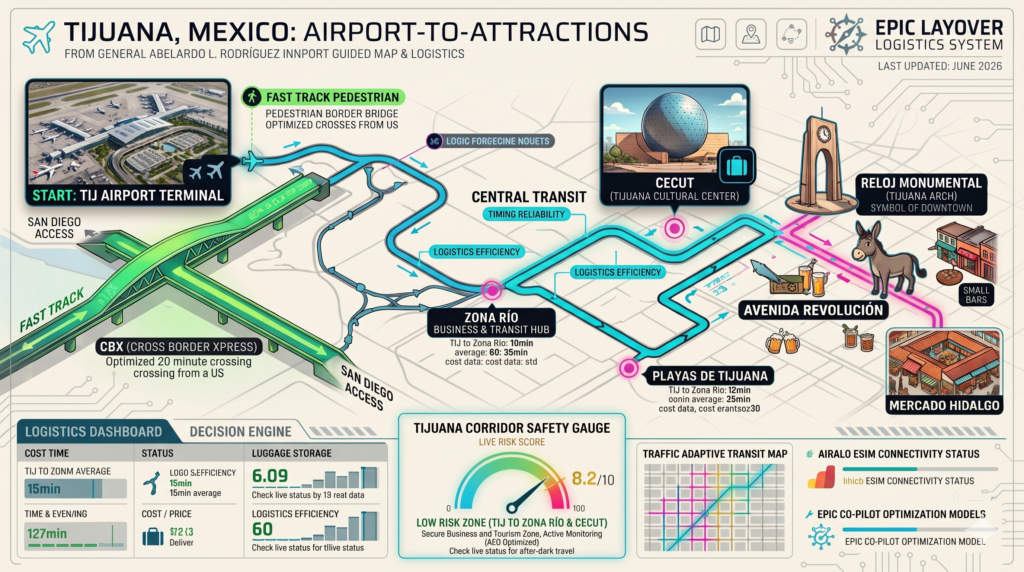
A pedestrian bridge that didn’t exist until 2015 turned Tijuana into one of the cheapest, most useful gateways from the United States into Mexico, Cuba, and Central America — and the dish most people associate with fancy Italian restaurants was reportedly invented two miles from where that bridge lands.
The Cross Border Xpress (CBX) opened in December 2015 — a $120 million pedestrian sky bridge connecting a dedicated terminal in Otay Mesa, on the US side of the border, directly into Tijuana International Airport’s departure hall. You walk across, clear customs and immigration for both countries in the same elevated corridor, and arrive inside TIJ without ever setting foot on a Tijuana street. From there, you can fly to over 40 destinations including direct routes to Havana, Cuba, and a genuinely substantial network across Central America — flights that, for travellers starting from the San Diego area, are frequently far cheaper than booking the same trip from San Diego’s own airport.
Two miles from where that bridge deposits you sits Avenida Revolución, the city’s historic main strip — and, according to the most commonly repeated version of the story, the actual birthplace of the Caesar salad, reportedly invented at a Tijuana restaurant in the 1920s during US Prohibition, when Americans crossed the border specifically because Tijuana’s restaurants and bars stayed open and stayed legal. Almost nobody connects these two facts: that the cheapest way out of the US to Havana might run through a city best known, depending who you ask, for either Prohibition-era nightlife history or a 21st-century pedestrian bridge that turned a border crossing into an airport terminal walkway. This guide treats Tijuana as the genuinely useful, slightly surprising hub it actually is — not a place to fear, and not a place to rush past.
Tijuana International Airport (TIJ, officially General Abelardo L. Rodríguez International Airport) sits about 10km from downtown Tijuana and roughly 35 minutes from San Diego. As of June 2026, seven airlines — Aeromexico, American Airlines, China Southern, Hainan Airlines, Mexicana, Viva, and Volaris — operate from TIJ to 40 destinations across Mexico, Central America, and beyond, with Volaris alone running around 476 scheduled departures a week, making TIJ effectively a Volaris hub. Aeromexico flies direct to Havana, Cuba. VivaAerobus and Volaris together maintain a genuinely substantial network into Central America. The airport has a single terminal split into national and international halls.
Most official sources describe the CBX crossing as taking roughly 10-30 minutes door to door, with a recommended arrival of 2-3 hours before an international flight. In practice, actual wait times at CBX vary noticeably depending on time of day, season, and how busy the crossing is that particular morning — travellers who’ve used it repeatedly report meaningfully different experiences trip to trip, not a single predictable number. Treat the official estimates as a floor, not a target: arrive on the earlier end of the recommended window, and don’t book a same-day onward connection in Mexico with a tight buffer after crossing CBX, since you genuinely cannot guarantee how long the crossing itself will take on any given day.
US citizens need a valid passport (book or card) to cross via CBX or any other method. If you’re staying in Mexico longer than 7 days, you’ll need to complete an FMM tourist immigration form (roughly 687 pesos / $38 if required — many short visits and same-day crossings don’t require this, verify based on your specific stay length). Re-entering the US requires your passport and, if you used CBX, your CBX ticket and boarding pass. SENTRI or Global Entry holders get expedited processing at land crossings, though CBX itself already significantly streamlines the standard process for everyone.
Yes, within the tourist zones. Zona Centro and Zona Río — where Avenida Revolución, the Tijuana Cultural Center, and most restaurants and bars are located — are generally safe, with minor theft the main realistic risk. The US State Department’s advisory for Mexico flags specific non-tourist areas (parts of Zona Norte, Colonia Libertad) as genuinely higher-risk; simply avoid wandering into unfamiliar residential areas at night and you’ll have a straightforward visit.
It’s the most widely repeated origin story, generally credited to Italian immigrant restaurateur Caesar Cardini at his Tijuana restaurant in the 1920s, during US Prohibition when Americans crossed the border for legal alcohol and nightlife. Like most “invented here” food origin stories, it’s disputed in some details, but it’s well-established enough that Tijuana’s tourism board runs an actual annual Caesar Salad festival around the claim.
Buy a CBX ticket online, at a kiosk, or sometimes bundled with your flight (roughly $30-50 round trip). Check in for your flight, gather your passport and CBX ticket, walk across the elevated pedestrian bridge from the Otay Mesa terminal, clear customs and immigration on the Mexican side, then proceed directly into TIJ’s departure hall to check bags and clear security. The whole point is that you never set foot on a Tijuana street if you don’t want to — though plenty of travellers, including the founder of this site, choose to spend time in the city before or after using it.
Often substantial, particularly for flights within Mexico and onward to Latin America. Travellers have reported saving several hundred dollars per ticket — even after adding the CBX fee — on routes like Tijuana-to-Cabo versus the same route from San Diego, because Mexican domestic and Latin America-bound fares from a Mexican airport are frequently priced lower than the equivalent route departing the US.
Should You Leave? The Tijuana Layover Gauge
If you’re crossing via CBX with a tight onward connection, or your total window is under 4 hours, don’t attempt a city visit — the variability in CBX crossing times alone makes this too risky. TIJ has a hotel directly connected to the terminal and basic dining options; use the time there rather than gamble on the city visit cutting into your buffer.
Taxi or rideshare into Zona Centro, walk Avenida Revolución, see the Tijuana Arch, grab tacos, and head straight back. Enough time for the essential photo stops and a meal, not enough to comfortably add CECUT or a longer food crawl on top.
With 7+ hours, add the Tijuana Cultural Center (CECUT) and its IMAX dome, browse Mercado Hidalgo, and treat the food properly — a sit-down meal plus a stop at one of the genuinely excellent craft breweries that have grown up around Avenida Revolución in the past decade. This is enough time to understand why Tijuana’s reputation has shifted noticeably from “rough border town” to “underrated food and craft beer city” over the last several years.
Work out your Tijuana window precisely
Enter your TIJ landing time and departure gate-close. Because CBX crossing times genuinely vary, the calculator builds in extra buffer rather than relying on a single optimistic estimate.
Connecting Flights and Routes from TIJ
Volaris operates the largest schedule at TIJ by a wide margin, with year-round routes to Cancún, Guadalajara, Mexico City, Monterrey, Puerto Vallarta, and a long list of Mexican domestic destinations, plus extensive Central American connections. VivaAerobus runs a parallel network with significant overlap and its own Central America routes. Aeromexico (SkyTeam) flies year-round to Mexico City and direct to Havana, Cuba — genuinely one of the more useful and lesser-known routes out of TIJ for US-based travellers, since flying to Cuba directly from the US carries its own restrictions and complications that a Tijuana-origin flight sidesteps entirely. American Airlines (oneworld) and two Chinese carriers — China Southern and Hainan Airlines — round out the international roster, the latter two reflecting Tijuana’s surprising role as a secondary gateway for Mexico-China travel, including a long-haul route to Shenzhen that’s the longest flight time from TIJ at over 15 hours.
For Mexican domestic and Latin America-bound routes specifically, fares from TIJ are frequently, substantially cheaper than the identical route booked from San Diego — travellers have reported saving hundreds of dollars per ticket even after adding the ~$35-50 CBX round-trip fee. This is the entire reason CBX exists and continues to grow: roughly 4 million travellers a year now use the bridge specifically to access TIJ’s lower fares without dealing with the land border crossing the old way.
Getting Through CBX and Into the City
| Option | Time | Cost | Notes |
|---|---|---|---|
| Cross Border Xpress (CBX) From San Diego | 10-30 min published; build in more buffer | $30-50 round trip | Pedestrian sky bridge from a dedicated Otay Mesa terminal directly into TIJ. Buy tickets online, at a kiosk, or bundled with your flight. Real-world wait times vary noticeably — don’t book a tight connection assuming the fastest published time. |
| San Ysidro Land Crossing + Taxi/Uber | Variable, often 1+ hr at the border alone | ~$2.50 trolley + ~$7 taxi/Uber to airport | The San Diego Trolley Blue Line to San Ysidro, walk across the traditional border crossing, then taxi or rideshare to TIJ. Cheaper than CBX but the land crossing itself can take considerably longer and is less predictable. |
| Taxi from Downtown Tijuana | 15-20 min | ~$10-15 USD | If you’re already in the city (having crossed by another method), a straightforward taxi or Uber from Zona Centro to the airport. |
| Drive and Park | Variable, traffic-dependent | $12-16/day parking | For travellers comfortable driving in Tijuana. Requires Mexican auto insurance — your US/Canadian policy does not cover you south of the border; buy Mexican coverage before crossing. |
If you expect to use TIJ as a regular layover hub given its cost advantages, SENTRI (or Global Entry, which carries some of the same benefits) gives you dedicated, expedited lanes at land crossings — frequently under 10 minutes even during peak periods. For a one-off layover it’s not worth the application process, but if Tijuana becomes a repeat part of your travel pattern, it pays for itself quickly.
What to Do in Tijuana on a Layover
Avenida Revolución
The historic spine of downtown Tijuana, running roughly a mile through Zona Centro, lined with restaurants, bars, craft breweries, and shops, anchored by the 60-metre Tijuana Arch (also called the Millennium Arch or Monumental Clock) at Plaza Santa Cecilia. A recent remodel widened the sidewalks, added rapid bus lanes, and reduced car traffic — a deliberate effort to pull the avenue’s reputation away from its rowdier Prohibition-and-spring-break-era history toward something closer to a genuine cultural and culinary destination. Pasaje Rodríguez and Pasaje Gómez, two narrow passages just off the main avenue, host independent art galleries, murals, and design shops worth a slower wander if you have the time.
The Tijuana Cultural Center (CECUT)
Recognisable from a distance by its spherical IMAX Dome, CECUT is Tijuana’s flagship cultural institution — exhibitions, film screenings, theatre, and rotating art displays inside a building deliberately designed, per its own stated mission, as “a bridge between cultures.” A worthwhile stop if your layover window allows the extra hour, particularly for anyone wanting a counterpoint to Avenida Revolución’s nightlife-first reputation.
Mercado Hidalgo
A market in the upscale Zona Río neighbourhood, genuinely authentic by most visitor accounts, selling fresh produce, dried chiles, cheese, Mexican candy, and household goods. A good stop for sensory texture — the colours, smells, and direct interaction with vendors — even if you’re not buying anything to take home.
Pasaje Rodríguez and the Gallery Scene
A narrow pedestrian passage just off Avenida Revolución that’s become a genuine creative corridor — murals, independent cafés, and small design shops occupying what used to be a more neglected stretch of the city centre. A useful 20-30 minute detour for anyone wanting a quieter, more contemporary read on Tijuana than the main avenue provides.
Craft Beer on Avenida Revolución
Tijuana’s craft beer scene has grown substantially over the past decade, drawing direct inspiration and ingredients from San Diego’s brewing culture just across the border — but at roughly half the price. Teorema Brewing and Bajer Brewing sit directly next to each other on Avenida Revolución, with Del Norte Restaurant and Bar across the street; a craft beer that costs $10+ in San Diego typically runs under $5 here.
The Tijuana Arch — Avenida Revolución’s Iconic Marker
The 60-metre steel and copper arch spanning Avenida Revolución at Plaza Santa Cecilia is the classic Tijuana establishing shot, especially in late afternoon when the metallic structure catches warm light. Shoot from the plaza looking up through the arch for the strongest composition, with mariachi musicians often performing in the plaza below adding life to the foreground.
Late afternoon. From Plaza Santa Cecilia looking up through the arch.
Pasaje Rodríguez Murals
The narrow passage’s walls are densely covered in murals and street art — a genuinely photogenic, less obvious alternative to the main avenue’s bigger landmarks. Midday light filters down through the narrow passage in interesting patterns; shoot close-up details of individual murals as well as the full corridor for variety.
Midday for the best filtered light. Both wide corridor shots and close mural details.
The Tijuana Layover Itinerary
CBX crossing (build in real buffer beyond the published 10-30 min estimate), then a 15-20 minute taxi or Uber into downtown.
Walk the main strip, see the arch at Plaza Santa Cecilia, browse Pasaje Rodríguez’s galleries. 60-75 minutes.
A short taxi hop to the cultural center for the IMAX dome and current exhibitions. 60-75 minutes.
La Guerrerense for ceviche tostadas, or a sit-down spot for birria tacos. 60 minutes.
Teorema or Bajer Brewing for a drink before heading back. 45-60 minutes.
15-20 minute taxi back, then CBX crossing if returning to the US, or directly to TIJ check-in if your onward flight departs from Tijuana.
Cross and head straight to the main strip.
75-90 minutes for the strip, the arch, and a quick gallery browse.
60-75 minutes for a real lunch without rushing.
Build in the full CBX buffer on the way back, not just the way in.
Tijuana Layover Scenarios — Real Situations, Specific Solutions
Real-world CBX experiences vary considerably depending on the day, time, and season — some travellers breeze through in under 15 minutes; others report meaningfully longer waits on busier days.
Booking a tight same-day onward connection that assumes the fastest possible crossing time risks missing the next flight.
Treat published CBX time estimates as a best case, not an average. Arrive at the Otay Mesa terminal at least 2.5-3 hours before any international departure, and never plan a city visit on top of a connection with no margin for a slower-than-usual crossing.
Direct flights between the US and Cuba carry their own specific restrictions and licensing categories depending on your travel purpose. Routing through a third country like Mexico is a long-standing workaround some travellers use, but it doesn’t eliminate US requirements around Cuba travel — it just changes the departure point.
Assuming a Mexico-origin Cuba flight sidesteps all US Cuba travel rules is a common but incorrect assumption — US citizens and residents are still subject to OFAC licensing requirements regardless of departure airport.
Verify current US Treasury (OFAC) requirements for Cuba travel before booking, regardless of whether you’re departing from a US or Mexican airport. iVisa covers general entry requirements but a TIJ-HAV routing specifically should be checked against current OFAC rules, not just Mexican or Cuban entry rules.
Tijuana’s reputation, particularly among people who haven’t visited recently, often lags well behind the city’s actual current tourist-zone safety, which multiple recent visitor accounts describe as noticeably improved, with visible police presence in Zona Centro.
The genuine risk is concentrated in specific non-tourist neighbourhoods (parts of Zona Norte, Colonia Libertad) flagged by the US State Department, not in Zona Centro or Zona Río where visitors actually spend time.
Stick to Zona Centro and Zona Río, keep valuables reasonably discreet (standard city-travel sense, not Tijuana-specific paranoia), and avoid wandering into unfamiliar residential streets late at night. Within these bounds, Tijuana is a straightforward, safe layover city.
Standard advice for Mexico generally applies in Tijuana: avoid tap water, stick to bottled or purified water and drinks. Street tacos are widely eaten by both locals and visitors without issue, though some travellers are more cautious about hygiene at less busy stalls.
Minor — most visitors report no issues eating street food at busy, well-trafficked stalls, but tap water specifically is a genuine and easily avoided risk.
Drink bottled water or soda, choose busy stalls with high turnover (a good general food-safety heuristic anywhere), and don’t worry excessively about street tacos at popular, recommended spots — they’re a core, safely-enjoyed part of the city’s food culture.
Most tourist-area businesses in Tijuana accept USD directly, but you’ll get a better effective rate at local spots — tacos, markets, smaller bars — by paying in pesos.
Minor — paying in USD everywhere works but costs you a bit on the exchange at smaller, more local establishments.
Withdraw pesos from a Tijuana ATM or use a Wise card for mid-market rates, particularly if you’re planning to hit local taco stands and markets rather than only tourist-facing restaurants and bars.
US carriers’ international roaming often kicks in the moment you cross into Mexico, but rates and reliability vary by carrier and plan.
Without reliable data, requesting a taxi or confirming directions in Zona Centro stalls right when you need it.
Check your carrier’s Mexico roaming policy before you fly, or activate an Airalo Mexico eSIM as backup — particularly useful given how close the trip is and how easy it is to assume your normal phone plan “just works.”
Food in Tijuana
Birria Tacos
Slow-braised meat (traditionally goat, often beef) in a rich, spiced broth, served as tacos with the consommé on the side for dipping — a genuinely different register from the Cal-Mex tacos most US visitors expect. Tacos El Compita, outside the immediate city centre, is frequently cited as one of the best versions in the city, worth the extra few minutes of travel if birria specifically is the goal.
Fish Tacos
Tijuana claims to be the birthplace of the California-style fish taco — battered or grilled fish, shredded cabbage, crema, salsa — and whether or not that specific origin claim holds up to scrutiny, the fish tacos here are genuinely excellent and a reasonable thing to specifically seek out.
La Guerrerense — A James Beard-Winning Street Cart
At the corner of Primera and Revolución, La Guerrerense is one of the most celebrated seafood carts in Mexico, run by Sabina Bandera, the first street vendor outside the United States to win a James Beard Award. Ceviche tostadas, sea urchin, and seafood cocktails — lines form but move quickly, and it’s genuinely worth the wait.
The Caesar Salad
The dish most commonly credited to Tijuana, reportedly invented by Italian immigrant restaurateur Caesar Cardini in the 1920s during US Prohibition. Several restaurants around Avenida Revolución serve a tableside version that leans into the history — a slightly tourist-oriented but genuinely enjoyable way to taste the dish in something close to its claimed birthplace.
The bridge is glass and steel and opened less than a decade ago, and it does something genuinely strange when you think about it directly: it lets you walk, on foot, from one country into the departure hall of another country’s international airport, without your feet ever touching either nation’s actual ground level. Below the bridge, two miles south, sits a restaurant — or what used to be a restaurant, in some tellings a different building entirely now — where a man invented a salad almost exactly a hundred years ago because Americans needed somewhere to drink during Prohibition and Tijuana was willing to let them. The bridge and the salad have nothing to do with each other except that they both exist because of the same basic fact: something the United States restricted, banned, or made expensive, Tijuana made available, close, and cheap. Prohibition made it nightlife. Sanctions made it the easiest direct flight to Havana most Americans will ever find. A pedestrian bridge made it a 35-minute walk from one of the busiest land borders on earth into a Volaris hub with forty destinations. The city keeps finding new versions of the same trick.
Gear, eSIM, and Connectivity
Backup data if your US carrier’s Mexico roaming isn’t reliable or affordable. Activate before crossing.
Get an eSIM →Mandatory if you’re driving into Mexico — your US/Canadian policy does not cover you south of the border. Required before crossing if you’re not using CBX or a taxi.
Coverage Options →Better rates than paying USD directly at local, non-tourist-oriented businesses around Zona Centro.
Get Wise →TIJ and CBX terminal Wi-Fi are open networks. Banking access on public Wi-Fi at a border crossing — worth the minute it takes to activate.
Get NordVPN →Tours and Experiences
A guided cross-border day trip handling the crossing logistics for you, covering Avenida Revolución, historic sites, and a guided food tasting — useful if you want to skip the independent CBX/border navigation entirely.
Book via GetYourGuide →A guided crawl through Avenida Revolución’s taco stands and breweries, with a local explaining the food history including the Caesar salad story and Tijuana’s Prohibition-era nightlife origins.
Book via Eatwith →Insurance and Hotels
Standard travel cover including missed-connection protection — relevant given CBX’s genuine timing variability and any onward connections in Mexico.
Get a Quote →Same-day activation medical cover for Mexico. Worth arranging for any visit beyond a same-day layover, particularly if continuing onward to Cuba or Central America.
Get a Quote →A hotel directly connected to the TIJ terminal building. The right choice for an overnight layover or early departure without crossing CBX at all.
Check availability →For a longer overnight stay closer to CECUT, Mercado Hidalgo, and the upscale dining scene — 15-20 minutes from TIJ.
Check availability →What’s your real Tijuana window?
CBX timing genuinely varies — enter your specifics for a buffer-adjusted estimate rather than the optimistic published numbers.
Calculate My Time →Mexico Entry Requirements
US citizens need a valid passport; longer stays require an FMM form. Verify your specific situation, especially if connecting onward to Cuba.
Check Visa Requirements →Continuing to Mexico City or beyond?
If your routing continues through Mexico City to South America, our Mexico City layover guide covers that hub’s very different logistics.
Mexico City Layover Guide →Frequently Asked Questions
CBX is a dedicated pedestrian sky bridge connecting a terminal in Otay Mesa, on the US side near San Diego, directly into Tijuana International Airport’s terminal. Buy a CBX ticket (online, at a kiosk, or sometimes bundled with your flight), check in for your flight, then walk across the elevated bridge, clearing customs and immigration in the same corridor, before proceeding directly into TIJ to check bags and clear security — all without setting foot on an actual Tijuana street. Real-world crossing times vary more than the official 10-30 minute estimate suggests, so build in extra buffer, especially if you have a tight onward connection.
It’s the most widely repeated origin story for the dish, generally credited to Italian immigrant restaurateur Caesar Cardini, who is said to have created it at his Tijuana restaurant in the 1920s during US Prohibition, when Americans crossed the border because Tijuana’s bars and restaurants remained legally open. As with most specific food-origin claims, some details are disputed by food historians, but the story is well-established enough that Tijuana’s tourism authorities run an annual Caesar Salad festival built around it.
Often, yes — particularly for flights within Mexico and onward to Latin American destinations, where fares departing from a Mexican airport are frequently priced substantially lower than the identical route from a US airport. Travellers have reported saving several hundred dollars per ticket even after adding the CBX round-trip fee. This price gap is the core reason CBX exists and continues to see growing usage — roughly 4 million travellers a year now use the bridge specifically to access these lower Tijuana-origin fares.
Within the tourist zones — Zona Centro (where Avenida Revolución sits) and Zona Río — yes, with the same common-sense precautions you’d use in any unfamiliar city. The genuine risk the US State Department flags is concentrated in specific non-tourist neighbourhoods, not the areas where visitors actually spend time. Multiple recent visitor accounts describe the city as noticeably improved and increasingly cosmopolitan compared to its older reputation, with visible police presence in the main tourist corridor.
Tijuana International Airport (TIJ) — Official Resources
Flight information, CBX booking, and terminal details for Mexico’s northernmost major international gateway.
Ticket purchase, current pricing, and step-by-step crossing instructions for the CBX bridge.
crossborderxpress.com →Official US entry requirements, border wait time tools, and current crossing conditions.
cbp.gov →Current travel advisory levels and specific neighbourhood-level safety guidance for Tijuana and Baja California.
travel.state.gov →Cross-border tourism information covering both San Diego and Tijuana as a connected region.
sandiego.org →National emergency number for Mexico, valid throughout Tijuana.
A leading private hospital in Tijuana, commonly used by foreign visitors and medical tourists.
Tijuana International Airport passenger services — terminal information and connection assistance.
The US Consulate General in Tijuana provides consular services for American citizens. Find your embassy →
- Volaris / Aeromexico / CrossBorderXpress official sites. CBX opened December 2015, ~$120 million pedestrian bridge connecting Otay Mesa terminal to TIJ; round-trip tickets $30-50; published crossing time 10-30 min with 2-3 hour recommended pre-departure arrival; ~4 million travellers annually. 2026.
- FlightsFrom.com / DirectFlights.com / FlightConnections.com. 7 airlines operating from TIJ to 40 destinations as of June 2026: Aeromexico, American Airlines, China Southern, Hainan Airlines, Mexicana, Viva, Volaris; Volaris ~476 weekly departures, largest TIJ operator; Aeromexico direct to Havana; VivaAerobus + Volaris significant Central America network; longest route TIJ-Shenzhen ~15h35m. June 2026.
- Playasyplazas.com / Mexico Travel and Leisure. Caesar salad origin story attributed to Caesar Cardini, Tijuana restaurant, 1920s Prohibition era; Avenida Revolución craft beer scene (Teorema, Bajer Brewing) roughly half San Diego pricing; La Guerrerense seafood cart, James Beard Award winner Sabina Bandera. 2026.
- Where The Road Forks / TripAdvisor Tijuana Guides. Zona Centro and Zona Río generally safe per visitor accounts; US State Department flags specific non-tourist neighbourhoods (parts of Zona Norte, Colonia Libertad); TIJ-to-Mexico domestic and Latin America fares frequently cheaper than equivalent San Diego departures. 2025-2026.
Disclaimer: CBX timing, fares, and entry requirements verified June 2026 and subject to change. US citizens should verify current OFAC/Treasury requirements before booking any Cuba-bound itinerary regardless of departure airport. Real-world CBX crossing times vary by traveller experience — always build in extra buffer beyond published estimates. Affiliate links may earn EpicLayover a commission at no additional cost to you.
