
Wheelchair Assistance at Airports in 2026: A Traveler’s Guide to Accessible, Dignified & Confident Air Travel
Airports are built for movement, speed, and long distances. For travelers with reduced mobility, that design can feel overwhelming. But accessible travel is not a privilege; it’s a global right backed by aviation law. With the proper preparation and a clear understanding of how wheelchair assistance actually works, you can move through any airport—no matter how large or chaotic- with confidence and dignity.
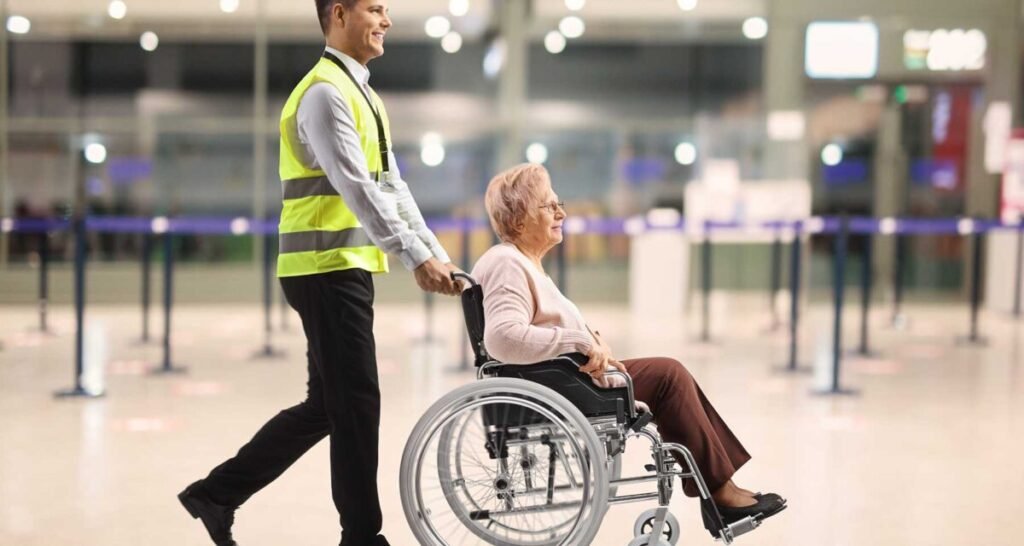
Wheelchair assistance is far more than a seat on wheels. When requested correctly, it becomes a complete, door-to-gate support system that includes check-in, security guidance, gate navigation, boarding, and post-flight assistance. PRM (Passengers with Reduced Mobility) teams at airports exist for one reason: to make air travel workable, predictable, and accessible for anyone who needs help.
A typical wheelchair assistance journey includes help at the terminal entrance, escorting through check-in, support navigating crowds and lines, priority or alternate security screening, escorting to the gate, aisle-chair boarding if required, and help on arrival through immigration, baggage claim, and transportation.
It is essential to understand the service’s limits. Wheelchair assistance does not include medical care, bathroom support, physical lifting, transferring into seats without proper equipment, or staying indefinitely during staff turnover. PRM staff are there to guide you safely—not perform the duties of a nurse or caregiver. Having the right expectations will help your travel flow more smoothly.
How to Request Wheelchair Assistance Correctly
The quality of your experience depends heavily on how early and how accurately you request assistance. The best approach is to request wheelchair assistance at the time of booking and confirm it again 48 hours before your flight. Airlines offer three mobility codes:
- WCHR: Can walk short distances but needs assistance inside the airport
- WCHS: Cannot walk stairs
- WCHC: Cannot walk at all and requires full assistance, including aisle chair use
Choosing the correct code ensures the airport brings the right equipment.
Travelers using electric wheelchairs or devices with lithium-ion batteries must provide additional details, including wheelchair weight, dimensions, battery specifications, and disassembly instructions. Most airlines offer dedicated accessibility portals for submitting this information:
- American Airlines: https://www.aa.com/i18n/disclaimers/special-assistance.jsp
- Delta: https://www.delta.com/us/en/accessible-travel-services/overview
- United: https://www.united.com/en/us/fly/travel/special-needs.html
If you forget to request assistance, it can still be arranged at the airport by speaking to the airline’s check-in desk or the mobility assistance counter. In the U.S., the TSA Cares program also offers support for travelers at security: https://www.tsa.gov/travel/passenger-support.
Security Screening: Knowing Your Rights Makes All the Difference
Security screening can be the most sensitive part of the journey. In the United States, the TSA allows travelers to remain seated during screening and request a same-gender officer or a private room. Officers must explain each step before touching your mobility device. TSA Cares can coordinate advance support, making the experience more predictable: https://www.tsa.gov/travel/passenger-support
Europe’s protections go even further under Regulation EC 1107/2006. Officers must verbally explain all procedures before touching your wheelchair or medical equipment. They cannot disconnect batteries without your permission. More details on European traveler rights:
https://transport.ec.europa.eu/transport-themes/passenger-rights/air_en
In the Middle East and many Asian airports such as Doha, Dubai, Singapore Changi, and Seoul Incheon, security tends to operate with more space, slower pacing, and a more precise flow—making the experience less stressful.
Wherever you are, communicate clearly, stay calm, and ask for clarification whenever you need it. You are not asking for favors; you are exercising your rights.
Navigating Terminals and Layovers
Once past security, mobility support truly shows its value. Large airports like Heathrow, Frankfurt, JFK, Istanbul, and LAX have distances between gates that can exceed a mile. PRM attendants know the fastest routes, the elevators, the back corridors, and the timing needed to reach your gate without rushing.
A simple but effective request is to ask the attendant to stay with you until your next escort arrives. Shift changes are common, and this prevents you from being left unattended.
If you have a layover, always add more time than a search engine suggests. PRM transfers during connections may require re-clearing security, switching terminals, or waiting for additional staff. One extra hour of buffer time can turn a stressful sprint into a relaxed connection.
Boarding the Aircraft
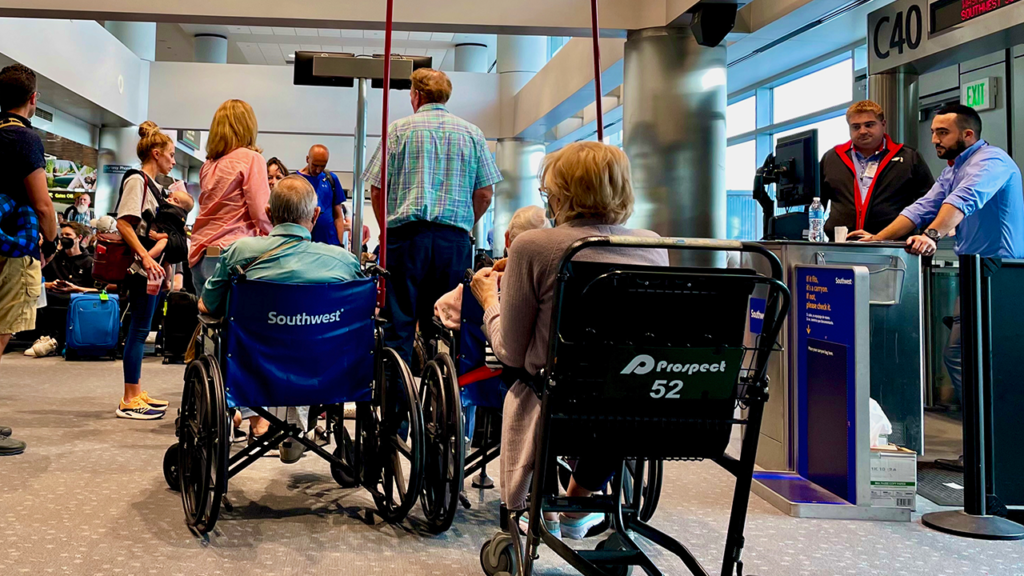
Boarding with wheelchair assistance is usually straightforward when communication is clear. You will pre-board before general passengers, allowing time for an aisle chair transfer if needed. Inform the gate agent early that you require an aisle chair or bulkhead seating for easier transfers.
Bulkhead seats are often ideal for travelers with limited mobility, but they must be requested before the day of travel, as they are assigned early and fill fast.
Arrival: The Most Unpredictable Phase
Arrival assistance varies the most between airports. Sometimes teams wait at the aircraft door; other times, you may wait a few minutes on board while staff coordinates. Flight attendants can improve this by contacting the mobility services team before landing. Asking them to do this ensures your escort is ready.
Arrival assistance includes immigration, customs, baggage claim, and transportation guidance or escorting you to your next gate during a layover. Fatigue is common at this stage, but a good PRM team will pace the journey according to your needs.
If your mobility equipment is damaged at any point, immediately document the damage and file a claim before leaving the airport. In the U.S. and EU, airlines are legally required to repair or replace damaged wheelchairs.
Plan Ahead for a Smoother Journey
If you’re requesting wheelchair assistance, consider travel protection for unexpected medical needs, trip interruptions, or equipment issues. Compare trusted coverage options or explore recommended travel gear for a more comfortable trip.
The Best and Worst Airports for Wheelchair Assistance (2026)
Top 5 Best Airports
| Rank | Airport | Region | Why They Excel |
|---|---|---|---|
| 1 | Doha Hamad (DOH) | Middle East | Strong coordination, clear signage, and reliable escort handoffs |
| 2 | Singapore Changi (SIN) | Asia | Efficient buggy networks, smooth transfers, excellent communication |
| 3 | Dubai International (DXB) | Middle East | PRM lounges, ambulifts at most gates, respectful and consistent service |
| 4 | Seoul Incheon (ICN) | Asia | Organized, predictable, exceptionally polite staff |
| 5 | Amsterdam Schiphol (AMS) | Europe | Strong coordination, clear signage, reliable escort handoffs |
Top 5 Worst Airports
| Rank | Airport | Region | Why They Struggle |
|---|---|---|---|
| 1 | New York JFK (USA) | North America | Understaffed contractors, long delays, inconsistent PRM response |
| 2 | London Heathrow (UK) | Europe | Long walking distances, inconsistent communication |
| 3 | Paris Charles de Gaulle (CDG) | Europe | Confusing layout, slow PRM response |
| 4 | Toronto Pearson (YYZ) | North America | Frequent delays and overwhelmed mobility teams |
| 5 | Los Angeles LAX (USA) | North America | Terminal sprawl, limited training consistency |
Knowing which airports excel and which fall short helps you plan layovers and connections more wisely.
If Something Goes Wrong
Travelers with reduced mobility face three common issues: delays, miscommunication, and equipment damage. You have formal avenues for recourse; use them confidently.
If your wheelchair is damaged, file a report immediately. Airlines in the U.S. and EU must repair or replace the device. If you feel abandoned or disrespected, document everything and escalate through the proper channels.
Helpful contacts include:
- U.S. DOT Disability Rights: https://www.transportation.gov/airconsumer
- TSA Cares (security assistance): https://www.tsa.gov/travel/passenger-support
- EU Passenger Rights: https://transport.ec.europa.eu/transport-themes/passenger-rights/air_en
- UK Civil Aviation Authority: https://www.caa.co.uk/passengers/passenger-assistance/
- Canada CTA: https://otc-cta.gc.ca/eng/accessible-transportation
- Dubai PRM: https://www.dubaiairports.ae/passengers/special-assistance
- Qatar Airways Accessibility: https://www.qatarairways.com/en/accessibility.html
Accessible travel works best when travelers know how to advocate for themselves.
Frequently Asked Questions (FAQ)
Is wheelchair assistance free at airports?
Yes. It is free in all major regions, including the U.S., UK, EU, Canada, and the Middle East. Airlines and airports cannot charge for mobility support.
How early should I request wheelchair assistance?
Request it when booking your flight and confirm 48 hours before departure. Electric wheelchair users must provide details on the battery and its disassembly.
Can I stay in my wheelchair during security screening?
In the U.S., yes. TSA allows seated screening and private rooms. Many international airports also allow it, though procedures vary.
Will I board the plane early?
Yes. PRM passengers typically pre-board before general passengers to allow time for aisle chair transfers and settling in.
What if my wheelchair is damaged during the flight?
File a claim immediately at the airport. In the U.S. and EU, airlines are legally required to repair or replace damaged mobility equipment.
Can my caregiver accompany me through security?
Yes, in most cases. They cannot ride PRM carts but may walk with you through the process.
Do I need medical documents to request assistance?
No. Self-identification of reduced mobility is sufficient.
What happens during a layover?
A PRM escort will assist you through terminal changes, security checks, and to your next gate. Always allow extra layover time.
What if no one shows up to help me?
Ask a gate agent or flight attendant to contact the mobility team immediately. If delays are extreme, file a report with the airline or aviation authority.
Final Thoughts
Accessible travel isn’t just a service; it is a right protected by aviation law and upheld by trained professionals around the world. Wheelchair assistance, when appropriately used, creates a smoother, safer, and more dignified travel experience for millions of passengers every year.
With realistic expectations, early planning, and knowledge of your rights, you can move through any airport with confidence. The system may not be perfect, but your journey can still be comfortable, efficient, and empowering.


One Comment