
Layover in Mexico City: 7 Reasons to Explore Beyond the Airport
No other capital on earth was built directly on top of the capital it replaced, and then kept building. Templo Mayor, the Aztec empire’s holiest site, sits excavated in open air two blocks from the colonial Metropolitan Cathedral the Spanish built partly from its stones, which itself faces a 21st-century glass-and-steel skyline. Three civilisations, stacked in under 40 metres of walking. You are not visiting Mexico City on a layover. You are walking through a cross-section of 700 years, one square at a time.
Here is the number that changes how you plan this layover: Mexico City sits at 2,240 metres above sea level, one of the highest capital cities on earth, and MEX airport itself sits at roughly the same altitude. Most visitors feel nothing. Some feel short of breath climbing Templo Mayor’s stairs or notice their first beer hits harder than usual. It rarely matters for a half-day visit, but it is worth knowing before you commit to power-walking six blocks uphill on a tight connection.
The airport itself handled 44 million passengers in 2025, the busiest in Latin America, and is mid-way through a US$461 million modernisation pushing toward the 2026 FIFA World Cup, for which Mexico City is a host city. The renovation has not been without criticism: IATA flagged in 2026 that the upgrades address immediate maintenance but not the airport’s structural capacity constraints. For a layover traveller, the practical result is manageable congestion at peak hours and a genuinely important 2026 rule change at the kerb: as of March 2026, Uber and DiDi are banned from picking passengers up inside the terminal, enforced by National Guard units. This guide is built around what that actually means for you.
Below: how to get past the taxi-versus-Uber confusion cleanly, what the FMM tourist card actually requires, how much time Centro Histórico genuinely needs, where to eat without gambling on a street stall, and how to protect your return leg through some of the worst traffic in North America.
Mexico admits passport holders from around 65 countries visa-free for stays up to 180 days. Every visitor, visa-exempt or not, receives an FMM (Forma Migratoria Múltiple) tourist card on arrival: as of 2026 this is largely digital, with immigration stamping your passport directly at most major airports rather than issuing paper. Keep any card or receipt you do receive until departure. Not sure what applies to your nationality? Our layover visa guide covers transit and entry rules by nationality, or use iVisa if your nationality does require a visa and you want a guided application with human review before your travel date.
Airlines at MEX: Who Flies Here and From Which Terminal
MEX served 44 million passengers in 2025 across more than 25 airlines flying to over 100 destinations. It is Aeroméxico’s home SkyTeam hub and a base for Volaris and Viva, which makes it the busiest airport in Latin America by a wide margin. Two terminals, connected by the airside Aerotrén automated train for boarding-pass holders, or a public road shuttle for everyone else: allow 45 to 60 minutes for any Terminal 1-to-Terminal 2 connection, longer if you must clear immigration or security again.
Aeroméxico: the SkyTeam hub carrier, based at Terminal 2
Aeroméxico and its SkyTeam partners (Delta prominent among them) operate almost entirely from Terminal 2, opened in 2007 specifically for this alliance. If you are connecting Aeroméxico-to-Aeroméxico or Aeroméxico-to-Delta within T2, your transfer is straightforward. The trap is a mixed itinerary: land on a Terminal 1 carrier and connect onward via Aeroméxico, or vice versa, and you are budgeting a genuine cross-terminal transfer, not a gate walk. Aeroméxico’s 2025-2026 network expansion added new routes to Barcelona and Paris, extending its European reach from this hub.
Should You Leave the Airport? The Decision Guide
The honest maths at MEX: entry formalities run 20 to 40 minutes for most nationalities, the authorised taxi queue and kiosk purchase adds another 10 to 15, and traffic into Centro or Roma Norte runs 25 to 40 minutes each way outside rush hour, considerably longer inside it (allow 90 minutes during the 7-9am and 5-8pm windows). Add a 90-minute return buffer and you are looking at roughly 3 to 3.5 hours of fixed overhead on a good day.
How much time do you actually have?
Enter your arrival and departure and we calculate the real usable window after immigration, transit and buffer time. Most people have less than they think.
Getting Into Mexico City: Every Option, Priced
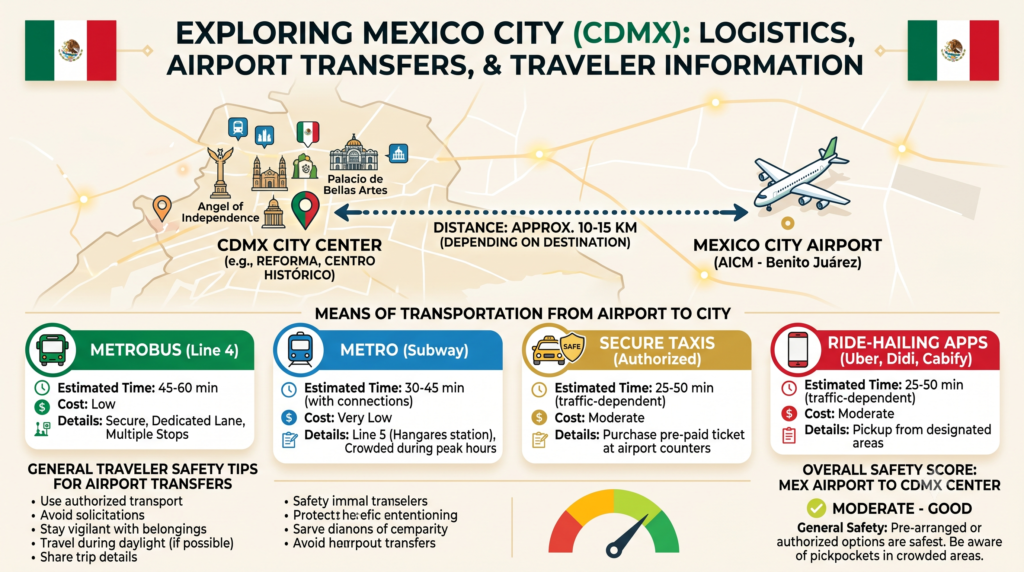
The authorised Sitio taxi, bought at the kiosk inside arrivals, is the right default for getting into the city: fixed zone pricing of roughly MXN 260 to 420, 25 to 40 minutes to Centro or Roma Norte outside rush hour. The 2026 rule change matters more here than almost any other transport decision on this page. Since 12 March 2026, ride-hailing apps cannot pick passengers up inside AICM’s terminals, enforced by National Guard, with Uber contesting the ban in court and a designated waiting zone between the terminals under development. Treat Uber pickup at arrivals as unreliable in 2026. Drop-offs to the airport for your departure still work exactly as normal.
| Option | To | Time | Cost | Notes |
|---|---|---|---|---|
| Authorised Sitio taxi | Centro / Roma / Polanco | 25–40 min | MXN 260–420 fixed by zone | Buy the ticket at the kiosk inside arrivals before exiting. The safe, recommended default for arrivals. |
| Uber / DiDi (departures only) | Anywhere in the city | Traffic-dependent | MXN 100–250 | Reliable for hotel-to-airport departures. Unreliable for airport pickups since March 2026’s terminal ban. |
| Metro Line 5 (Terminal Aérea) | Pantitlán, then transfer | 45–90 min with transfer | MXN 5 | Cheapest option by far, but slow with luggage and requires at least one line change. Daytime only, not recommended solo at night. |
| Metrobús Line 4 | Centro / Zócalo corridor | 40–50 min | MXN 6–13 | More direct than the Metro for the historic centre, still awkward with bags. |
| Pre-booked private transfer | Anywhere in the city | 25–40 min | Fixed price, booked in advance | Confirmed price before landing, driver waiting in arrivals. Removes the taxi-kiosk decision entirely. |
Pay for taxis, markets and street food the smart way. Mexico remains a cash-forward economy at the stall level, and airport currency exchange booths run 10 to 15 per cent below street rates, a quiet tax on anyone who exchanges the moment they land. A Wise or Revolut card converts at the mid-market rate at any city ATM, meaning the pesos you withdraw in Roma Norte cost noticeably less than the ones you’d get at the arrivals kiosk.
Planning an onward leg by bus rather than flying? ADO buses run direct from the airport (outside Terminal 2) to Puebla, Cuernavaca and destinations across the Bajío region, and can be compared and booked in English on Omio alongside domestic flight options.
AICM banned Uber and DiDi from picking up passengers inside the terminal as of 12 March 2026, deploying National Guard to enforce it. Uber is contesting the ban in court, and the government has announced plans for a designated ride-hailing waiting zone roughly an 8-minute walk between Terminal 1 and Terminal 2, but as of this writing it functions inconsistently. If you specifically want a rideshare rather than a taxi, follow the in-app pickup instructions exactly, expect to walk outside the terminal to a meeting point, and never enter a vehicle whose plate does not match the app. For a guaranteed, no-walking pickup, book a fixed-price transfer in advance instead.
Your phone needs to work from the moment you land, not least because requesting any rideshare at all now depends on navigating the 2026 pickup-zone confusion with a live map. Install an Airalo Mexico eSIM before boarding and it activates the moment you land. For a short layover where a fixed plan wastes money, Roamless pay-as-you-go data covers a half-day visit for a few dollars.
What to Do in Mexico City on a Layover
Centro Histórico is where a layover earns its keep: the Zócalo, one of the largest public squares on earth, is ringed by three civilisations’ worth of architecture within a genuinely walkable radius, and it sits roughly 25 to 40 minutes from the airport by authorised taxi.
The Zócalo and Templo Mayor
The Zócalo has been Mexico City’s central square since the Aztec capital of Tenochtitlan stood here, and the Metropolitan Cathedral on its north side was built over more than two centuries, partly from stones taken from the Aztec temples the Spanish demolished. A block away, Templo Mayor sits excavated at street level: the ceremonial heart of the Aztec empire, rediscovered by accident in 1978 when electrical workers hit a carved stone disc. Admission to the site museum is MXN 100 (about US$5.50), Tuesday to Sunday, closed Mondays.
Palacio de Bellas Artes
A ten-minute walk from the Zócalo, this white marble concert hall and museum, completed in 1934, houses Diego Rivera murals and a genuinely spectacular Art Nouveau and Art Deco interior. The exterior alone, framed against the surrounding plaza, is worth the detour even if you skip the ticket queue inside.
Chapultepec Castle
The only royal castle in the Americas to have actually housed emperors, sitting atop a hill in one of the largest urban parks in the world. Admission is MXN 90 to 100, but the walk up from the park entrance takes 15 to 20 minutes on foot, and weekend queues can run up to 2 hours. This only fits a layover with 8-plus hours and a taxi rather than public transport both ways; skip it on anything shorter and stay in Centro.
Roma Norte and Condesa
Tree-lined, Art Deco, and the neighbourhood where Mexico City’s contemporary food and coffee culture lives. Roma Norte in particular rewards an unplanned walk more than a checklist: wander from Álvaro Obregón toward Parque México and let the architecture and cafés do the work. This is the natural add-on for a 7-hour-plus window after Centro Histórico, not a replacement for it.
Coyoacán
Frida Kahlo’s birthplace and the Museo Frida Kahlo (the “Blue House”) sit in this cobblestoned southern neighbourhood, along with a lively weekend market. It is genuinely worth a dedicated day, but on a layover it competes directly with Centro Histórico for your time and adds real transit distance: only attempt it with 9-plus hours and a pre-booked return.
Stand on the Metropolitan Cathedral’s front steps at midday and frame the full width of the square with the National Palace’s façade behind it. The flag at the centre of the Zócalo is one of the largest ceremonial flags in the world, raised and lowered daily with a small honour-guard ceremony worth timing your visit around if you can.
Cross to the small park directly opposite the building and shoot with the white marble dome centred and the surrounding plaza’s palm trees framing both sides. Late afternoon light picks up the building’s warm tones against a blue sky; the fountain in front adds reflection if the wind is calm.
Itineraries by Time Window
Mexico City sits at 2,240 metres, one of the highest capital cities on earth, and MEX airport is at a similar elevation. Most half-day visitors feel nothing beyond mild breathlessness on stairs or an unusually fast-hitting drink. It rarely affects a layover, but skip the Chapultepec Castle hill-climb if you have any history of altitude sensitivity, and drink water rather than starting with alcohol the moment you land.
Travel Scenarios: Real Situations at MEX
You land at MEX, open the Uber app out of habit, and request a ride straight from the arrivals door, exactly as you would at most other airports.
Since March 2026, drivers face fines and National Guard enforcement for picking up inside the terminal. Your driver cancels, or you are redirected to a pickup point an 8-minute walk away that you cannot easily find with a rolling bag and a 5-hour window shrinking by the minute.
Skip the app entirely for arrivals. Buy an authorised Sitio taxi ticket at the kiosk inside arrivals, fixed zone price, no walking, no app confusion. Save the rideshare apps for your departure back to the airport, where pickups from hotels work normally.
Your inbound lands at Terminal 1 and your onward Aeroméxico flight departs from Terminal 2, on a mixed-carrier itinerary booked as two separate tickets.
The Aerotrén is airside and boarding-pass only; you need the public road shuttle instead, plus a full re-check-in at Terminal 2. The airport’s own guidance is to allow 45 to 60 minutes for this, longer if you re-clear security.
Treat any separate-ticket T1-to-T2 self-connect under 2 hours as high-risk, and carry cover that pays out if it collapses: World Nomads covers missed connections on separately booked itineraries.
You planned a 7-hour layover around a leisurely Roma Norte lunch, not realising your return taxi would leave right as the 5 to 8pm traffic window begins.
A 25-minute airport run can stretch to 90 minutes in Mexico City rush hour. Locals plan around this as a matter of routine; visitors on a layover clock often don’t, and it is the single most common way a good layover becomes a missed flight here.
If any part of your return trip overlaps 5 to 8pm, add a full extra hour to your buffer, or fix the risk entirely with a Welcome Pickups transfer booked at a set time, so a traffic-inflated fare is never a surprise.
You land with no pesos and change USD at the first currency booth you see in arrivals, before a taxi ticket or a taco stand.
Airport exchange rates run 10 to 15 per cent below the street rate, a quiet loss on every peso you convert, at the exact moment you’re converting the most.
Withdraw from a city ATM with a Wise card at the mid-market rate instead, or tap the card directly wherever cards are accepted, and change only enough cash at the airport to cover the taxi.
The 2026 rideshare pickup rules are actively changing, and the in-app instructions for where to meet your driver depend on a live connection to work at all.
Airport Wi-Fi gets you as far as the terminal door, then drops you exactly when you need live directions to a pickup point that changes without much notice.
Install an Airalo Mexico eSIM before you board so it is live the moment you land, well before you need to make any pickup decision at all.
You climb the 15-to-20-minute uphill path to Chapultepec Castle without having acclimatised to the city’s 2,240m elevation, and start to feel genuinely light-headed partway up.
Mild altitude effects are common and usually harmless, but pushing through them on a hill climb, on a layover, far from your hotel, is a bad combination if symptoms escalate.
Stop, sit, and hydrate rather than pushing on; skip the castle climb entirely on a layover if you have any history of altitude sensitivity. Same-day medical cover from Visitors Coverage closes the gap if you do need care.
What to Eat: Mexico City in Four Dishes
Everything below is realistic within a short walk of Centro Histórico or a quick taxi to Roma Norte.
Tacos al pastor
Marinated pork shaved from a vertical trompo spit, a technique itself descended from Lebanese immigrants’ shawarma in the early 20th century, served on small corn tortillas with pineapple, onion and cilantro. El Huequito, with a Centro location dating to 1959, is one of the city’s benchmark spots. Expect to pay MXN 15 to 25 per taco, and order several.
Mole
Not one sauce but a whole family of them, built from chiles, spices, nuts and often chocolate, simmered for hours. Oaxaca-style mole negro is the version most visitors encounter, typically ladled over chicken. A proper sit-down plate runs MXN 150 to 250 in a mid-range Centro or Roma restaurant, and is worth the extra time it takes to order rather than grabbing something faster.
Chilaquiles
Fried tortilla strips simmered briefly in red or green salsa until just softened, topped with crema, cheese, onion and often a fried egg. A breakfast-through-early-afternoon dish, and the single best test of a neighbourhood café’s real cooking rather than its tourist appeal.
Elote and esquites
Corn on the cob (elote) or off the cob in a cup (esquites), slathered with mayonnaise, cotija cheese, chile powder and lime. Street carts sell it everywhere Centro Histórico foot traffic runs heavy, for MXN 30 to 50, and it is the easiest, fastest bite on this list if your window is genuinely tight.
Staying Inside the Airport: The Under-5-Hours Plan
If the gauge says stay, Terminal 1 has a reasonable food court and duty-free retail, and Terminal 2 (Aeroméxico’s home) is generally regarded as the more comfortable of the two, with better lounge access and dining. Free Wi-Fi is available in both terminals. Neither terminal offers the kind of dramatic architecture or extended amenity build-out found at newer Asian or Gulf hubs, so a short layover here is functional rather than an attraction in itself.
Working on shared airport Wi-Fi for several hours means your banking and saved passwords are travelling over a network shared with thousands of strangers, in an airport whose own infrastructure has faced public scrutiny in 2026. A VPN closes that exposure in one tap: NordVPN covers the laptop-and-phone combination most travellers carry.
Layover Gear: Connectivity and Power
Your phone needs to work from the moment you land, especially in 2026 when the correct rideshare pickup point is itself a moving target.
Hotels for Overnight Layovers
The overnight decision at MEX is straightforward: stay near the airport for an early departure, or stay in the city for a proper evening, given Mexico City traffic makes a late-night airport dash genuinely risky.
Tours Worth Booking in Advance
Luggage Storage, Transfers and Insurance
Luggage storage
Both terminals have storage counters, but for a Centro Histórico day, storing the bag before you head into the city means you’re not hauling it through crowded plazas.
Airport transfers
Given the 2026 rideshare pickup restrictions, a pre-booked transfer is worth more here in 2026 than at almost any other airport on this site: it removes the taxi-kiosk decision, the app-pickup-point confusion, and the rush-hour price surprise, all in one booking.
Insurance
Mexico is generally safe for tourists who stick to well-known areas, and private medical care for foreign visitors is billed directly, without the safety net of a home-country health system behind it.
If something goes seriously wrong, lost passport, medical emergency, legal situation, you need your country’s consular representation. Our embassy and consulate guide lists every consular office in every city we cover, with direct phone numbers.
More Layover Guides
MEX Layover FAQ
Official MEX and Mexico City Resources
Primary sources for live flight, transport and entry information. Bookmark these before you fly.
Safety and Help in Mexico City
Sources and Citations
- Mexico City International Airport, Wikipedia: passenger rankings, terminal structure, Aerotrén, 2025-2026 traffic figures
- Mexico Business News, “AICM Handles 18.4 Million Passengers, Up 2.1% in Early 2026” — modernisation programme scrutiny, IATA remarks on structural capacity constraints
- Mexico Tribune, “New Rule to Officially Allow Uber Pickups at Mexico City Airport,” April 2026 — designated waiting zone plans
- Mexico Travel and Leisure / Saily / Aeropuerto-Mex.com transport guides — March 2026 Uber/DiDi terminal pickup ban, National Guard enforcement, authorised Sitio taxi zone pricing
- Wego Travel Blog, “Mexico Tourist Card (FMM) 2026” — digital FMM rollout, visa-exemption list, fee structure
- INM (Instituto Nacional de Migración) official FMM guidance
- INAH official sites: Templo Mayor (admission MXN 100) and Museo Nacional de Historia / Chapultepec Castle (admission MXN 90–100)
- Templo Mayor Museum official site: 1978 discovery account, excavation history
- Mexico-Airport.com (independent guide): terminal layout, taxi companies, Metro Line 5 routing and fares
- Wikipedia / general reference: Mexico City elevation (2,240m), altitude context
Fares, admission prices, transport rules and entry requirements were verified in July 2026 and change without notice, particularly the 2026 rideshare pickup rules, which remain contested in court. Always confirm critical details against the official sources above before travelling. Some links on this page are affiliate links: they cost you nothing and help keep EpicLayover’s guides free and current.
