
7 Incredible Santiago Layover Experiences Between the Andes & the City
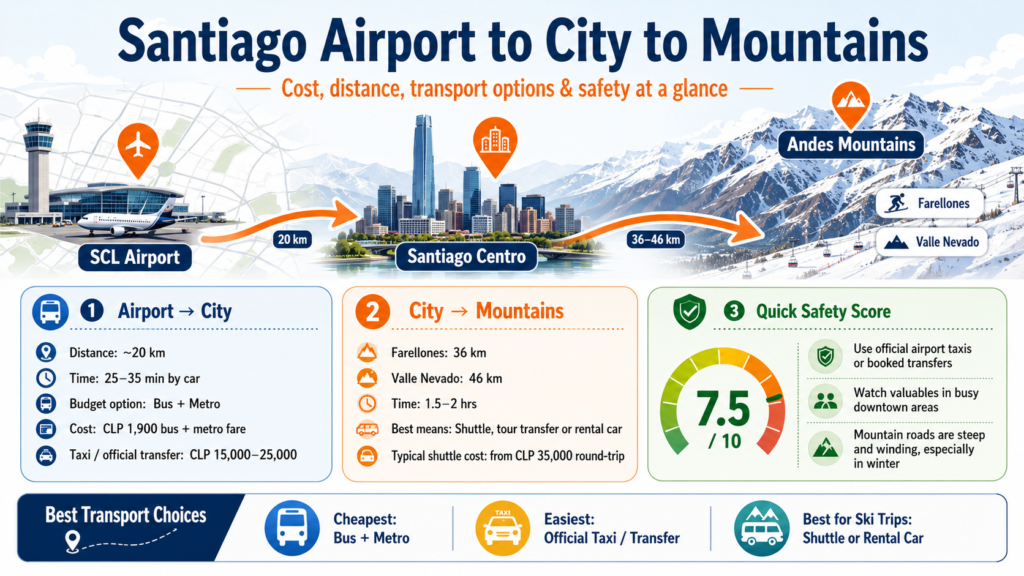
Ride the elevator to the Sky Costanera observation deck, the highest viewpoint in South America, on a clear day and you’ll see something few capital cities can offer: a metropolitan area of more than 6 million people laid out in a valley, with the snow-capped Andes rising directly behind it, close enough that the mountains don’t feel like scenery, they feel like a wall. Santiago is one of the only major capitals on Earth where you can stand downtown and photograph both a modern skyline and genuine high-altitude peaks in the same frame, no zoom lens required.
Santiago is the answer sentence first: SCL is Chile’s largest and busiest airport, handling 26.5 million passengers in 2025, and sits 15km northwest of downtown. There is no train link yet (one is planned for 2028-2030), but the Centropuerto or TurBus airport bus to a Metro connection is fast, cheap and genuinely easy to figure out on arrival.
Here’s the pain point most guides get wrong, in the other direction: several older sources still mention a “reciprocity fee,” a one-time entry charge that used to hit US ($160), Canadian and Australian passport holders on arrival. It was abolished in March 2014. If a guidebook, an old airline email, or a helpful-sounding travel forum post tells you to budget for this, ignore it completely. As of 2026, US, EU, UK, Canadian and Australian citizens all enter Chile visa-free for up to 90 days with nothing more than a passport stamp and a small Tourist Card.
Below: the honest transit options from a 15km, no-rail airport, why Chile’s customs process takes agricultural declarations more seriously than almost anywhere else in this guide series, how much time the Plaza de Armas and La Moneda genuinely need, and where to get that Andes-and-skyline photograph for yourself.
For years, Chile charged a one-time “reciprocity fee” on arrival to US (~$160), Canadian (~$132) and Australian (~$117) passport holders, matching what those countries charged Chilean visitors. It was abolished in March 2014 and has not been collected since. Numerous guidebooks, old airline confirmation emails and travel forum threads still reference it, sometimes with specific dollar figures that sound very precise and very wrong. As of 2026, citizens of the US, EU, UK, Canada, Australia and New Zealand all enter Chile visa-free for up to 90 days with just a passport and the small Tourist Card issued at immigration. If anyone or anything asks you to pre-pay a Chile entry fee before travel, it is not a legitimate government charge.
Most Western passport holders skip this section entirely, but not every nationality enters Chile visa-free. If yours does require an advance visa, Chilean consular processing can take weeks, not days, so this is not something to sort out during a layover. Check your specific requirement well ahead of travel. Our layover visa guide covers entry rules by nationality, or use iVisa for a guided application with human review if you need one.
Airlines at SCL: Who Flies Here
SCL handled 26.5 million passengers in 2025 and functions as Latin America’s main gateway to Oceania as well as a critical South American hub. LATAM Airlines accounts for roughly 82% of the airport’s commercial operations, reflecting Santiago’s role as the carrier’s home base and maintenance centre.
LATAM: the dominant hub carrier
LATAM’s overwhelming presence at SCL means most connections through Santiago involve this carrier at some point, whether flying onward within Chile, across South America, or on one of its long-haul routes to North America, Europe or Oceania. LATAM-to-LATAM connections are typically straightforward within the same terminal structure; the airline’s dominance also makes SCL one of the more predictable hubs in this series for connection reliability.
Should You Leave the Airport? The Decision Guide
Five hours is the realistic floor for a Santiago layover. The maths: immigration and Chile’s thorough agricultural/customs inspection run 30 to 60 minutes, transit is 30 to 60 minutes each way depending on your chosen method, and a 90-minute return buffer covers most scenarios given the airport’s genuinely manageable, if traffic-exposed, distance.
How much time do you actually have?
Enter your arrival and departure and we calculate the real usable window after immigration, transit and buffer time. Most people have less than they think.
Getting Into Santiago: Every Option, Priced
Without a train link, the choice comes down to value versus convenience: the bus-plus-metro combination is genuinely cheap and reliable, while rideshare trades a higher price for door-to-door simplicity.
| Option | To | Time | Cost | Notes |
|---|---|---|---|---|
| Centropuerto or TurBus + Metro | Centro / Providencia / Las Condes | 45–60 min total | CLP 1,900–2,500 bus + CLP 800–890 metro | Centropuerto goes to Pajaritos (Line 1 east); TurBus goes to Estación Central (Line 1 west). Cheapest reliable option. |
| Uber / Cabify / DiDi | Anywhere in the city | 25–50 min, traffic-dependent | CLP 12,000–28,000 | Legal and widely used. Pickup from a designated app zone in the parking structure, not the curb. |
| Official taxi | Anywhere in the city | 25–50 min, traffic-dependent | CLP 20,000–35,000 fixed by zone | Prepaid at the official desk inside arrivals, past customs. The safest choice if you’d rather not use an app. |
| Transvip shared van | Major hotel districts | 30–60 min | CLP 8,000–12,000 per person | Good value for solo travellers heading to a well-known hotel area; departs once filled. |
| Pre-booked private transfer | Anywhere in the city | 25–50 min | Fixed price from ~CLP 30,000 | Driver waits in arrivals with a name sign, useful for early departures or heavy luggage. |
Uber, Cabify and DiDi are fully legal at SCL, but pickup happens from a designated “Aplicaciones” zone inside the parking structure, not directly outside arrivals. First-time visitors sometimes wander toward the taxi rank instead. Follow the terminal signage specifically for app-based rides, and budget a few extra minutes to find it.
Pay for the bus, metro and empanadas the smart way. Chile is broadly card-friendly in Santiago proper, but a home bank card can still add foreign transaction fees, and airport currency exchange counters run well below the ATM rate. A Wise or Revolut card, or a withdrawal from an arrivals-hall ATM, both beat the exchange counter.
Planning an onward leg to Valparaíso or the ski resorts rather than flying? Compare bus and private transfer options on Omio, useful for the roughly 90-minute run to the coast.
Your phone needs to work from the moment you land, especially for navigating the Metro and confirming your rideshare pickup zone. Install an Airalo Chile eSIM before boarding and it activates the moment you land. For a short layover, Roamless pay-as-you-go data covers a few hours for a couple of dollars.
What to Do in Santiago on a Layover
The Plaza de Armas is the honest centre of a Santiago layover: the cathedral, the historic centre and La Moneda Palace all sit within a compact, walkable core, directly reachable from either the Centropuerto/Metro combination or a rideshare.
Plaza de Armas
Santiago’s founding square, laid out in 1541 when the city itself was established, ringed by the Metropolitan Cathedral, the National History Museum and the old Post Office building. Free to visit, always busy with street performers and chess players, and the natural starting point for the historic centre.
La Moneda Palace
The seat of Chile’s presidency, a neoclassical building completed in 1805, and the site of the 1973 military coup, a history the country continues to reckon with openly. The palace and its plaza are freely accessible on weekdays, and the changing of the guard ceremony (Cambio de Guardia) takes place periodically, worth timing your visit around if your window allows.
Sky Costanera
The highest observation deck in South America, 300 metres up in the Gran Torre Costanera, delivering the single best version of Santiago’s Andes-and-skyline view described at the top of this guide. Admission runs roughly CLP 12,000 to 16,000 depending on the day, open until 10pm with last entry at 9pm. A short walk from Tobalaba metro station on Lines 1 and 4.
Cerro San Cristóbal
A hill rising nearly 300 metres above the surrounding Metropolitan Park, reached by a historic funicular from the Bellavista neighbourhood, crowned by a large statue of the Virgin Mary and genuinely sweeping views back toward the Andes. A worthy alternative or addition to Sky Costanera on a longer window, though check the smog forecast: Santiago’s valley setting can trap haze that dulls the view on a bad-air day.
Bellavista
A bohemian neighbourhood at the base of Cerro San Cristóbal, known for street art, restaurants and its association with Pablo Neruda, whose Santiago house (La Chascona) is a short walk away. A natural pairing with the funicular ride if your window allows.
Shoot on a clear day, ideally in the hour before sunset when the light softens on the mountains without losing the city’s detail below. Face east toward the Andes for the classic frame: modern towers in the foreground, snow-capped peaks filling the background. Check the observatory’s own weather screen before committing, since haze can flatten the shot entirely on a bad-air day.
Frame the statue from the plaza just below the summit, with the city and, on a clear day, the Andes visible behind it. Morning light avoids the haze that tends to build over the valley by afternoon. The funicular ride up is itself worth a few frames, a genuine piece of early-20th-century infrastructure still running today.
Itineraries by Time Window
Both deliver a version of the same payoff, an elevated view of Santiago against the Andes, and both require a dedicated trip away from the historic centre. On anything under 9 hours, choose one rather than splitting your window between them. Sky Costanera is faster and more reliable (indoor, elevator-based, unaffected by hiking conditions); Cerro San Cristóbal has more character and a genuinely lower price, but adds a funicular queue and more exposure to Santiago’s occasional haze.
Travel Scenarios: Real Situations at SCL
You read an old guidebook or a forum post claiming you need to pay a $160 entry fee to Chile as a US citizen, and look for somewhere to pre-pay it before you fly.
The fee was abolished in March 2014. Any site offering to collect it from you now is either badly outdated or an outright scam charging for something that doesn’t exist.
Don’t pay anyone for Chile entry in advance. US, Canadian, Australian, EU and UK citizens all enter visa-free for up to 90 days with just a passport stamp and the small Tourist Card issued on arrival.
You land with a piece of fruit or a bag of nuts left over from your flight, tucked in a bag pocket and forgotten, and check “no” on the customs declaration for agricultural products.
Chile enforces agricultural biosecurity more strictly than most countries in this guide series, and an undeclared item found in a bag search can result in a genuine fine, not just confiscation.
Empty your bags of any food before landing, or declare everything without exception on the form. When in doubt, declare it; the honesty costs nothing, the omission can.
You land with a 6-hour layover, open your rideshare app, and head toward the taxi rank expecting your driver there.
Uber, Cabify and DiDi pick up from a separate designated zone inside the parking structure, not the taxi rank or the curb. First-timers routinely lose several minutes finding it on a layover that can’t spare them.
Follow the terminal signage specifically for “Aplicaciones” rather than the general taxi signage, or default to the official taxi desk inside arrivals if you’d rather not hunt for the app zone.
Your inbound international flight lands at Terminal 2 and your onward domestic connection (to Easter Island, Patagonia or Calama for Atacama) departs from Terminal 1, booked with under 3 hours between them.
Immigration and Chile’s agricultural inspection both take real time, and the terminal shuttle, while quick, adds another step. Some onward domestic routes (Easter Island in particular) run only a handful of times weekly, making a missed connection genuinely costly to fix.
Book at least 3 hours between an international arrival and a domestic SCL departure, more if your onward destination has limited weekly frequency, and carry cover that pays out on missed connections: World Nomads.
You plan to use the Centropuerto-plus-Metro combination to save money, but land with no working data to navigate an unfamiliar transit system.
Without live directions, working out the right metro line and transfer at Pajaritos or Los Héroes takes real trial and error, time a short layover doesn’t have.
Install an Airalo Chile eSIM before you board so Google Maps’ transit directions work the moment you land.
You plan a full walking itinerary including the Cerro San Cristóbal climb on a day when Santiago’s valley setting has trapped heavy smog.
Santiago sits in a valley prone to thermal inversion, particularly in winter, and heavy smog days can make strenuous outdoor activity genuinely uncomfortable, especially for visitors with respiratory sensitivity.
Check the day’s air quality before committing to a hill climb, and default to Sky Costanera’s indoor, elevator-based option instead on a bad-air day.
What to Eat: Santiago in Four Bites
Empanadas
Baked pastry pockets, classically filled with pino (a mix of beef, onion, olive, egg and raisin), sold at bakeries and market stalls across the city. A proper empanada de pino runs CLP 1,500 to 2,500, and it’s the single most reliable fast bite on this list.
Completo
Chile’s answer to the hot dog, and a genuinely ambitious one: a bun piled with a sausage, mashed avocado, tomato, mayonnaise and sometimes sauerkraut, in a combination locals take seriously. A completo italiano (avocado, tomato, mayo, the colours of the Italian flag) costs CLP 2,000 to 3,500 from a street stand or diner.
Pisco sour
Chile and Peru both claim this pisco-based cocktail as their own, and the debate is genuinely unresolved outside each country’s own borders. The Chilean version, made with pisco, lime, sugar and egg white, runs CLP 4,000 to 7,000 at a bar near the Plaza de Armas or in Bellavista, and it’s worth trying regardless of which country’s claim you believe.
Chilean wine, by the glass
Chile’s Central Valley, visible in part from the SCL approach on a clear day, produces some of South America’s best wine, and a glass of Carmenère or Cabernet Sauvignon at a restaurant near the historic centre runs CLP 3,000 to 6,000, a genuinely good value introduction if you don’t have time for a vineyard visit.
Staying Inside the Airport: The Under-5-Hours Plan
If the gauge says stay, SCL’s terminals have solid Chilean food options and duty-free shopping reflecting the country’s wine and pisco industries, plus free Wi-Fi throughout. Terminal 2 (international) has the stronger amenity build-out of the two terminals.
Working on shared airport Wi-Fi for several hours means your banking and saved passwords are travelling over a network shared with thousands of strangers. A VPN closes that exposure in one tap: NordVPN covers the laptop-and-phone combination most travellers carry.
Layover Gear: Connectivity and Power
Your phone needs to work from the moment you land, since navigating an unfamiliar Metro system and confirming your rideshare pickup zone both depend on it.
Hotels for Overnight Layovers
The overnight decision at SCL depends on the direction of your trip: stay near the airport for an early departure, or stay near the historic centre or Sky Costanera for a proper evening.
Tours Worth Booking in Advance
Luggage Storage, Transfers and Insurance
Luggage storage
SCL’s terminals have storage options, but for a historic-centre day, storing the bag before boarding the bus or metro means arriving in Santiago hands-free.
Airport transfers
A pre-booked transfer earns its price at SCL for pre-dawn departures, heavy luggage, or simply avoiding the app-pickup-zone hunt described above.
Insurance
Chile is generally safe for tourists, and the practical risks on a layover are logistical (a missed international-to-domestic connection to somewhere like Easter Island or Patagonia) rather than criminal.
If something goes seriously wrong, lost passport, medical emergency, legal situation, you need your country’s consular representation. Our embassy and consulate guide lists every consular office in every city we cover, with direct phone numbers.
More Layover Guides
SCL Layover FAQ
Official SCL and Santiago Resources
Primary sources for live flight, transport and entry information. Bookmark these before you fly.
Safety and Help in Santiago
Sources and Citations
- Santiago de Chile Airport (santiago-airport.com) and Unisco Airport Info — 2025 passenger totals (26.5 million), year-over-year growth figures
- Wikipedia, “Arturo Merino Benítez International Airport” — terminal history, LATAM’s approximately 82% commercial operations share
- AiFly, “Santiago de Chile Arturo Merino Benítez Airport (SCL) — The Complete Master Guide 2026,” May 2026 — reciprocity fee abolition (March 2014) confirmation and historical fee amounts, Metro Line 7 timeline (2028-2030), rideshare pickup zone detail, international-to-domestic connection buffer guidance
- Secret Flying, “Santiago, Chile Airports Guide 2026,” January 2026 — Centropuerto/TurBus/taxi fare and timing detail, terminal verification guidance
- Airport Transfer Portal / Airport Car Hub / Machu Picchu Org, 2026 Santiago transport guides — Uber/Cabify/DiDi fare ranges, official taxi fixed-zone pricing, currency exchange guidance
- Two Shoes One World, SCL transport guide, April 2026 — rideshare pickup location detail (Terminal 2 Departures level Door 3 for outbound, designated app zone for arrivals)
- SAG (Servicio Agrícola y Ganadero) official guidance — Chile’s agricultural declaration requirements
- Sky Costanera official site (skycostanera.cl) — current admission pricing (CLP 12,000-16,000), hours, 300m height claim
- US News, “Sky Costanera” and “Cerro San Cristóbal” — Cerro San Cristóbal height and funicular detail, smog/air-quality visitor notes
- General reference: Plaza de Armas (founded 1541), La Moneda Palace (completed 1805, 1973 coup site)
Fares, admission prices, timetables and entry requirements were verified in July 2026 and change without notice. Always confirm critical details against the official sources above before travelling. Some links on this page are affiliate links: they cost you nothing and help keep EpicLayover’s guides free and current.
