
2026 US Open Travel Guide: Tickets, Stadiums, NYC Transportation, Hotels & Things to Do
Everything you need to turn “I want to go to the US Open” into an actual, workable New York trip.
The US Open looks simple from the outside: buy a ticket, fly to New York, watch tennis. Then you start actually planning it, and the questions pile up fast. Which airport do you fly into? Is Arthur Ashe worth the money, or should you buy a grounds pass and chase matches around the outer courts? Day session or night session? Stay in Manhattan, where everything else in New York is, or stay near Flushing Meadows, where the tennis actually is? How do you get from JFK to a tennis complex in Queens with two bags and a redeye behind you? And what happens when a men’s five-setter on Arthur Ashe is still going at 12:40 a.m. and you have a 7 a.m. flight home?
This guide answers those questions in order, the way you’d actually plan the trip: pick your experience, pick your stadium, pick your ticket, get the transportation right in both directions, find a hotel that makes sense for what you’re doing, and build a realistic itinerary around Flushing, Queens, and the rest of New York City.
Tournament dates, ticket prices, and transit routes below reflect the most recent information available as of publication. The MTA, LIRR, and Port Authority all issue service changes close to event dates, so confirm anything transit-related in the week before you travel. If you’re arriving on a connecting flight rather than a dedicated trip, our NYC Layover Guide covers the airport-to-city basics this article builds on.
Quick Answers
When is the 2026 US Open?
Fan Week runs August 23-29, 2026, with free grounds access. The main draw runs August 30 – September 13, 2026, at the USTA Billie Jean King National Tennis Center in Flushing, Queens.
What’s the closest subway stop to the US Open?
Mets-Willets Point, served by both the 7 train and the LIRR Port Washington Branch, a short walk from the grounds via the Passerelle Boardwalk.
Which NYC airport is best for the US Open?
LaGuardia (LGA) — it’s the closest of the three major airports to Flushing Meadows, roughly five miles away, with a direct Q90 Limited bus to the grounds.
Do I need a ticket for Fan Week?
No. Fan Week grounds access is free with a Fan Access Pass obtained through the USTA app, and includes qualifying matches and practice courts.
Does a Grounds Pass include Arthur Ashe Stadium?
No. A Grounds Pass covers Louis Armstrong, Grandstand, and the outer courts. An Arthur Ashe ticket includes a reserved Ashe seat plus general grounds access to everything else.
What’s the fastest way from Manhattan to the US Open?
The 7 train from Grand Central or Times Square, direct to Mets-Willets Point — no transfers required.
US Open 2026 Quick-Planning Snapshot
Confirm exact schedule and gate times at usopen.org before booking flights. Working with a tight connection instead of a dedicated trip? Run your numbers through the Layover Calculator first.
Section 1: Choose Your US Open Experience
Before you buy anything, decide what kind of trip you actually want. The US Open supports wildly different visits depending on your priorities, and the ticket and stadium choices that follow all flow from this decision.
The recommended experience
An Arthur Ashe day session ticket. It includes grounds access to everything else, so you get the icon stadium plus the freedom to wander outer courts between changeovers.
Arthur Ashe night session
The lights, the crowd, the biggest names playing under a closed or open roof. This is the “I went to the US Open” memory most people are chasing.
Opening rounds + outer courts
Buy a grounds pass in the first week and court-hop. You’ll see more live tennis in one day than any single-stadium ticket allows.
Fan Week / qualifying
Free grounds access, real professional tennis, and a genuine US Open atmosphere for the cost of a subway fare.
Night session + NYC evening
Buy an evening session, have a late dinner in Flushing after, and treat the trip as a New York weekend with tennis as the centerpiece night out.
Day session + Queens attraction
A grounds pass or Ashe day session paired with the Unisphere, the Hall of Science, or the Queens Zoo keeps kids engaged beyond match length.
US Open + Citi Field
If a Mets home date overlaps your visit, you can build a genuine two-sport New York day. See Section 16 for what’s realistic.
One major session, concentrated sightseeing
Pick a single session, anchor one full day around it, and spend remaining hours on a tight, geographically sensible Manhattan loop. With limited time, a pre-booked guided tour or skip-the-line ticket saves more hours than it costs.
Section 2: Understanding the US Open Stadiums
Not all courts are equal, and treating them that way is the single most common planning mistake first-time visitors make. Here’s how the three main stadiums and the outer courts actually differ.
Arthur Ashe Stadium
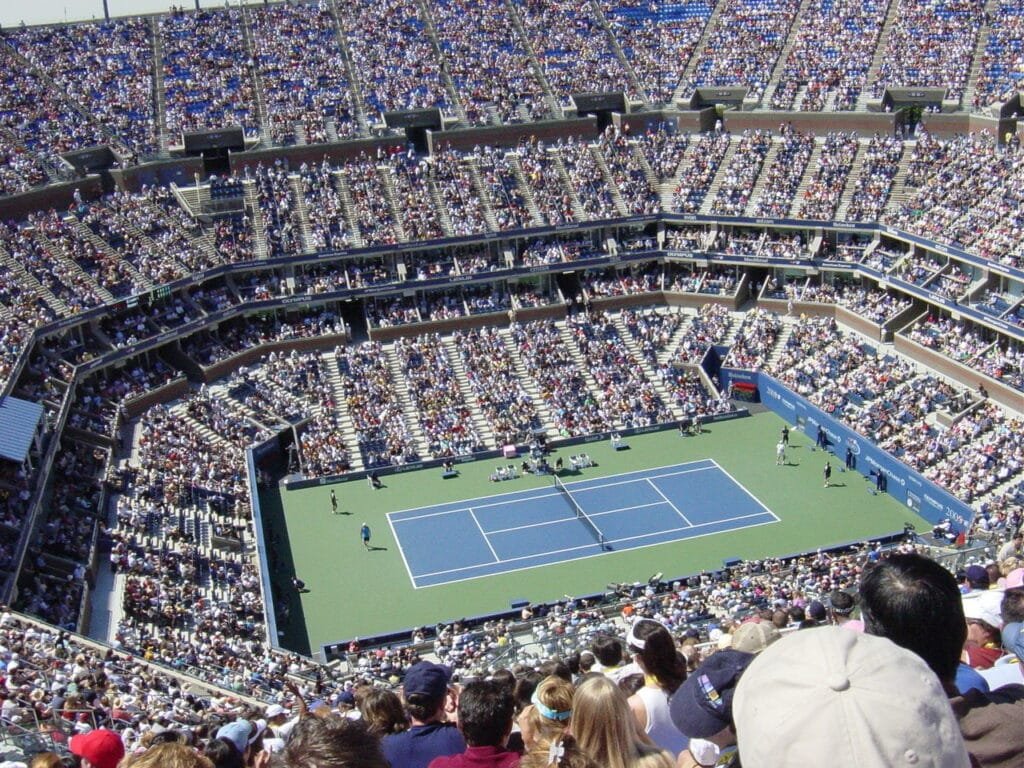
Arthur Ashe is the largest tennis stadium in the world, seating 23,771. It’s the venue built for television, for closing ceremonies, for match points that end major runs. A retractable roof, added in 2016, means rain no longer wipes out an evening at Ashe the way it once did.
Day sessions at Ashe typically carry marquee singles matches from the tournament’s biggest names in the early-to-middle rounds. Night sessions are curated by the tournament to showcase star power, and by the second week you’re looking at quarterfinals, semifinals, and eventually the finals themselves.
Because of its scale, seat location matters more here than at any other court. Upper-level seats at Ashe are noticeably far from play; first-timers sometimes underestimate just how large 23,771 seats feels in person. If you have a choice and this is a once-in-a-while trip, prioritize lower-bowl or mid-bowl seating over upper-deck value seats.
If you’re only attending the US Open once, an Arthur Ashe night session is worth strong consideration for the atmosphere alone: the lighting, the sense of occasion, and the chance of a marquee matchup. It is not automatically the best choice for everyone — a hardcore fan who wants to see the most tennis, or a value-conscious traveler, will likely be happier elsewhere in this guide.
Louis Armstrong Stadium
Armstrong holds 14,053 and feels noticeably more intimate than Ashe despite still being a genuine stadium court. It hosts high-quality singles matches, including some marquee names in early rounds, plus strong doubles action. The lower bowl is reserved seating; the cantilevered upper bowl (over 7,000 seats) is unreserved and included with grounds access on many session types — confirm current access rules for your ticket type before you go, since policies are adjusted periodically. Armstrong also has a retractable roof, so it stays productive during rain delays that shut down outer courts.
For serious tennis fans, Armstrong during the first week is often a sweet spot: closer to the action than Ashe, less crowded to move around, and still hosting real quality matches.
Grandstand
Grandstand seats about 8,125 and sits partially below ground level in a 16-sided bowl that keeps the crowd close to the court. About 2,000 seats are reserved in the lower bowl; the rest are first-come, first-served. It only runs day sessions, no evening play.
Grandstand is the court most people describe as feeling different from the rest of the grounds — smaller, shaded in more sections than you’d expect, and a strong match-watching experience for fans who find Ashe too distant.
The Outer Courts: The Secret to Seeing the Most Tennis
Here’s what a lot of first-time visitors miss entirely: a grounds pass gets you into a dozen-plus outer courts running simultaneous singles, doubles, and junior or wheelchair matches throughout the day, often with sightlines close enough to hear players talk to their coaches between points.
If your priority is volume — seeing as many matches and players as possible in one day — spending the whole day parked in one reserved seat is the wrong strategy. Court-hop instead: check the order of play posted each morning, walk the outer courts, and catch rising players and doubles specialists you’d never see on a single-stadium ticket. Early rounds are the best time to do this, since dozens of matches run at once across the grounds.
Practice Courts
During Fan Week especially, the practice courts are one of the closest experiences fans get to elite players outside of match play. Practice schedules are typically posted the day of or the evening before via the official app, and access is included with grounds admission. It’s one of the better uses of a Fan Week morning before qualifying matches ramp up.
Traveling with mobility needs? Accessible seating is available at all three main stadiums and the grounds are largely step-free, but airport-to-venue logistics deserve their own planning — our Wheelchair Assistance at Airports guide covers what to arrange before you fly.
Section 3: Which US Open Ticket Should You Buy?
Skip the generic ticket-type breakdown and think about it by what you actually want out of the day.
| What you want | Buy this |
|---|---|
| The biggest, most iconic experience | Arthur Ashe Stadium ticket, day or night session |
| To see as much tennis as possible | Grounds Pass and court-hop the outer courts, Armstrong, and Grandstand |
| Better value for a strong match | Louis Armstrong Stadium during the first week |
| To see top players up close in an intimate setting | Grandstand, day session |
| A true championship match | Finals weekend Arthur Ashe ticket (book early — these sell out and carry a premium) |
| The cheapest possible US Open experience | Fan Week grounds access with the free Fan Access Pass |
A Grounds Pass ($65 and up in recent pricing) gets you into Armstrong, Grandstand, the outer courts, and general grounds — but not Arthur Ashe. An Arthur Ashe ticket includes a reserved seat plus general grounds access to everything else, so it’s effectively the more complete admission if your budget allows it. Armstrong and Grandstand tickets are reserved-seat tickets specific to those stadiums. Exact pricing tiers, availability, and access rules change from year to year and even week to week within the tournament — confirm current details at usopen.org or the official Ticketmaster partner page before buying.
Ticket access rules (what a Grounds Pass does and doesn’t include, whether Armstrong’s upper bowl is open to grounds admission, etc.) have shifted in recent years. Verify the current rules for the exact date and session you’re buying — don’t assume last year’s policy still applies.
Section 4: Day Session vs Night Session
More tennis, more flexibility
Runs from grounds opening through roughly 6 p.m. More total matches across more courts means better court-hopping. Expect sun and heat in late August — plan accordingly. Best for families, hardcore fans, and anyone wanting to maximize match count.
Atmosphere and marquee matches
Starts around 7 p.m. and features top-billed matchups, usually limited to Ashe and Armstrong. The energy is different — genuinely electric during a big match. The tradeoff: five-set matches can run past midnight, and your transportation plan needs to account for that (see Section 13).
Recommendation: couples and bucket-list travelers lean night session for the experience; families and hardcore fans lean day session for tennis volume and predictability.
Section 5: Best Stage of the Tournament to Attend
| Stage | What you get |
|---|---|
| Opening rounds (days 1-4) | Maximum volume of tennis — dozens of simultaneous matches, best value, best for court-hopping |
| Middle rounds (days 5-8) | A balance of recognizable names still in the draw with multiple courts still active |
| Quarterfinals | Higher-stakes tennis with a smaller, more focused draw |
| Semifinals | Major-event atmosphere, limited matches, premium pricing |
| Finals | The bucket-list championship experience — highest cost, least tennis volume, biggest occasion |
Best overall value: opening rounds. Best for hardcore tennis fans: opening or middle rounds with a Grounds Pass. Best for first-time visitors: middle rounds — enough star power remains without finals-week pricing. Best luxury experience: semifinals or finals weekend at Arthur Ashe.
Section 6: Fan Week
Fan Week runs August 23-29, 2026, ahead of the main draw, and it’s one of the best-kept values in the entire tournament. Grounds access is free with a Fan Access Pass obtained through the USTA app or website, and it includes qualifying tournament matches (real professional tennis, often featuring players who will be seeded stars within a year or two), practice court access, and grounds-wide fan activities.
Some Fan Week events and exhibitions require separate timed reservations even though base grounds access is free — check the app for same-day reservation windows once you arrive.
Arrive at grounds opening and head straight for the practice courts, where you can often watch top players warm up at close range. Move to qualifying matches on the outer courts through midday. Take a break to walk Flushing Meadows-Corona Park and see the Unisphere while the sun is high. Head back for late-afternoon qualifying rounds, then finish with dinner in downtown Flushing before the trip back to Manhattan or your hotel.
Fan Week runs seven days, and rooms near the grounds fill up as the week goes on — if you’re staying multiple nights, it’s worth locking in a hotel now rather than waiting. Compare rates on Booking.com or Agoda.
Section 7: Getting to the US Open
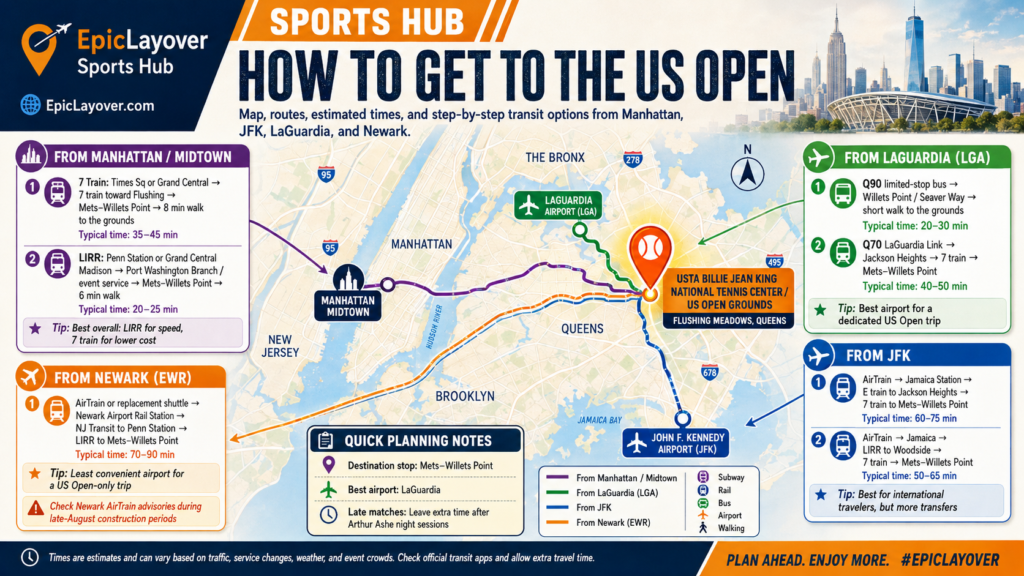
Every route into the tournament — whether you’re coming from an airport, from Midtown, or from a hotel in Queens — ends at the same place: Mets-Willets Point, served by both the 7 subway and the LIRR Port Washington Branch, a short walk from the National Tennis Center’s Champion’s Entry via the Passerelle Boardwalk.
The 7 train runs from Grand Central through Manhattan into Queens and stops at Mets-Willets Point. The LIRR Port Washington Branch also stops there, with boarding available from Penn Station, Grand Central Madison, and Woodside (where transfers from other LIRR branches connect). During the tournament, the MTA has historically added supplemental subway and LIRR service around session start and end times — confirm the current year’s service enhancements close to your travel dates.
Driving, Rental Cars, and Parking
Transit is the better call for nearly everyone reading this, and the routes in the next two sections reflect that. But if you’re renting a car for a broader trip, driving down from outside the city, or traveling with people who truly need a vehicle, here’s what you need to know.
GPS address: USTA Billie Jean King National Tennis Center, Flushing Meadows Corona Park, Flushing, NY 11368.
Recommended highway exits: Grand Central Parkway Exit 9E, Whitestone Expressway Exit 13D, or Long Island Expressway Exit 22B (College Point Blvd).
On-site parking at the National Tennis Center is limited and event traffic around Flushing Meadows-Corona Park is notably heavy during session start and end times — arriving or leaving by car during peak windows can easily cost you more time than the transit alternatives in this guide. If you’re driving, budget significant extra time and expect to pay for parking; confirm current lot availability and pricing at usopen.org before you commit to driving over transit.
All rideshare and taxi pickup/drop-off happens at the New York Hall of Science parking lot, with a direct walk to the Champion’s Entry — the same lot referenced in Section 15. If you’re renting a car for the trip (say, to combine the Open with a drive elsewhere in the Northeast), plan to park it near your hotel and use transit for tournament days rather than driving to the grounds daily.
Not interested in driving at all? A pre-booked pickup gets you a driver waiting at arrivals or your hotel, no rental logistics involved.
Compare Rental Car Rates Book an Airport PickupSection 8: Manhattan → US Open
Times Square → US Open
This is the most straightforward route from Midtown. The 7 runs local and express (green express trains skip stops in Queens and are faster during peak times, though not every train is express — check the platform display). Expect heavier-than-normal crowding on 7 trains around session start and end times; boarding early or using the front/rear cars can help. OMNY tap-to-pay works at all turnstiles, so a physical MetroCard isn’t necessary — the base subway fare is $3 per ride as of the January 2026 fare increase, with a weekly cap that kicks in automatically if you’re riding more than a handful of times.
Grand Central → US Open
Two real choices here.
The subway is usually cheaper (standard fare vs. LIRR ticket pricing) and simpler if you already have an OMNY card or MetroCard. The LIRR is often faster and less crowded, particularly valuable after a late night session when a seated, less-packed ride home matters more than saving a few dollars. Confirm current LIRR event-service frequency for your travel dates.
Penn Station → US Open
This is the most convenient path for Amtrak arrivals, NJ Transit travelers connecting in from Newark or New Jersey, anyone staying near Penn Station, and travelers with luggage who’d rather avoid subway stairs. One LIRR ride, no subway transfer required.
Section 9: LaGuardia Airport → US Open
LaGuardia is the clear best airport for a dedicated US Open trip — it’s the closest of the three major NYC airports to Flushing Meadows, at roughly five miles.
Q90 Limited: LaGuardia to Flushing
Under the Queens Bus Network Redesign that took effect June 29, 2025, the Q90 Limited runs directly between LaGuardia and Flushing via Seaver Way, replacing the old Q48 and giving a faster, more direct run through Willets Point that avoids Corona traffic. It boards from LGA’s B/C terminal area and drops close to the grounds. Bus network changes do happen, so it’s still worth a quick check on the current MTA Q90 Limited page before you travel, but this route is confirmed current as of this guide’s publication.
Q70 + 7 train alternative
This routing trades a slightly longer ride for a well-established, high-frequency bus-to-subway connection at a major transit hub. It’s a solid backup if the direct-to-Flushing bus option isn’t running conveniently for your arrival time.
Rideshare or taxi from LGA makes more sense than transit when you’re traveling with multiple travelers, heavy luggage, arriving very early or late, or working with a short connection window before your session starts. It’s a short, relatively inexpensive ride from LGA to the tennis center compared to a JFK or Newark rideshare. If your hotel check-in doesn’t line up with your session time, dropping bags at a Bounce or LuggageHero storage location near the airport or in Flushing beats hauling a suitcase around the grounds.
Section 10: JFK Airport → US Open
Rail-focused option
Jamaica does not offer a simple, direct LIRR train straight to Mets-Willets Point — you’ll typically connect through Woodside to reach the 7 train, or check whether a same-branch LIRR connection to Mets-Willets Point is running that day. This makes JFK meaningfully less direct than LaGuardia or Penn Station routes, so budget extra time.
Budget subway option
More transfers, more stairs and elevators to navigate, and more time — but noticeably cheaper than a rail-plus-rideshare combination. Fine for a light packer with time to spare; frustrating with a large suitcase during a crowded commute window.
Families or groups landing at JFK with checked bags are often better served by a direct taxi or rideshare straight to their hotel or the tennis center rather than chaining AirTrain, LIRR, and subway transfers. Don’t assume rail is automatically the smarter choice just because it’s cheaper — factor in stairs, transfer time, and how many bags you’re carrying. For a same-day arrival before a session, or a same-day flight home after your last match, Bounce luggage storage is worth booking near the grounds or your hotel so you’re not carrying bags through the tennis center. And if you’d rather skip the transfer logistics entirely, a pre-booked airport pickup gets you a driver waiting at arrivals instead of navigating this on your own.
Section 11: Newark Airport → US Open
Be upfront with yourself about this one: Newark is the least convenient of the three major NYC airports for a US Open-focused trip, because you have to cross from New Jersey through Manhattan and then continue out to Queens — a longer routing than either LaGuardia or JFK.
This routing through Penn Station is preferable to trying to piece together multiple subway lines from a New Jersey arrival — one NJ Transit ride into Penn Station, then a single LIRR ride out to the tennis center.
Starting Monday, July 27, 2026, and continuing through late August 2026, Port Authority is replacing AirTrain Newark service with shuttle buses from roughly 5:00 a.m. to 3:00 p.m. on most weekdays as part of a major AirTrain Newark replacement project. AirTrain has generally continued running on weekends. This window overlaps directly with US Open Fan Week (August 23-29) and the opening days of the main draw (August 30 onward), so a weekday daytime arrival at Newark during that stretch may mean boarding a shuttle bus to the rail station instead of the AirTrain. NJ Transit and Amtrak trains themselves continue operating normally — it’s specifically the airport-to-station AirTrain link that’s affected. Confirm current status at njtransit.com before you fly, since construction timelines shift.
Taxi / Rideshare from Newark
Given the AirTrain disruption and the inherently longer routing, rideshare from Newark deserves real consideration during this window, especially for groups, travelers with luggage, or anyone arriving outside AirTrain’s normal operating hours. It won’t be cheap for a trip that ultimately needs to reach Queens, but it removes a layer of uncertainty during an active construction period.
Section 12: Airport Comparison
| Factor | LaGuardia (LGA) | JFK | Newark (EWR) |
|---|---|---|---|
| Distance/convenience to Flushing Meadows | Closest, ~5 miles | Moderate | Farthest — requires a Manhattan crossing |
| Public transit complexity | Low — one bus or bus + subway | Moderate — AirTrain + rail/subway transfer | High — AirTrain/shuttle + NJ Transit + LIRR |
| Number of transfers | 1-2 | 2-3 | 2-3, plus a longer overall distance |
| International flight usefulness | Mostly domestic | Best international gateway | Strong international option, especially certain alliances |
| Ease with luggage | Good | Moderate | More demanding given distance and transfers |
| Best for a quick sports weekend | Yes | Workable | Not ideal |
| Best for a Manhattan + tennis trip | Good | Good | Workable if flight economics favor it |
| Best for a layover visitor | Strong candidate | Strong candidate | Only with a long layover |
Best for a dedicated US Open trip: LaGuardia. Best international gateway: JFK. Newark is worth considering when airfare pricing, loyalty program routing, or your broader itinerary make it the better overall value — just build in extra transit time and, during the 2026 construction window, extra buffer for the AirTrain shuttle. Landing on an international itinerary with a connection to work around rather than a dedicated US Open trip? Our NYC Layover Guide breaks down all three airports in more depth than we can here.
Plan Your Trip: EpicLayover Resources
Before you go further, these tools and guides tie directly into everything above:
Section 13: Getting Home After a Late Arthur Ashe Match
Tennis doesn’t run on a broadcast clock. A five-set men’s match, or a night session with two competitive matches back to back, can easily push past midnight — and there’s no way to know in advance which night that’ll be.
When a night session lets out late, expect a genuinely crowded exit: thousands of people moving toward Mets-Willets Point at once, the 7 train and LIRR both running heavier than normal, and rideshare pricing that can surge hard right at that moment given the concentrated demand. None of this is a reason to skip a night session — it’s a reason to plan your next-day schedule with real buffer.
Booking a very early flight home the morning after a late Arthur Ashe night match. If the match runs long, you’re racing a crowded transit exit, a late night, and airport security on almost no sleep — a bad combination that turns a great night into a miserable, high-risk morning.
This is the same time-buffer thinking behind everything else on this site: build slack into transitions rather than planning against a best-case scenario. If you have an early flight, treat a night session the evening before as a risk, not a given — and if you must fly out early, prioritize LIRR over subway for a calmer, faster exit, or budget for a taxi straight from the grounds.
Section 14: Where to Stay
Flushing
Best for: multiple tournament days. Flushing puts you minutes from the grounds, in the middle of one of New York’s best food neighborhoods, and largely out of the daily Manhattan commute. It’s also convenient to LaGuardia if you’re flying in or out mid-trip.
Long Island City
Best for: a compromise position. LIC sits in Queens with strong subway access to both Manhattan and, via a 7 train ride, the tennis center — a reasonable middle ground if you want a foot in both worlds.
Midtown Manhattan
Best for: first-time NYC visitors who want sightseeing on tap. You’ll have direct 7 train access to the Open, but expect a longer daily commute each way and higher hotel costs than Queens.
Near LaGuardia
Best for: a one-night trip, a very short tournament visit, or an early flight out the next morning. Minimal transit time to both the grounds and the airport.
| Category | What to look for |
|---|---|
| Budget | Flushing or LIC properties within walking distance of the 7 train |
| Mid-range | LIC waterfront hotels or Midtown East, close to Grand Central |
| Luxury | Midtown or Manhattan flagship properties, paired with a planned LIRR or rideshare exit strategy for night sessions |
Deciding between a Queens base and a Manhattan base is really the same tradeoff covered in our NYC Layover Guide — proximity to what you’re there for versus proximity to everything else the city offers. Search rates on Booking.com or Agoda for whichever neighborhood fits your plan.
Section 15: What to Do Around the US Open
You’re already standing in Flushing Meadows-Corona Park, one of New York City’s largest and most historically interesting green spaces. Don’t treat it purely as the parking lot for a tennis complex.
The Unisphere
The 12-story stainless steel globe built for the 1964 World’s Fair is the park’s signature landmark and an easy, iconic photo stop before or after a session — it sits a short walk from the tennis center.
Queens Museum
Home to the Panorama of the City of New York, a massive scale model of all five boroughs originally built for the 1964 World’s Fair. A good stop if you have a couple of spare hours and want something indoors and air-conditioned during peak afternoon heat.
New York Hall of Science
A hands-on science museum that works well for families with kids who need a break between sessions — also doubles as the rideshare pickup/drop-off point for the tennis center, so you may end up there anyway.
Queens Zoo
A smaller, manageable zoo experience, good for a family morning before an afternoon session.
Flushing Meadows-Corona Park
Beyond the named attractions, the park itself is worth walking — open lawns, remnants of the 1964 World’s Fair, and a welcome contrast to a day spent in stadium seating. Check walking distances on a map before committing to a tight schedule; the park is large and some attractions are a real 15-20 minute walk from the tennis center gates, not a quick stroll.
Section 16: US Open + Citi Field / New York Mets
Citi Field sits essentially next door to the tennis center, sharing the Mets-Willets Point station, so a Mets home stand overlapping your trip is a legitimate two-sport New York day, not just a novelty.
| Dates (2026) | Mets home opponent | Overlaps with |
|---|---|---|
| Aug 25-27 | Milwaukee Brewers | Fan Week |
| Aug 28-30 | Houston Astros | Fan Week / main draw opening weekend |
| Sep 4-6 | San Francisco Giants | Main draw, second week |
Based on the currently published 2026 schedule, those are the only Mets home dates that fall inside the US Open window (August 23 – September 13) — the Mets are on the road for the Sep 7-9 and Sep 11-13 stretches, including finals weekend. This schedule is subject to change (postponements, doubleheader reshuffles), so confirm the exact dates and start times at mlb.com/mets/schedule before you build a day around this.
If your dates land on one of the three windows above: catch a Mets afternoon game at Citi Field, then walk over to Flushing Meadows for an Arthur Ashe night session. Or flip it — daytime tennis on the grounds, then an evening Mets game. Either combination depends entirely on actual game start times, which tennis session you’re holding a ticket for, and how flexible your grounds/stadium access is that day. Don’t build this itinerary until you’ve confirmed both schedules for your specific dates — a good idea on paper falls apart fast if a night session runs long and collides with first pitch.
Section 17: Eat in Flushing — Don’t Rush Back to Manhattan Hungry
Downtown Flushing is one of New York City’s most interesting food neighborhoods, built around one of the largest Chinese communities outside Asia along with a strong Korean and Taiwanese presence. It deserves its own trip, not just a rushed meal before the train back.
- Soup dumplings and Shanghainese cuisine — Flushing has multiple well-regarded spots specializing in xiaolongbao and other Shanghainese dishes.
- Regional Chinese cuisine — Sichuan, Northeastern, and Cantonese kitchens are all well represented within a few blocks of Main Street.
- Korean food — a concentrated cluster of Korean restaurants and BBQ spots, particularly along Northern Boulevard.
- Taiwanese food — beef noodle soup, bubble tea originators, and Taiwanese breakfast spots.
- Hot pot — several dedicated hot pot restaurants good for a group meal after a long day.
- Noodles — hand-pulled and knife-cut noodle shops throughout the neighborhood.
- Bakeries and desserts — Hong Kong-style bakeries and dessert shops for something quick between matches.
- Food courts — the New World Mall food court and similar multi-vendor courts let a group sample several cuisines in one stop.
Restaurant names and hours change often enough that we’re not listing specific businesses here — search current reviews for whichever category above appeals to you, and confirm a spot is still operating before making it the centerpiece of your evening.
Fast and filling
Noodles or a bakery stop near the Main Street/Flushing-Main St subway station before heading to the grounds.
Food crawl
A slower, multi-stop evening working through a food court or several small plates across two or three restaurants.
After a day session
Hot pot or a full sit-down Shanghainese or Sichuan meal — you have the evening open.
Section 18: Things to Do in New York City
If You Have 3 Extra Hours
Grand Central Terminal, a walk to Rockefeller Center, and Times Square are all within easy walking distance of each other in Midtown — a tight, sensible loop if you’re short on time before or after a session.
If You Have Half a Day
Lower Manhattan: the 9/11 Memorial, a walk through the Financial District, and a crossing of the Brooklyn Bridge on foot. Or Central Park + Fifth Avenue: a park walk, Fifth Avenue shopping, ending at Rockefeller Center.
If You Have One Full Extra Day
First-Time NYC: a Statue of Liberty/Ellis Island ferry ticket booked ahead in the morning, Lower Manhattan in the afternoon, Times Square at night. Food-Focused NYC: a guided food tour in a neighborhood like the Lower East Side or Chelsea Market, with an evening in Flushing to bookend it. Brooklyn Day: DUMBO, the Brooklyn Bridge walk from the Brooklyn side, and Brooklyn Heights Promenade. Museum/Central Park Day: the Met or MoMA in the morning, a long Central Park walk in the afternoon.
Section 19: Build the Trip by Traveler Type
Midtown base, Ashe day session
Stay Midtown, spend a day on classic sightseeing, one full day at the Open with an Ashe ticket.
Flushing base, Grounds Pass
Stay in Flushing, buy multi-day Grounds Passes during the first week, court-hop relentlessly.
LIC or Midtown, night session
One special night session, a late Flushing dinner after, one relaxed sightseeing day.
Flushing or near LGA, day sessions
Day sessions paired with Queens attractions; avoid late-night transit with young kids.
Flushing hostel/budget hotel, Fan Week
Free grounds access during Fan Week, budget lodging, minimal Manhattan commuting.
Midtown flagship hotel, Ashe premium seating
Premium Ashe seats for a marquee session, with a pre-booked private transfer arranged in advance for the return trip so a late finish doesn’t mean scrambling for a ride.
Flushing base, Open + Citi Field
Build around confirmed Mets dates for a two-sport day; see Section 16.
JFK arrival, Midtown or LIC base
Budget extra transit time from JFK on arrival day; use the rail-focused route in Section 10. Sort out a local data plan and consider a travel VPN before you land.
LGA or JFK, single session if feasible
See Section 22 before committing — this only works with a genuinely long layover.
Section 20: Two-Day US Open Itinerary
Day 1 — NYC + Arthur Ashe
Morning: Midtown sightseeing loop (Section 18). Lunch: Midtown. Afternoon: hotel rest, pack for the grounds. Evening: transit to Queens ahead of gates, Arthur Ashe night session. Late night: LIRR or subway return, budgeting for a possible late finish (Section 13).
Day 2 — Full Tennis + Queens
Morning: arrive at grounds opening, hit the outer courts early while crowds are thin. Midday: Armstrong or Grandstand match. Lunch: on the grounds or a quick Flushing stop. Afternoon: more outer-court tennis. Early evening: Flushing Meadows-Corona Park walk, Unisphere photo. Dinner: Flushing. Night: return to hotel.
Section 21: Three-Day US Open Itinerary
Day 1: arrival, settle in, light NYC sightseeing depending on arrival time. Day 2: full day at the US Open, day or night session per your ticket. Day 3: Queens exploration in the morning (Flushing Meadows, Unisphere, a Flushing meal), NYC sightseeing or departure prep in the afternoon.
Adapt this frame by traveler type: budget travelers can swap Day 2 for Fan Week grounds access; luxury travelers can add a private transfer on Day 2’s return leg; tennis-heavy travelers can extend Day 2 into a full Grounds Pass court-hopping day; families can split Day 3 between a Queens attraction and rest time.
Section 22: Can You Visit the US Open During an NYC Layover?
Sometimes, but it depends on more variables than total layover length alone: which airport you’re connecting through, whether you’re arriving domestically or internationally (customs and immigration add real time), how much luggage you’re carrying, ground transportation time in both directions, which tennis session you’d be attending, security line length at both the airport and the tennis center, and how much buffer you build in before your return flight.
| Layover length | Realistic? |
|---|---|
| Very short layover | Do not attempt it. There’s no margin if transit, security, or a match runs long. |
| Medium layover | Usually not worth the risk — you’ll spend most of it in transit and rushing back. |
| Long layover | Potentially realistic from LGA or JFK, depending on your specific circumstances, whether you’re domestic-to-domestic, and how disciplined you are about a hard turnaround time. |
Rather than relying on total layover length, calculate your actual usable city time — layover minus check-in/security buffers, minus immigration and customs if applicable, minus ground transport both directions. Use the Layover Calculator to work out a realistic number before you commit to this plan, and set a hard, non-negotiable return-to-airport time before you leave the grounds. If your connection falls on the shorter end, our Short Layover Guide is a better fit than trying to force in a tennis session; if you’ve genuinely got hours to spare, How to Survive a Long Airport Layover covers the same buffer-and-contingency thinking applied to the rest of your day.
Section 23: What to Pack for the US Open
Bag policy has generally limited attendees to one bag no larger than roughly 12 x 12 x 16 inches (backpacks are typically not allowed; small single-compartment bags and clear bags are fine). Confirm the current year’s exact bag policy at usopen.org before you pack, since dimensions and rules are reviewed each year.
Plan to arrive at least 60 to 90 minutes before your session, especially for a night session or a marquee day-session match. Security screening and bag check can back up fast once gates open, and that buffer is what protects you from missing the start of a match you flew in for. Bag-free entry lanes typically move faster than bag lanes if you can manage without one.
- Sunscreen — reapply, especially for day sessions
- Sunglasses and a hat
- Phone plus a portable charger (a long day session drains batteries fast) — international visitors should sort out connectivity before you land rather than hunting for Wi-Fi at the grounds
- Comfortable, broken-in walking shoes — you’ll cover real distance court-hopping
- A light rain layer — outdoor courts can see weather delays
- A light jacket or layer for night sessions, which cool off after sunset
- Mobile ticket downloaded and accessible offline
- ID and payment method
- Any needed medication
- An empty reusable water bottle if refill stations are permitted that year — check current rules on outside liquids
What Not to Bring
Backpacks, hard-sided coolers, tripods or monopods, professional camera lenses over the permitted length, glass containers, outside alcohol, and anything on the current prohibited items list at usopen.org.
Stay Connected and Powered
A full day at the grounds plus a subway ride each way will drain a phone fast, and international visitors shouldn’t count on grounds Wi-Fi being fast or reliable during peak session crowds. Worth sorting out before you land:
Airalo
Straightforward eSIM setup for US data before you land — no physical SIM swap needed. Get an Airalo eSIM
NordVPN
Useful on hotel and public Wi-Fi, especially if you’re banking or streaming from abroad. Get NordVPN
Bitdefender
Device security worth having before connecting to airport, hotel, or stadium Wi-Fi. Get Bitdefender
GlocalMe Portable Wi-Fi Hotspot
A dedicated hotspot beats hunting for signal at the grounds if you’re traveling with a group sharing one connection. See the GlocalMe hotspot
Anker Nano Power Bank
Small enough to clear the bag policy, enough charge to get a phone through a full day session and the ride home. See the Anker Nano power bank
Section 24: Weather and Heat
Late August and early September in New York typically means warm, humid days with real sun exposure during day sessions, and cooler, more comfortable evenings for night sessions. Afternoon thunderstorms are a realistic possibility during this stretch of summer, and outdoor courts (everything except Ashe and Armstrong, which have roofs) can see rain delays. Since this is seasonal tendency rather than a specific forecast, don’t rely on it as gospel — check the actual forecast in the days leading up to your session.
Practical prep: hydrate throughout a day session, seek shaded seating sections where available, and don’t underestimate how much sun exposure adds up across a six-hour day session versus a three-hour evening session.
Section 25: First-Time US Open Mistakes
Thinking Arthur Ashe is the entire tournament. It’s the flagship, not the whole grounds — you’re missing most of the tennis if that’s all you see.
Ignoring the outer courts. This is where the volume and the discovery happen, especially in the first week.
Not understanding ticket access. A Grounds Pass doesn’t include Ashe. Know exactly what your ticket gets you before you arrive.
Underestimating travel time. Especially from JFK or Newark — build real buffer, not best-case timing.
Driving without understanding parking and event traffic. Public transit is almost always the better call during tournament sessions.
Wearing uncomfortable shoes. You’ll walk far more than you expect across a full grounds day.
Not preparing for sun and heat. Sunscreen and hydration aren’t optional for a day session.
Leaving Queens immediately without exploring. Flushing Meadows and downtown Flushing deserve your time, not just a transit corridor.
Booking an early flight after a late night session. See Section 13 — this is the single most common self-inflicted travel mistake at this event.
Assuming matches have predictable end times. They don’t. Plan around uncertainty, not a fixed schedule.
Staying somewhere inconvenient just because it’s technically “New York.” A cheap Manhattan hotel with a brutal commute isn’t necessarily better than a well-located Queens hotel.
Not checking current MTA/LIRR service changes. Routes, schedules, and even bus numbers shift — verify close to your travel dates rather than trusting an old article.
Section 26: How Much Does a US Open Trip Cost?
Rather than inventing precise numbers that go stale fast, plan around these categories and build your own budget with current prices at booking time.
| Category | Budget Trip | Mid-Range Trip | Bucket-List Trip |
|---|---|---|---|
| Flights | Economy, flexible dates | Economy, fixed dates | Premium economy/business |
| Hotel | Flushing/Queens budget property | LIC or Midtown 3-4 star | Midtown flagship |
| Tickets | Fan Week (free) or one Grounds Pass day | Grounds Pass + one Ashe session | Premium Ashe seating, possibly finals weekend |
| NYC transit | OMNY pay-per-ride | OMNY pay-per-ride + occasional LIRR | Mix of transit and private transfers |
| Food | Flushing food court/casual | Mix of casual and sit-down | Sit-down throughout, including on-grounds dining |
| Attractions | Free park attractions (Unisphere) | One or two paid attractions | Guided tours, premium experiences |
Confirm current ticket pricing at usopen.org or the official ticketing partner before budgeting — prices vary by session, round, and how far in advance you buy.
Frequently Asked Questions
What’s the closest subway stop to the US Open?
Which airport is best for the US Open?
Does a Grounds Pass include Arthur Ashe Stadium?
What happens if a night match runs past midnight?
Is Fan Week worth attending if I can’t make the main tournament?
Can I drive to the US Open and park on-site?
How early should I arrive for a session?
Can I visit the US Open during a layover?
Section 27: Final Trip-Building Checklist
- Pick your tournament dates
- Choose your preferred stadium and session type
- Buy the appropriate ticket for what you actually want (Section 3)
- Pick your airport (Section 12)
- Choose a hotel neighborhood that matches your priorities (Section 14)
- Plan your airport-to-hotel route
- Plan your hotel-to-US Open route (Section 8)
- Add Queens activities to your itinerary (Section 15)
- Add NYC sightseeing that fits your available time (Section 18)
- Check current bag, weather, and security rules (Sections 23-24)
- Check the tournament schedule for your exact dates
- Check MTA, LIRR, and NJ Transit advisories close to travel
- Leave real transportation buffers, especially after night sessions
- Use EpicLayover’s planning tools to tie it all together
Continue Planning
This guide gets you to the grounds. These get you through the rest of the trip:
Tournament dates, stadium capacities, ticket types, and transit routes in this guide were verified against USTA/US Open official communications, MTA and LIRR press releases, and NJ Transit service advisories current as of publication. Transportation routes, bus numbers, and construction schedules change — always confirm details at usopen.org, mta.info, and njtransit.com in the days before you travel.
